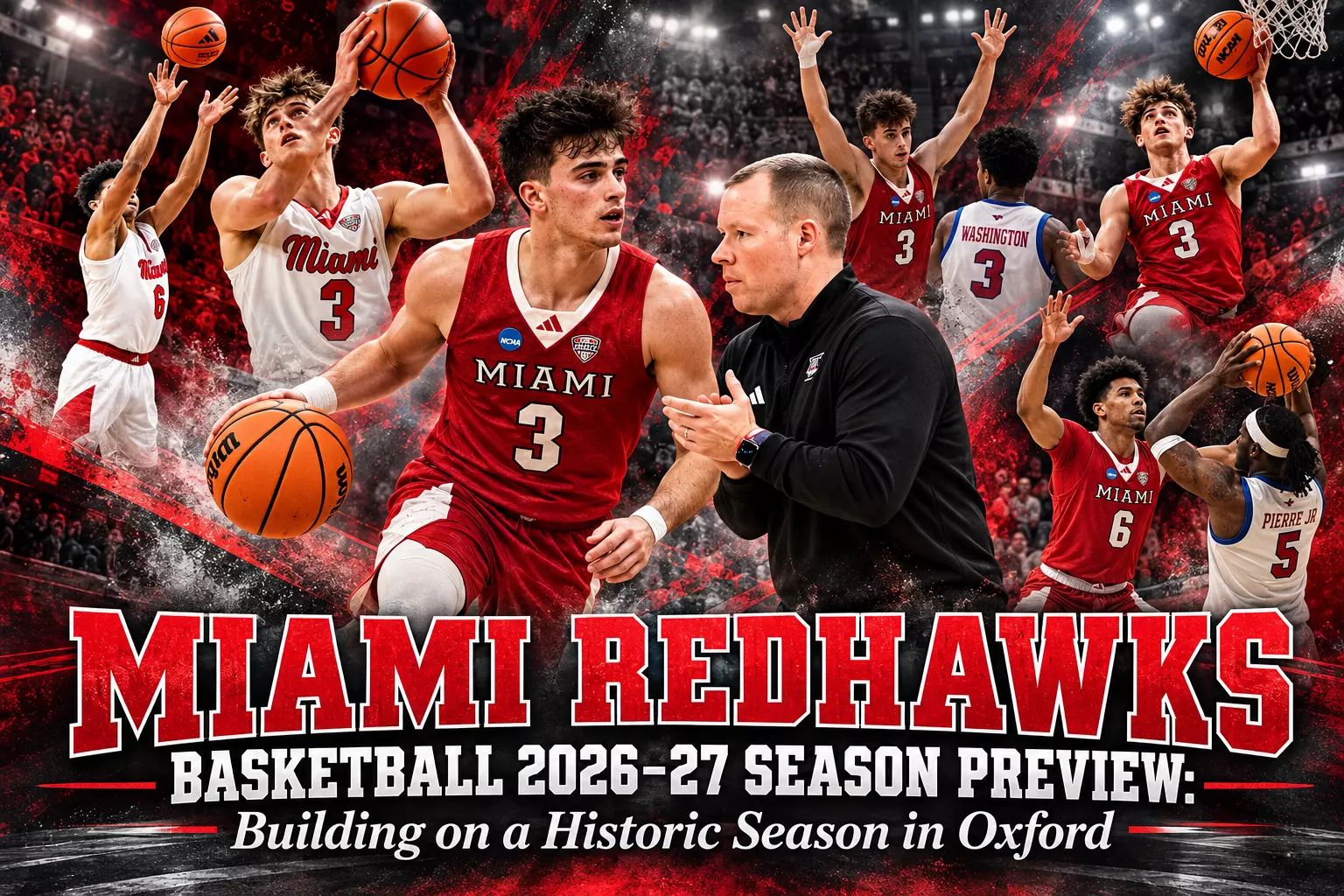
Miami RedHawks Basketball 2026–27 Season Preview: Building on a Historic Season in Oxford
Miami University enters the 2026–27 men’s basketball season facing a different kind of challenge: following an extraordinary breakthrough.
After an undefeated regular season, a Mid-American Conference championship and an NCAA Tournament victory, the RedHawks have raised expectations in Oxford. Travis Steele’s program now must replace important contributors while maintaining the confidence and offensive execution that made last season special.
Returning guards Evan Ipsaro and Luke Skaljac, forward Almar Atlason and experienced big man Antwone Woolfolk give Miami a strong foundation. The question is whether that core, supported by newcomers and developing reserves, can keep the RedHawks near the top of the MAC.
How Did Miami Do Last Season?
Miami finished
32–2 overall and 18–0 in MAC play, completing the regular season
31–0. The RedHawks went
16–0 at home and 14–0 on the road, producing a remarkable combination of consistency and composure.
Their first loss came against Massachusetts,
87–83, in the MAC Tournament quarterfinals. Miami nevertheless earned an
NCAA Tournament
at-large bid and defeated
SMU 89–79 in the First Four
before falling
78–56 to Tennessee
in the first round.
The 32 victories set a program record. Miami captured its first MAC regular-season title since 2005 and earned its first NCAA Tournament victory since 1999. Steele was unanimously selected as MAC Coach of the Year, while Peter Suder earned MAC Player of the Year honors.
Offensive efficiency drove the success. Miami averaged
89.6 points, shot
51.8% from the field, and connected on
38.7% of its three-pointers. The RedHawks made
10.5 threes per game, forcing opponents to defend across the floor.
However, this season’s roster does not include Suder, Brant Byers or Eian Elmer. Replacing their scoring, experience and contributions on the wings is a major part of the challenge ahead.
Coaching Staff Breakdown
Travis Steele — Head Coach:
Steele enters his fifth season at Miami with considerable momentum. Following the historic 2025–26 campaign, the university extended his contract through
2033–34.
His task now is to preserve the habits behind last season’s success while adjusting responsibilities.
Miami
has established that its approach can produce excellent offense; sustaining that efficiency with different leading scorers will test the program’s development work.
Khristian Smith — Associate Head Coach:
Smith has worked with Steele at Miami since 2022. His background includes helping the RedHawks improve defensively, making his continuity valuable as the team replaces experienced perimeter players.
Ben Botts — Assistant Coach:
Botts brings extensive MAC experience from his time at Ball State, where his responsibilities included offensive planning, scouting and player development. That familiarity should help Miami prepare for conference opponents and integrate players into clearly defined roles.
Andrew Dakich — Assistant Coach:
Dakich joins Miami after four seasons at Illinois State, where he served as offensive coordinator. His experience developing guards is particularly relevant for a team built around Ipsaro and Skaljac, with younger backcourt players pushing for minutes.
Carl Richburg and Elijah Pennington — Assistant Coaches:
Both remain part of Steele’s staff, providing continuity as Miami develops its rotation.
Dan Luers
serves as a graduate assistant.
Centers and Interior Play
Miami lists most of its big men as forwards, so these groupings reflect projected responsibilities rather than an announced depth chart.
Antwone Woolfolk
provides the most established interior presence. The
6-foot-9 veteran
started all 33 games he played last season, averaging
9.8 points and 5.3 rebounds
while earning
Honorable Mention All-MAC
recognition.
Woolfolk’s return gives Miami a player who understands its system and has already handled important minutes on a championship team. His screening, finishing and ability to hold position inside should help the guards operate effectively.
Tyler Robbins, a
6-foot-10, 245-pound sophomore, is a candidate for increased responsibility. He averaged
3.1 points in 5.9 minutes per game
last season and recorded
17 blocks. The next step is showing that his production can translate to longer stretches against starting-caliber opponents.
Preston Copeland
arrives from Ball State with useful conference experience. The
6-foot-9 sophomore
started 24 games as a freshman and averaged
4.6 points and 4.4 rebounds.
Copeland could help Miami manage foul trouble and maintain rebounding when Woolfolk rests. He does not need to become a featured scorer immediately to make the rotation stronger.
Freshman
Alan Horton, listed as a 6-foot-9 forward/center, adds another developmental option in the paint.
Forwards Breakdown
Almar Atlason
is positioned for a larger offensive role. The senior averaged
9.9 points and 2.5 rebounds
last season and was named a team captain alongside Ipsaro and Skaljac.
Atlason demonstrated his scoring potential with a
26-point performance at Ball State, including five three-pointers. His ability to stretch the floor should remain important as Miami replaces production from its departing wings. Greater consistency as a rebounder and defender would make him even more valuable.
Rich Rolf
brings experience from Youngstown State, where he averaged
9.1 points, 4.5 rebounds and 2.1 assists
while making 30 starts last season.
The
6-foot-7 Centerville native
offers a potential combination of scoring, rebounding and passing. His opportunity is to fit into Miami’s ball movement while helping fill the minutes left by departing forwards.
Jackson Kotecki
supplies returning size at 6-foot-9, while
Kyle Waltz
and
Ethan Wright
provide additional forward options. Freshman
Danny Kelly, a Cincinnati native from Archbishop Moeller, adds another local connection to the roster.
Their paths to meaningful minutes will depend on defensive reliability, rebounding and making good decisions within the offense.
Guards Breakdown
Evan Ipsaro
is one of Miami’s most important players entering the season. The former
Covington Catholic standout
averaged
13.9 points and 3.2 assists
in the first 12 games last year before suffering a season-ending injury.
His return offers a proven scoring and ballhandling option. With
Miami
replacing several established contributors, Ipsaro’s ability to regain his rhythm could determine how quickly the offense settles into its new rotation.
Luke Skaljac
gives the RedHawks another experienced organizer. He earned
Third Team All-MAC
honors and led Miami with
149 assists and 4.7 assists per game
last season.
Skaljac’s passing and decision-making should help newcomers find comfortable scoring opportunities. Pairing him with Ipsaro also gives Miami flexibility: either guard can initiate the offense, reducing the pressure on one player to create every possession.
Stevie Elam
is an intriguing transfer addition from Milwaukee. As a freshman, he averaged
10.5 points and 4.7 rebounds, earned
Horizon League All-Freshman Team
honors, and made
2.0 three-pointers per game.
His rebounding from the guard position could be especially useful following the loss of productive wings. If his scoring translates smoothly, Elam could become an important complementary option alongside Miami’s returning ballhandlers.
Justin Kirby
is another candidate for a larger role. He averaged
6.2 points and 3.2 rebounds
last season while making
40.5% of his three-pointers. That shooting gives him a clear way to contribute when defenses concentrate on Ipsaro, Skaljac or the interior players.
Redshirt freshman
Leshawn Stowers, freshman
Anthony Fresh
and senior
Blake Anderson
round out the backcourt. Their development will help determine how much flexibility Steele has when managing injuries, foul trouble and different defensive matchups.
Prediction for the 2026–27 Season
My projection is
23–26 overall victories and a top-three MAC finish, with Miami firmly in the conference championship race.
Repeating a 31–0 regular season is an exceptionally high standard. The more practical measure of success is whether Miami remains a championship contender while replacing substantial production.
The returning guard combination is the strongest reason for confidence. Ipsaro and Skaljac should provide organization and composure, while Woolfolk offers stability inside. Atlason, Rolf, Elam and Kirby give the offense several potential supporting scorers.
The key concerns are replacing the departed wings’ two-way contributions and maintaining efficiency when opponents focus their scouting on the returning core.
My pick is a MAC Tournament championship-game appearance, with a return to the NCAA Tournament a realistic possibility. Miami should approach the season expecting to compete for the automatic bid; another at-large selection would require an exceptional résumé.
Conclusion
Miami
has earned the right to enter this season with ambitious expectations. Steele has established a winning foundation, and several players who helped build it remain in place.
The RedHawks’ next challenge is proving that last season’s success can carry forward through roster changes. If Ipsaro returns effectively, Skaljac continues directing the offense and the supporting cast develops dependable roles, Miami should remain one of the MAC’s most compelling teams—and a serious threat when March arrives.
New Users – Get $350 in Bonus Bets when you wager $5 for 7 days
T&Cs apply
4.6/5
Gambling Problem? Call 1-800-GAMBLER or 1-800-MY-RESET. Call 1-888-789-7777 or visit ccpgg.org/chat (CT). Hope is here. GamblingHelpLineMA.org or call (800) 327-5050 for 24/7 support (MA). Visit www.mdgamblinghelp.org (MD). Call 1-877-8HOPE-NY or text HOPENY (NY). 21+ (18+ DC, WY) and present in select states (for KS, in affiliation with Kansas Star Casino). Find online real money wagering only. Min $5 wager required for 7 consecutive days. $5 free play credit. Bonus issued as non-withdrawable bonus with cash withdrawable bonus with cash withdrawable. Bonus bets which expire 7 days after receipt. Restrictions apply. See terms at sportsbook.fanduel.com. Call 1-877-770-7867 (LA).
Up To $1500 in Bonus Bets Paid Back if your First Bet Does Not Win
T&Cs apply
4.5/5
Gambling problem? Call 1-800-GAMBLER or 1-800-MY-RESET (Available in the US) 877-8-HOPENY or text HOPENY (467369) (NY) 1-800-327-5050 (MA), 1-800-BETS-OFF (IA), 1-800-981-0023 (PR). 21+ only. Please Gamble Responsibly. See BetMGM.com for Terms. First Bet Offer for new customers only (if applicable). Subject to eligibility requirements. Bonus bets are non-withdrawable. In partnership with Kansas Crossing Casino and Hotel. Promotional offers not available in Mississippi, Massachusetts, New York, Ontario, or Puerto Rico.
New DraftKings Customers: Bet $5, Get $200 + 3 Months of NBA League Pass!
T&Cs apply
4.5/5
GAMBLING PROBLEM? CALL 1-800-GAMBLER or 1-800-MY-RESET, (800) 327-5050 or visit gamblinghelplinema.org (MA). Please Gamble Responsibly. 888-789-7777/visit ccpg.org (CT), or visit www.mdgamblinghelp.org (MD), 1-800-981-0023 (PR). 21+ and present in most states. (18+ DC/NH/PR/WY). Void in CAN. Eligibility restrictions apply. On behalf of Boot Hill Casino (KS). Pass-thru of per wager tax may apply in IL. 1 per new Sportsbook customer. $5+ first-time bet req. Max. $200 issued as non-withdrawable Bonus Bets. Stake removed from payout. Reward issued as $50 in Bonus Bets every 7 days via click-to-claim for 21 days. Bonus Bets and click-to-claims expire 7 days (168hrs) after issuance. Terms: dkng.co/offer. Get 1 promo code to redeem a 3-month NBA League Pass subscription, complimentary of DraftKings. Subscription auto-renews monthly at then-current price (currently $16.99/mo); cancel anytime. Terms, restrictions, and eligibility requirements apply. Redeem League Pass by 12/19/26 at 11:59 PM ET. Addt’l terms: support.watch.nba.com/hc/en-us/articles/9165532876183-League-Pass-Terms-of-Use_. Ends 11/29/26 at 11:59 PM ET. Sponsored by DK.
Must be 21+. GAMBLING PROBLEM? CALL 1-800-GAMBLER OR CALL 1-800-MY-RESET, www.mdgamblinghelp.org (MD), (800)-327-5050 or gamblinghelplinema.org (MA), Call (877)8-HOPENY or text HOPENY (467369) (NY), (888) 789-7777 or ccpg.org (CT), morethanagame.nc.gov (NC), 1800gambler.net (WV)
Bet $1 and get double the winnings up to $25 for your next 10 bets
T&Cs apply
4.4/5
21+ New users only. Must register using eligible promo code. First bet after registration must qualify. Max. Bonus Bet: $1,000. Bonus Bet expires 14 days after receipt. Void where prohibited. See Caesars.com/promos for full terms. Gambling Problem? 1-800-GAMBLER (1-800-426-2537)
21+ and present in OH. Gambling Problem? Call 1-800-GAMBLER.
This site is using
Cloudflare
and adheres to the
Google Safe Browsing Program. We adapted
Google's Privacy Guidelines
to keep your data safe at all times.
Close
Ready to Win Big? Join the Elite with Our Sports Betting Deals!
FanDuel Promo
New Users – Get $350 in Bonus Bets when you wager $5 for 7 days
Our Favorite
T&Cs and 21+ apply
Gambling Problem? Call 1-800-GAMBLER or 1-800-MY-RESET. Call 1-888-789-7777 or visit ccpgg.org/chat (CT). Hope is here. GamblingHelpLineMA.org or call (800) 327-5050 for 24/7 support (MA). Visit www.mdgamblinghelp.org (MD). Call 1-877-8HOPE-NY or text HOPENY (NY). 21+ (18+ DC, WY) and present in select states (for KS, in affiliation with Kansas Star Casino). Find online real money wagering only. Min $5 wager required for 7 consecutive days. $5 free play credit. Bonus issued as non-withdrawable bonus with cash withdrawable bonus with cash withdrawable. Bonus bets which expire 7 days after receipt. Restrictions apply. See terms at sportsbook.fanduel.com. Call 1-877-770-7867 (LA).
Code:
Open FanDuel
Get Bonus
BetMGM Promo
Up To $1500 in Bonus Bets Paid Back if your First Bet Does Not Win
Best Slots
T&Cs and 21+ apply
Gambling problem? Call 1-800-GAMBLER or 1-800-MY-RESET (Available in the US) 877-8-HOPENY or text HOPENY (467369) (NY) 1-800-327-5050 (MA), 1-800-BETS-OFF (IA), 1-800-981-0023 (PR). 21+ only. Please Gamble Responsibly. See BetMGM.com for Terms. First Bet Offer for new customers only (if applicable). Subject to eligibility requirements. Bonus bets are non-withdrawable. In partnership with Kansas Crossing Casino and Hotel. Promotional offers not available in Mississippi, Massachusetts, New York, Ontario, or Puerto Rico.
Code:
Open BetMGM
Get Bonus
DraftKings Promo
New DraftKings Customers: Bet $5, Get $200 + 3 Months of NBA League Pass!
Newcomer
T&Cs and 21+ apply
GAMBLING PROBLEM? CALL 1-800-GAMBLER or 1-800-MY-RESET, (800) 327-5050 or visit gamblinghelplinema.org (MA). Please Gamble Responsibly. 888-789-7777/visit ccpg.org (CT), or visit www.mdgamblinghelp.org (MD), 1-800-981-0023 (PR). 21+ and present in most states. (18+ DC/NH/PR/WY). Void in CAN. Eligibility restrictions apply. On behalf of Boot Hill Casino (KS). Pass-thru of per wager tax may apply in IL. 1 per new Sportsbook customer. $5+ first-time bet req. Max. $200 issued as non-withdrawable Bonus Bets. Stake removed from payout. Reward issued as $50 in Bonus Bets every 7 days via click-to-claim for 21 days. Bonus Bets and click-to-claims expire 7 days (168hrs) after issuance. Terms: dkng.co/offer. Get 1 promo code to redeem a 3-month NBA League Pass subscription, complimentary of DraftKings. Subscription auto-renews monthly at then-current price (currently $16.99/mo); cancel anytime. Terms, restrictions, and eligibility requirements apply. Redeem League Pass by 12/19/26 at 11:59 PM ET. Addt’l terms: support.watch.nba.com/hc/en-us/articles/9165532876183-League-Pass-Terms-of-Use_. Ends 11/29/26 at 11:59 PM ET. Sponsored by DK.
Code:
Open DraftKings
Get Bonus
Find out what the legends have to say about sports this week....
New Users – Get $350 in Bonus Bets when you wager $5 for 7 days
Gambling Problem? Call 1-800-GAMBLER or 1-800-MY-RESET. Call 1-888-789-7777 or visit ccpgg.org/chat (CT). Hope is here. GamblingHelpLineMA.org or call (800) 327-5050 for 24/7 support (MA). Visit www.mdgamblinghelp.org (MD). Call 1-877-8HOPE-NY or text HOPENY (NY). 21+ (18+ DC, WY) and present in select states (for KS, in affiliation with Kansas Star Casino). Find online real money wagering only. Min $5 wager required for 7 consecutive days. $5 free play credit. Bonus issued as non-withdrawable bonus with cash withdrawable bonus with cash withdrawable. Bonus bets which expire 7 days after receipt. Restrictions apply. See terms at sportsbook.fanduel.com. Call 1-877-770-7867 (LA).