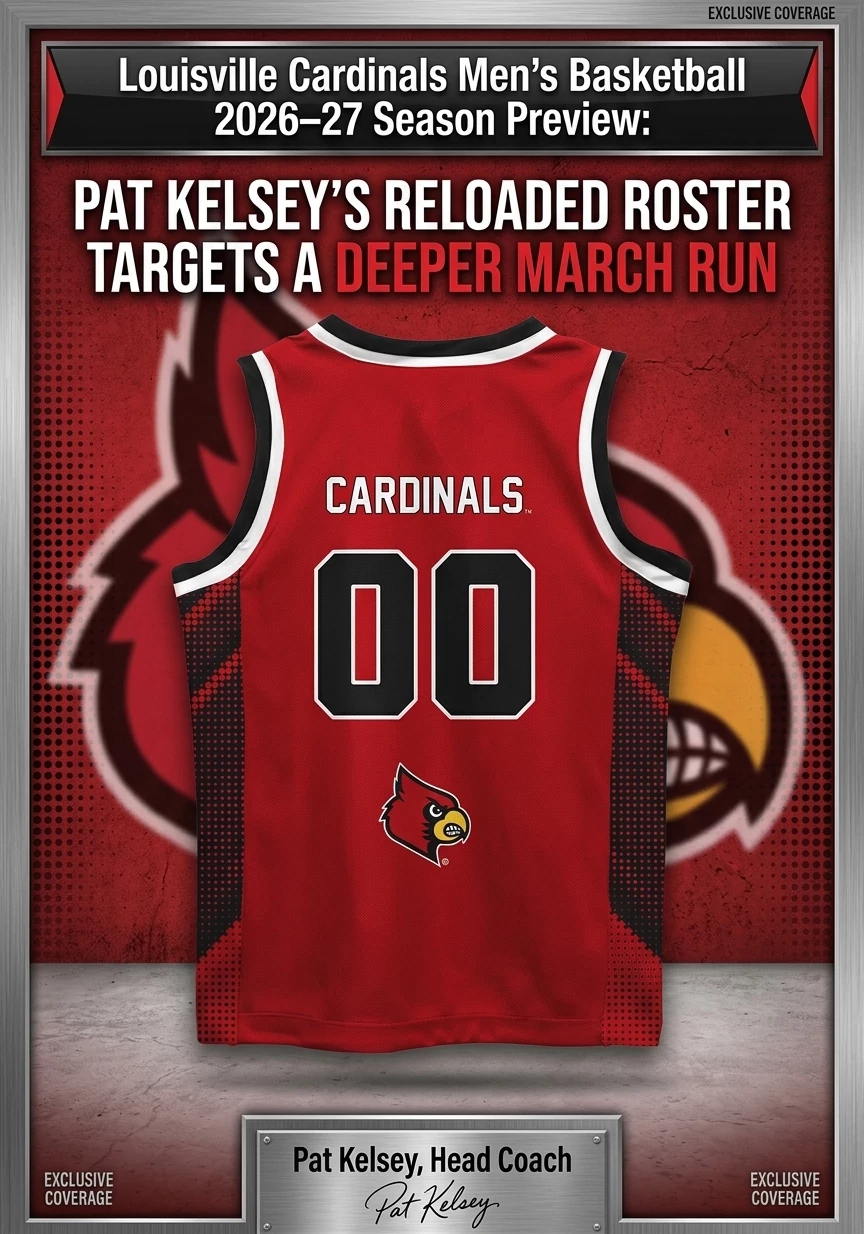
Louisville Cardinals Men’s Basketball 2026–27 Season Preview: Pat Kelsey’s Reloaded Roster Targets a Deeper March Run
Louisville enters the 2026–27 season with the personnel to raise expectations. An experienced backcourt, a proven interior defender, and several versatile forwards give the Cardinals a promising foundation as Pat Kelsey begins his third season.
The next challenge is turning that talent into a team capable of advancing beyond the NCAA Tournament’s opening weekend. Louisville has restored its competitiveness. This roster offers an opportunity to take another step.
How Did Louisville Do Last Season?
The Cardinals finished
24–11 overall and 11–7 in ACC play, placing sixth in the conference. They earned a No. 6 seed in the NCAA Tournament and defeated South Florida
83–79
before falling
77–69 to Michigan State
in the second round. Louisville also reached the ACC Tournament quarterfinals, where Miami eliminated the Cardinals
78–73.
Louisville averaged
84.3 points per game
while allowing
72.5, demonstrating its offensive potential. However, the season included uneven performances against strong competition. The challenge for 2026–27 is maintaining that scoring ability while becoming more dependable defensively and in close games.
Coaching Staff: Pat Kelsey Adds Defensive Experience
Kelsey has delivered consecutive NCAA Tournament appearances, following a 27–8 debut season with last year’s 24 victories. His next task is integrating another collection of newcomers without losing the confidence and urgency that have helped revive the program.
A significant addition is
associate head coach and defensive coordinator John Andrzejek. He arrives after leading Campbell and previously coordinated the defense for Florida’s 2025 national championship team. That background makes him particularly relevant to Louisville’s pursuit of greater defensive consistency.
Sean Dixon
also serves as associate head coach. The staff includes assistants
Ronnie Hamilton, Mike Cassidy, Jermaine Ukaegbu, and Mitch Johnson, with
Tim Austing
serving as special assistant to the head coach.
The coaching priority should be establishing a clear rotation and defensive identity.
Louisville
has several players accustomed to meaningful roles elsewhere; getting those players to complement one another will matter more than their individual résumés.
Centers and Interior Players: Flory Bidunga Changes the Outlook
Although officially listed as a forward,
Flory Bidunga
projects as Louisville’s primary interior anchor. The Kansas transfer averaged
13.3 points, 9.0 rebounds, and 2.6 blocks
as a sophomore while shooting
64% from the field. His combination of efficient finishing, rebounding, and shot-blocking gives the Cardinals a substantial presence around the basket.
Bidunga should help
Louisville
finish defensive possessions and turn stops into transition opportunities. Offensively, his ability to finish near the rim gives the guards a reliable target when they draw help.
His importance also creates a clear concern: foul trouble. Louisville needs him available late in competitive games, making positioning and disciplined challenges essential.
Gabe Dynes, a 7-foot-5 senior arriving from USC, provides exceptional size. The Independence, Kentucky, native and former Simon Kenton standout gives the Cardinals another option against opponents determined to attack the paint. Freshman
Obinna Ekezie Jr., listed at 7-foot-2, adds a developing center prospect.
Their minutes should depend on defensive mobility, rebounding, and their ability to keep the offense connected.
Forwards: Experience and Multiple Ways to Contribute
Álvaro Folgueiras
brings a versatile offensive skill set. He averaged
8.4 points, 3.6 rebounds, and 2.2 assists
at Iowa last season and contributed to the Hawkeyes’ Elite Eight run. Before Iowa, he earned Horizon League Player of the Year honors at Robert Morris.
His passing could make him an effective partner for Bidunga. Louisville needs forwards who can recognize cutters, move the ball quickly, and punish defenses that concentrate on the primary guards.
LJ Wells
is another important addition, particularly familiar to Northern Kentucky basketball followers. He arrives after four seasons at NKU, averaging
15.0 points and 7.3 rebounds
in his final season with the Norse. He shot
55.4% overall and 38.3% from three-point range.
Wells offers a productive blend of rebounding and scoring. Translating that performance to ACC competition will be a test, but his experience gives
Louisville
another credible frontcourt option.
Freshman
Boyuan Zhang, a 6-foot-9 forward, adds size and developmental potential. His opportunity will depend on how quickly he adjusts to the physical and defensive demands of college basketball.
Guards: Shelstad Leads a Deep Group
Jackson Shelstad
arrives from Oregon as a strong candidate to direct the offense. He averaged
15.6 points and 4.9 assists
last season, although he appeared in only 12 games. His experience and scoring ability give Louisville a promising lead guard, with sustained availability an important factor.
Seth Trimble
adds experience from North Carolina, where he averaged
14.0 points, 3.8 rebounds, and 3.0 assists
last season. He gives Kelsey another veteran capable of sharing responsibility in the backcourt.
Returning guard
Adrian Wooley
provides valuable continuity. He played in all 35 games last season, averaging
8.7 points, 3.9 rebounds, and 1.8 assists, while shooting
35% from three-point range. His familiarity with Louisville’s expectations should help the newcomers settle in.
Karter Knox
supplies size on the wing. At Arkansas last season, he averaged
8.1 points and 4.5 rebounds, shooting
38% from beyond the arc. He has the opportunity to become an important contributor without needing to dominate the ball.
Former Dayton guard
De’Shayne Montgomery, freshman
Isaac Ellis, and returning guard
Will Hanke
complete the perimeter group. Montgomery adds another experienced option, while Ellis has an opportunity to develop behind veteran teammates.
Season Prediction
My projection is
24–26 regular-season victories, a top-four ACC finish, and an NCAA Tournament seed in the No. 3–5 range.
Bidunga gives Louisville a strong interior foundation, while Shelstad and the veteran guards provide multiple options for creating offense. Folgueiras and Wells could help the Cardinals adapt to different opponents and avoid becoming predictable.
A
Sweet 16 appearance is my postseason prediction, with an Elite Eight run possible if Louisville develops consistent perimeter defense and reliable late-game execution. The biggest question is how quickly the new rotation builds chemistry.
Conclusion
Louisville
has assembled a roster capable of competing near the top of the ACC. Bidunga’s interior impact, Shelstad’s playmaking, Wooley’s continuity, and the experience throughout the rotation provide reasons for optimism.
The Cardinals’ success will depend on how well those pieces work together. If the defense becomes more dependable and the guards manage important possessions effectively, Kelsey’s third season could produce Louisville’s most meaningful postseason progress in years.
Up To $1500 in Bonus Bets Paid Back if your First Bet Does Not Win
T&Cs apply
4.5/5
Gambling problem? Call 1-800-GAMBLER or 1-800-MY-RESET (Available in the US) 877-8-HOPENY or text HOPENY (467369) (NY) 1-800-327-5050 (MA), 1-800-BETS-OFF (IA), 1-800-981-0023 (PR). 21+ only. Please Gamble Responsibly. See BetMGM.com for Terms. First Bet Offer for new customers only (if applicable). Subject to eligibility requirements. Bonus bets are non-withdrawable. In partnership with Kansas Crossing Casino and Hotel. Promotional offers not available in Mississippi, Massachusetts, New York, Ontario, or Puerto Rico.
New DraftKings Customers: Spend $5+ Get $150 in Bonuses
T&Cs apply
4.5/5
GAMBLING PROBLEM? CALL 1-800-GAMBLER or 1-800-MY-RESET, (800) 327-5050 or visit gamblinghelplinema.org (MA). Please Gamble Responsibly. 888-789-7777/visit ccpg.org (CT), or visit www.mdgamblinghelp.org (MD), 1-800-981-0023 (PR). 21+ and present in most states. (18+ DC/NH/PR/WY). Void in CAN. Eligibility restrictions apply. On behalf of Boot Hill Casino (KS). Pass-thru of per wager tax may apply in IL. 1 per new DraftKings customer. $5+ first-time bet req. Max. $150 issued as non-withdrawable Bonus Bets. Stake removed from payout. Reward issued as $50 in Bonus Bets every 7 days via click-to-claim for 14 days. Bonus Bets and click-to-claims expire 7 days (168hrs) after issuance. Terms: sportsbook.draftkings.com/promos. Ends 10/11/26 at 11:59 PM ET. Sponsored by DK.
Must be 21+. GAMBLING PROBLEM? CALL 1-800-GAMBLER OR CALL 1-800-MY-RESET, www.mdgamblinghelp.org (MD), (800)-327-5050 or gamblinghelplinema.org (MA), Call (877)8-HOPENY or text HOPENY (467369) (NY), (888) 789-7777 or ccpg.org (CT), morethanagame.nc.gov (NC), 1800gambler.net (WV)
Bet $1 and get double the winnings up to $25 for your next 10 bets
T&Cs apply
4.4/5
21+ New users only. Must register using eligible promo code. First bet after registration must qualify. Max. Bonus Bet: $1,000. Bonus Bet expires 14 days after receipt. Void where prohibited. See Caesars.com/promos for full terms. Gambling Problem? 1-800-GAMBLER (1-800-426-2537)
21+ and present in OH. Gambling Problem? Call 1-800-GAMBLER.
This site is using
Cloudflare
and adheres to the
Google Safe Browsing Program. We adapted
Google's Privacy Guidelines
to keep your data safe at all times.
Close
Ready to Win Big? Join the Elite with Our Sports Betting Deals!
FanDuel Promo
New Users – Get $250 in Bonus Bets when you wager $5 for 5 days
Up To $1500 in Bonus Bets Paid Back if your First Bet Does Not Win
Best Slots
T&Cs and 21+ apply
Gambling problem? Call 1-800-GAMBLER or 1-800-MY-RESET (Available in the US) 877-8-HOPENY or text HOPENY (467369) (NY) 1-800-327-5050 (MA), 1-800-BETS-OFF (IA), 1-800-981-0023 (PR). 21+ only. Please Gamble Responsibly. See BetMGM.com for Terms. First Bet Offer for new customers only (if applicable). Subject to eligibility requirements. Bonus bets are non-withdrawable. In partnership with Kansas Crossing Casino and Hotel. Promotional offers not available in Mississippi, Massachusetts, New York, Ontario, or Puerto Rico.
Code:
Open BetMGM
Get Bonus
DraftKings Promo
New DraftKings Customers: Spend $5+ Get $150 in Bonuses
Newcomer
T&Cs and 21+ apply
GAMBLING PROBLEM? CALL 1-800-GAMBLER or 1-800-MY-RESET, (800) 327-5050 or visit gamblinghelplinema.org (MA). Please Gamble Responsibly. 888-789-7777/visit ccpg.org (CT), or visit www.mdgamblinghelp.org (MD), 1-800-981-0023 (PR). 21+ and present in most states. (18+ DC/NH/PR/WY). Void in CAN. Eligibility restrictions apply. On behalf of Boot Hill Casino (KS). Pass-thru of per wager tax may apply in IL. 1 per new DraftKings customer. $5+ first-time bet req. Max. $150 issued as non-withdrawable Bonus Bets. Stake removed from payout. Reward issued as $50 in Bonus Bets every 7 days via click-to-claim for 14 days. Bonus Bets and click-to-claims expire 7 days (168hrs) after issuance. Terms: sportsbook.draftkings.com/promos. Ends 10/11/26 at 11:59 PM ET. Sponsored by DK.
Code:
Open DraftKings
Get Bonus
Find out what the legends have to say about sports this week....