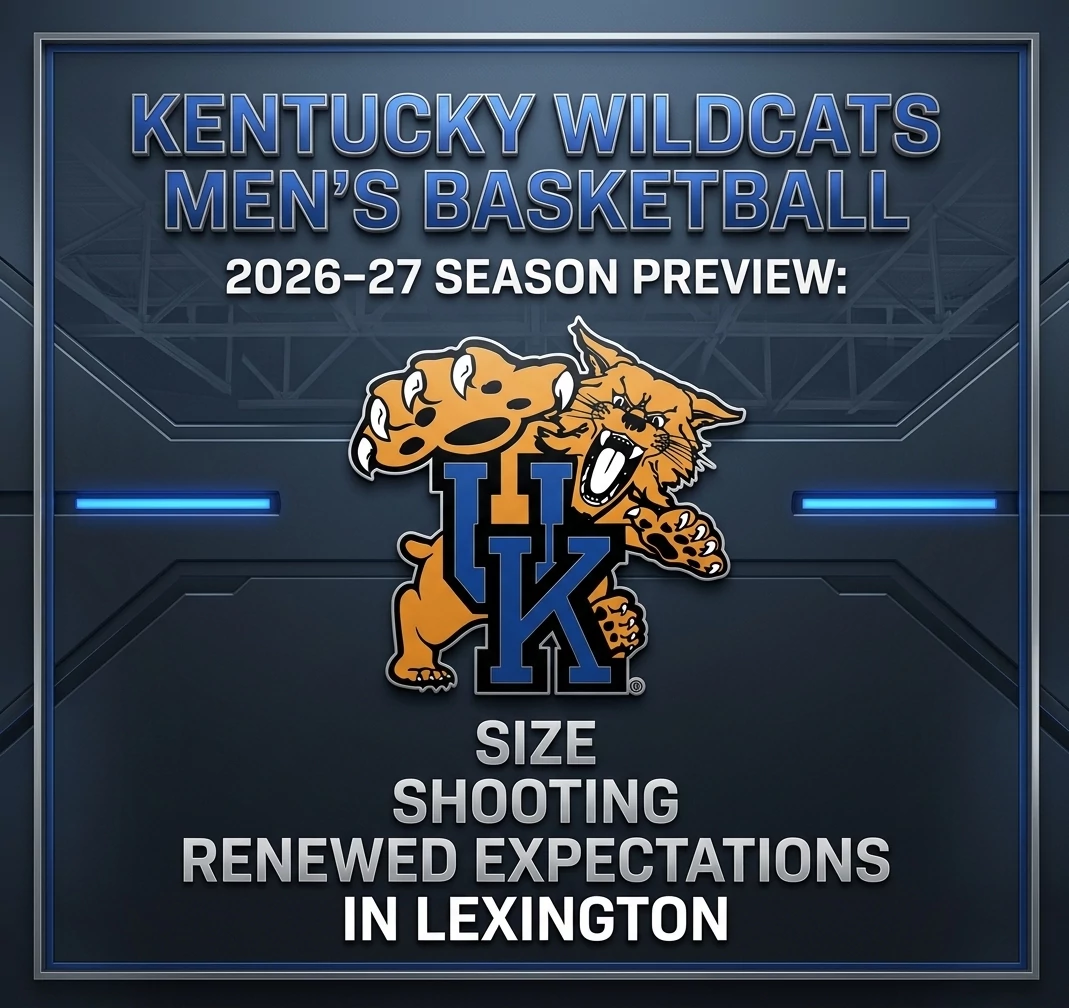
Kentucky Wildcats Men’s Basketball 2026–27 Season Preview: Size, Shooting, and Renewed Expectations in Lexington
Kentucky enters the 2026–27 season with a roster built to give Mark Pope more ways to win. The Wildcats have experienced perimeter scorers, substantial frontcourt size, and a returning center capable of becoming a defensive anchor.
The challenge is bringing those pieces together. After a second-round NCAA Tournament exit last March, Kentucky needs greater consistency to turn its considerable talent into a deeper postseason run.
How Did Kentucky Do Last Season?
Kentucky finished
22–14 overall and 10–8 in SEC play
in 2025–26. As the No. 7 seed in the Midwest Region, the Wildcats escaped Santa Clara
89–84 in overtime
before losing
82–63 to Iowa State
in the second round. Otega Oweh’s dramatic three-pointer to force overtime against Santa Clara provided the postseason’s defining Kentucky highlight.
Injuries complicated the season. Jaland Lowe appeared in only nine games, while Jayden Quaintance played four. Kentucky also entered the NCAA Tournament having faced 19 opponents from the tournament field, illustrating the difficulty of its schedule. Nevertheless, the final loss exposed an important weakness: Kentucky committed a season-high 20 turnovers against Iowa State.
The lesson for this season is clear. Talent and scoring ability must be supported by reliable ballhandling, defensive execution, and enough depth to withstand setbacks.
Coaching Staff: Mark Pope’s Third Season
Pope’s approach for this roster emphasizes movement, multiple playmakers, and shooting. At September’s media availability, he highlighted the team’s length and its commitment to cutting hard without the ball. Those priorities should help Kentucky create scoring opportunities without asking one guard to manufacture every possession.
The staff includes
associate coach Mark Fox
and assistants
Cody Fueger, Mo Williams, and Mikhail McLean.
Nick Robinson
directs basketball operations, while
Keegan Brown
oversees roster management.
Williams is a notable addition. The former NBA All-Star and champion joined Kentucky after four seasons leading Jackson State. His
experience
as a professional guard and college head coach should offer useful perspective for a backcourt adjusting to new responsibilities.
Pope’s central task is finding combinations that defend as effectively as they score. The roster offers choices, but establishing clear roles will be essential.
Centers: Malachi Moreno Anchors the Interior
Malachi Moreno
returns after earning SEC All-Freshman honors. He averaged
7.8 points, 6.3 rebounds, and 1.47 blocks, shot
58.2% from the field, and started 30 games. That
experience
makes him one of Kentucky’s most important returning pieces.
Moreno’s next step is becoming a more commanding interior presence. Kentucky needs him to finish possessions with rebounds, protect the basket without unnecessary fouls, and convert opportunities created by its guards. His passing also offers a way to keep the offense moving when opponents crowd the perimeter.
Franck Kepnang, a 7-foot, 270-pound graduate transfer from Washington, provides another substantial body at center. Pope has specifically praised his aggression and physicality. He projects as an option when Kentucky needs stronger interior resistance or relief for Moreno.
The two centers give Kentucky the potential to maintain size throughout a game. Their effectiveness against quicker lineups will be an important test.
Forwards: Milan Momcilovic Leads a Versatile Group
Milan Momcilovic
is the frontcourt’s most accomplished perimeter scorer. At Iowa State last season, he averaged
16.9 points, made
136 three-pointers, and shot
48.7% from beyond the arc
while earning second-team All-Big 12 honors. Kentucky saw his ability firsthand when he scored 20 points against the Wildcats in the NCAA Tournament.
His shooting should create space for drives, cuts, and interior finishes. Opponents will have difficulty helping off him, giving Pope a valuable piece around which to organize the offense.
Justin McBride
brings a different combination of strength and scoring. The James Madison transfer averaged
15.3 points and 5.6 rebounds, shooting
40% from three-point range
last season. His ability to contribute inside and outside could make him an effective partner for either center.
Ousmane N’Diaye,
Braydon Hawthorne,
Trent Noah, and
Reece Potter
provide additional frontcourt options. N’Diaye and Potter add considerable height, while Hawthorne and Noah offer alternatives in smaller combinations. Their opportunities should depend on defensive dependability, rebounding, and their ability to keep the ball moving.
Guards: Diallo and Wilkins Bring Proven Production
Zoom Diallo
arrives from Washington after averaging
15.7 points and 4.5 assists, while shooting
48.9% from the field. His production against Big Ten competition makes him a strong candidate to handle a major share of Kentucky’s offensive creation.
Diallo should be particularly valuable when Kentucky needs to attack the paint and force defenders to rotate. The key will be turning those advantages into efficient finishes and clean passes.
Alex Wilkins
joins the Wildcats after an outstanding freshman season at Furman. He averaged
17.8 points and 4.7 assists, earned Southern Conference Tournament Most Outstanding Player honors, and scored 21 points against UConn in the NCAA Tournament. His three-point percentage was
32.1%, leaving room for improvement as he adjusts to SEC defenses.
Together, Diallo and Wilkins give Kentucky two potential creators with the size to see over smaller defenders.
Kam Williams
supplies another
experienced
perimeter option.
Jerone Morton, freshman
Mason Williams, and
Zyon Hawthorne
round out the guard group. Pope has already identified Mason Williams as one of the players contributing physicality in the backcourt.
Season Prediction
My projection is
23–25 regular-season victories, a top-five SEC finish, and an NCAA Tournament seed in the No. 4–6 range.
Kentucky’s shooting and multiple ballhandlers should make the offense difficult to contain. Moreno’s development and the frontcourt’s ability to defend will determine whether the Wildcats become a balanced contender.
A
Sweet 16 appearance is my postseason prediction, with an Elite Eight run within reach if the guards protect the ball and the defense improves. The biggest concern is whether a newly assembled rotation can execute consistently against the SEC’s best teams.
Conclusion
Kentucky has a promising mix of proven scorers and returning players ready for greater responsibility. Momcilovic can change how opponents defend the floor, Diallo and Wilkins can create opportunities, and Moreno gives the Wildcats an established foundation inside.
The potential is substantial. Turning it into a successful March will require disciplined defense, dependable rebounding, and clear late-game decision-making. If Kentucky develops those habits, Pope’s third season could deliver a meaningful step forward.
Up To $1500 in Bonus Bets Paid Back if your First Bet Does Not Win
T&Cs apply
4.5/5
Gambling problem? Call 1-800-GAMBLER or 1-800-MY-RESET (Available in the US) 877-8-HOPENY or text HOPENY (467369) (NY) 1-800-327-5050 (MA), 1-800-BETS-OFF (IA), 1-800-981-0023 (PR). 21+ only. Please Gamble Responsibly. See BetMGM.com for Terms. First Bet Offer for new customers only (if applicable). Subject to eligibility requirements. Bonus bets are non-withdrawable. In partnership with Kansas Crossing Casino and Hotel. Promotional offers not available in Mississippi, Massachusetts, New York, Ontario, or Puerto Rico.
New DraftKings Customers: Spend $5+ Get $150 in Bonuses
T&Cs apply
4.5/5
GAMBLING PROBLEM? CALL 1-800-GAMBLER or 1-800-MY-RESET, (800) 327-5050 or visit gamblinghelplinema.org (MA). Please Gamble Responsibly. 888-789-7777/visit ccpg.org (CT), or visit www.mdgamblinghelp.org (MD), 1-800-981-0023 (PR). 21+ and present in most states. (18+ DC/NH/PR/WY). Void in CAN. Eligibility restrictions apply. On behalf of Boot Hill Casino (KS). Pass-thru of per wager tax may apply in IL. 1 per new DraftKings customer. $5+ first-time bet req. Max. $150 issued as non-withdrawable Bonus Bets. Stake removed from payout. Reward issued as $50 in Bonus Bets every 7 days via click-to-claim for 14 days. Bonus Bets and click-to-claims expire 7 days (168hrs) after issuance. Terms: sportsbook.draftkings.com/promos. Ends 10/11/26 at 11:59 PM ET. Sponsored by DK.
Must be 21+. GAMBLING PROBLEM? CALL 1-800-GAMBLER OR CALL 1-800-MY-RESET, www.mdgamblinghelp.org (MD), (800)-327-5050 or gamblinghelplinema.org (MA), Call (877)8-HOPENY or text HOPENY (467369) (NY), (888) 789-7777 or ccpg.org (CT), morethanagame.nc.gov (NC), 1800gambler.net (WV)
Bet $1 and get double the winnings up to $25 for your next 10 bets
T&Cs apply
4.4/5
21+ New users only. Must register using eligible promo code. First bet after registration must qualify. Max. Bonus Bet: $1,000. Bonus Bet expires 14 days after receipt. Void where prohibited. See Caesars.com/promos for full terms. Gambling Problem? 1-800-GAMBLER (1-800-426-2537)
21+ and present in OH. Gambling Problem? Call 1-800-GAMBLER.
This site is using
Cloudflare
and adheres to the
Google Safe Browsing Program. We adapted
Google's Privacy Guidelines
to keep your data safe at all times.
Close
Ready to Win Big? Join the Elite with Our Sports Betting Deals!
FanDuel Promo
New Users – Get $250 in Bonus Bets when you wager $5 for 5 days
Up To $1500 in Bonus Bets Paid Back if your First Bet Does Not Win
Best Slots
T&Cs and 21+ apply
Gambling problem? Call 1-800-GAMBLER or 1-800-MY-RESET (Available in the US) 877-8-HOPENY or text HOPENY (467369) (NY) 1-800-327-5050 (MA), 1-800-BETS-OFF (IA), 1-800-981-0023 (PR). 21+ only. Please Gamble Responsibly. See BetMGM.com for Terms. First Bet Offer for new customers only (if applicable). Subject to eligibility requirements. Bonus bets are non-withdrawable. In partnership with Kansas Crossing Casino and Hotel. Promotional offers not available in Mississippi, Massachusetts, New York, Ontario, or Puerto Rico.
Code:
Open BetMGM
Get Bonus
DraftKings Promo
New DraftKings Customers: Spend $5+ Get $150 in Bonuses
Newcomer
T&Cs and 21+ apply
GAMBLING PROBLEM? CALL 1-800-GAMBLER or 1-800-MY-RESET, (800) 327-5050 or visit gamblinghelplinema.org (MA). Please Gamble Responsibly. 888-789-7777/visit ccpg.org (CT), or visit www.mdgamblinghelp.org (MD), 1-800-981-0023 (PR). 21+ and present in most states. (18+ DC/NH/PR/WY). Void in CAN. Eligibility restrictions apply. On behalf of Boot Hill Casino (KS). Pass-thru of per wager tax may apply in IL. 1 per new DraftKings customer. $5+ first-time bet req. Max. $150 issued as non-withdrawable Bonus Bets. Stake removed from payout. Reward issued as $50 in Bonus Bets every 7 days via click-to-claim for 14 days. Bonus Bets and click-to-claims expire 7 days (168hrs) after issuance. Terms: sportsbook.draftkings.com/promos. Ends 10/11/26 at 11:59 PM ET. Sponsored by DK.
Code:
Open DraftKings
Get Bonus
Find out what the legends have to say about sports this week....