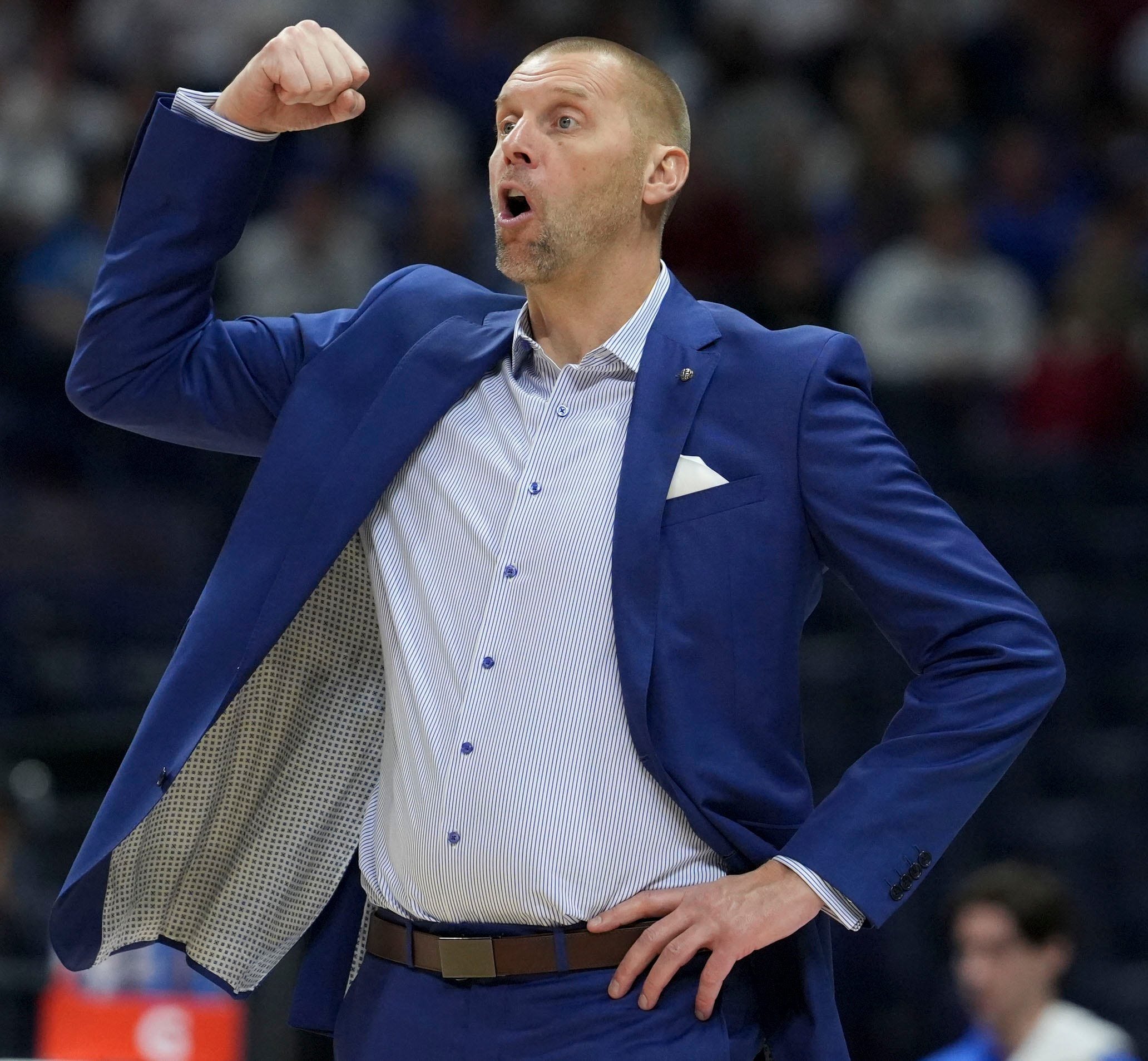
Kentucky Wildcats head coach Mark Pope yells to his team during a game against the Indiana Hoosiers on Friday, Nov. 20, 2026, at Lucas Oil Stadium in Indianapolis. The Hoosiers defeated the Wildcats 90-76.
Kentucky should fire Mark Pope.
That is a harsh judgment seven games into a season. It should be. Removing a head coach in November is a major decision, and nobody should pretend that an interim appointment automatically fixes a struggling team.
But Kentucky needs to ask a more important question than whether firing Pope now would be uncomfortable.
What evidence suggests that keeping him will produce the standard this program expects?
The Wildcats are
4–3 after losing 73–71 in overtime to Wichita State at Rupp Arena on Friday. They have already accumulated three losses before December, and their next assignment is a trip to No. 2 Virginia.
This is Pope’s third season. Kentucky has moved beyond the point where every disappointing performance can be treated as part of a transition.
The program needs an honest evaluation of where it is going. My conclusion is that Kentucky should make a change now.
The Wichita State loss exposed a coaching failure Pope acknowledged himself
Losing a close game does not automatically justify firing a coach. Good teams lose, and capable coaches occasionally make costly decisions.
But Pope’s explanation of Kentucky’s final inbound
situation against Wichita State
should concern anyone responsible for evaluating him.
Asked about the play and the circumstances surrounding it, Pope accepted responsibility and said,
“Somehow that changed to a live ball in my mind and I messed that up.”
That is a significant admission.
Late-game preparation is one of the clearest responsibilities a coaching staff has. Players depend on the bench to understand the situation, communicate the available options and put them in position to execute.
A coach can draw up an appropriate action and watch a player miss an open shot. That happens. Here, Pope acknowledged that his own understanding of the situation was wrong.
Accepting responsibility is appropriate. Kentucky must also decide what that responsibility means.
A postgame admission cannot become the end of the discussion when the underlying mistake concerns the circumstances governing a potential game-winning possession.
Kentucky had opportunities to finish and failed
The Wildcats led
65–61 with 2:03 remaining in regulation. Wichita State erased that advantage and forced overtime. Kentucky eventually received another opportunity to change the outcome, but Milan Momcilovic’s final three-point attempt missed.
Close games require several things to work together. Offensive decisions, defensive rebounding, communication and an understanding of time and score all become more consequential.
Kentucky did not close successfully.
Players share responsibility for that result. They take the shots, pursue rebounds and execute assignments. But the head coach establishes the preparation and structure supporting those decisions.
When the team fails to finish and the coach acknowledges a costly situational mistake, scrutiny belongs on the bench.
The rebounding damage was impossible to ignore
Wichita State’s William Berg finished with
20 rebounds, while Dillon Battie collected
17. Both scored 16 points. Battie’s second-chance basket put the Shockers ahead for good with 36 seconds remaining in overtime.
Those numbers reveal a fundamental problem.
A defensive possession remains unfinished until someone secures the ball. Contesting the initial shot accomplishes little if the opponent receives another chance in the paint.
Kentucky allowed two Wichita State players to combine for 37 rebounds. Whatever combination of personnel, positioning and execution produced that outcome, the Wildcats failed to solve it effectively enough to win.
Pope is responsible for the lineup choices and adjustments available to address those problems. The players are responsible for carrying them out.
A program evaluating its coach must consider both. It cannot keep placing every physical breakdown into a category that somehow excludes the person responsible for building and directing the team.
The first two seasons provide context—and a reason for concern
Pope’s Kentucky record deserves an accurate accounting.
His first team went
24–12, finished
10–8 in the SEC
and reached the
2025 Sweet 16. That season included eight victories over Associated Press top-15 opponents. His second team finished
22–14, again went
10–8 in conference play
and exited in the
NCAA Tournament’s second round.
Those accomplishments matter. Pope has won significant games at Kentucky, and the Sweet 16 appearance gives his supporters a legitimate argument for patience.
They also establish the full context for the criticism.
Kentucky followed a promising first postseason with a shorter tournament run and another season containing double-digit losses. Now, the third season has opened with three defeats in seven games.
The concern is the direction of the program.
Kentucky hired Pope to build sustained championship contention. A promising first year should become a foundation for greater consistency. The early evidence from this season gives fans reason to question whether that progression is happening.
His connection to Kentucky cannot settle the coaching evaluation
Pope’s place in Kentucky history is secure. He was a captain on the
1996 national championship team
and returned as head coach in April 2024.
That connection explains why his arrival meant so much to so many people.
It should not determine how long he remains in charge.
A university can respect an alumnus, appreciate his commitment and still conclude that the coaching arrangement is failing to meet its expectations.
The relevant questions concern preparation, roster construction, player development and results. Emotional investment cannot answer them.
Kentucky’s history creates an obligation to evaluate those areas honestly, even when the person being evaluated cares deeply about the school.
Waiting carries a cost, too
The strongest argument against firing Pope immediately is straightforward. November is early, teams can improve and an in-season change creates disruption.
Those are real considerations.
But keeping a coach also represents a decision with consequences. Every additional practice and game places more of the season under the same leadership. If Kentucky’s administration concludes that Pope is unlikely to deliver the required standard, postponing action simply because the calendar is inconvenient serves little purpose.
A change would not guarantee a championship run. It would establish accountability and allow the university to begin choosing its next direction.
Kentucky should make that decision through a serious evaluation of the program. It should resist allowing familiarity, affection or a reluctance to admit disappointment to substitute for judgment.
Pope has had two completed seasons and now a troubling start to his third. The Wichita State loss added a fundamental late-game coaching mistake to the concerns already visible in the results.
In my view, Kentucky has seen enough. It should fire Mark Pope now and begin the work of restoring a consistent championship standard.
Get $250 in Bonus Bets when you wager $5 for 5 days
T&Cs apply
4.6/5
Gambling Problem? Call 1-800-GAMBLER or 1-800-MY-RESET. Visit www.mdgamblinghelp.org (MD). 1-888-789-7777 or ccpg.org/chat (CT). Hope is here. GamblingHelpLineMA.org or (800) 327-5050 for 24/7 support (MA). 1-877-8-HOPENY or text HOPENY (467369) (NY). 21+ (18+ D.C., WY) and present in select states (for KS, in affiliation with Kansas Star Casino). First online real money wager only. Min $5 wager required for 5 consecutive days. $5 first deposit required. Bonus issued as nonwithdrawable bonus bets which expire 5 days after receipt. Restrictions apply. See terms at sportsbook.fanduel.com. Call 1-877-770-7867 (LA).
Get Up to $1,000 Back in Bonus Bets Over Your First 10 Days
T&Cs apply
4.5/5
Gambling problem? Call 1-800-GAMBLER or 1-800-MY-RESET (Available in the US) 877-8-HOPENY or text HOPENY (467369) (NY) 1-800-327-5050 (MA), 1-800-BETS-OFF (IA), 21+ only. Please Gamble Responsibly. Visit mdgamblinghelp.org (MD). See BetMGM.com for Terms. New Player Offer for new players only. Subject to eligibility requirements. Bonus bets are non-withdrawable. In partnership with Kansas Crossing Casino and Hotel. This promotional offer is not available in NJ, MA, MI, NV, NY, ON, PA, PR, and WV.
GAMBLING PROBLEM? CALL 1-800-GAMBLER or 1-800-MY-RESET, (800) 327-5050 or visit gamblinghelplinema.org (MA). Please Gamble Responsibly. 888-789-7777/visit ccpg.org (CT), or visit www.mdgamblinghelp.org (MD), 1-800-981-0023 (PR). 21+ and present in most states. (18+ DC/NH/PR/WY). Void in CAN. Eligibility restrictions apply. On behalf of Boot Hill Casino (KS). Pass-thru of per wager tax may apply in IL. 1 per new Sportsbook customer. $5+ first-time bet req. Max. $200 issued as non-withdrawable Bonus Bets. Stake removed from payout. Reward issued as $50 in Bonus Bets every 7 days via click-to-claim for 21 days. Bonus Bets and click-to-claims expire 7 days (168hrs) after issuance. Terms: dkng.co/offer. Get 1 promo code to redeem a 3-month NBA League Pass subscription, complimentary of DraftKings. Subscription auto-renews monthly at then-current price (currently $16.99/mo); cancel anytime. Terms, restrictions, and eligibility requirements apply. Redeem League Pass by 12/19/26 at 11:59 PM ET. Addt’l terms: support.watch.nba.com/hc/en-us/articles/9165532876183-League-Pass-Terms-of-Use_. Ends 11/29/26 at 11:59 PM ET. Sponsored by DK.
Must be 21+. GAMBLING PROBLEM? CALL 1-800-GAMBLER OR CALL 1-800-MY-RESET, www.mdgamblinghelp.org (MD), (800)-327-5050 or gamblinghelplinema.org (MA), Call (877)8-HOPENY or text HOPENY (467369) (NY), (888) 789-7777 or ccpg.org (CT), morethanagame.nc.gov (NC), 1800gambler.net (WV)
Bet $1 and get double the winnings up to $25 for your next 10 bets
T&Cs apply
4.4/5
21+ New users only. Must register using eligible promo code. First bet after registration must qualify. Max. Bonus Bet: $1,000. Bonus Bet expires 14 days after receipt. Void where prohibited. See Caesars.com/promos for full terms. Gambling Problem? 1-800-GAMBLER (1-800-426-2537)
21+ and present in OH. Gambling Problem? Call 1-800-GAMBLER.
The sweepstakes and social casinos featured here are for adults aged 18 or over. No purchase is necessary to enter or win, and every operator offers a free way to get Sweeps Coins. Availability in Ohio varies by operator. Offers are subject to each operator's terms. Need a break? Call or text 1-800-MY-RESET (24/7) or visit https://ncpgambling.org. We may earn a commission when you sign up through links on this site. This does not change how we review operators.
This site is using
Cloudflare
and adheres to the
Google Safe Browsing Program. We adapted
Google's Privacy Guidelines
to keep your data safe at all times.
Close
Ready to Win Big? Join the Elite with Our Sports Betting Deals!
FanDuel Promo
Get $250 in Bonus Bets when you wager $5 for 5 days
Our Favorite
T&Cs and 21+ apply
Gambling Problem? Call 1-800-GAMBLER or 1-800-MY-RESET. Visit www.mdgamblinghelp.org (MD). 1-888-789-7777 or ccpg.org/chat (CT). Hope is here. GamblingHelpLineMA.org or (800) 327-5050 for 24/7 support (MA). 1-877-8-HOPENY or text HOPENY (467369) (NY). 21+ (18+ D.C., WY) and present in select states (for KS, in affiliation with Kansas Star Casino). First online real money wager only. Min $5 wager required for 5 consecutive days. $5 first deposit required. Bonus issued as nonwithdrawable bonus bets which expire 5 days after receipt. Restrictions apply. See terms at sportsbook.fanduel.com. Call 1-877-770-7867 (LA).
Code:
Open FanDuel
Get Bonus
BetMGM Promo
Get Up to $1,000 Back in Bonus Bets Over Your First 10 Days
Best Slots
T&Cs and 21+ apply
Gambling problem? Call 1-800-GAMBLER or 1-800-MY-RESET (Available in the US) 877-8-HOPENY or text HOPENY (467369) (NY) 1-800-327-5050 (MA), 1-800-BETS-OFF (IA), 21+ only. Please Gamble Responsibly. Visit mdgamblinghelp.org (MD). See BetMGM.com for Terms. New Player Offer for new players only. Subject to eligibility requirements. Bonus bets are non-withdrawable. In partnership with Kansas Crossing Casino and Hotel. This promotional offer is not available in NJ, MA, MI, NV, NY, ON, PA, PR, and WV.
Code:
Open BetMGM
Get Bonus
DraftKings Promo
Bet $5, Get $200 + 3 Months of NBA League Pass
Newcomer
T&Cs and 21+ apply
GAMBLING PROBLEM? CALL 1-800-GAMBLER or 1-800-MY-RESET, (800) 327-5050 or visit gamblinghelplinema.org (MA). Please Gamble Responsibly. 888-789-7777/visit ccpg.org (CT), or visit www.mdgamblinghelp.org (MD), 1-800-981-0023 (PR). 21+ and present in most states. (18+ DC/NH/PR/WY). Void in CAN. Eligibility restrictions apply. On behalf of Boot Hill Casino (KS). Pass-thru of per wager tax may apply in IL. 1 per new Sportsbook customer. $5+ first-time bet req. Max. $200 issued as non-withdrawable Bonus Bets. Stake removed from payout. Reward issued as $50 in Bonus Bets every 7 days via click-to-claim for 21 days. Bonus Bets and click-to-claims expire 7 days (168hrs) after issuance. Terms: dkng.co/offer. Get 1 promo code to redeem a 3-month NBA League Pass subscription, complimentary of DraftKings. Subscription auto-renews monthly at then-current price (currently $16.99/mo); cancel anytime. Terms, restrictions, and eligibility requirements apply. Redeem League Pass by 12/19/26 at 11:59 PM ET. Addt’l terms: support.watch.nba.com/hc/en-us/articles/9165532876183-League-Pass-Terms-of-Use_. Ends 11/29/26 at 11:59 PM ET. Sponsored by DK.
Code:
Open DraftKings
Get Bonus
Find out what the legends have to say about sports this week....
Get $250 in Bonus Bets when you wager $5 for 5 days
Gambling Problem? Call 1-800-GAMBLER or 1-800-MY-RESET. Visit www.mdgamblinghelp.org (MD). 1-888-789-7777 or ccpg.org/chat (CT). Hope is here. GamblingHelpLineMA.org or (800) 327-5050 for 24/7 support (MA). 1-877-8-HOPENY or text HOPENY (467369) (NY). 21+ (18+ D.C., WY) and present in select states (for KS, in affiliation with Kansas Star Casino). First online real money wager only. Min $5 wager required for 5 consecutive days. $5 first deposit required. Bonus issued as nonwithdrawable bonus bets which expire 5 days after receipt. Restrictions apply. See terms at sportsbook.fanduel.com. Call 1-877-770-7867 (LA).