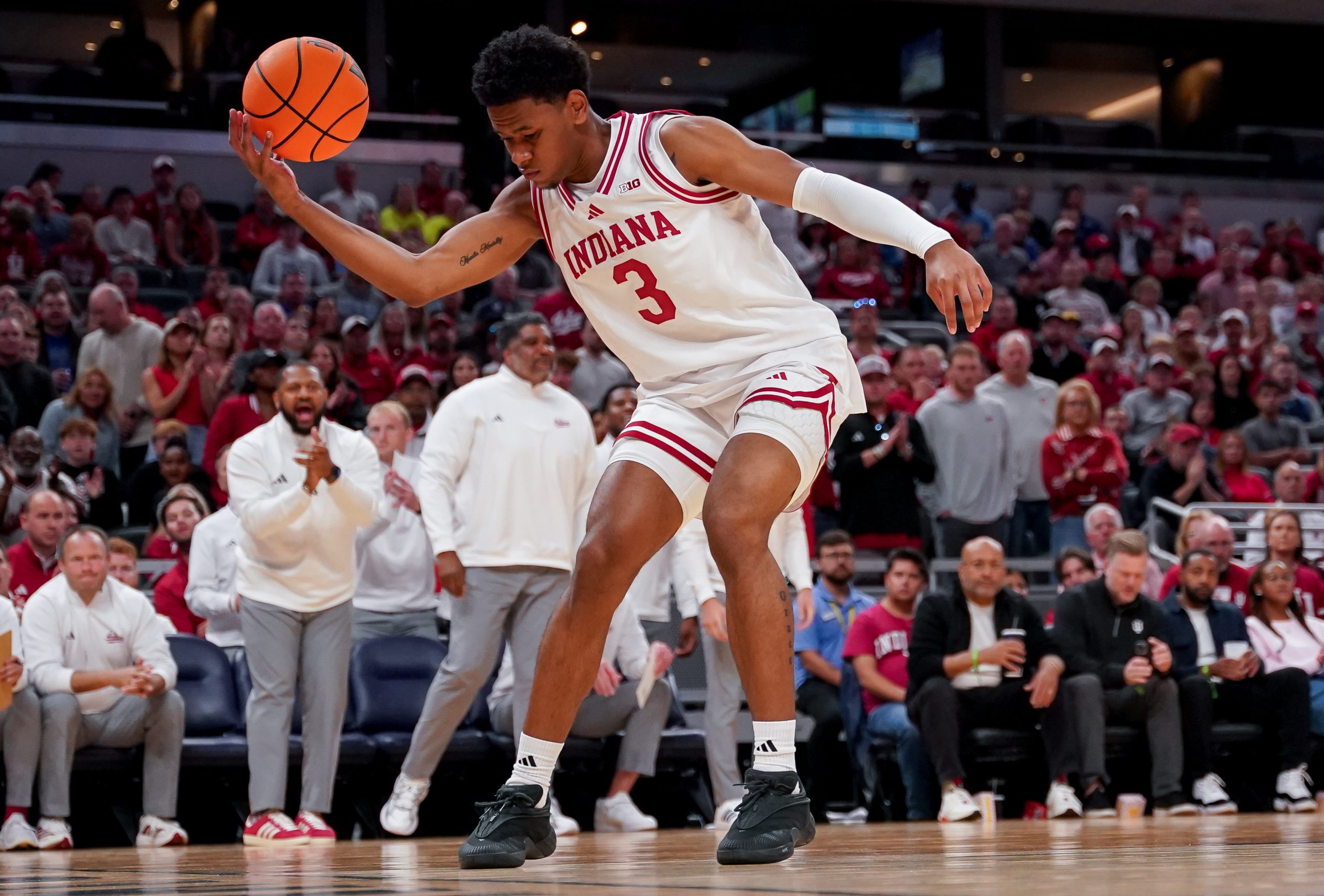
Oct 18, 2026; Indianapolis, IN, USA; Indiana Hoosiers guard Jaeden Mustaf (3) rebounds the ball against the North Carolina Tar Heels during the first half at Gainbridge Fieldhouse. Mandatory Credit: Robert Goddin-Imagn Images
Indiana’s rotation should come with one condition: earn your place in it.
That applies to the most experienced player on the roster. It applies to the newcomer with the biggest reputation. And after Sunday’s exhibition finale, it needs to apply to freshmen Trevor Manhertz, Prince-Alexander Moody and Vaughn Karvala, too.
The three helped Indiana erase an 11-point second-half deficit and beat Western Kentucky 79–74 in Evansville. They finished alongside veterans
Bryce Lindsay
and Sam Alexis, giving Darian DeVries a productive combination when the Hoosiers needed one.
That performance should influence what happens next.
An exhibition does not settle a season’s rotation. But if preseason games are supposed to reveal which players can help, a coach has to respond when somebody supplies an answer.
On Sunday, Indiana’s freshmen supplied one.
They earned another opportunity.
The Most Important Part Was When They Produced
There is a difference between getting freshmen on the floor and trusting them to help finish a competitive game.
Sunday offered the latter.
Manhertz scored seven points, Moody added six, and Karvala finished with four points and four rebounds. Moody hit the tying three with 5:30 remaining. Karvala contributed a rebound basket and two free throws late. Those were meaningful possessions in a game Indiana was trying to rescue.
For a young player, that matters. For a coach evaluating his options, it should matter even more.
Anyone can talk about readiness in October. A competitive finish gives players a chance to demonstrate it.
The freshmen did enough to make the next rotation discussion more interesting. If their opportunities increase, the reason should be easy for everyone in that locker room to understand: they helped the team win.
Experience Has to Show Up on the Floor
Experience is valuable because it should produce something.
Better decisions. More dependable execution. An understanding of when to attack, when to move the ball and how to respond when an opponent makes a run.
Those advantages deserve respect. They also have to be visible.
A veteran should have an edge when his experience makes Indiana better. But the number of college games a player has appeared in cannot become permanent protection against somebody else outplaying him.
DeVries’ assessment of Sunday made the issue clear.
“They flat out played harder than we did,” he said afterward.
That is a team criticism, and it should not be twisted into an accusation against every veteran. It does, however, establish the standard Indiana needs to enforce.
When effort becomes a problem, playing time is one of the coach’s strongest tools.
A reminder in practice can help. A substitution can make the point immediately.
DeVries Already Made the Right First Decision
To his credit, DeVries gave the freshmen the chance to contribute and stayed with a group that was working.
The next step is carrying that openness into the regular season.
Coaches naturally become more cautious when results begin to count. A freshman’s mistake can feel more costly than a veteran’s because the coach has less evidence about how the younger player will respond.
But that caution can become its own problem.
If an inexperienced player believes one mistake will end his night, he may start playing to avoid being removed. The decisive player from the exhibition becomes hesitant. An open shot becomes an extra pass. An opportunity disappears while he checks the bench.
Accountability should be consistent enough that players understand the difference between an honest mistake and a failure to compete.
Freshmen need correction. They also need room to apply it.
The Veterans Still Belong in This Conversation
Sunday’s finish also demonstrated the value of mixing youth with experience.
Lindsay led Indiana with 20 points. Alexis supplied 15 points, five rebounds and four blocks. Their production was central to the comeback.
That is why the useful question is which combinations make Indiana most effective.
Perhaps a freshman provides the energy a particular lineup needs. Perhaps an experienced scorer gives younger teammates the space to settle in. Perhaps the best closing group changes with the opponent.
DeVries should keep all of those possibilities available.
A rotation is a basketball decision. It should remain responsive to what is happening on the court.
Make Them Earn It Again
Manhertz, Moody and Karvala should have to build on Sunday.
One productive afternoon does not guarantee dependable defense through a
Big Ten schedule. It does not answer every question about decision-making, consistency or how a player responds when opponents begin targeting his weaknesses.
The appropriate reward is a meaningful chance to prove more.
Give them competitive minutes. Evaluate their execution. See whether the energy holds up when shots stop falling.
Apply the same process to the veterans.
That creates a standard players can trust because the path to the floor is clear. Perform your job, help the group and give the coach a reason to keep you out there.
Indiana’s freshmen gave DeVries that reason Sunday.
Now, with the season approaching, he should make sure their performance carries weight. The strongest message he can send this team is also the simplest:
New Users – Get $350 in Bonus Bets when you wager $5 for 7 days
T&Cs apply
4.6/5
Gambling Problem? Call 1-800-GAMBLER or 1-800-MY-RESET. Call 1-888-789-7777 or visit ccpgg.org/chat (CT). Hope is here. GamblingHelpLineMA.org or call (800) 327-5050 for 24/7 support (MA). Visit www.mdgamblinghelp.org (MD). Call 1-877-8HOPE-NY or text HOPENY (NY). 21+ (18+ DC, WY) and present in select states (for KS, in affiliation with Kansas Star Casino). Find online real money wagering only. Min $5 wager required for 7 consecutive days. $5 free play credit. Bonus issued as non-withdrawable bonus with cash withdrawable bonus with cash withdrawable. Bonus bets which expire 7 days after receipt. Restrictions apply. See terms at sportsbook.fanduel.com. Call 1-877-770-7867 (LA).
Get Up to $1,000 Back in Bonus Bets Over Your First 10 Days
T&Cs apply
4.5/5
Gambling problem? Call 1-800-GAMBLER or 1-800-MY-RESET (Available in the US) 877-8-HOPENY or text HOPENY (467369) (NY) 1-800-327-5050 (MA), 1-800-BETS-OFF (IA), 21+ only. Please Gamble Responsibly. Visit mdgamblinghelp.org (MD). See BetMGM.com for Terms. New Player Offer for new players only. Subject to eligibility requirements. Bonus bets are non-withdrawable. In partnership with Kansas Crossing Casino and Hotel. This promotional offer is not available in NJ, MA, MI, NV, NY, ON, PA, PR, and WV.
New DraftKings Customers: Bet $5, Get $200 + 3 Months of NBA League Pass!
T&Cs apply
4.5/5
GAMBLING PROBLEM? CALL 1-800-GAMBLER or 1-800-MY-RESET, (800) 327-5050 or visit gamblinghelplinema.org (MA). Please Gamble Responsibly. 888-789-7777/visit ccpg.org (CT), or visit www.mdgamblinghelp.org (MD), 1-800-981-0023 (PR). 21+ and present in most states. (18+ DC/NH/PR/WY). Void in CAN. Eligibility restrictions apply. On behalf of Boot Hill Casino (KS). Pass-thru of per wager tax may apply in IL. 1 per new Sportsbook customer. $5+ first-time bet req. Max. $200 issued as non-withdrawable Bonus Bets. Stake removed from payout. Reward issued as $50 in Bonus Bets every 7 days via click-to-claim for 21 days. Bonus Bets and click-to-claims expire 7 days (168hrs) after issuance. Terms: dkng.co/offer. Get 1 promo code to redeem a 3-month NBA League Pass subscription, complimentary of DraftKings. Subscription auto-renews monthly at then-current price (currently $16.99/mo); cancel anytime. Terms, restrictions, and eligibility requirements apply. Redeem League Pass by 12/19/26 at 11:59 PM ET. Addt’l terms: support.watch.nba.com/hc/en-us/articles/9165532876183-League-Pass-Terms-of-Use_. Ends 11/29/26 at 11:59 PM ET. Sponsored by DK.
Must be 21+. GAMBLING PROBLEM? CALL 1-800-GAMBLER OR CALL 1-800-MY-RESET, www.mdgamblinghelp.org (MD), (800)-327-5050 or gamblinghelplinema.org (MA), Call (877)8-HOPENY or text HOPENY (467369) (NY), (888) 789-7777 or ccpg.org (CT), morethanagame.nc.gov (NC), 1800gambler.net (WV)
Bet $1 and get double the winnings up to $25 for your next 10 bets
T&Cs apply
4.4/5
21+ New users only. Must register using eligible promo code. First bet after registration must qualify. Max. Bonus Bet: $1,000. Bonus Bet expires 14 days after receipt. Void where prohibited. See Caesars.com/promos for full terms. Gambling Problem? 1-800-GAMBLER (1-800-426-2537)
21+ and present in OH. Gambling Problem? Call 1-800-GAMBLER.
This site is using
Cloudflare
and adheres to the
Google Safe Browsing Program. We adapted
Google's Privacy Guidelines
to keep your data safe at all times.
Close
Ready to Win Big? Join the Elite with Our Sports Betting Deals!
FanDuel Promo
New Users – Get $350 in Bonus Bets when you wager $5 for 7 days
Our Favorite
T&Cs and 21+ apply
Gambling Problem? Call 1-800-GAMBLER or 1-800-MY-RESET. Call 1-888-789-7777 or visit ccpgg.org/chat (CT). Hope is here. GamblingHelpLineMA.org or call (800) 327-5050 for 24/7 support (MA). Visit www.mdgamblinghelp.org (MD). Call 1-877-8HOPE-NY or text HOPENY (NY). 21+ (18+ DC, WY) and present in select states (for KS, in affiliation with Kansas Star Casino). Find online real money wagering only. Min $5 wager required for 7 consecutive days. $5 free play credit. Bonus issued as non-withdrawable bonus with cash withdrawable bonus with cash withdrawable. Bonus bets which expire 7 days after receipt. Restrictions apply. See terms at sportsbook.fanduel.com. Call 1-877-770-7867 (LA).
Code:
Open FanDuel
Get Bonus
BetMGM Promo
Get Up to $1,000 Back in Bonus Bets Over Your First 10 Days
Best Slots
T&Cs and 21+ apply
Gambling problem? Call 1-800-GAMBLER or 1-800-MY-RESET (Available in the US) 877-8-HOPENY or text HOPENY (467369) (NY) 1-800-327-5050 (MA), 1-800-BETS-OFF (IA), 21+ only. Please Gamble Responsibly. Visit mdgamblinghelp.org (MD). See BetMGM.com for Terms. New Player Offer for new players only. Subject to eligibility requirements. Bonus bets are non-withdrawable. In partnership with Kansas Crossing Casino and Hotel. This promotional offer is not available in NJ, MA, MI, NV, NY, ON, PA, PR, and WV.
Code:
Open BetMGM
Get Bonus
DraftKings Promo
New DraftKings Customers: Bet $5, Get $200 + 3 Months of NBA League Pass!
Newcomer
T&Cs and 21+ apply
GAMBLING PROBLEM? CALL 1-800-GAMBLER or 1-800-MY-RESET, (800) 327-5050 or visit gamblinghelplinema.org (MA). Please Gamble Responsibly. 888-789-7777/visit ccpg.org (CT), or visit www.mdgamblinghelp.org (MD), 1-800-981-0023 (PR). 21+ and present in most states. (18+ DC/NH/PR/WY). Void in CAN. Eligibility restrictions apply. On behalf of Boot Hill Casino (KS). Pass-thru of per wager tax may apply in IL. 1 per new Sportsbook customer. $5+ first-time bet req. Max. $200 issued as non-withdrawable Bonus Bets. Stake removed from payout. Reward issued as $50 in Bonus Bets every 7 days via click-to-claim for 21 days. Bonus Bets and click-to-claims expire 7 days (168hrs) after issuance. Terms: dkng.co/offer. Get 1 promo code to redeem a 3-month NBA League Pass subscription, complimentary of DraftKings. Subscription auto-renews monthly at then-current price (currently $16.99/mo); cancel anytime. Terms, restrictions, and eligibility requirements apply. Redeem League Pass by 12/19/26 at 11:59 PM ET. Addt’l terms: support.watch.nba.com/hc/en-us/articles/9165532876183-League-Pass-Terms-of-Use_. Ends 11/29/26 at 11:59 PM ET. Sponsored by DK.
Code:
Open DraftKings
Get Bonus
Find out what the legends have to say about sports this week....
New Users – Get $350 in Bonus Bets when you wager $5 for 7 days
Gambling Problem? Call 1-800-GAMBLER or 1-800-MY-RESET. Call 1-888-789-7777 or visit ccpgg.org/chat (CT). Hope is here. GamblingHelpLineMA.org or call (800) 327-5050 for 24/7 support (MA). Visit www.mdgamblinghelp.org (MD). Call 1-877-8HOPE-NY or text HOPENY (NY). 21+ (18+ DC, WY) and present in select states (for KS, in affiliation with Kansas Star Casino). Find online real money wagering only. Min $5 wager required for 7 consecutive days. $5 free play credit. Bonus issued as non-withdrawable bonus with cash withdrawable bonus with cash withdrawable. Bonus bets which expire 7 days after receipt. Restrictions apply. See terms at sportsbook.fanduel.com. Call 1-877-770-7867 (LA).