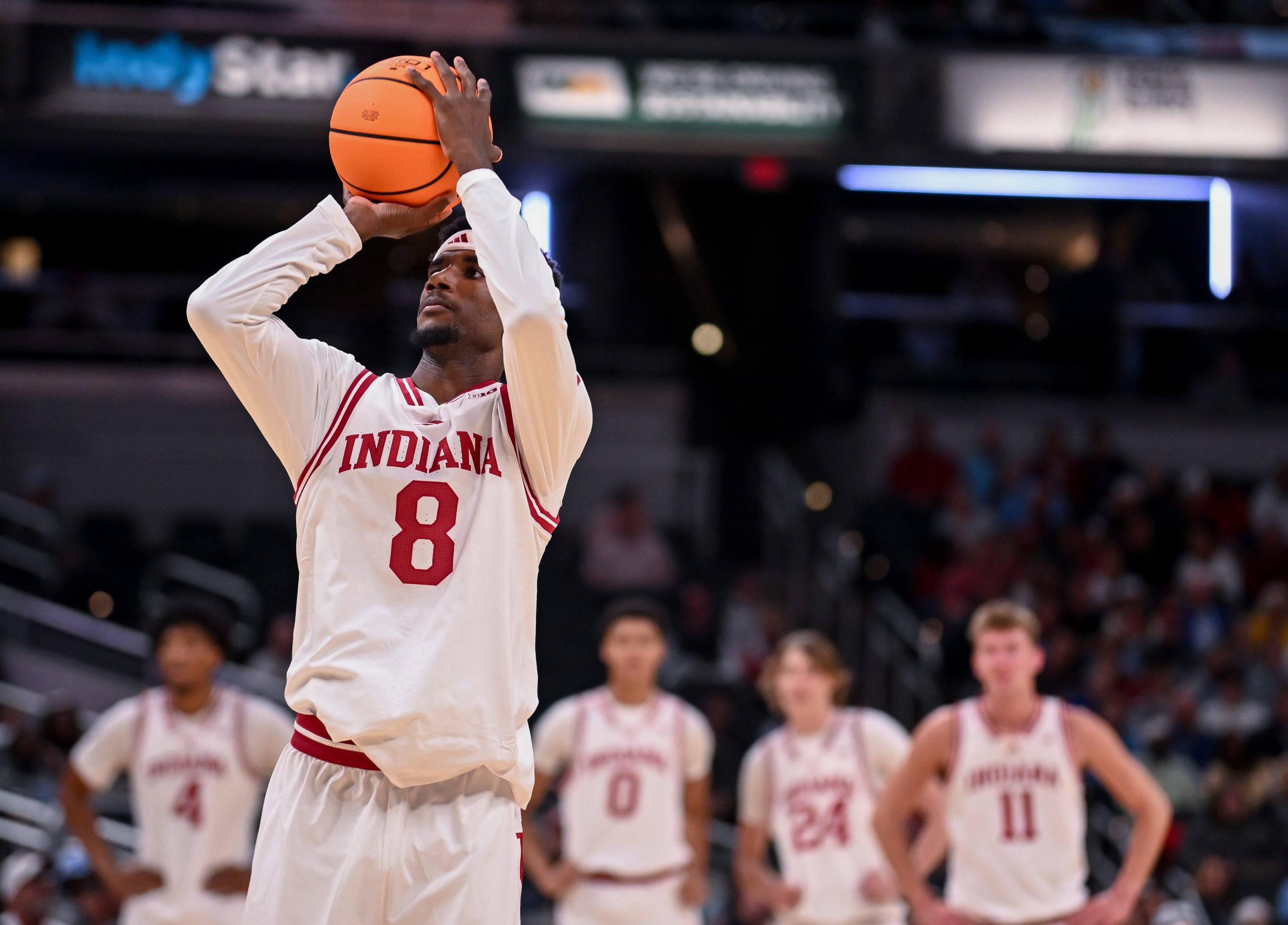
Oct 18, 2026; Indianapolis, IN, USA; Indiana Hoosiers guard Prince-Alexander Moody (8) attempts a free throw against the North Carolina Tar Heels during the second half at Gainbridge Fieldhouse. Mandatory Credit: Robert Goddin-Imagn Images
Indiana’s season began with a comfortable victory and an uncomfortable reminder: a deep roster can become thinner before the schedule becomes difficult.
The Hoosiers beat Eastern Illinois
91–57
on Monday, but Darian DeVries also announced that freshman guard
Prince-Alexander Moody had suffered a knee injury and would miss an extended period. The injury occurred in practice, and further evaluation was continuing.
There was no announced return date in those comments. That uncertainty leaves Indiana preparing its rotation around the players available now while supporting a freshman whose development has been interrupted.
For DeVries, the immediate assignment is to determine how the remaining guards share responsibilities.
Depth Matters When the Combinations Change
The effect of an injury is not limited to subtracting one player’s expected minutes.
It can change who initiates offense, who defends the opposing lead guard and which combinations remain available when foul trouble interrupts the original plan.
Moody had not established a regular-season role before the injury. That makes it premature to assign him a specific workload Indiana must replace.
But losing an option still matters. Early games provide opportunities to test younger players, spread responsibilities and discover which lineups function best. Moody’s absence removes him from that process for now.
Indiana needs to preserve those opportunities for the remaining players without asking anyone to become a different kind of player overnight.
Burton and Lindsay Remain Important Starting Points
Their responsibilities now deserve close attention. Indiana benefits if it can protect its primary ballhandling without sacrificing the spacing that makes the offense easier to operate.
That does not automatically require extending their minutes substantially. It does require a clear plan for the stretches when one or both are resting.
DeVries must identify who can organize those possessions, handle pressure and keep the offense from becoming dependent on a single guard’s availability.
The goal should be continuity across substitutions. Indiana cannot expect every lineup to score in the same way, but each lineup needs a workable method.
Opportunity Should Follow Execution
Trevor Manhertz scored
11 points in his debut, offering one encouraging example of a freshman contributing immediately.
That performance earns further evaluation. It does not establish that he should absorb every responsibility Moody might eventually have handled.
The same principle applies throughout the roster. Shooting, ball security, defensive positioning and communication should determine which combinations receive more time.
DeVries has reason to experiment while the schedule allows it. Those experiments should have a purpose: finding groups that can execute when an opponent changes defenses, pressures the ball or forces Indiana into longer possessions.
The Development Cost Deserves Recognition
For Moody, missing time means losing more than games.
A freshman learns through practices, preparation and the experience of correcting mistakes against unfamiliar opponents. An extended absence interrupts those repetitions.
Indiana should avoid allowing the rotation discussion to overshadow that individual setback. The immediate basketball adjustment belongs to the staff; the recovery timetable belongs to the evaluation process.
There is no need to manufacture certainty about either.
The Opener Supplied Encouragement, Not Immunity
Indiana has enough available talent to keep building. The opening victory provided evidence of that.
What Moody’s injury changes is the margin available for other complications. Another injury, foul trouble or an uneven performance could force combinations the staff had not expected to need so soon.
That is why the next games matter beyond their final scores. DeVries needs to develop dependable alternatives while establishing the core rotation.
Indiana’s depth will now be judged by how well those alternatives function when called upon.
New Users - Get $200 in Bonus Bets when you wager $5 for 4 days
T&Cs apply
4.6/5
Gambling Problem? Call 1-800-GAMBLER or 1-800-MY-RESET. Visit www.mdgamblinghelp.org (MD). 1-888-789-7777 or ccpg.org/chat (CT). Hope is here. GamblingHelpLineMA.org or (800) 327-5050 for 24/7 support (MA). 1-877-8-HOPENY or text HOPENY (467369) (NY). 21+ (18+ D.C., WY) and present in select states (for KS, in affiliation with Kansas Star Casino). First online real money wager only. Min $5 wager required for 4 consecutive days. $5 first deposit required. Bonus issued as nonwithdrawable bonus bets which expire 5 days after receipt. Restrictions apply. See terms at sportsbook.fanduel.com. Call 1-877-770-7867 (LA).
Get Up to $1,000 Back in Bonus Bets Over Your First 10 Days
T&Cs apply
4.5/5
Gambling problem? Call 1-800-GAMBLER or 1-800-MY-RESET (Available in the US) 877-8-HOPENY or text HOPENY (467369) (NY) 1-800-327-5050 (MA), 1-800-BETS-OFF (IA), 21+ only. Please Gamble Responsibly. Visit mdgamblinghelp.org (MD). See BetMGM.com for Terms. New Player Offer for new players only. Subject to eligibility requirements. Bonus bets are non-withdrawable. In partnership with Kansas Crossing Casino and Hotel. This promotional offer is not available in NJ, MA, MI, NV, NY, ON, PA, PR, and WV.
New DraftKings Customers: Bet $5, Get $200 + 3 Months of NBA League Pass
T&Cs apply
4.5/5
GAMBLING PROBLEM? CALL 1-800-GAMBLER or 1-800-MY-RESET, (800) 327-5050 or visit gamblinghelplinema.org (MA). Please Gamble Responsibly. 888-789-7777/visit ccpg.org (CT), or visit www.mdgamblinghelp.org (MD), 1-800-981-0023 (PR). 21+ and present in most states. (18+ DC/NH/PR/WY). Void in CAN. Eligibility restrictions apply. On behalf of Boot Hill Casino (KS). Pass-thru of per wager tax may apply in IL. 1 per new Sportsbook customer. $5+ first-time bet req. Max. $200 issued as non-withdrawable Bonus Bets. Stake removed from payout. Reward issued as $50 in Bonus Bets every 7 days via click-to-claim for 21 days. Bonus Bets and click-to-claims expire 7 days (168hrs) after issuance. Terms: dkng.co/offer. Get 1 promo code to redeem a 3-month NBA League Pass subscription, complimentary of DraftKings. Subscription auto-renews monthly at then-current price (currently $16.99/mo); cancel anytime. Terms, restrictions, and eligibility requirements apply. Redeem League Pass by 12/19/26 at 11:59 PM ET. Addt’l terms: support.watch.nba.com/hc/en-us/articles/9165532876183-League-Pass-Terms-of-Use_. Ends 11/29/26 at 11:59 PM ET. Sponsored by DK.
Must be 21+. GAMBLING PROBLEM? CALL 1-800-GAMBLER OR CALL 1-800-MY-RESET, www.mdgamblinghelp.org (MD), (800)-327-5050 or gamblinghelplinema.org (MA), Call (877)8-HOPENY or text HOPENY (467369) (NY), (888) 789-7777 or ccpg.org (CT), morethanagame.nc.gov (NC), 1800gambler.net (WV)
Bet $1 and get double the winnings up to $25 for your next 10 bets
T&Cs apply
4.4/5
21+ New users only. Must register using eligible promo code. First bet after registration must qualify. Max. Bonus Bet: $1,000. Bonus Bet expires 14 days after receipt. Void where prohibited. See Caesars.com/promos for full terms. Gambling Problem? 1-800-GAMBLER (1-800-426-2537)
21+ and present in OH. Gambling Problem? Call 1-800-GAMBLER.
This site is using
Cloudflare
and adheres to the
Google Safe Browsing Program. We adapted
Google's Privacy Guidelines
to keep your data safe at all times.
Close
Ready to Win Big? Join the Elite with Our Sports Betting Deals!
FanDuel Promo
New Users - Get $200 in Bonus Bets when you wager $5 for 4 days
Our Favorite
T&Cs and 21+ apply
Gambling Problem? Call 1-800-GAMBLER or 1-800-MY-RESET. Visit www.mdgamblinghelp.org (MD). 1-888-789-7777 or ccpg.org/chat (CT). Hope is here. GamblingHelpLineMA.org or (800) 327-5050 for 24/7 support (MA). 1-877-8-HOPENY or text HOPENY (467369) (NY). 21+ (18+ D.C., WY) and present in select states (for KS, in affiliation with Kansas Star Casino). First online real money wager only. Min $5 wager required for 4 consecutive days. $5 first deposit required. Bonus issued as nonwithdrawable bonus bets which expire 5 days after receipt. Restrictions apply. See terms at sportsbook.fanduel.com. Call 1-877-770-7867 (LA).
Code:
Open FanDuel
Get Bonus
BetMGM Promo
Get Up to $1,000 Back in Bonus Bets Over Your First 10 Days
Best Slots
T&Cs and 21+ apply
Gambling problem? Call 1-800-GAMBLER or 1-800-MY-RESET (Available in the US) 877-8-HOPENY or text HOPENY (467369) (NY) 1-800-327-5050 (MA), 1-800-BETS-OFF (IA), 21+ only. Please Gamble Responsibly. Visit mdgamblinghelp.org (MD). See BetMGM.com for Terms. New Player Offer for new players only. Subject to eligibility requirements. Bonus bets are non-withdrawable. In partnership with Kansas Crossing Casino and Hotel. This promotional offer is not available in NJ, MA, MI, NV, NY, ON, PA, PR, and WV.
Code:
Open BetMGM
Get Bonus
DraftKings Promo
New DraftKings Customers: Bet $5, Get $200 + 3 Months of NBA League Pass
Newcomer
T&Cs and 21+ apply
GAMBLING PROBLEM? CALL 1-800-GAMBLER or 1-800-MY-RESET, (800) 327-5050 or visit gamblinghelplinema.org (MA). Please Gamble Responsibly. 888-789-7777/visit ccpg.org (CT), or visit www.mdgamblinghelp.org (MD), 1-800-981-0023 (PR). 21+ and present in most states. (18+ DC/NH/PR/WY). Void in CAN. Eligibility restrictions apply. On behalf of Boot Hill Casino (KS). Pass-thru of per wager tax may apply in IL. 1 per new Sportsbook customer. $5+ first-time bet req. Max. $200 issued as non-withdrawable Bonus Bets. Stake removed from payout. Reward issued as $50 in Bonus Bets every 7 days via click-to-claim for 21 days. Bonus Bets and click-to-claims expire 7 days (168hrs) after issuance. Terms: dkng.co/offer. Get 1 promo code to redeem a 3-month NBA League Pass subscription, complimentary of DraftKings. Subscription auto-renews monthly at then-current price (currently $16.99/mo); cancel anytime. Terms, restrictions, and eligibility requirements apply. Redeem League Pass by 12/19/26 at 11:59 PM ET. Addt’l terms: support.watch.nba.com/hc/en-us/articles/9165532876183-League-Pass-Terms-of-Use_. Ends 11/29/26 at 11:59 PM ET. Sponsored by DK.
Code:
Open DraftKings
Get Bonus
Find out what the legends have to say about sports this week....
New Users - Get $200 in Bonus Bets when you wager $5 for 4 days
Gambling Problem? Call 1-800-GAMBLER or 1-800-MY-RESET. Visit www.mdgamblinghelp.org (MD). 1-888-789-7777 or ccpg.org/chat (CT). Hope is here. GamblingHelpLineMA.org or (800) 327-5050 for 24/7 support (MA). 1-877-8-HOPENY or text HOPENY (467369) (NY). 21+ (18+ D.C., WY) and present in select states (for KS, in affiliation with Kansas Star Casino). First online real money wager only. Min $5 wager required for 4 consecutive days. $5 first deposit required. Bonus issued as nonwithdrawable bonus bets which expire 5 days after receipt. Restrictions apply. See terms at sportsbook.fanduel.com. Call 1-877-770-7867 (LA).