Indiana basketball has spent too many offseasons asking fans to believe that a new roster will produce a different result.
Indiana basketball has spent too many offseasons asking fans to believe that a new roster will produce a different result.
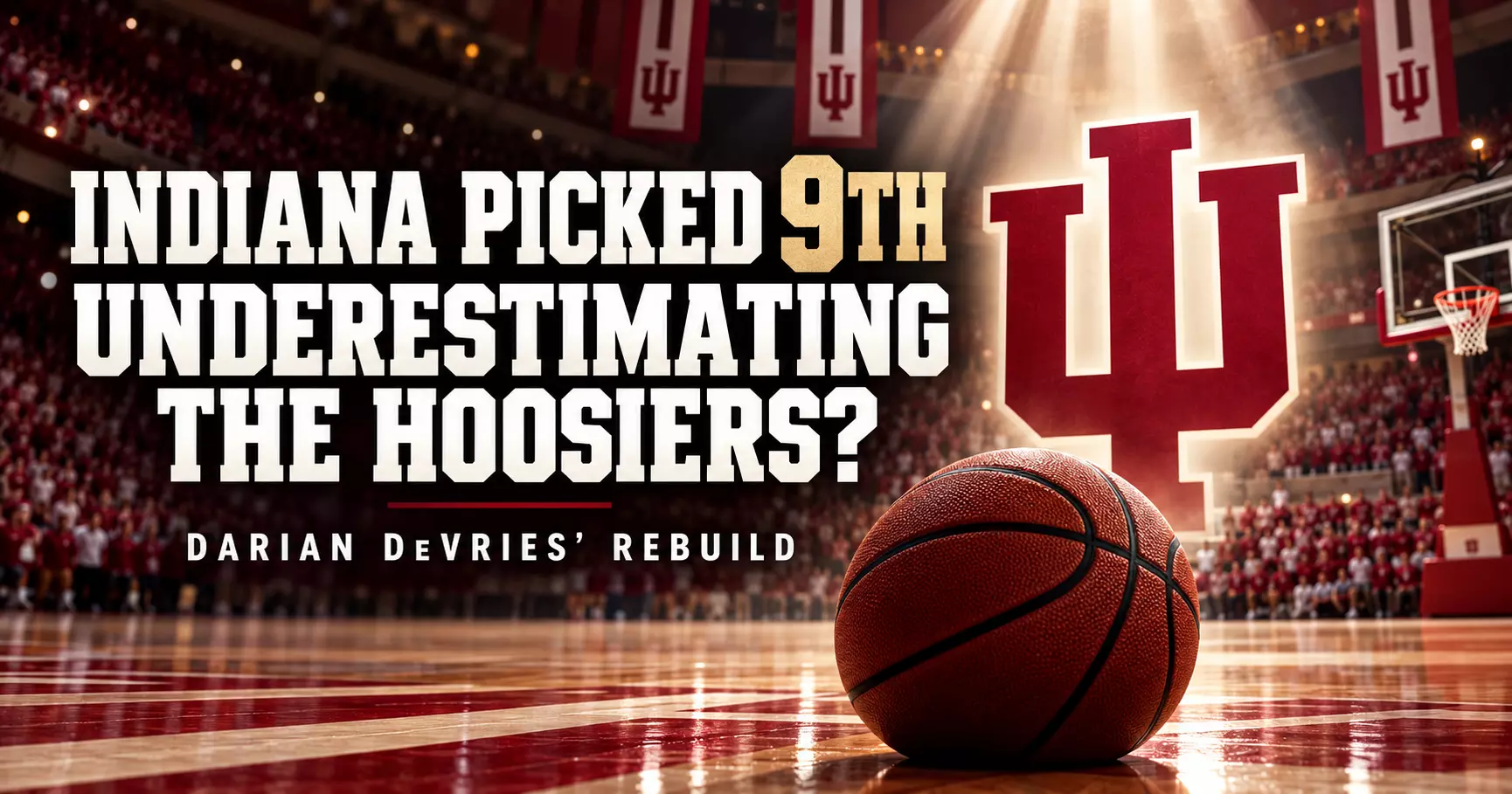
That history helps explain why the Hoosiers landed ninth in the unofficial preseason Big Ten media poll. Indiana finished 10th last season, and voters apparently need more than another collection of promising transfers before moving Darian DeVries’ program into the conference’s upper tier.
Fair enough. Indiana has to earn that confidence.
But there is a legitimate question behind this prediction: Are voters properly accounting for how directly DeVries addressed the weaknesses of his first team?
The strongest argument for Indiana exceeding expectations comes from the roster’s construction. The Hoosiers have added the size, interior options and perimeter creation that could make them considerably harder to defend—and better equipped to survive the Big Ten.
Ninth is a reasonable starting point. It could also prove too cautious.
Last Season Explains the Skepticism
DeVries’ first Indiana team finished 18–14 overall and 9–11 in conference play. The Hoosiers lost six of their final seven games, turning a season with opportunities into another disappointing finish.
That matters when evaluating this
preseason poll. Voters are judging a program that has struggled to turn optimism into sustained success.
Last season also exposed specific limitations. Indiana’s own offseason assessment identified insufficient size, strength and perimeter quickness. DeVries prioritized physicality and depth when rebuilding the roster.
Those weaknesses can compound during conference play. A defense that struggles to contain the ball forces its big men into difficult decisions. A team that cannot finish possessions with rebounds gives opponents additional chances. An offense without enough ways to reach the paint becomes easier to disrupt.
The encouraging part is that Indiana’s offseason moves appear connected to those problems.
Indiana Finally Has More Answers Inside
Samet Yigitoglu gives Indiana a 7-foot-2 center, while Alabama transfer Aiden Sherrell adds another substantial frontcourt presence. Their arrival changes the physical options available to DeVries.
Size alone guarantees very little. Big men still have to defend without fouling, move their feet and secure rebounds against opponents determined to displace them.
But having those options matters.
Indiana should have greater flexibility when an opponent attacks the basket or tries to establish a post mismatch. DeVries can evaluate different frontcourt combinations instead of asking the same lineup to solve every matchup.
Sherrell is particularly intriguing because his production extends beyond his measurements. He averaged 11.1 points, 6.2 rebounds and 2.2 blocks last season at Alabama, while shooting 33.8% from three-point range.
That combination offers a useful possibility: Indiana can put a shot-blocking presence on the floor without automatically surrendering offensive spacing.
If Sherrell makes opponents respect his jumper, a defender must decide whether to follow him outside or remain near the rim. Either decision can create an opportunity elsewhere.
That is how a better roster begins to make an entire offense work more effectively.
Markus Burton Can Change How Indiana Creates Shots
Markus Burton’s arrival from Notre Dame gives Indiana a guard capable of applying pressure off the dribble.
His first public appearance offered an encouraging glimpse. According to the Indiana Daily Student’s unofficial statistics from the Cream and Crimson scrimmage, Burton finished with six assists and no turnovers.
An intrasquad scrimmage cannot establish how he will handle Big Ten defenses. Still, the value of his role is clear.
When a guard gets into the lane, somebody has to respond. A help defender steps toward the ball. A big man leaves his assignment. A perimeter defender hesitates between protecting the paint and staying attached to a shooter.
Indiana needs to create those decisions consistently.
Burton does not have to dominate every possession to influence the offense. Sometimes the most valuable play is the drive that produces a rotation, followed by the pass that allows somebody else to attack an unsettled defense.
The question is whether Indiana can turn that initial advantage into good shots without becoming careless with the ball.
The Three-Pointer Should Become a Better Weapon
DeVries has made clear that Indiana will continue emphasizing spacing and three-point shooting. He also wants more paint touches and post opportunities after acknowledging that excessive dependence on threes hurt last season’s team.
That distinction is central to the rebuild.
An offense becomes vulnerable when defenders can crowd the perimeter without fearing what happens behind them. Indiana’s added interior options should give opponents more to consider.
A productive post possession can force help. A successful drive can create an open perimeter shot. A credible shooting threat can clear space for the next drive.
The goal should be an offense in which those actions support each other.
Bryce Lindsay and Darren Harris supplied early encouragement at the scrimmage, scoring 23 and 22 points, respectively, in the Indiana Daily Student’s unofficial tally.
Those performances provide something to watch as the preseason continues. The more meaningful test will come when opposing coaches design a defense specifically to take away Indiana’s preferred shots.
The Poll Still Has a Defensible Case
There is a reason to resist declaring Indiana a certain
top-five team.
The unofficial poll placed Illinois first, Michigan State second and Michigan third, with UCLA, Nebraska and Purdue occupying the next three positions. Indiana has several teams to pass before it can claim a place near the top.
The Hoosiers also face the familiar challenge of integrating a substantially rebuilt roster.
Talent does not automatically establish defensive communication. Players have to learn when to help, when to recover and who is responsible for finishing a possession. On offense, they must develop an understanding of when to attack and when another teammate has the better opportunity.
Those details often decide close conference games.
DeVries deserves credit for identifying his roster’s deficiencies. He now has to demonstrate that the solutions function together.
What Would Make Ninth Look Too Low?
Indiana’s progress should be measured through repeatable habits.
Can the Hoosiers finish defensive possessions with rebounds? Can their guards create good shots when the initial action breaks down? Can they defend dribble penetration without constantly exposing the rim?
And when the three-pointers stop falling, can Indiana still produce enough offense to win?
Those questions reveal more than an impressive highlight or an October scoring burst.
My view is that Indiana has a credible path into the Big Ten’s top six if its improved personnel translates into dependable defense and a more varied offense. That is a projection, with plenty still to prove, but it follows from the problems this roster was assembled to address.
Ninth reflects understandable skepticism about Indiana basketball.
DeVries’ opportunity is to make that skepticism outdated. He has given himself more options. Now the Hoosiers have to turn those options into wins.
New Users – Get $350 in Bonus Bets when you wager $5 for 7 days
T&Cs apply
4.6/5
Gambling Problem? Call 1-800-GAMBLER or 1-800-MY-RESET. Call 1-888-789-7777 or visit ccpgg.org/chat (CT). Hope is here. GamblingHelpLineMA.org or call (800) 327-5050 for 24/7 support (MA). Visit www.mdgamblinghelp.org (MD). Call 1-877-8HOPE-NY or text HOPENY (NY). 21+ (18+ DC, WY) and present in select states (for KS, in affiliation with Kansas Star Casino). Find online real money wagering only. Min $5 wager required for 7 consecutive days. $5 free play credit. Bonus issued as non-withdrawable bonus with cash withdrawable bonus with cash withdrawable. Bonus bets which expire 7 days after receipt. Restrictions apply. See terms at sportsbook.fanduel.com. Call 1-877-770-7867 (LA).
Up To $1500 in Bonus Bets Paid Back if your First Bet Does Not Win
T&Cs apply
4.5/5
Gambling problem? Call 1-800-GAMBLER or 1-800-MY-RESET (Available in the US) 877-8-HOPENY or text HOPENY (467369) (NY) 1-800-327-5050 (MA), 1-800-BETS-OFF (IA), 1-800-981-0023 (PR). 21+ only. Please Gamble Responsibly. See BetMGM.com for Terms. First Bet Offer for new customers only (if applicable). Subject to eligibility requirements. Bonus bets are non-withdrawable. In partnership with Kansas Crossing Casino and Hotel. Promotional offers not available in Mississippi, Massachusetts, New York, Ontario, or Puerto Rico.
New DraftKings Customers: Bet $5, Get $200 + 3 Months of NBA League Pass!
T&Cs apply
4.5/5
GAMBLING PROBLEM? CALL 1-800-GAMBLER or 1-800-MY-RESET, (800) 327-5050 or visit gamblinghelplinema.org (MA). Please Gamble Responsibly. 888-789-7777/visit ccpg.org (CT), or visit www.mdgamblinghelp.org (MD), 1-800-981-0023 (PR). 21+ and present in most states. (18+ DC/NH/PR/WY). Void in CAN. Eligibility restrictions apply. On behalf of Boot Hill Casino (KS). Pass-thru of per wager tax may apply in IL. 1 per new Sportsbook customer. $5+ first-time bet req. Max. $200 issued as non-withdrawable Bonus Bets. Stake removed from payout. Reward issued as $50 in Bonus Bets every 7 days via click-to-claim for 21 days. Bonus Bets and click-to-claims expire 7 days (168hrs) after issuance. Terms: dkng.co/offer. Get 1 promo code to redeem a 3-month NBA League Pass subscription, complimentary of DraftKings. Subscription auto-renews monthly at then-current price (currently $16.99/mo); cancel anytime. Terms, restrictions, and eligibility requirements apply. Redeem League Pass by 12/19/26 at 11:59 PM ET. Addt’l terms: support.watch.nba.com/hc/en-us/articles/9165532876183-League-Pass-Terms-of-Use_. Ends 11/29/26 at 11:59 PM ET. Sponsored by DK.
Must be 21+. GAMBLING PROBLEM? CALL 1-800-GAMBLER OR CALL 1-800-MY-RESET, www.mdgamblinghelp.org (MD), (800)-327-5050 or gamblinghelplinema.org (MA), Call (877)8-HOPENY or text HOPENY (467369) (NY), (888) 789-7777 or ccpg.org (CT), morethanagame.nc.gov (NC), 1800gambler.net (WV)
Bet $1 and get double the winnings up to $25 for your next 10 bets
T&Cs apply
4.4/5
21+ New users only. Must register using eligible promo code. First bet after registration must qualify. Max. Bonus Bet: $1,000. Bonus Bet expires 14 days after receipt. Void where prohibited. See Caesars.com/promos for full terms. Gambling Problem? 1-800-GAMBLER (1-800-426-2537)
21+ and present in OH. Gambling Problem? Call 1-800-GAMBLER.
This site is using
Cloudflare
and adheres to the
Google Safe Browsing Program. We adapted
Google's Privacy Guidelines
to keep your data safe at all times.
Close
Ready to Win Big? Join the Elite with Our Sports Betting Deals!
FanDuel Promo
New Users – Get $350 in Bonus Bets when you wager $5 for 7 days
Our Favorite
T&Cs and 21+ apply
Gambling Problem? Call 1-800-GAMBLER or 1-800-MY-RESET. Call 1-888-789-7777 or visit ccpgg.org/chat (CT). Hope is here. GamblingHelpLineMA.org or call (800) 327-5050 for 24/7 support (MA). Visit www.mdgamblinghelp.org (MD). Call 1-877-8HOPE-NY or text HOPENY (NY). 21+ (18+ DC, WY) and present in select states (for KS, in affiliation with Kansas Star Casino). Find online real money wagering only. Min $5 wager required for 7 consecutive days. $5 free play credit. Bonus issued as non-withdrawable bonus with cash withdrawable bonus with cash withdrawable. Bonus bets which expire 7 days after receipt. Restrictions apply. See terms at sportsbook.fanduel.com. Call 1-877-770-7867 (LA).
Code:
Open FanDuel
Get Bonus
BetMGM Promo
Up To $1500 in Bonus Bets Paid Back if your First Bet Does Not Win
Best Slots
T&Cs and 21+ apply
Gambling problem? Call 1-800-GAMBLER or 1-800-MY-RESET (Available in the US) 877-8-HOPENY or text HOPENY (467369) (NY) 1-800-327-5050 (MA), 1-800-BETS-OFF (IA), 1-800-981-0023 (PR). 21+ only. Please Gamble Responsibly. See BetMGM.com for Terms. First Bet Offer for new customers only (if applicable). Subject to eligibility requirements. Bonus bets are non-withdrawable. In partnership with Kansas Crossing Casino and Hotel. Promotional offers not available in Mississippi, Massachusetts, New York, Ontario, or Puerto Rico.
Code:
Open BetMGM
Get Bonus
DraftKings Promo
New DraftKings Customers: Bet $5, Get $200 + 3 Months of NBA League Pass!
Newcomer
T&Cs and 21+ apply
GAMBLING PROBLEM? CALL 1-800-GAMBLER or 1-800-MY-RESET, (800) 327-5050 or visit gamblinghelplinema.org (MA). Please Gamble Responsibly. 888-789-7777/visit ccpg.org (CT), or visit www.mdgamblinghelp.org (MD), 1-800-981-0023 (PR). 21+ and present in most states. (18+ DC/NH/PR/WY). Void in CAN. Eligibility restrictions apply. On behalf of Boot Hill Casino (KS). Pass-thru of per wager tax may apply in IL. 1 per new Sportsbook customer. $5+ first-time bet req. Max. $200 issued as non-withdrawable Bonus Bets. Stake removed from payout. Reward issued as $50 in Bonus Bets every 7 days via click-to-claim for 21 days. Bonus Bets and click-to-claims expire 7 days (168hrs) after issuance. Terms: dkng.co/offer. Get 1 promo code to redeem a 3-month NBA League Pass subscription, complimentary of DraftKings. Subscription auto-renews monthly at then-current price (currently $16.99/mo); cancel anytime. Terms, restrictions, and eligibility requirements apply. Redeem League Pass by 12/19/26 at 11:59 PM ET. Addt’l terms: support.watch.nba.com/hc/en-us/articles/9165532876183-League-Pass-Terms-of-Use_. Ends 11/29/26 at 11:59 PM ET. Sponsored by DK.
Code:
Open DraftKings
Get Bonus
Find out what the legends have to say about sports this week....
New Users – Get $350 in Bonus Bets when you wager $5 for 7 days
Gambling Problem? Call 1-800-GAMBLER or 1-800-MY-RESET. Call 1-888-789-7777 or visit ccpgg.org/chat (CT). Hope is here. GamblingHelpLineMA.org or call (800) 327-5050 for 24/7 support (MA). Visit www.mdgamblinghelp.org (MD). Call 1-877-8HOPE-NY or text HOPENY (NY). 21+ (18+ DC, WY) and present in select states (for KS, in affiliation with Kansas Star Casino). Find online real money wagering only. Min $5 wager required for 7 consecutive days. $5 free play credit. Bonus issued as non-withdrawable bonus with cash withdrawable bonus with cash withdrawable. Bonus bets which expire 7 days after receipt. Restrictions apply. See terms at sportsbook.fanduel.com. Call 1-877-770-7867 (LA).