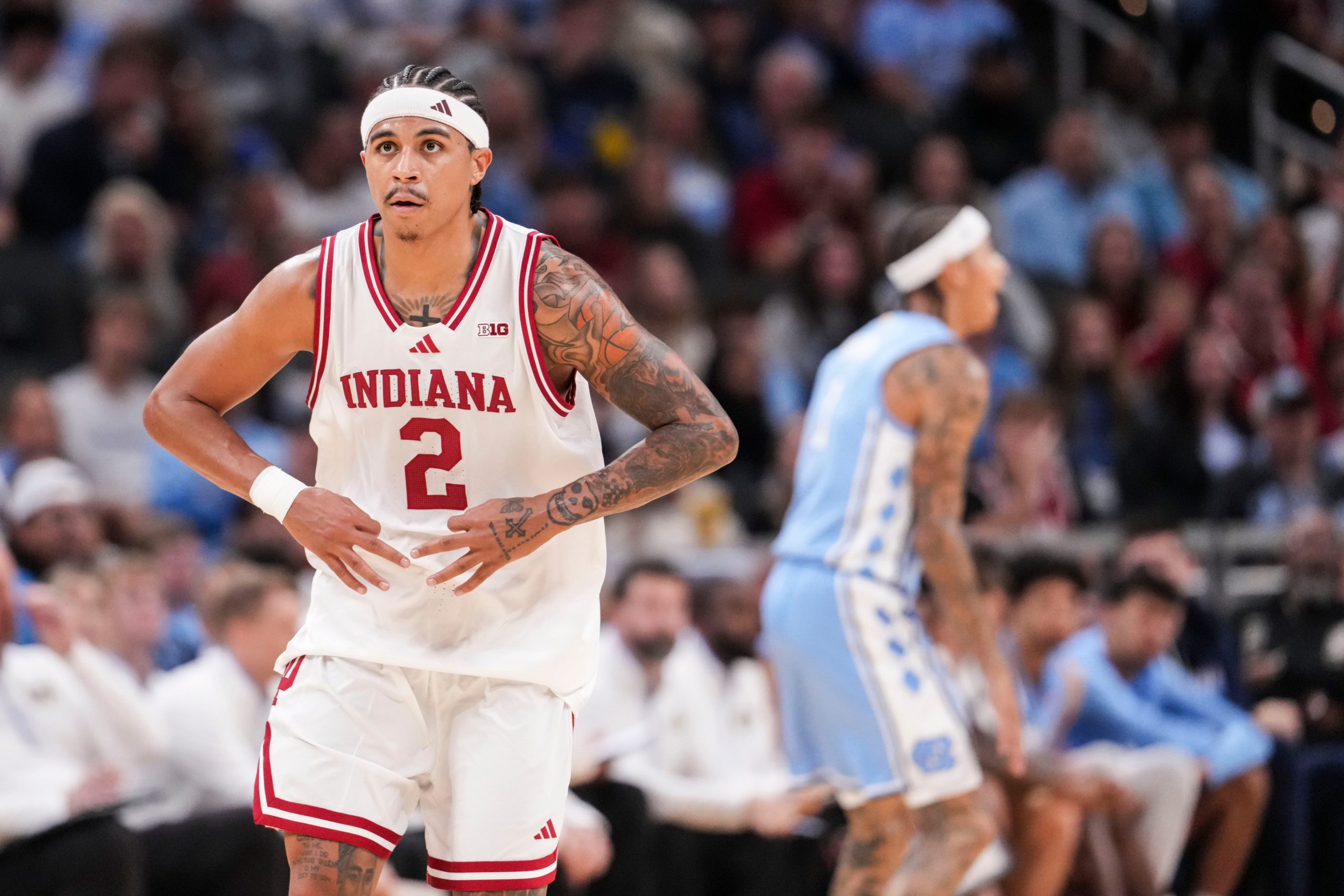
Indiana Hoosiers guard Bryce Lindsay (2) celebrates a 3-pointer Sunday, Oct. 18, 2026, during the first half of an exhibition game at Gainbridge Fieldhouse in Indianapolis.
Indiana did not need a great shooting night to handle North Carolina. That may have been the most encouraging part of Sunday’s performance.
The Hoosiers defeated the Tar Heels
76–58 at Gainbridge Fieldhouse in Indianapolis on October 18, combining Bryce Lindsay’s scoring with a commanding advantage on the glass. Indiana led 41–29 at halftime and maintained control through North Carolina’s second-half push.
For Indiana fans, the result offered a promising look at how
Darian DeVries’ team
can win when its offense is imperfect.
The Hoosiers were physical, generated additional opportunities through offensive rebounds and received a major contribution from a reserve guard when early foul trouble disrupted the starting backcourt.
This was an exhibition, so it does not count toward Indiana’s regular-season record. But the performance provided meaningful evidence of an emerging identity—and several clear areas that still require improvement.
Indiana’s Biggest Statement Came on the Glass
The defining numbers were
53–31 in total rebounds
and
20–10 in offensive rebounds, both in Indiana’s favor. The Hoosiers converted their second opportunities into a
17–7 advantage in second-chance points.
That was the foundation of the victory.
Indiana repeatedly extended possessions that otherwise would have ended with a missed shot. At the opposite end, its defensive rebounding helped prevent North Carolina from receiving the same opportunities.
For a team still developing its offensive timing, that kind of possession advantage is valuable. A missed jumper becomes less damaging when another Hoosier retrieves it. A good defensive stand becomes more useful when Indiana secures the rebound and finishes the possession.
North Carolina’s own recap acknowledged the extent of the difference: Indiana held a 27–14 rebounding advantage at halftime, including 11–4 on the offensive glass.
The Hoosiers established their physical advantage early and sustained it.
Bryce Lindsay Changed the Game When Indiana Needed Him
Lindsay supplied the afternoon’s standout individual performance.
The Villanova transfer scored
26 points off the bench, including
18 before halftime. He made four of nine three-point attempts and all six of his free throws, stepping into a larger ballhandling role after Markus Burton encountered early foul trouble.
That contribution mattered beyond the scoring total.
When a starting point guard picks up quick fouls, an offense can lose its organization. Indiana instead had another experienced guard capable of handling the ball and generating offense.
Lindsay gave the Hoosiers a perimeter threat that North Carolina had to respect. His shooting also helped Indiana capitalize on a game in which consistent offense was difficult to find.
DeVries highlighted that versatility afterward:
“He had to play a lot of the point. He had the ball in his hands a lot. He made some really good plays.
From Indiana’s perspective, this was an important demonstration of backcourt depth. Burton remains a significant piece, but Sunday showed that his absence does not have to leave the Hoosiers without a workable offensive answer.
Yigitoglu and Sherrell Made Their Size Matter
Indiana’s frontcourt gave its guards room for error.
Samet Yigitoglu collected 11 rebounds, while
Aiden Sherrell added 10 rebounds and seven points. Their combined work accounted for 21 of Indiana’s rebounds.
The important takeaway is how much they contributed beyond scoring.
Yigitoglu finished with only two points, but his rebounding made him influential. Sherrell provided another substantial presence around the basket while contributing offensively.
Indiana needs that kind of production from its size. Having tall players is useful only when they establish position, pursue the ball and complete possessions. Sunday’s rebounding totals indicate that the Hoosiers converted their frontcourt dimensions into a practical advantage.
The next test is sustaining that effort against opponents better equipped to challenge them physically. North Carolina’s difficulties do not guarantee Indiana will dominate the glass throughout the season, but the performance establishes a standard worth demanding again.
The Supporting Contributions Were Important
Lindsay led the scoring, but Indiana received useful production elsewhere.
Burton and Darren Harris each finished with
11 points, while Sam Alexis contributed
10 points. Jaeden Mustaf added eight points and five rebounds. Alexis also collected four offensive rebounds and blocked two shots.
Alexis’ contribution was particularly helpful because Indiana needed production around the basket on a difficult shooting afternoon. His offensive rebounds created additional chances, and his scoring gave the Hoosiers another source of points.
Mustaf’s work on the glass also matters. Rebounding cannot become an assignment reserved for the centers and forwards. Guards who secure available rebounds help finish defensive possessions and reduce the burden on the frontcourt.
Indiana’s
37–19 advantage in bench scoring
reflected both Lindsay’s exceptional afternoon and the value of having additional contributors available.
Indiana Answered North Carolina’s Second-Half Push
The Hoosiers created separation before halftime and initially expanded it afterward.
Indiana moved ahead
46–29 early in the second half, but North Carolina reduced the deficit to
54–45 with approximately 10 minutes remaining. The Hoosiers then responded, with a Sherrell putback and consecutive Lindsay three-pointers helping extend the lead to
67–46.
That response was another encouraging part of the exhibition.
A nine-point advantage still leaves an opponent within reach. A few empty possessions can quickly turn a comfortable afternoon into a difficult finish.
Indiana restored separation before North Carolina could make that happen.
The Hoosiers’ response also connected the two strongest parts of their performance: offensive rebounding and Lindsay’s perimeter scoring. The game’s decisive strengths remained available when the margin tightened.
The Defense Deserves Credit, With Some Perspective
North Carolina finished
22-for-63 from the field, or 34.9%, and made
seven of 22 three-point attempts. The Tar Heels scored 29 points in each half.
Holding an opponent to 58 points is encouraging, particularly when Indiana’s own offense was not consistently efficient.
Still, shooting percentages alone cannot explain every defensive possession. North Carolina had its own execution problems, and one exhibition cannot establish how Indiana will defend more polished offenses.
The strongest conclusion is that the Hoosiers combined enough defensive resistance with dominant rebounding to keep the Tar Heels from building sustained scoring momentum.
That combination can travel. Indiana must now make it dependable.
The Offense Has Considerable Room to Improve
An 18-point victory should not obscure the less efficient parts of the performance.
Indiana shot
25-for-69 overall, or 36.2%, and
nine-for-27 from three-point range. The Hoosiers committed
15 turnovers against 13 assists.
Those are meaningful concerns.
Indiana’s offensive rebounding helped cover missed shots, but the Hoosiers cannot assume they will receive 20 offensive rebounds every night. Against stronger rebounding teams, first-shot execution will become more important.
The turnover total also needs to fall. Giving away possessions undermines the extra opportunities Indiana works so hard to create.
The task for DeVries is to preserve the aggression that produced Sunday’s physical advantage while improving decision-making and offensive organization. Indiana should become more difficult to defend as its players grow more comfortable together, but that improvement still has to happen.
Two Exhibitions Have Revealed a Promising Foundation
Sunday followed Indiana’s
96–68 exhibition victory over Butler on October 11.
The Hoosiers
have now produced two convincing preseason results against recognizable opponents.
The more useful observation is that Indiana did not need the same offensive output to win both games.
Against North Carolina, the Hoosiers demonstrated that rebounding, defensive work and a timely individual scoring performance could carry them through an uneven shooting afternoon.
That gives Indiana a credible foundation.
It does not establish where the Hoosiers will finish in the Big Ten, and it should not turn October exhibitions into predictions about March. But it provides something concrete for fans to evaluate: this roster has shown an ability to impose its size and keep functioning when circumstances change.
Indiana’s final scheduled exhibition is
October 25 against Western Kentucky at the Ford Center in Evansville, before the regular-season opener against Eastern Illinois on November 2.
Indiana Gave Its Fans Reasons for Optimism
The best part of Sunday’s victory was that Indiana had dependable strengths to draw upon.
Lindsay supplied the scoring. Yigitoglu and Sherrell led the rebounding. The supporting players contributed enough to keep North Carolina from concentrating entirely on one threat.
There is work ahead on shooting efficiency, turnovers and offensive flow. Those issues deserve attention even after a comfortable win.
But Indiana left Indianapolis with evidence that its physical identity is beginning to take shape.
The Hoosiers beat North Carolina by 18 while leaving substantial room for improvement. For Indiana fans, that is an encouraging place to begin.
New Users – Get $350 in Bonus Bets when you wager $5 for 7 days
T&Cs apply
4.6/5
Gambling Problem? Call 1-800-GAMBLER or 1-800-MY-RESET. Call 1-888-789-7777 or visit ccpgg.org/chat (CT). Hope is here. GamblingHelpLineMA.org or call (800) 327-5050 for 24/7 support (MA). Visit www.mdgamblinghelp.org (MD). Call 1-877-8HOPE-NY or text HOPENY (NY). 21+ (18+ DC, WY) and present in select states (for KS, in affiliation with Kansas Star Casino). Find online real money wagering only. Min $5 wager required for 7 consecutive days. $5 free play credit. Bonus issued as non-withdrawable bonus with cash withdrawable bonus with cash withdrawable. Bonus bets which expire 7 days after receipt. Restrictions apply. See terms at sportsbook.fanduel.com. Call 1-877-770-7867 (LA).
Up To $1500 in Bonus Bets Paid Back if your First Bet Does Not Win
T&Cs apply
4.5/5
Gambling problem? Call 1-800-GAMBLER or 1-800-MY-RESET (Available in the US) 877-8-HOPENY or text HOPENY (467369) (NY) 1-800-327-5050 (MA), 1-800-BETS-OFF (IA), 1-800-981-0023 (PR). 21+ only. Please Gamble Responsibly. See BetMGM.com for Terms. First Bet Offer for new customers only (if applicable). Subject to eligibility requirements. Bonus bets are non-withdrawable. In partnership with Kansas Crossing Casino and Hotel. Promotional offers not available in Mississippi, Massachusetts, New York, Ontario, or Puerto Rico.
New DraftKings Customers: Bet $5, Get $200 + 3 Months of NBA League Pass!
T&Cs apply
4.5/5
GAMBLING PROBLEM? CALL 1-800-GAMBLER or 1-800-MY-RESET, (800) 327-5050 or visit gamblinghelplinema.org (MA). Please Gamble Responsibly. 888-789-7777/visit ccpg.org (CT), or visit www.mdgamblinghelp.org (MD), 1-800-981-0023 (PR). 21+ and present in most states. (18+ DC/NH/PR/WY). Void in CAN. Eligibility restrictions apply. On behalf of Boot Hill Casino (KS). Pass-thru of per wager tax may apply in IL. 1 per new Sportsbook customer. $5+ first-time bet req. Max. $200 issued as non-withdrawable Bonus Bets. Stake removed from payout. Reward issued as $50 in Bonus Bets every 7 days via click-to-claim for 21 days. Bonus Bets and click-to-claims expire 7 days (168hrs) after issuance. Terms: dkng.co/offer. Get 1 promo code to redeem a 3-month NBA League Pass subscription, complimentary of DraftKings. Subscription auto-renews monthly at then-current price (currently $16.99/mo); cancel anytime. Terms, restrictions, and eligibility requirements apply. Redeem League Pass by 12/19/26 at 11:59 PM ET. Addt’l terms: support.watch.nba.com/hc/en-us/articles/9165532876183-League-Pass-Terms-of-Use_. Ends 11/29/26 at 11:59 PM ET. Sponsored by DK.
Must be 21+. GAMBLING PROBLEM? CALL 1-800-GAMBLER OR CALL 1-800-MY-RESET, www.mdgamblinghelp.org (MD), (800)-327-5050 or gamblinghelplinema.org (MA), Call (877)8-HOPENY or text HOPENY (467369) (NY), (888) 789-7777 or ccpg.org (CT), morethanagame.nc.gov (NC), 1800gambler.net (WV)
Bet $1 and get double the winnings up to $25 for your next 10 bets
T&Cs apply
4.4/5
21+ New users only. Must register using eligible promo code. First bet after registration must qualify. Max. Bonus Bet: $1,000. Bonus Bet expires 14 days after receipt. Void where prohibited. See Caesars.com/promos for full terms. Gambling Problem? 1-800-GAMBLER (1-800-426-2537)
21+ and present in OH. Gambling Problem? Call 1-800-GAMBLER.
This site is using
Cloudflare
and adheres to the
Google Safe Browsing Program. We adapted
Google's Privacy Guidelines
to keep your data safe at all times.
Close
Ready to Win Big? Join the Elite with Our Sports Betting Deals!
FanDuel Promo
New Users – Get $350 in Bonus Bets when you wager $5 for 7 days
Our Favorite
T&Cs and 21+ apply
Gambling Problem? Call 1-800-GAMBLER or 1-800-MY-RESET. Call 1-888-789-7777 or visit ccpgg.org/chat (CT). Hope is here. GamblingHelpLineMA.org or call (800) 327-5050 for 24/7 support (MA). Visit www.mdgamblinghelp.org (MD). Call 1-877-8HOPE-NY or text HOPENY (NY). 21+ (18+ DC, WY) and present in select states (for KS, in affiliation with Kansas Star Casino). Find online real money wagering only. Min $5 wager required for 7 consecutive days. $5 free play credit. Bonus issued as non-withdrawable bonus with cash withdrawable bonus with cash withdrawable. Bonus bets which expire 7 days after receipt. Restrictions apply. See terms at sportsbook.fanduel.com. Call 1-877-770-7867 (LA).
Code:
Open FanDuel
Get Bonus
BetMGM Promo
Up To $1500 in Bonus Bets Paid Back if your First Bet Does Not Win
Best Slots
T&Cs and 21+ apply
Gambling problem? Call 1-800-GAMBLER or 1-800-MY-RESET (Available in the US) 877-8-HOPENY or text HOPENY (467369) (NY) 1-800-327-5050 (MA), 1-800-BETS-OFF (IA), 1-800-981-0023 (PR). 21+ only. Please Gamble Responsibly. See BetMGM.com for Terms. First Bet Offer for new customers only (if applicable). Subject to eligibility requirements. Bonus bets are non-withdrawable. In partnership with Kansas Crossing Casino and Hotel. Promotional offers not available in Mississippi, Massachusetts, New York, Ontario, or Puerto Rico.
Code:
Open BetMGM
Get Bonus
DraftKings Promo
New DraftKings Customers: Bet $5, Get $200 + 3 Months of NBA League Pass!
Newcomer
T&Cs and 21+ apply
GAMBLING PROBLEM? CALL 1-800-GAMBLER or 1-800-MY-RESET, (800) 327-5050 or visit gamblinghelplinema.org (MA). Please Gamble Responsibly. 888-789-7777/visit ccpg.org (CT), or visit www.mdgamblinghelp.org (MD), 1-800-981-0023 (PR). 21+ and present in most states. (18+ DC/NH/PR/WY). Void in CAN. Eligibility restrictions apply. On behalf of Boot Hill Casino (KS). Pass-thru of per wager tax may apply in IL. 1 per new Sportsbook customer. $5+ first-time bet req. Max. $200 issued as non-withdrawable Bonus Bets. Stake removed from payout. Reward issued as $50 in Bonus Bets every 7 days via click-to-claim for 21 days. Bonus Bets and click-to-claims expire 7 days (168hrs) after issuance. Terms: dkng.co/offer. Get 1 promo code to redeem a 3-month NBA League Pass subscription, complimentary of DraftKings. Subscription auto-renews monthly at then-current price (currently $16.99/mo); cancel anytime. Terms, restrictions, and eligibility requirements apply. Redeem League Pass by 12/19/26 at 11:59 PM ET. Addt’l terms: support.watch.nba.com/hc/en-us/articles/9165532876183-League-Pass-Terms-of-Use_. Ends 11/29/26 at 11:59 PM ET. Sponsored by DK.
Code:
Open DraftKings
Get Bonus
Find out what the legends have to say about sports this week....
New Users – Get $350 in Bonus Bets when you wager $5 for 7 days
Gambling Problem? Call 1-800-GAMBLER or 1-800-MY-RESET. Call 1-888-789-7777 or visit ccpgg.org/chat (CT). Hope is here. GamblingHelpLineMA.org or call (800) 327-5050 for 24/7 support (MA). Visit www.mdgamblinghelp.org (MD). Call 1-877-8HOPE-NY or text HOPENY (NY). 21+ (18+ DC, WY) and present in select states (for KS, in affiliation with Kansas Star Casino). Find online real money wagering only. Min $5 wager required for 7 consecutive days. $5 free play credit. Bonus issued as non-withdrawable bonus with cash withdrawable bonus with cash withdrawable. Bonus bets which expire 7 days after receipt. Restrictions apply. See terms at sportsbook.fanduel.com. Call 1-877-770-7867 (LA).