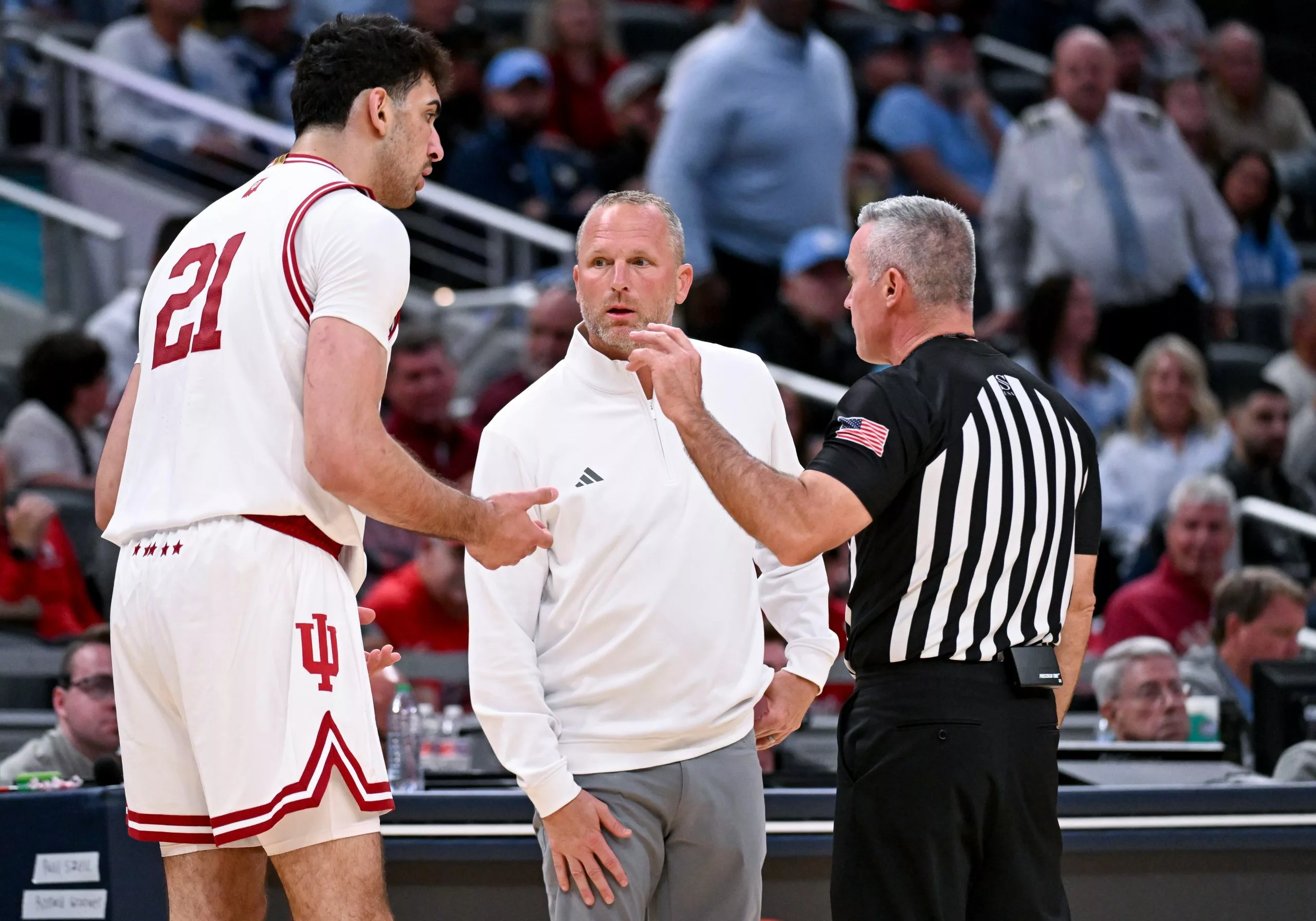
Oct 18, 2026; Indianapolis, IN, USA; Indiana Hoosiers center Samet Yigitoglu (21) and Indiana Hoosiers head coach Darian DeVries talk to a referee against the North Carolina Tar Heels during the second half at Gainbridge Fieldhouse. Mandatory Credit: Robert Goddin-Imagn Images
Indiana gave its fans something more useful than an encouraging October score Sunday. It offered a clear picture of how Darian DeVries wants this team to win.
The Hoosiers defeated North Carolina 76–58 at Gainbridge Fieldhouse behind 26 points from Bryce Lindsay, overwhelming rebounding and enough backcourt depth to handle early foul trouble. They led 41–29 at halftime and maintained control despite an uneven shooting performance.
An exhibition cannot establish where Indiana belongs in the
Big Ten standings
or how far it can advance in March. It can reveal whether the pieces of a rebuilt roster appear to fit.
Sunday supplied tangible reasons for optimism. Indiana had size that affected possessions, guards who could share offensive responsibility and a physical identity that remained useful when shots missed.
Those are meaningful developments for DeVries as he prepares for his second season in Bloomington.
Indiana’s Size Became a Competitive Advantage
The most persuasive number was the rebounding margin.
Indiana finished with a
53–31 advantage on the glass, collected
20 offensive rebounds
and outscored North Carolina
17–7 in second-chance points. Those extra opportunities helped the Hoosiers control a game in which neither team shot particularly well.
That is the practical value of building a bigger roster.
A missed shot does not have to end a possession. A defensive stop becomes more valuable when it is followed by a secure rebound. Over time, those details can separate a team that competes from one that consistently wins.
Samet Yigitoglu grabbed 11 rebounds, while Aiden Sherrell added 10. Their combined work gave Indiana a substantial presence around the basket.
The Hoosiers will encounter opponents better equipped to match that size. They should not expect a 22-rebound advantage to become routine.
But they demonstrated that their frontcourt can influence a game without needing the offense to revolve around post scoring. That gives DeVries another way to manage difficult nights.
DeVries Has Built Options Into the Frontcourt
Before the game, DeVries explained why he likes pairing the 7-foot Sherrell with the 7-foot-2 Yigitoglu: Sherrell’s ability to stretch the floor can preserve spacing while Yigitoglu operates closer to the basket. DeVries also described the option of using Sherrell at center with four perimeter players.
That flexibility matters.
Two big players can become a problem for their own offense if defenders crowd the lane without consequence. A frontcourt that combines size with perimeter capability creates more difficult choices.
Should an opponent stay attached to the shooter or provide help inside? Can it switch a smaller defender onto a big without surrendering position? Can it compete on the glass while also covering the perimeter?
Indiana now has personnel that can ask those questions.
The next stage is making those combinations work against different defensive approaches. Sunday provided evidence that the size is useful. The regular season will test how consistently Indiana can preserve spacing and generate quality shots around it.
Bryce Lindsay Supplied More Than a Hot Hand
Lindsay’s scoring deserves attention because of the circumstances surrounding it.
Markus Burton encountered early foul trouble, requiring Indiana to adjust its backcourt responsibilities. Lindsay responded with 18 first-half points and finished with 26, making four of nine three-point attempts and all six of his free throws.
The importance extends beyond the total.
Indiana had another guard capable of taking possession of the offense when its primary point guard was unavailable. That can prevent foul trouble, fatigue or an unfavorable matchup from dictating an entire game.
Lindsay also showed that his scoring could come from different areas. He made perimeter shots while demonstrating the ability to attack the paint and reach the foul line. DeVries praised that combination after the game.
That is a more useful foundation than relying exclusively on contested jumpers.
Nobody should pencil in 26 points every night. The encouraging possibility is that Lindsay can remain productive in different roles, giving Indiana another creator and allowing Burton to spend selected possessions away from the ball.
The Scoring Responsibility Can Be Shared
Indiana placed four players in double figures: Lindsay, Burton and Darren Harris, who each scored 11, and Sam Alexis, who added 10.
That distribution suggests an offense with several potential answers.
When multiple players can contribute, an opponent has fewer opportunities to shut everything down by loading its defense toward one scorer. Different combinations also give a coach ways to respond when a player struggles.
There is still a distinction between having scoring options and having a dependable offense. Indiana must establish which combinations create good shots against pressure, which players can initiate late in the shot clock and how the group responds when its preferred action is denied.
Those answers require more games.
But Sunday showed why the roster deserves attention. The Hoosiers had useful contributions available beyond their starting point guard, and those contributions helped them sustain control.
Winning Without Great Shooting Was Encouraging
Indiana shot
36.2% from the field
and
33.3% from three-point range. It still won by 18 points.
That should be read in two ways.
First, the offense has room to improve. Rebounding can rescue possessions, but Indiana cannot assume it will always recover enough misses to overcome inefficient shooting.
Second, the Hoosiers demonstrated another route to a comfortable result. Their physical advantages remained relevant when their shooting was ordinary.
That is an important quality over a long season. Every team encounters nights when open attempts fail to fall. A group that rebounds, defends and competes for additional opportunities gives itself a chance to withstand those stretches.
Indiana’s task is to combine that effort with better offensive efficiency. If the Hoosiers can preserve their work around the basket while converting more of their initial opportunities, their offense becomes considerably harder to contain.
There Are Problems the Final Score Should Not Hide
Indiana committed
15 turnovers. That is too many empty possessions for a team trying to build a dependable offense.
Against stronger opposition, wasted possessions can cancel out the advantage created by offensive rebounds. They also can expose a defense before it has an opportunity to get organized.
Perimeter foul discipline remains another area to monitor. Before Sunday, DeVries had already identified the need for his guards to play aggressively without fouling. Burton’s early trouble against North Carolina demonstrated why backcourt depth is valuable—and why that discipline still matters.
North Carolina also was missing guard Isaiah Denis and remained without Cameron Fens while awaiting NCAA clearance. Those absences belong in any fair assessment of the matchup.
Indiana deserved credit for exploiting its advantages. The circumstances do limit how broadly this result should be applied.
The Optimism Has a Basketball Foundation
The strongest reason to pay attention to Indiana is that its encouraging signs are specific.
The Hoosiers
have frontcourt size that can create additional possessions. They have guards capable of sharing responsibility. They showed the ability to maintain a physical advantage without an exceptional shooting night.
DeVries has made rebounding a deliberate priority, and Sunday’s performance reflected that emphasis. The roster construction and the on-court approach appeared connected.
Now Indiana must carry those habits into games that count, against opponents with better scouting information and more time to attack its weaknesses.
The turnovers need to decline. The shooting needs greater consistency. The lineup combinations need to prove themselves repeatedly.
But the Hoosiers gave their fans a credible starting point. They handled North Carolina by imposing advantages that could remain useful throughout the season.
That is enough to make DeVries’ rebuild worth watching closely.
New Users – Get $350 in Bonus Bets when you wager $5 for 7 days
T&Cs apply
4.6/5
Gambling Problem? Call 1-800-GAMBLER or 1-800-MY-RESET. Call 1-888-789-7777 or visit ccpgg.org/chat (CT). Hope is here. GamblingHelpLineMA.org or call (800) 327-5050 for 24/7 support (MA). Visit www.mdgamblinghelp.org (MD). Call 1-877-8HOPE-NY or text HOPENY (NY). 21+ (18+ DC, WY) and present in select states (for KS, in affiliation with Kansas Star Casino). Find online real money wagering only. Min $5 wager required for 7 consecutive days. $5 free play credit. Bonus issued as non-withdrawable bonus with cash withdrawable bonus with cash withdrawable. Bonus bets which expire 7 days after receipt. Restrictions apply. See terms at sportsbook.fanduel.com. Call 1-877-770-7867 (LA).
Up To $1500 in Bonus Bets Paid Back if your First Bet Does Not Win
T&Cs apply
4.5/5
Gambling problem? Call 1-800-GAMBLER or 1-800-MY-RESET (Available in the US) 877-8-HOPENY or text HOPENY (467369) (NY) 1-800-327-5050 (MA), 1-800-BETS-OFF (IA), 1-800-981-0023 (PR). 21+ only. Please Gamble Responsibly. See BetMGM.com for Terms. First Bet Offer for new customers only (if applicable). Subject to eligibility requirements. Bonus bets are non-withdrawable. In partnership with Kansas Crossing Casino and Hotel. Promotional offers not available in Mississippi, Massachusetts, New York, Ontario, or Puerto Rico.
New DraftKings Customers: Bet $5, Get $200 + 3 Months of NBA League Pass!
T&Cs apply
4.5/5
GAMBLING PROBLEM? CALL 1-800-GAMBLER or 1-800-MY-RESET, (800) 327-5050 or visit gamblinghelplinema.org (MA). Please Gamble Responsibly. 888-789-7777/visit ccpg.org (CT), or visit www.mdgamblinghelp.org (MD), 1-800-981-0023 (PR). 21+ and present in most states. (18+ DC/NH/PR/WY). Void in CAN. Eligibility restrictions apply. On behalf of Boot Hill Casino (KS). Pass-thru of per wager tax may apply in IL. 1 per new Sportsbook customer. $5+ first-time bet req. Max. $200 issued as non-withdrawable Bonus Bets. Stake removed from payout. Reward issued as $50 in Bonus Bets every 7 days via click-to-claim for 21 days. Bonus Bets and click-to-claims expire 7 days (168hrs) after issuance. Terms: dkng.co/offer. Get 1 promo code to redeem a 3-month NBA League Pass subscription, complimentary of DraftKings. Subscription auto-renews monthly at then-current price (currently $16.99/mo); cancel anytime. Terms, restrictions, and eligibility requirements apply. Redeem League Pass by 12/19/26 at 11:59 PM ET. Addt’l terms: support.watch.nba.com/hc/en-us/articles/9165532876183-League-Pass-Terms-of-Use_. Ends 11/29/26 at 11:59 PM ET. Sponsored by DK.
Must be 21+. GAMBLING PROBLEM? CALL 1-800-GAMBLER OR CALL 1-800-MY-RESET, www.mdgamblinghelp.org (MD), (800)-327-5050 or gamblinghelplinema.org (MA), Call (877)8-HOPENY or text HOPENY (467369) (NY), (888) 789-7777 or ccpg.org (CT), morethanagame.nc.gov (NC), 1800gambler.net (WV)
Bet $1 and get double the winnings up to $25 for your next 10 bets
T&Cs apply
4.4/5
21+ New users only. Must register using eligible promo code. First bet after registration must qualify. Max. Bonus Bet: $1,000. Bonus Bet expires 14 days after receipt. Void where prohibited. See Caesars.com/promos for full terms. Gambling Problem? 1-800-GAMBLER (1-800-426-2537)
21+ and present in OH. Gambling Problem? Call 1-800-GAMBLER.
This site is using
Cloudflare
and adheres to the
Google Safe Browsing Program. We adapted
Google's Privacy Guidelines
to keep your data safe at all times.
Close
Ready to Win Big? Join the Elite with Our Sports Betting Deals!
FanDuel Promo
New Users – Get $350 in Bonus Bets when you wager $5 for 7 days
Our Favorite
T&Cs and 21+ apply
Gambling Problem? Call 1-800-GAMBLER or 1-800-MY-RESET. Call 1-888-789-7777 or visit ccpgg.org/chat (CT). Hope is here. GamblingHelpLineMA.org or call (800) 327-5050 for 24/7 support (MA). Visit www.mdgamblinghelp.org (MD). Call 1-877-8HOPE-NY or text HOPENY (NY). 21+ (18+ DC, WY) and present in select states (for KS, in affiliation with Kansas Star Casino). Find online real money wagering only. Min $5 wager required for 7 consecutive days. $5 free play credit. Bonus issued as non-withdrawable bonus with cash withdrawable bonus with cash withdrawable. Bonus bets which expire 7 days after receipt. Restrictions apply. See terms at sportsbook.fanduel.com. Call 1-877-770-7867 (LA).
Code:
Open FanDuel
Get Bonus
BetMGM Promo
Up To $1500 in Bonus Bets Paid Back if your First Bet Does Not Win
Best Slots
T&Cs and 21+ apply
Gambling problem? Call 1-800-GAMBLER or 1-800-MY-RESET (Available in the US) 877-8-HOPENY or text HOPENY (467369) (NY) 1-800-327-5050 (MA), 1-800-BETS-OFF (IA), 1-800-981-0023 (PR). 21+ only. Please Gamble Responsibly. See BetMGM.com for Terms. First Bet Offer for new customers only (if applicable). Subject to eligibility requirements. Bonus bets are non-withdrawable. In partnership with Kansas Crossing Casino and Hotel. Promotional offers not available in Mississippi, Massachusetts, New York, Ontario, or Puerto Rico.
Code:
Open BetMGM
Get Bonus
DraftKings Promo
New DraftKings Customers: Bet $5, Get $200 + 3 Months of NBA League Pass!
Newcomer
T&Cs and 21+ apply
GAMBLING PROBLEM? CALL 1-800-GAMBLER or 1-800-MY-RESET, (800) 327-5050 or visit gamblinghelplinema.org (MA). Please Gamble Responsibly. 888-789-7777/visit ccpg.org (CT), or visit www.mdgamblinghelp.org (MD), 1-800-981-0023 (PR). 21+ and present in most states. (18+ DC/NH/PR/WY). Void in CAN. Eligibility restrictions apply. On behalf of Boot Hill Casino (KS). Pass-thru of per wager tax may apply in IL. 1 per new Sportsbook customer. $5+ first-time bet req. Max. $200 issued as non-withdrawable Bonus Bets. Stake removed from payout. Reward issued as $50 in Bonus Bets every 7 days via click-to-claim for 21 days. Bonus Bets and click-to-claims expire 7 days (168hrs) after issuance. Terms: dkng.co/offer. Get 1 promo code to redeem a 3-month NBA League Pass subscription, complimentary of DraftKings. Subscription auto-renews monthly at then-current price (currently $16.99/mo); cancel anytime. Terms, restrictions, and eligibility requirements apply. Redeem League Pass by 12/19/26 at 11:59 PM ET. Addt’l terms: support.watch.nba.com/hc/en-us/articles/9165532876183-League-Pass-Terms-of-Use_. Ends 11/29/26 at 11:59 PM ET. Sponsored by DK.
Code:
Open DraftKings
Get Bonus
Find out what the legends have to say about sports this week....
New Users – Get $350 in Bonus Bets when you wager $5 for 7 days
Gambling Problem? Call 1-800-GAMBLER or 1-800-MY-RESET. Call 1-888-789-7777 or visit ccpgg.org/chat (CT). Hope is here. GamblingHelpLineMA.org or call (800) 327-5050 for 24/7 support (MA). Visit www.mdgamblinghelp.org (MD). Call 1-877-8HOPE-NY or text HOPENY (NY). 21+ (18+ DC, WY) and present in select states (for KS, in affiliation with Kansas Star Casino). Find online real money wagering only. Min $5 wager required for 7 consecutive days. $5 free play credit. Bonus issued as non-withdrawable bonus with cash withdrawable bonus with cash withdrawable. Bonus bets which expire 7 days after receipt. Restrictions apply. See terms at sportsbook.fanduel.com. Call 1-877-770-7867 (LA).