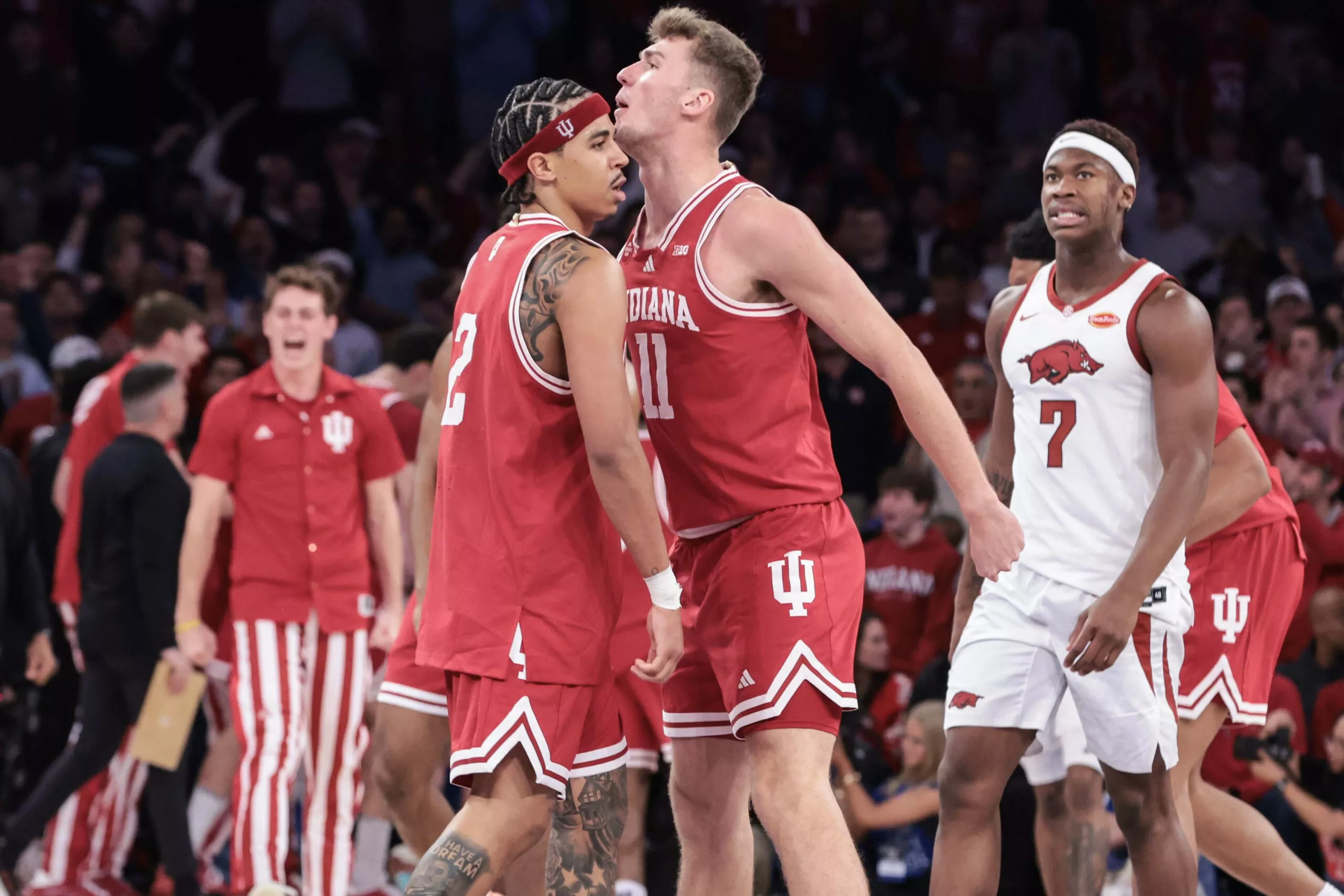
Nov 17, 2026; New York, New York, USA; Indiana Hoosiers guard Bryce Lindsay (2) celebrates with forward Trent Sisley (11) in the second half against the Arkansas Razorbacks at Madison Square Garden. Mandatory Credit: Wendell Cruz-Imagn Images
Indiana no longer needs to sell its potential with preseason promises. It has a week of results that makes the argument considerably easier.
The Hoosiers followed Tuesday’s 81–76 victory over Arkansas with a 90–76 win against Kentucky on Friday at Lucas Oil Stadium. They are 6–0, and Darian DeVries’ team has given the national conversation a reason to move beyond familiar assumptions about where Indiana belongs.
That does not make Indiana a finished product. It does mean the Hoosiers deserve to be evaluated on what they are doing, with considerably more attention paid to the possibilities this roster creates.
A Rivalry Win With Substance
Kentucky made shots. Indiana still found a way to build separation.
The Wildcats finished at 54.1 percent from the field, yet the Hoosiers won the rebounding battle 35–27 and went 28-for-31 at the free-throw line. Indiana shot just 39.7 percent overall. Those numbers explain why this was more interesting than a night when one team got hot and the other could not answer.
Indiana created ways to score that survived stretches of missed shots. For a team trying to establish an identity, that matters. A perimeter miss does not have to end an offensive possession, and a cold stretch does not have to end the threat of putting points on the board.
There is a difference between admiring that approach and assuming every future opponent will allow the same opportunities. Stronger defensive possessions will test Indiana’s patience. Officials will not produce identical free-throw totals every night. The useful takeaway is that the Hoosiers have shown more than one route to a productive offense.
The Scoring Does Not Depend on One Player
Bryce Lindsay led Indiana
with 20 points against Kentucky. Aiden Sherrell added 16, while Markus Burton and Darren Harris each scored 15. Burton also had six assists.
The value of that distribution goes beyond the comfort of having multiple double-figure scorers. It changes the decisions an opposing defense has to make.
Load up on a guard, and another player has to be accounted for. Send help toward the basket, and the next pass can create a perimeter opportunity. Stay attached to shooters, and the ballhandler may have more room to finish. Indiana’s job is to recognize those choices quickly enough to benefit from them.
Balance becomes particularly valuable late in close games. A team that can only run its best action for one scorer is easier to prepare for than a team with several credible answers. The Hoosiers should continue developing those answers before conference opponents begin taking away their first preference.
The Defense Still Has to Improve
There is no reason to hide the concern. Allowing an opponent to shoot better than 54 percent is not a comfortable defensive standard, regardless of the final margin.
Indiana needs to make the initial drive harder, communicate through the next rotation and avoid giving an opponent a clean decision after help arrives. A strong offensive night can cover for defensive problems. It cannot eliminate them.
The encouraging interpretation is that the Hoosiers have room to improve while already winning meaningful games. The less comfortable interpretation is that their margin will shrink against opponents who prevent extra possessions and limit free throws. Both possibilities deserve attention.
DeVries should have enough evidence now to demand better execution without draining the confidence that has helped his team start well. Accountability is easier to establish when winning does not become an excuse to overlook mistakes.
Attention Should Follow the Results
Indiana does not need a premature championship label. It needs a fair place in the discussion of teams capable of making the Big Ten more difficult than expected.
Beating Arkansas and Kentucky in the same week provides a stronger foundation for that discussion than reputation alone. The Hoosiers have shown they can handle recognizable opponents, find scoring from several places and remain productive when their overall shooting percentage is ordinary.
The next challenge is consistency. Indiana has to bring the same attention to possessions when the opponent’s name attracts less excitement. It has to defend with greater discipline and continue turning offensive options into good decisions.
But the burden of proof has changed. The question is no longer simply whether Indiana might have something worth watching. The Hoosiers have produced enough to make watching them a priority.
Six games have not defined their season. This week has made it much harder to dismiss what that season could become.
Certain limitations apply. The offer is available to new users only, subject to the terms and conditions at http://kalshi.com/tc/55. 18+ only. Restrictions and eligibility requirements apply. Event contract trading involves significant risk and is not appropriate for everyone. Please carefully consider if it is appropriate for you in light of your personal financial circumstances. Kalshi products are not available in all jurisdictions. See kalshi.com/regulatory for more information.
18+ Only. Restrictions and eligibility requirements apply. Not available in all jurisdictions. Trading involves high risk and may result in loss of your entire investment. See polymarket.us/tos for more information. The Polymarket US App serves as an independent software provider and affiliate of Polymarket US and Polymarket Clearing, the CFTC-regulated derivatives exchange and clearing organization.
Trading involves risk, including total loss on positions. Trading decisions and their consequences are your sole responsibility. Nothing on underdogexchange.com constitutes a recommendation, solicitation, or offer to buy or sell any financial instrument. UDX is subject to CFTC regulatory oversight. Promotion issued by affiliate.
Players must be 21 years of age or older or reach the minimum age for gambling in their respective state and located in jurisdictions where online gambling is legal. Please play responsibly. Bet with your head, not over it. If you or someone you know has a gambling problem, and wants help, call or visit: (a) the Council on Compulsive Gambling of New Jersey at 1-800-Gambler or www.800gambler.org; or (b) Gamblers Anonymous at 855-2-CALL-GA or www.gamblersanonymous.org.
The sweepstakes and social casinos featured here are for adults aged 18 or over (19 in Alabama and Nebraska). No purchase is necessary to enter or win, and every operator offers a free way to get Sweeps Coins. Availability varies by state. These sites are not available in California, Connecticut, Delaware, Idaho, Indiana, Louisiana, Maine, Michigan, Montana, Nevada, New Jersey, New York, Oklahoma, Tennessee or Washington, and may be restricted elsewhere. Offers are subject to each operator's terms. Need a break? Call or text 1-800-MY-RESET (24/7) or visit ncpgambling.org. We may earn a commission when you sign up through links on this site. This does not change how we review operators.
This site is using
Cloudflare
and adheres to the
Google Safe Browsing Program. We adapted
Google's Privacy Guidelines
to keep your data safe at all times.
Close
Don’t Miss Out on Our Best Offers
Trade $25 Get $55
97/100
Top picks for new players
Get Bonus
Terms and conditions apply
Certain limitations apply. The offer is available to new users only, subject to the terms and conditions at http://kalshi.com/tc/55. 18+ only. Restrictions and eligibility requirements apply. Event contract trading involves significant risk and is not appropriate for everyone. Please carefully consider if it is appropriate for you in light of your personal financial circumstances. Kalshi products are not available in all jurisdictions. See kalshi.com/regulatory for more information.
Deposit $10 Get a $25 Trading Bonus
95/100
Trusted by sports prediction fans
Get Bonus
T&Cs and 18+ apply
18+ Only. Restrictions and eligibility requirements apply. Not available in all jurisdictions. Trading involves high risk and may result in loss of your entire investment. See polymarket.us/tos for more information. The Polymarket US App serves as an independent software provider and affiliate of Polymarket US and Polymarket Clearing, the CFTC-regulated derivatives exchange and clearing organization.