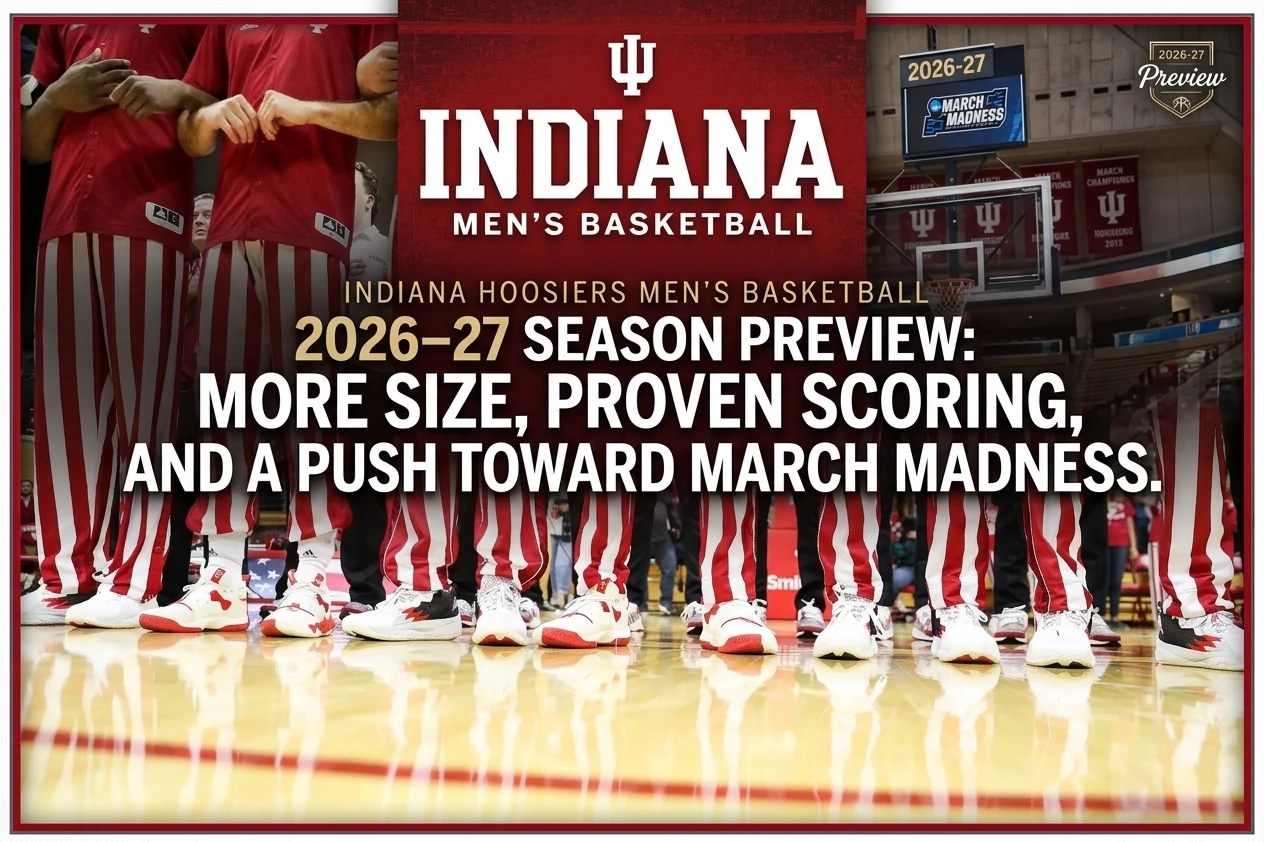
Indiana Hoosiers Men’s Basketball 2026–27 Season Preview: More Size, Proven Scoring, and a Push Toward March Madness
Indiana enters the 2026–27 season looking to turn a promising roster into a return to the NCAA Tournament. Darian DeVries begins his second season with an experienced scoring guard in Markus Burton, substantial frontcourt additions, and several newcomers competing for meaningful roles.
The Hoosiers have reasons for optimism, particularly around the basket. Whether that translates into a significant improvement will depend on perimeter consistency, defensive execution, and how quickly the new rotation develops chemistry.
How Did Indiana Do Last Season?
Indiana finished
18–14 overall and 9–11 in Big Ten play
in 2025–26, missing the
NCAA Tournament. The Hoosiers averaged
78.2 points per game
while allowing
72.2, but their positive scoring margin did not translate into enough conference victories.
Their season ended with a
74–61 loss to Northwestern
in the second round of the Big Ten Tournament. That followed a
91–78 defeat at Ohio State
in the regular-season finale, leaving Indiana without the strong finish it needed.
For DeVries, the task now is building a team that can sustain its performance through the conference schedule. Winning difficult road games and avoiding extended offensive droughts will be essential to improving Indiana’s postseason position.
Coaching Staff: Darian DeVries Enters Year Two
DeVries has approached this roster with greater physicality in mind. Indiana’s own preseason coverage identifies the addition of center Samet Yigitoglu as a response to the demands of Big Ten basketball. That gives the Hoosiers a clear opportunity to become more competitive around the rim.
The coaching staff includes assistants
Drew Adams, Thomas Carr, Rod Clark, Kenny Johnson, and Nick Norton.
Ryan Carr
serves as executive director of basketball, while
Mike Bargen
is special assistant to the head coach.
The staff’s biggest tactical decision will be balancing size with spacing. Indiana can use substantial frontcourt combinations, but those lineups must leave room for Burton to attack. Developing dependable perimeter defenders will be equally important; interior size cannot compensate for every breakdown outside.
Centers: Samet Yigitoglu Provides an Interior Foundation
Samet Yigitoglu
arrives from SMU after averaging
10.7 points, 7.9 rebounds, and 1.3 blocks
last season. He shot
62.8% from the field
and started all 34 games in which he appeared. His production gives Indiana an established center rather than a player learning the position at this level.
At 7-foot-2 and 270 pounds, Yigitoglu offers the size to establish deep position, set strong screens, and compete for rebounds against the conference’s biggest frontcourts. His ability to finish efficiently should make him a valuable target for the guards.
The main test will come defensively against teams that force him away from the basket. Indiana must coordinate its perimeter coverage with his positioning to avoid surrendering open shots or uncontested drives.
Freshman
Clemens Sokolov, listed at 7-foot and 265 pounds, provides another center option. His readiness for college competition will help determine how much flexibility DeVries has behind Yigitoglu.
Forwards: Aiden Sherrell Adds Versatility
Aiden Sherrell
could be one of Indiana’s most consequential additions. At Alabama last season, he averaged
11.1 points, 6.2 rebounds, and 2.2 blocks, while shooting
33.8% from three-point range. His shot-blocking and ability to step outside offer a different skill set from a traditional interior scorer.
Sherrell projects as a player who can contribute beside Yigitoglu or handle interior responsibilities in a smaller lineup. His shooting must remain credible enough to prevent opponents from crowding the paint.
Sam Alexis
supplies returning experience after averaging
8.8 points and 4.8 rebounds, shooting
68.7% from the field
last season. His eligibility was restored through a preliminary injunction in September; his availability remains connected to ongoing proceedings. If available throughout the season, he gives Indiana a valuable additional finisher and rebounder.
Trent Sisley
returns after averaging
4.2 points and 2.8 rebounds
as a freshman. He has an opportunity to earn greater responsibility, but improving his shooting consistency will matter after making 27.1% of his three-point attempts last season.
Freshmen
Trevor Manhertz
and
Vaughn Karvala, along with sophomore
Ben Winker, provide additional forward options. Their minutes should depend on defensive readiness and their ability to complement the veteran contributors.
Guards: Markus Burton Drives the Offense
Markus Burton
gives Indiana a proven scorer against major-conference competition. He averaged
18.5 points and 3.7 assists
in 10 games at Notre Dame last season before an ankle injury ended his campaign. The previous season, he averaged
21.3 points
and earned second-team All-ACC honors.
Burton projects as Indiana’s primary creator, particularly when an initial offensive action fails. His ability to draw defensive attention should generate opportunities for the big men and perimeter shooters. Staying healthy and balancing scoring with distribution will be crucial.
Bryce Lindsay
arrives from Villanova after averaging
12.3 points
and making
78 three-pointers at a 35.6% rate. He provides an established perimeter threat who can help punish opponents for concentrating on Burton.
Transfers
Darren Harris, formerly of Duke, and
Jaeden Mustaf, formerly of Georgia Tech, add size to the guard rotation. Freshman
Prince-Alexander Moody
offers another developmental option.
The key question is who supplies dependable secondary creation. Indiana will be harder to defend if Burton can occasionally work away from the ball while another guard organizes the offense.
Season Prediction
My projection is
21–23 regular-season victories, a finish between sixth and ninth in the Big Ten, and an NCAA Tournament berth in the No. 7–10 seed range.
The frontcourt additions give Indiana a plausible path to better rebounding and rim protection. Burton raises the offense’s potential, while Lindsay provides shooting that should help the pieces fit together.
My postseason prediction is a
second-round
NCAA Tournament appearance, with a Sweet 16 run possible if the perimeter defense improves and the rotation stays healthy. The principal concern is whether Indiana can produce consistent offense when opponents limit Burton’s penetration.
Conclusion
Indiana has assembled a roster with clearer interior strength and a proven lead scorer. Yigitoglu and Sherrell can change the Hoosiers’ presence around the basket, while Burton gives them someone capable of creating difficult shots.
The next step is turning those individual strengths into reliable team play. If Indiana defends without excessive fouling, protects the ball, and gets steady shooting around its primary creators, DeVries’ second season can end with the Hoosiers back in March Madness.
New Users – Get $350 in Bonus Bets when you wager $5 for 7 days
T&Cs apply
4.6/5
Gambling Problem? Call 1-800-GAMBLER or 1-800-MY-RESET. Call 1-888-789-7777 or visit ccpgg.org/chat (CT). Hope is here. GamblingHelpLineMA.org or call (800) 327-5050 for 24/7 support (MA). Visit www.mdgamblinghelp.org (MD). Call 1-877-8HOPE-NY or text HOPENY (NY). 21+ (18+ DC, WY) and present in select states (for KS, in affiliation with Kansas Star Casino). Find online real money wagering only. Min $5 wager required for 7 consecutive days. $5 free play credit. Bonus issued as non-withdrawable bonus with cash withdrawable bonus with cash withdrawable. Bonus bets which expire 7 days after receipt. Restrictions apply. See terms at sportsbook.fanduel.com. Call 1-877-770-7867 (LA).
Up To $1500 in Bonus Bets Paid Back if your First Bet Does Not Win
T&Cs apply
4.5/5
Gambling problem? Call 1-800-GAMBLER or 1-800-MY-RESET (Available in the US) 877-8-HOPENY or text HOPENY (467369) (NY) 1-800-327-5050 (MA), 1-800-BETS-OFF (IA), 1-800-981-0023 (PR). 21+ only. Please Gamble Responsibly. See BetMGM.com for Terms. First Bet Offer for new customers only (if applicable). Subject to eligibility requirements. Bonus bets are non-withdrawable. In partnership with Kansas Crossing Casino and Hotel. Promotional offers not available in Mississippi, Massachusetts, New York, Ontario, or Puerto Rico.
New DraftKings Customers: Bet $5, Get $200 + 3 Months of NBA League Pass!
T&Cs apply
4.5/5
GAMBLING PROBLEM? CALL 1-800-GAMBLER or 1-800-MY-RESET, (800) 327-5050 or visit gamblinghelplinema.org (MA). Please Gamble Responsibly. 888-789-7777/visit ccpg.org (CT), or visit www.mdgamblinghelp.org (MD), 1-800-981-0023 (PR). 21+ and present in most states. (18+ DC/NH/PR/WY). Void in CAN. Eligibility restrictions apply. On behalf of Boot Hill Casino (KS). Pass-thru of per wager tax may apply in IL. 1 per new Sportsbook customer. $5+ first-time bet req. Max. $200 issued as non-withdrawable Bonus Bets. Stake removed from payout. Reward issued as $50 in Bonus Bets every 7 days via click-to-claim for 21 days. Bonus Bets and click-to-claims expire 7 days (168hrs) after issuance. Terms: dkng.co/offer. Get 1 promo code to redeem a 3-month NBA League Pass subscription, complimentary of DraftKings. Subscription auto-renews monthly at then-current price (currently $16.99/mo); cancel anytime. Terms, restrictions, and eligibility requirements apply. Redeem League Pass by 12/19/26 at 11:59 PM ET. Addt’l terms: support.watch.nba.com/hc/en-us/articles/9165532876183-League-Pass-Terms-of-Use_. Ends 11/29/26 at 11:59 PM ET. Sponsored by DK.
Must be 21+. GAMBLING PROBLEM? CALL 1-800-GAMBLER OR CALL 1-800-MY-RESET, www.mdgamblinghelp.org (MD), (800)-327-5050 or gamblinghelplinema.org (MA), Call (877)8-HOPENY or text HOPENY (467369) (NY), (888) 789-7777 or ccpg.org (CT), morethanagame.nc.gov (NC), 1800gambler.net (WV)
Bet $1 and get double the winnings up to $25 for your next 10 bets
T&Cs apply
4.4/5
21+ New users only. Must register using eligible promo code. First bet after registration must qualify. Max. Bonus Bet: $1,000. Bonus Bet expires 14 days after receipt. Void where prohibited. See Caesars.com/promos for full terms. Gambling Problem? 1-800-GAMBLER (1-800-426-2537)
21+ and present in OH. Gambling Problem? Call 1-800-GAMBLER.
This site is using
Cloudflare
and adheres to the
Google Safe Browsing Program. We adapted
Google's Privacy Guidelines
to keep your data safe at all times.
Close
Ready to Win Big? Join the Elite with Our Sports Betting Deals!
FanDuel Promo
New Users – Get $350 in Bonus Bets when you wager $5 for 7 days
Our Favorite
T&Cs and 21+ apply
Gambling Problem? Call 1-800-GAMBLER or 1-800-MY-RESET. Call 1-888-789-7777 or visit ccpgg.org/chat (CT). Hope is here. GamblingHelpLineMA.org or call (800) 327-5050 for 24/7 support (MA). Visit www.mdgamblinghelp.org (MD). Call 1-877-8HOPE-NY or text HOPENY (NY). 21+ (18+ DC, WY) and present in select states (for KS, in affiliation with Kansas Star Casino). Find online real money wagering only. Min $5 wager required for 7 consecutive days. $5 free play credit. Bonus issued as non-withdrawable bonus with cash withdrawable bonus with cash withdrawable. Bonus bets which expire 7 days after receipt. Restrictions apply. See terms at sportsbook.fanduel.com. Call 1-877-770-7867 (LA).
Code:
Open FanDuel
Get Bonus
BetMGM Promo
Up To $1500 in Bonus Bets Paid Back if your First Bet Does Not Win
Best Slots
T&Cs and 21+ apply
Gambling problem? Call 1-800-GAMBLER or 1-800-MY-RESET (Available in the US) 877-8-HOPENY or text HOPENY (467369) (NY) 1-800-327-5050 (MA), 1-800-BETS-OFF (IA), 1-800-981-0023 (PR). 21+ only. Please Gamble Responsibly. See BetMGM.com for Terms. First Bet Offer for new customers only (if applicable). Subject to eligibility requirements. Bonus bets are non-withdrawable. In partnership with Kansas Crossing Casino and Hotel. Promotional offers not available in Mississippi, Massachusetts, New York, Ontario, or Puerto Rico.
Code:
Open BetMGM
Get Bonus
DraftKings Promo
New DraftKings Customers: Bet $5, Get $200 + 3 Months of NBA League Pass!
Newcomer
T&Cs and 21+ apply
GAMBLING PROBLEM? CALL 1-800-GAMBLER or 1-800-MY-RESET, (800) 327-5050 or visit gamblinghelplinema.org (MA). Please Gamble Responsibly. 888-789-7777/visit ccpg.org (CT), or visit www.mdgamblinghelp.org (MD), 1-800-981-0023 (PR). 21+ and present in most states. (18+ DC/NH/PR/WY). Void in CAN. Eligibility restrictions apply. On behalf of Boot Hill Casino (KS). Pass-thru of per wager tax may apply in IL. 1 per new Sportsbook customer. $5+ first-time bet req. Max. $200 issued as non-withdrawable Bonus Bets. Stake removed from payout. Reward issued as $50 in Bonus Bets every 7 days via click-to-claim for 21 days. Bonus Bets and click-to-claims expire 7 days (168hrs) after issuance. Terms: dkng.co/offer. Get 1 promo code to redeem a 3-month NBA League Pass subscription, complimentary of DraftKings. Subscription auto-renews monthly at then-current price (currently $16.99/mo); cancel anytime. Terms, restrictions, and eligibility requirements apply. Redeem League Pass by 12/19/26 at 11:59 PM ET. Addt’l terms: support.watch.nba.com/hc/en-us/articles/9165532876183-League-Pass-Terms-of-Use_. Ends 11/29/26 at 11:59 PM ET. Sponsored by DK.
Code:
Open DraftKings
Get Bonus
Find out what the legends have to say about sports this week....
New Users – Get $350 in Bonus Bets when you wager $5 for 7 days
Gambling Problem? Call 1-800-GAMBLER or 1-800-MY-RESET. Call 1-888-789-7777 or visit ccpgg.org/chat (CT). Hope is here. GamblingHelpLineMA.org or call (800) 327-5050 for 24/7 support (MA). Visit www.mdgamblinghelp.org (MD). Call 1-877-8HOPE-NY or text HOPENY (NY). 21+ (18+ DC, WY) and present in select states (for KS, in affiliation with Kansas Star Casino). Find online real money wagering only. Min $5 wager required for 7 consecutive days. $5 free play credit. Bonus issued as non-withdrawable bonus with cash withdrawable bonus with cash withdrawable. Bonus bets which expire 7 days after receipt. Restrictions apply. See terms at sportsbook.fanduel.com. Call 1-877-770-7867 (LA).