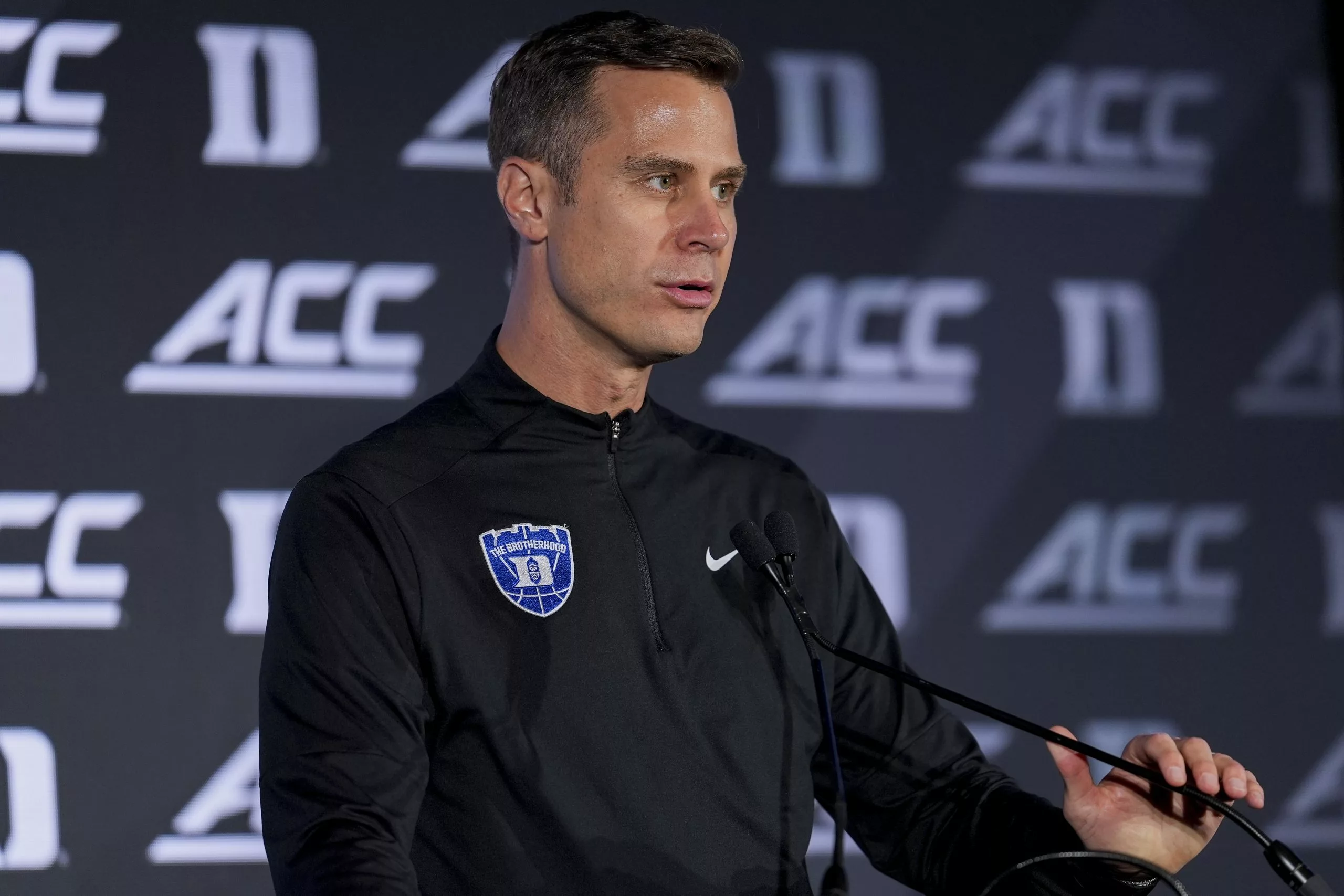
Oct 7, 2026; Charlotte, NC, USA; Duke Blue Devils head coach Jon Scheyer answers questions from the media during the ACC Tip-Off in Charlotte, NC. Mandatory Credit: Jim Dedmon-Imagn Images
Duke needed less than six minutes to turn a matchup between preseason top-10 teams into a showcase.
By the time Tuesday’s exhibition ended at Cameron Indoor Stadium, the second-ranked Blue Devils had demolished No. 8 Tennessee 103–64. Six Duke players scored in double figures, and the lead reached 42 points. An opponent expected to provide a serious preseason examination instead spent most of the evening trying to contain the damage.
One exhibition cannot establish the best team in
college basketball. It can, however, reveal why a team belongs in that discussion.
Duke’s case extends beyond a spectacular final score. The Blue Devils demonstrated scoring depth, efficient guard play and the ability to control the area around the basket. Those qualities offer a stronger foundation for championship expectations than a single player’s hot shooting night.
The question now is how much of that performance Duke can reproduce when opponents offer greater resistance.
Duke Took Control Immediately
The opening stretch established the terms of the game.
Duke surged ahead 17–2 while keeping Tennessee without a field goal for nearly six minutes. Patrick Ngongba II supplied seven early points during the run. By halftime, the Blue Devils led 54–30.
That matters when evaluating the result. Duke established its superiority while the game was still competitive, before a large second-half margin could change the atmosphere or urgency.
An early lead gives a team freedom, but building that lead requires execution. Duke immediately made Tennessee defend, then denied the Volunteers the offensive success needed to settle into the game.
The most encouraging element was how quickly that combination became overwhelming. The Blue Devils did not need a prolonged feeling-out period to find productive offense.
Still, the next test is different: maintaining that same organization when the opening shots miss and the opponent scores consistently.
Deron Rippey Jr. Gave Duke Another Dangerous Option
Freshman guard Deron Rippey Jr. led Duke with 21 points, making nine of his 12 shots and three of six attempts from beyond the arc. He also recorded three assists and three steals.
The efficiency is as significant as the scoring total.
A young guard can accumulate points through heavy usage without necessarily making an offense better. Rippey’s production came with relatively few missed shots, suggesting how valuable he can become within a group that has other credible scoring options.
For Duke, the larger implication is flexibility.
If Rippey can consistently create or finish opportunities against quality defenses, opponents will have another player to account for when organizing their coverage. Help directed toward one scorer can leave another with room to operate.
That possibility becomes particularly valuable late in possessions. Championship contenders need players who can generate something useful after the first action fails.
Tuesday offered an encouraging glimpse of Rippey’s potential. Establishing that reliability over an entire season remains the next step.
The Scoring Balance Makes Duke Difficult to Solve
John Blackwell added 18 points, Dame Sarr scored 15 and Ngongba finished with 13. Sebastian Wilkins and Joaquim Boumtje Boumtje contributed 11 apiece.
Those contributions give the result more substance.
Defenses become more comfortable when they can concentrate their attention on one primary scorer. They can deny his preferred areas, send help early and challenge teammates to make enough plays to compensate.
A team with several productive options complicates those choices.
Duke’s potential lies in making defensive adjustments expensive. If an opponent commits additional attention to the perimeter, the interior must remain productive. If it protects the paint, the guards and wings must punish the space available outside.
Tuesday’s scoring distribution suggests Duke has the personnel to pursue that kind of balance.
It also gives the Blue Devils some protection against the ordinary fluctuations of a season. Foul trouble, an unfavorable matchup or an inefficient shooting night need not leave the offense dependent on one solution.
The Interior Numbers Give the Performance Weight
Duke outrebounded Tennessee 44–29 and outscored the Volunteers 46–16 in the paint. The Blue Devils also held a 28–7 advantage in fast-break points.
Those figures help explain why this was such a decisive performance.
Rebounding ends defensive possessions and creates opportunities to attack before the opposing defense gets organized. Interior scoring provides another source of offense when perimeter shots become less reliable.
Duke combined both advantages Tuesday.
That is relevant to the national-title discussion because even talented shooting teams eventually encounter games in which the jumpers stop falling. Contenders need other ways to generate points and maintain control.
The Blue Devils showed several.
The caution is that this game cannot establish how effectively Duke will rebound against every frontcourt or finish against every type of defensive coverage. It does provide a tangible starting point for believing that its strengths extend across multiple areas.
Tennessee’s Injuries Belong in the Evaluation
The Volunteers were dealing with significant availability problems.
Terrence Hill Jr. left with a left ankle injury after approximately five minutes. Troy Henderson later exited with a right ankle injury. Tennessee’s official report said the team had four players unavailable for more than 35 minutes and five unavailable for the final 17-plus minutes.
That context limits how broadly the margin should be interpreted.
A depleted opponent has fewer options to change matchups, manage fatigue and respond when its original plan fails. Duke still had to execute, but Tennessee’s circumstances contributed to the difficulty of mounting a recovery.
It would be premature to conclude that the Volunteers are fundamentally overrated. It would be equally premature to assume Duke will overwhelm healthy contenders by similar margins.
The reasonable conclusion is that Duke performed exceptionally well against the Tennessee team available Tuesday.
Is Duke the Nation’s Best Team?
Duke has presented a compelling early argument. It has not settled the question.
The Blue Devils shot 54.5% from the floor, made 12 three-pointers and converted 19 of 21 free throws. Tennessee finished at 33.9% shooting.
That combination can produce a blowout even between talented teams. The challenge is determining which advantages remain when shooting percentages move closer together.
Can Duke generate efficient offense in a slower game? Can it maintain defensive discipline through a tight second half? Who supplies the necessary basket when the opponent takes away the first option?
Those questions require competitive games and a larger sample.
Another examination comes Sunday, October 25, when Duke visits
No. 17 Kansas
for a 1 p.m. ET exhibition at Allen Fieldhouse.
For now, Duke has earned serious consideration as the nation’s best team. Its scoring options and interior production give that argument substance.
Tuesday established how impressive the Blue Devils can look when their strengths work together. The season will determine how consistently they can reach that level—and how effectively they respond when somebody finally makes them uncomfortable.
New Users – Get $350 in Bonus Bets when you wager $5 for 7 days
T&Cs apply
4.6/5
Gambling Problem? Call 1-800-GAMBLER or 1-800-MY-RESET. Call 1-888-789-7777 or visit ccpgg.org/chat (CT). Hope is here. GamblingHelpLineMA.org or call (800) 327-5050 for 24/7 support (MA). Visit www.mdgamblinghelp.org (MD). Call 1-877-8HOPE-NY or text HOPENY (NY). 21+ (18+ DC, WY) and present in select states (for KS, in affiliation with Kansas Star Casino). Find online real money wagering only. Min $5 wager required for 7 consecutive days. $5 free play credit. Bonus issued as non-withdrawable bonus with cash withdrawable bonus with cash withdrawable. Bonus bets which expire 7 days after receipt. Restrictions apply. See terms at sportsbook.fanduel.com. Call 1-877-770-7867 (LA).
Up To $1500 in Bonus Bets Paid Back if your First Bet Does Not Win
T&Cs apply
4.5/5
Gambling problem? Call 1-800-GAMBLER or 1-800-MY-RESET (Available in the US) 877-8-HOPENY or text HOPENY (467369) (NY) 1-800-327-5050 (MA), 1-800-BETS-OFF (IA), 1-800-981-0023 (PR). 21+ only. Please Gamble Responsibly. See BetMGM.com for Terms. First Bet Offer for new customers only (if applicable). Subject to eligibility requirements. Bonus bets are non-withdrawable. In partnership with Kansas Crossing Casino and Hotel. Promotional offers not available in Mississippi, Massachusetts, New York, Ontario, or Puerto Rico.
New DraftKings Customers: Bet $5, Get $200 + 3 Months of NBA League Pass!
T&Cs apply
4.5/5
GAMBLING PROBLEM? CALL 1-800-GAMBLER or 1-800-MY-RESET, (800) 327-5050 or visit gamblinghelplinema.org (MA). Please Gamble Responsibly. 888-789-7777/visit ccpg.org (CT), or visit www.mdgamblinghelp.org (MD), 1-800-981-0023 (PR). 21+ and present in most states. (18+ DC/NH/PR/WY). Void in CAN. Eligibility restrictions apply. On behalf of Boot Hill Casino (KS). Pass-thru of per wager tax may apply in IL. 1 per new Sportsbook customer. $5+ first-time bet req. Max. $200 issued as non-withdrawable Bonus Bets. Stake removed from payout. Reward issued as $50 in Bonus Bets every 7 days via click-to-claim for 21 days. Bonus Bets and click-to-claims expire 7 days (168hrs) after issuance. Terms: dkng.co/offer. Get 1 promo code to redeem a 3-month NBA League Pass subscription, complimentary of DraftKings. Subscription auto-renews monthly at then-current price (currently $16.99/mo); cancel anytime. Terms, restrictions, and eligibility requirements apply. Redeem League Pass by 12/19/26 at 11:59 PM ET. Addt’l terms: support.watch.nba.com/hc/en-us/articles/9165532876183-League-Pass-Terms-of-Use_. Ends 11/29/26 at 11:59 PM ET. Sponsored by DK.
Must be 21+. GAMBLING PROBLEM? CALL 1-800-GAMBLER OR CALL 1-800-MY-RESET, www.mdgamblinghelp.org (MD), (800)-327-5050 or gamblinghelplinema.org (MA), Call (877)8-HOPENY or text HOPENY (467369) (NY), (888) 789-7777 or ccpg.org (CT), morethanagame.nc.gov (NC), 1800gambler.net (WV)
Bet $1 and get double the winnings up to $25 for your next 10 bets
T&Cs apply
4.4/5
21+ New users only. Must register using eligible promo code. First bet after registration must qualify. Max. Bonus Bet: $1,000. Bonus Bet expires 14 days after receipt. Void where prohibited. See Caesars.com/promos for full terms. Gambling Problem? 1-800-GAMBLER (1-800-426-2537)
21+ and present in OH. Gambling Problem? Call 1-800-GAMBLER.
This site is using
Cloudflare
and adheres to the
Google Safe Browsing Program. We adapted
Google's Privacy Guidelines
to keep your data safe at all times.
Close
Ready to Win Big? Join the Elite with Our Sports Betting Deals!
FanDuel Promo
New Users – Get $350 in Bonus Bets when you wager $5 for 7 days
Our Favorite
T&Cs and 21+ apply
Gambling Problem? Call 1-800-GAMBLER or 1-800-MY-RESET. Call 1-888-789-7777 or visit ccpgg.org/chat (CT). Hope is here. GamblingHelpLineMA.org or call (800) 327-5050 for 24/7 support (MA). Visit www.mdgamblinghelp.org (MD). Call 1-877-8HOPE-NY or text HOPENY (NY). 21+ (18+ DC, WY) and present in select states (for KS, in affiliation with Kansas Star Casino). Find online real money wagering only. Min $5 wager required for 7 consecutive days. $5 free play credit. Bonus issued as non-withdrawable bonus with cash withdrawable bonus with cash withdrawable. Bonus bets which expire 7 days after receipt. Restrictions apply. See terms at sportsbook.fanduel.com. Call 1-877-770-7867 (LA).
Code:
Open FanDuel
Get Bonus
BetMGM Promo
Up To $1500 in Bonus Bets Paid Back if your First Bet Does Not Win
Best Slots
T&Cs and 21+ apply
Gambling problem? Call 1-800-GAMBLER or 1-800-MY-RESET (Available in the US) 877-8-HOPENY or text HOPENY (467369) (NY) 1-800-327-5050 (MA), 1-800-BETS-OFF (IA), 1-800-981-0023 (PR). 21+ only. Please Gamble Responsibly. See BetMGM.com for Terms. First Bet Offer for new customers only (if applicable). Subject to eligibility requirements. Bonus bets are non-withdrawable. In partnership with Kansas Crossing Casino and Hotel. Promotional offers not available in Mississippi, Massachusetts, New York, Ontario, or Puerto Rico.
Code:
Open BetMGM
Get Bonus
DraftKings Promo
New DraftKings Customers: Bet $5, Get $200 + 3 Months of NBA League Pass!
Newcomer
T&Cs and 21+ apply
GAMBLING PROBLEM? CALL 1-800-GAMBLER or 1-800-MY-RESET, (800) 327-5050 or visit gamblinghelplinema.org (MA). Please Gamble Responsibly. 888-789-7777/visit ccpg.org (CT), or visit www.mdgamblinghelp.org (MD), 1-800-981-0023 (PR). 21+ and present in most states. (18+ DC/NH/PR/WY). Void in CAN. Eligibility restrictions apply. On behalf of Boot Hill Casino (KS). Pass-thru of per wager tax may apply in IL. 1 per new Sportsbook customer. $5+ first-time bet req. Max. $200 issued as non-withdrawable Bonus Bets. Stake removed from payout. Reward issued as $50 in Bonus Bets every 7 days via click-to-claim for 21 days. Bonus Bets and click-to-claims expire 7 days (168hrs) after issuance. Terms: dkng.co/offer. Get 1 promo code to redeem a 3-month NBA League Pass subscription, complimentary of DraftKings. Subscription auto-renews monthly at then-current price (currently $16.99/mo); cancel anytime. Terms, restrictions, and eligibility requirements apply. Redeem League Pass by 12/19/26 at 11:59 PM ET. Addt’l terms: support.watch.nba.com/hc/en-us/articles/9165532876183-League-Pass-Terms-of-Use_. Ends 11/29/26 at 11:59 PM ET. Sponsored by DK.
Code:
Open DraftKings
Get Bonus
Find out what the legends have to say about sports this week....
New Users – Get $350 in Bonus Bets when you wager $5 for 7 days
Gambling Problem? Call 1-800-GAMBLER or 1-800-MY-RESET. Call 1-888-789-7777 or visit ccpgg.org/chat (CT). Hope is here. GamblingHelpLineMA.org or call (800) 327-5050 for 24/7 support (MA). Visit www.mdgamblinghelp.org (MD). Call 1-877-8HOPE-NY or text HOPENY (NY). 21+ (18+ DC, WY) and present in select states (for KS, in affiliation with Kansas Star Casino). Find online real money wagering only. Min $5 wager required for 7 consecutive days. $5 free play credit. Bonus issued as non-withdrawable bonus with cash withdrawable bonus with cash withdrawable. Bonus bets which expire 7 days after receipt. Restrictions apply. See terms at sportsbook.fanduel.com. Call 1-877-770-7867 (LA).