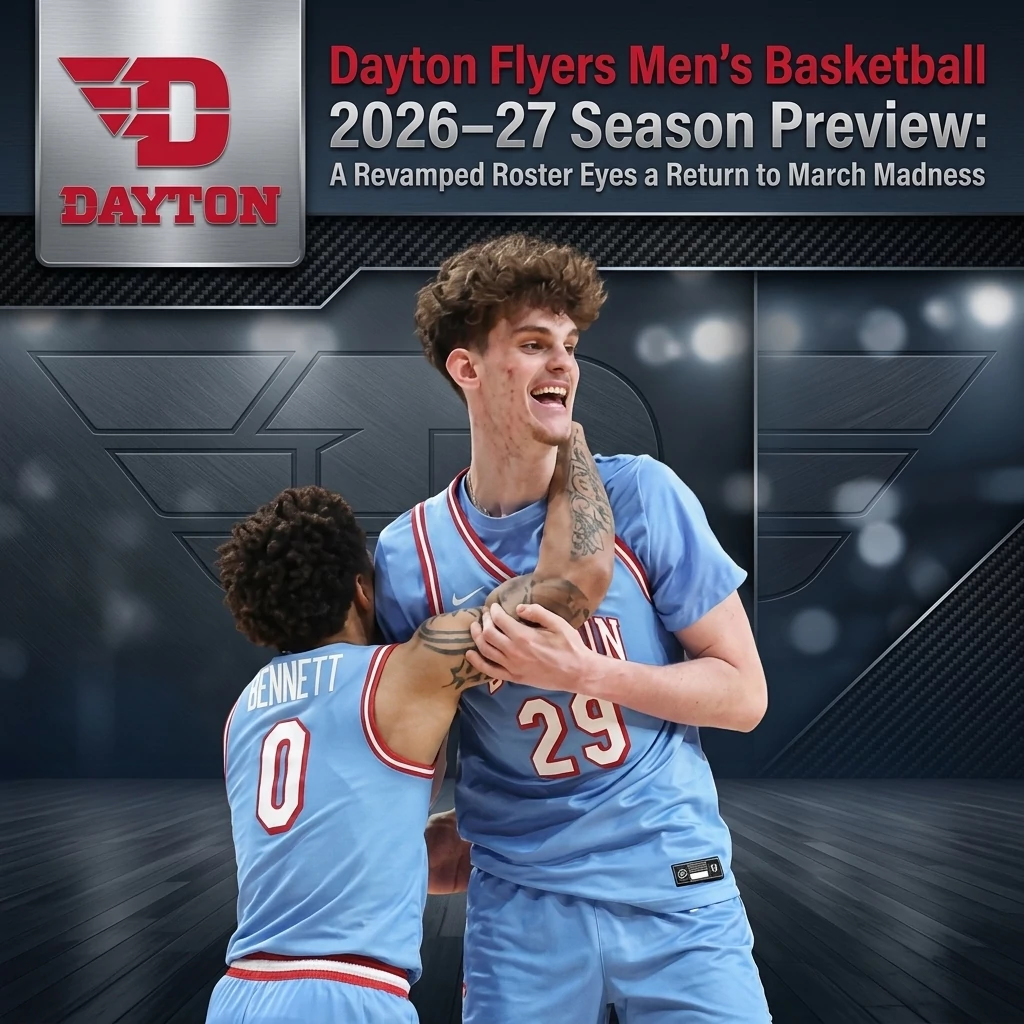
Dayton Flyers Men’s Basketball 2026–27 Season Preview: A Revamped Roster Eyes a Return to March Madness
The Dayton Flyers enter the 2026–27 season with an established frontcourt, a rebuilt backcourt, and expectations that extend beyond another winning record. After finishing one victory short of an automatic NCAA Tournament berth last March, Dayton faces a familiar challenge: turning its place among the Atlantic 10’s contenders into a spot in the national tournament.
Anthony Grant’s team has enough size and experience to compete near the top of the conference. Whether the Flyers can take the next step will depend on how quickly their newcomers settle into meaningful roles.
How Did Dayton Do Last Season?
Dayton finished
25–12 overall and 12–6 in Atlantic 10 play
in 2025–26. The Flyers defeated St. Bonaventure and Saint Louis in the conference tournament before losing
70–62 to VCU in the championship game. They continued into the NIT, winning road games against Bradley and UNC Wilmington before Illinois State ended their season with a
61–55 quarterfinal victory.
The Flyers averaged 74.1 points and allowed 69.3 per game. Their ability to create turnovers helped, but shooting and rebounding left room for improvement. Dayton made 33.9% of its three-pointers and finished with a minus-0.8 rebounding margin. Leading scorers Javon Bennett and De’Shayne Montgomery averaged 15.8 and 13.4 points, respectively; neither appears on the current roster. Replacing that perimeter production is a central offseason challenge.
Coaching Staff: Anthony Grant Leads Another Transition
Grant enters his
10th season at Dayton
with a 197–95 record at his alma mater. Last season marked the program’s fifth consecutive 20-win campaign. His résumé includes the 29–2 season in 2019–20 and an NCAA Tournament victory in 2024. That history gives Dayton a proven foundation as another roster takes shape.
The current staff includes associate head coach
James Kane
and assistants
Jermaine Henderson, Nick Irvin, Sean Damaska, and Jordan Talley. Damaska also serves as recruiting coordinator.
The staff’s biggest task is establishing a dependable perimeter rotation. Dayton needs guards who can initiate offense, feed its interior scorers, and make good decisions late in close games. Finding productive combinations will matter as much as identifying the five starters.
Centers and Interior Players: L’Etang Sets the Standard
Although Dayton officially lists its big men as forwards,
Amaël L’Etang
projects as the central figure in its center rotation. The 7-foot-1 junior averaged
11.9 points and 5.9 rebounds
last season while shooting
36.1% from three-point range. His combination of size and shooting gives Dayton options in both traditional interior sets and lineups that spread the floor.
L’Etang’s next step is becoming a more consistent possession-by-possession presence. Dayton would benefit from stronger rebounding, fewer wasted offensive possessions, and reliable production when opponents make him the focus of their defense. He should have an opportunity to become the Flyers’ offensive centerpiece.
Jalen Haynes, a 6-foot-8, 250-pound graduate forward, provides a different interior option. He previously earned first-team All-Atlantic 10 recognition at George Mason but missed last season at Cincinnati with a knee injury. His return to form could substantially improve Dayton’s ability to score through contact and withstand physical opponents.
A productive Haynes would also give Grant flexibility: Dayton could use him alongside L’Etang or stagger their minutes to maintain an interior scoring threat.
Forwards: Competition and Versatility
Jaiun Simon
offers continuity. He started 16 games last season and averaged
5.6 points and 3.3 rebounds. His familiarity with the program should help a team incorporating several newcomers. The opportunity now is to turn that experience into steadier offensive contributions and stronger rebounding.
Transfer
Grant Randall
arrives from Quinnipiac after averaging
11.4 points and 6.6 rebounds
as a sophomore. His previous production makes him an intriguing addition to a team that needs to improve on the glass. Translating those numbers to Atlantic 10 competition will be an important test.
Returning forwards
Malcolm Thomas
and
Damon Friery, along with freshman
Cody Peck, give Dayton additional options. Thomas and Friery have experience in the program, while Peck adds another long frame to the frontcourt. Their minutes should depend on defensive reliability, rebounding, and how well they complement the primary scorers.
Guards: The Group That Could Decide the Season
Dayton’s perimeter rotation carries the most uncertainty—and considerable opportunity.
Travis Perry
arrives after stops at Kentucky and Ole Miss. The former Kentucky high school career scoring record-setter gives the Flyers a recognizable offensive addition. At Dayton, his challenge will be establishing consistent college production while helping organize the offense.
Zaide Lowery, formerly of Marquette, adds size to the backcourt.
Landen Joseph, a Marshall transfer, adds another option for ballhandling and perimeter minutes. Both will have opportunities to help replace the production Dayton lost after last season.
The younger group includes
Tristian Ford, who redshirted at Murray State;
Jaron McKie, who redshirted at Dayton; and freshmen
Aiden Derkack
and
Julian Washington. Their development could determine whether the Flyers have enough perimeter depth to sustain pressure through a full conference schedule.
The essential question is who becomes the trusted creator when the first offensive action breaks down. Dayton has promising candidates, but that responsibility must be earned.
Season Prediction
My projection is
22–24 regular-season wins, a top-four Atlantic 10 finish, and a place in the NCAA Tournament bubble discussion.
The frontcourt gives Dayton a credible foundation. If L’Etang takes another step, Haynes returns to productive form, and the new guards provide dependable shooting and decision-making, the Flyers can challenge for the conference championship.
The concern is offensive consistency. An unsettled backcourt could produce uneven stretches, particularly away from home. Dayton’s NCAA chances will depend on building a strong résumé throughout the season rather than relying entirely on the conference tournament.
Conclusion
Dayton has the ingredients for another competitive season: an experienced coach, a skilled returning big man, and several newcomers with opportunities to make an immediate impact.
L’Etang gives the Flyers a player to build around. Haynes and Randall could strengthen the interior, while the rebuilt guard rotation will determine how effectively those advantages translate into victories. If those pieces come together early, Dayton can turn last season’s near miss into a return to March Madness.
New Users – Get $350 in Bonus Bets when you wager $5 for 7 days
T&Cs apply
4.6/5
Gambling Problem? Call 1-800-GAMBLER or 1-800-MY-RESET. Call 1-888-789-7777 or visit ccpgg.org/chat (CT). Hope is here. GamblingHelpLineMA.org or call (800) 327-5050 for 24/7 support (MA). Visit www.mdgamblinghelp.org (MD). Call 1-877-8HOPE-NY or text HOPENY (NY). 21+ (18+ DC, WY) and present in select states (for KS, in affiliation with Kansas Star Casino). Find online real money wagering only. Min $5 wager required for 7 consecutive days. $5 free play credit. Bonus issued as non-withdrawable bonus with cash withdrawable bonus with cash withdrawable. Bonus bets which expire 7 days after receipt. Restrictions apply. See terms at sportsbook.fanduel.com. Call 1-877-770-7867 (LA).
Up To $1500 in Bonus Bets Paid Back if your First Bet Does Not Win
T&Cs apply
4.5/5
Gambling problem? Call 1-800-GAMBLER or 1-800-MY-RESET (Available in the US) 877-8-HOPENY or text HOPENY (467369) (NY) 1-800-327-5050 (MA), 1-800-BETS-OFF (IA), 1-800-981-0023 (PR). 21+ only. Please Gamble Responsibly. See BetMGM.com for Terms. First Bet Offer for new customers only (if applicable). Subject to eligibility requirements. Bonus bets are non-withdrawable. In partnership with Kansas Crossing Casino and Hotel. Promotional offers not available in Mississippi, Massachusetts, New York, Ontario, or Puerto Rico.
New DraftKings Customers: Bet $5, Get $200 + 3 Months of NBA League Pass!
T&Cs apply
4.5/5
GAMBLING PROBLEM? CALL 1-800-GAMBLER or 1-800-MY-RESET, (800) 327-5050 or visit gamblinghelplinema.org (MA). Please Gamble Responsibly. 888-789-7777/visit ccpg.org (CT), or visit www.mdgamblinghelp.org (MD), 1-800-981-0023 (PR). 21+ and present in most states. (18+ DC/NH/PR/WY). Void in CAN. Eligibility restrictions apply. On behalf of Boot Hill Casino (KS). Pass-thru of per wager tax may apply in IL. 1 per new Sportsbook customer. $5+ first-time bet req. Max. $200 issued as non-withdrawable Bonus Bets. Stake removed from payout. Reward issued as $50 in Bonus Bets every 7 days via click-to-claim for 21 days. Bonus Bets and click-to-claims expire 7 days (168hrs) after issuance. Terms: dkng.co/offer. Get 1 promo code to redeem a 3-month NBA League Pass subscription, complimentary of DraftKings. Subscription auto-renews monthly at then-current price (currently $16.99/mo); cancel anytime. Terms, restrictions, and eligibility requirements apply. Redeem League Pass by 12/19/26 at 11:59 PM ET. Addt’l terms: support.watch.nba.com/hc/en-us/articles/9165532876183-League-Pass-Terms-of-Use_. Ends 11/29/26 at 11:59 PM ET. Sponsored by DK.
Must be 21+. GAMBLING PROBLEM? CALL 1-800-GAMBLER OR CALL 1-800-MY-RESET, www.mdgamblinghelp.org (MD), (800)-327-5050 or gamblinghelplinema.org (MA), Call (877)8-HOPENY or text HOPENY (467369) (NY), (888) 789-7777 or ccpg.org (CT), morethanagame.nc.gov (NC), 1800gambler.net (WV)
Bet $1 and get double the winnings up to $25 for your next 10 bets
T&Cs apply
4.4/5
21+ New users only. Must register using eligible promo code. First bet after registration must qualify. Max. Bonus Bet: $1,000. Bonus Bet expires 14 days after receipt. Void where prohibited. See Caesars.com/promos for full terms. Gambling Problem? 1-800-GAMBLER (1-800-426-2537)
21+ and present in OH. Gambling Problem? Call 1-800-GAMBLER.
This site is using
Cloudflare
and adheres to the
Google Safe Browsing Program. We adapted
Google's Privacy Guidelines
to keep your data safe at all times.
Close
Ready to Win Big? Join the Elite with Our Sports Betting Deals!
FanDuel Promo
New Users – Get $350 in Bonus Bets when you wager $5 for 7 days
Our Favorite
T&Cs and 21+ apply
Gambling Problem? Call 1-800-GAMBLER or 1-800-MY-RESET. Call 1-888-789-7777 or visit ccpgg.org/chat (CT). Hope is here. GamblingHelpLineMA.org or call (800) 327-5050 for 24/7 support (MA). Visit www.mdgamblinghelp.org (MD). Call 1-877-8HOPE-NY or text HOPENY (NY). 21+ (18+ DC, WY) and present in select states (for KS, in affiliation with Kansas Star Casino). Find online real money wagering only. Min $5 wager required for 7 consecutive days. $5 free play credit. Bonus issued as non-withdrawable bonus with cash withdrawable bonus with cash withdrawable. Bonus bets which expire 7 days after receipt. Restrictions apply. See terms at sportsbook.fanduel.com. Call 1-877-770-7867 (LA).
Code:
Open FanDuel
Get Bonus
BetMGM Promo
Up To $1500 in Bonus Bets Paid Back if your First Bet Does Not Win
Best Slots
T&Cs and 21+ apply
Gambling problem? Call 1-800-GAMBLER or 1-800-MY-RESET (Available in the US) 877-8-HOPENY or text HOPENY (467369) (NY) 1-800-327-5050 (MA), 1-800-BETS-OFF (IA), 1-800-981-0023 (PR). 21+ only. Please Gamble Responsibly. See BetMGM.com for Terms. First Bet Offer for new customers only (if applicable). Subject to eligibility requirements. Bonus bets are non-withdrawable. In partnership with Kansas Crossing Casino and Hotel. Promotional offers not available in Mississippi, Massachusetts, New York, Ontario, or Puerto Rico.
Code:
Open BetMGM
Get Bonus
DraftKings Promo
New DraftKings Customers: Bet $5, Get $200 + 3 Months of NBA League Pass!
Newcomer
T&Cs and 21+ apply
GAMBLING PROBLEM? CALL 1-800-GAMBLER or 1-800-MY-RESET, (800) 327-5050 or visit gamblinghelplinema.org (MA). Please Gamble Responsibly. 888-789-7777/visit ccpg.org (CT), or visit www.mdgamblinghelp.org (MD), 1-800-981-0023 (PR). 21+ and present in most states. (18+ DC/NH/PR/WY). Void in CAN. Eligibility restrictions apply. On behalf of Boot Hill Casino (KS). Pass-thru of per wager tax may apply in IL. 1 per new Sportsbook customer. $5+ first-time bet req. Max. $200 issued as non-withdrawable Bonus Bets. Stake removed from payout. Reward issued as $50 in Bonus Bets every 7 days via click-to-claim for 21 days. Bonus Bets and click-to-claims expire 7 days (168hrs) after issuance. Terms: dkng.co/offer. Get 1 promo code to redeem a 3-month NBA League Pass subscription, complimentary of DraftKings. Subscription auto-renews monthly at then-current price (currently $16.99/mo); cancel anytime. Terms, restrictions, and eligibility requirements apply. Redeem League Pass by 12/19/26 at 11:59 PM ET. Addt’l terms: support.watch.nba.com/hc/en-us/articles/9165532876183-League-Pass-Terms-of-Use_. Ends 11/29/26 at 11:59 PM ET. Sponsored by DK.
Code:
Open DraftKings
Get Bonus
Find out what the legends have to say about sports this week....
New Users – Get $350 in Bonus Bets when you wager $5 for 7 days
Gambling Problem? Call 1-800-GAMBLER or 1-800-MY-RESET. Call 1-888-789-7777 or visit ccpgg.org/chat (CT). Hope is here. GamblingHelpLineMA.org or call (800) 327-5050 for 24/7 support (MA). Visit www.mdgamblinghelp.org (MD). Call 1-877-8HOPE-NY or text HOPENY (NY). 21+ (18+ DC, WY) and present in select states (for KS, in affiliation with Kansas Star Casino). Find online real money wagering only. Min $5 wager required for 7 consecutive days. $5 free play credit. Bonus issued as non-withdrawable bonus with cash withdrawable bonus with cash withdrawable. Bonus bets which expire 7 days after receipt. Restrictions apply. See terms at sportsbook.fanduel.com. Call 1-877-770-7867 (LA).