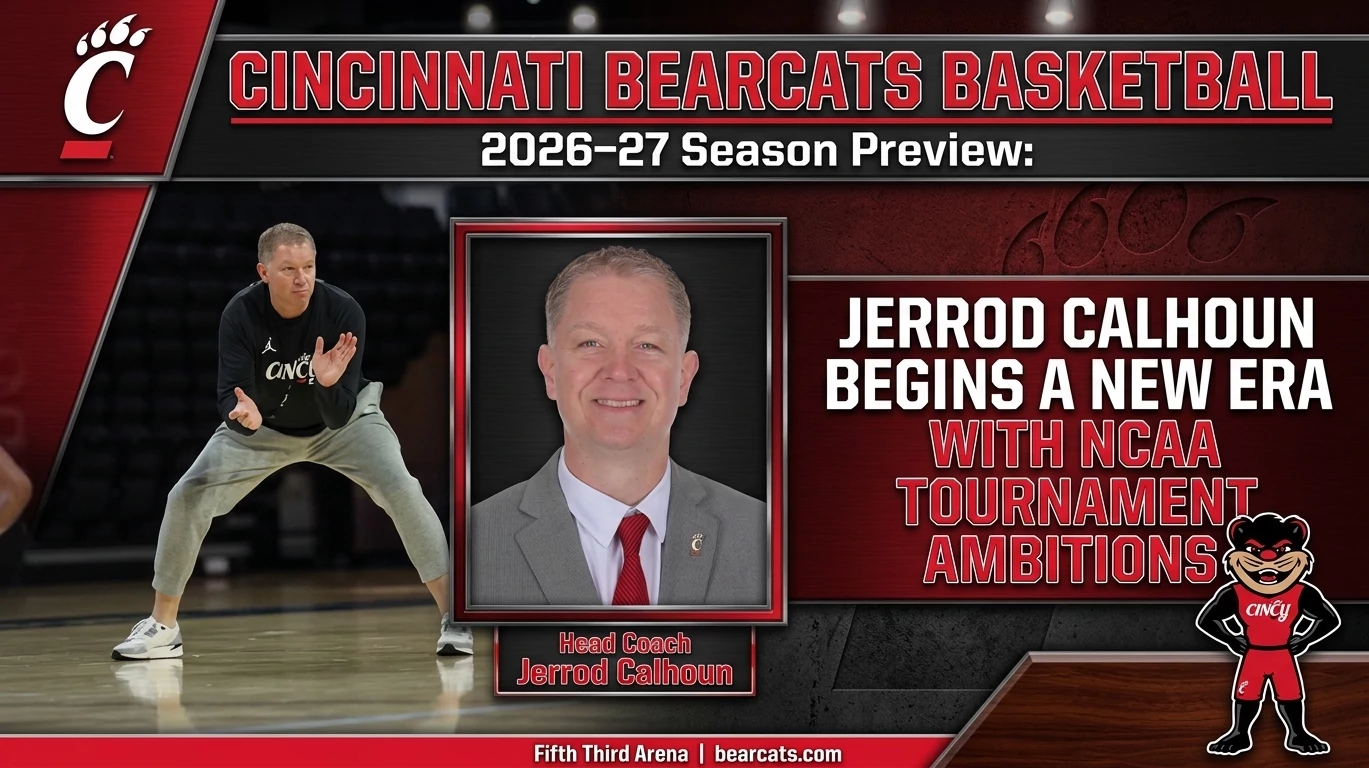
Cincinnati Bearcats Basketball 2026–27 Season Preview: Jerrod Calhoun Begins a New Era with NCAA Tournament Ambitions
The University of Cincinnati enters the 2026–27 men’s basketball season with a new head coach, a rebuilt roster and an opportunity to change the program’s direction.
Jerrod Calhoun returns to his alma mater after a successful run at Utah State, bringing an offensive approach that could energize Fifth Third Arena. His first Cincinnati team features experienced scorers, multiple ballhandlers and several frontcourt options.
The central question is whether those individual strengths can become a cohesive team quickly enough to compete in the Big 12 and put Cincinnati back in the
NCAA Tournament.
How Did Cincinnati Do Last Season?
Cincinnati finished
18–15 overall and 9–9 in Big 12 play
during the 2025–26 season. The Bearcats were excellent at Fifth Third Arena, going
15–3 at home, but struggled elsewhere with a
2–8 road record and 1–4 mark at neutral sites.
There were impressive performances, including wins over Iowa State, Kansas and BYU. However, Cincinnati could not sustain that level consistently. Its season ended with a
66–65 loss to UCF in the second round of the Big 12 Tournament, following a first-round victory over Utah.
The statistical profile reflected a team whose defense frequently outperformed its offense. Cincinnati averaged
73.1 points per game
while allowing
67.6, but shot just
43.1% from the field and 68.1% at the free-throw line. Those offensive limitations reduced its margin for error in close games.
The university announced its separation agreement with Wes Miller on March 19, then named Calhoun head coach on March 24. That change makes this season a fresh evaluation of the program rather than a continuation of last year’s rotation.
Coaching Staff Breakdown
Jerrod Calhoun — Head Coach:
Calhoun arrives after going
55–15 in two seasons at Utah State, reaching the NCAA Tournament both years. His 2025–26 team finished
29–7
and won the Mountain West regular-season and tournament championships.
His offensive credentials are especially encouraging. Utah State averaged
82.1 points and 17.6 assists
last season and ranked 26th in adjusted offensive efficiency. Cincinnati’s personnel gives him a chance to build around multiple creators, efficient finishing and better spacing. Translating that success against Big 12 defenses will be his first major test.
Mantoris Robinson — Associate Head Coach:
Robinson follows Calhoun from Utah State and brings 15 years of coaching experience. His familiarity with the head coach’s expectations should help establish consistency during the transition.
Ben Asher — Assistant Coach/Offensive Coordinator:
Another Utah State arrival, Asher will help organize an offense with several players accustomed to significant scoring responsibilities. Establishing roles and maintaining ball movement will be essential.
Johnny Hill — Assistant Coach/Defensive Coordinator:
Hill also worked under Calhoun at Utah State. His challenge is to build dependable team defense while allowing Cincinnati’s aggressive guards to pressure the ball and create turnovers.
The staff also includes
Max Bent and Curran Walsh, both assigned to offense and analytics;
Mike Fuline, assistant coach and high school relations coordinator; and
Jason Slay, assistant coach.
Paul Molinari
serves as chief of staff, while
Corey Evans
is the program’s general manager.
Centers and Interior Play
Cincinnati officially lists its big men as forwards. For this preview, the interior grouping reflects projected roles rather than an announced depth chart.
Riley Allenspach
offers an appealing combination of size and offensive skill. The
6-foot-11, 245-pound George Mason transfer
earned second-team All-Atlantic 10 honors last season, shot
56.6% from the field, and averaged
6.1 rebounds. In conference play, he scored
14.9 points per game
and shot
39.4% from three-point range.
His ability to finish inside and threaten from outside could open driving lanes for Cincinnati’s guards. The question is how effectively he handles the physical demands of defending Big 12 frontcourts.
Jayden Hastings
brings a more established shot-blocking presence. At Boston College, the
6-foot-10, 245-pound transfer
averaged
6.7 points and 5.6 rebounds, blocked
47 shots, and made
61.1% of his field-goal attempts.
Hastings should be valuable when Cincinnati needs rim protection, rebounding and efficient finishing without requiring many offensive touches. His skill set gives Calhoun a different option alongside Allenspach.
David Iweze, a 6-foot-9, 245-pound transfer who redshirted at Utah State, provides a developmental interior option.
Deshaun Vaden, listed at 6-foot-11, adds further size. Their opportunities will depend on readiness, defensive reliability and the rotation’s needs.
Forwards Breakdown
Tyler Tejada
is a strong candidate to become one of Cincinnati’s primary scoring options. The
6-foot-9 Towson transfer
averaged
17.7 points, 5.5 rebounds and 2.3 assists
last season while shooting
88.2% at the free-throw line.
Tejada scored at least 20 points in 12 games and averaged 31.3 points during the CAA Tournament. His scoring résumé gives Cincinnati a potential answer when its initial offensive action breaks down. Maintaining efficiency against longer, more athletic defenders will determine how large that role becomes.
Adlan Elamin
provides familiarity with Calhoun’s system. The
6-foot-10 sophomore
started 28 games at Utah State last season, averaging
6.7 points and 3.1 rebounds.
Elamin’s length and experience make him an intriguing complementary piece. Improved outside shooting—he made 30.2% of his three-pointers last season—would give Cincinnati greater flexibility when pairing him with another big man.
The forward group’s challenge is balancing scoring with the less visible work: defensive rotations, box-outs and protecting possessions against pressure.
Guards Breakdown
MJ Collins Jr.
brings both proven scoring and experience playing for Calhoun. At Utah State last season, he averaged
17.5 points, shot
36.1% from three, and earned
Mountain West Tournament MVP
honors.
Collins looks capable of becoming a central offensive piece immediately. His knowledge of the system should also help teammates adjust to its timing and expectations.
Javontae Campbell
offers production at both ends. At Bowling Green, he averaged
18.7 points and 5.1 assists
while leading the nation with
97 steals and 3.0 steals per game.
Campbell’s ability to disrupt opposing ballhandlers could create transition opportunities. The challenge will be applying that pressure against Big 12 guards while staying disciplined and avoiding unnecessary fouls.
Tylen Riley
gives Cincinnati another experienced creator. The Tulsa transfer averaged
15.0 points and 4.4 assists, shot
87.1% at the foul line, and earned second-team all-conference recognition.
His combination of scoring, distribution and free-throw shooting could be particularly useful late in close games. Having multiple capable ballhandlers should also help Cincinnati withstand pressure without relying on one player to initiate every possession.
Myles Colvin
adds another perimeter scoring option after averaging
11.6 points at Wake Forest. The 6-foot-5 guard brings experience against ACC competition and gives Calhoun another player capable of taking advantage when defenses concentrate on Cincinnati’s leading scorers.
The remaining backcourt includes
Trevian Carson, Elijah Perryman, Akai Fleming, Grant Darbyshire and Eric Mahaffey. With so many options available, minutes will depend on fit as much as individual scoring ability.
Prediction for the 2026–27 Season
My preseason projection is
20–22 overall victories, a seventh- to ninth-place Big 12 finish, and a place in the NCAA Tournament bubble conversation.
Cincinnati has enough incoming scoring to improve offensively. Collins, Campbell, Riley and Tejada give the Bearcats several potential answers when opponents take away a preferred option. Allenspach’s offensive versatility and Hastings’ interior defense provide useful alternatives in the frontcourt.
The uncertainty is how those pieces work together. Statistics from previous schools will not simply add up in a new system, and players must adjust to different responsibilities.
Three developments would push Cincinnati toward the upper end of that projection: dependable defensive rebounding, efficient offense late in games, and more wins away from Fifth Third Arena.
My pick is a narrow NCAA Tournament berth, assuming the Bearcats remain
healthy
and develop into a cohesive defensive team. That is a forecast, not an established preseason ranking.
Conclusion
Cincinnati has assembled a roster with credible scoring, experienced guards and enough frontcourt variety to make Calhoun’s first season compelling.
The Bearcats’ opportunity is clear: turn individual production into a balanced offense while building the defensive consistency needed to win difficult road games. If that happens,
Fifth Third Arena
could host a team whose March ambitions extend well beyond a promising stretch in conference play.
New Users – Get $350 in Bonus Bets when you wager $5 for 7 days
T&Cs apply
4.6/5
Gambling Problem? Call 1-800-GAMBLER or 1-800-MY-RESET. Call 1-888-789-7777 or visit ccpgg.org/chat (CT). Hope is here. GamblingHelpLineMA.org or call (800) 327-5050 for 24/7 support (MA). Visit www.mdgamblinghelp.org (MD). Call 1-877-8HOPE-NY or text HOPENY (NY). 21+ (18+ DC, WY) and present in select states (for KS, in affiliation with Kansas Star Casino). Find online real money wagering only. Min $5 wager required for 7 consecutive days. $5 free play credit. Bonus issued as non-withdrawable bonus with cash withdrawable bonus with cash withdrawable. Bonus bets which expire 7 days after receipt. Restrictions apply. See terms at sportsbook.fanduel.com. Call 1-877-770-7867 (LA).
Up To $1500 in Bonus Bets Paid Back if your First Bet Does Not Win
T&Cs apply
4.5/5
Gambling problem? Call 1-800-GAMBLER or 1-800-MY-RESET (Available in the US) 877-8-HOPENY or text HOPENY (467369) (NY) 1-800-327-5050 (MA), 1-800-BETS-OFF (IA), 1-800-981-0023 (PR). 21+ only. Please Gamble Responsibly. See BetMGM.com for Terms. First Bet Offer for new customers only (if applicable). Subject to eligibility requirements. Bonus bets are non-withdrawable. In partnership with Kansas Crossing Casino and Hotel. Promotional offers not available in Mississippi, Massachusetts, New York, Ontario, or Puerto Rico.
New DraftKings Customers: Bet $5, Get $200 + 3 Months of NBA League Pass!
T&Cs apply
4.5/5
GAMBLING PROBLEM? CALL 1-800-GAMBLER or 1-800-MY-RESET, (800) 327-5050 or visit gamblinghelplinema.org (MA). Please Gamble Responsibly. 888-789-7777/visit ccpg.org (CT), or visit www.mdgamblinghelp.org (MD), 1-800-981-0023 (PR). 21+ and present in most states. (18+ DC/NH/PR/WY). Void in CAN. Eligibility restrictions apply. On behalf of Boot Hill Casino (KS). Pass-thru of per wager tax may apply in IL. 1 per new Sportsbook customer. $5+ first-time bet req. Max. $200 issued as non-withdrawable Bonus Bets. Stake removed from payout. Reward issued as $50 in Bonus Bets every 7 days via click-to-claim for 21 days. Bonus Bets and click-to-claims expire 7 days (168hrs) after issuance. Terms: dkng.co/offer. Get 1 promo code to redeem a 3-month NBA League Pass subscription, complimentary of DraftKings. Subscription auto-renews monthly at then-current price (currently $16.99/mo); cancel anytime. Terms, restrictions, and eligibility requirements apply. Redeem League Pass by 12/19/26 at 11:59 PM ET. Addt’l terms: support.watch.nba.com/hc/en-us/articles/9165532876183-League-Pass-Terms-of-Use_. Ends 11/29/26 at 11:59 PM ET. Sponsored by DK.
Must be 21+. GAMBLING PROBLEM? CALL 1-800-GAMBLER OR CALL 1-800-MY-RESET, www.mdgamblinghelp.org (MD), (800)-327-5050 or gamblinghelplinema.org (MA), Call (877)8-HOPENY or text HOPENY (467369) (NY), (888) 789-7777 or ccpg.org (CT), morethanagame.nc.gov (NC), 1800gambler.net (WV)
Bet $1 and get double the winnings up to $25 for your next 10 bets
T&Cs apply
4.4/5
21+ New users only. Must register using eligible promo code. First bet after registration must qualify. Max. Bonus Bet: $1,000. Bonus Bet expires 14 days after receipt. Void where prohibited. See Caesars.com/promos for full terms. Gambling Problem? 1-800-GAMBLER (1-800-426-2537)
21+ and present in OH. Gambling Problem? Call 1-800-GAMBLER.
This site is using
Cloudflare
and adheres to the
Google Safe Browsing Program. We adapted
Google's Privacy Guidelines
to keep your data safe at all times.
Close
Ready to Win Big? Join the Elite with Our Sports Betting Deals!
FanDuel Promo
New Users – Get $350 in Bonus Bets when you wager $5 for 7 days
Our Favorite
T&Cs and 21+ apply
Gambling Problem? Call 1-800-GAMBLER or 1-800-MY-RESET. Call 1-888-789-7777 or visit ccpgg.org/chat (CT). Hope is here. GamblingHelpLineMA.org or call (800) 327-5050 for 24/7 support (MA). Visit www.mdgamblinghelp.org (MD). Call 1-877-8HOPE-NY or text HOPENY (NY). 21+ (18+ DC, WY) and present in select states (for KS, in affiliation with Kansas Star Casino). Find online real money wagering only. Min $5 wager required for 7 consecutive days. $5 free play credit. Bonus issued as non-withdrawable bonus with cash withdrawable bonus with cash withdrawable. Bonus bets which expire 7 days after receipt. Restrictions apply. See terms at sportsbook.fanduel.com. Call 1-877-770-7867 (LA).
Code:
Open FanDuel
Get Bonus
BetMGM Promo
Up To $1500 in Bonus Bets Paid Back if your First Bet Does Not Win
Best Slots
T&Cs and 21+ apply
Gambling problem? Call 1-800-GAMBLER or 1-800-MY-RESET (Available in the US) 877-8-HOPENY or text HOPENY (467369) (NY) 1-800-327-5050 (MA), 1-800-BETS-OFF (IA), 1-800-981-0023 (PR). 21+ only. Please Gamble Responsibly. See BetMGM.com for Terms. First Bet Offer for new customers only (if applicable). Subject to eligibility requirements. Bonus bets are non-withdrawable. In partnership with Kansas Crossing Casino and Hotel. Promotional offers not available in Mississippi, Massachusetts, New York, Ontario, or Puerto Rico.
Code:
Open BetMGM
Get Bonus
DraftKings Promo
New DraftKings Customers: Bet $5, Get $200 + 3 Months of NBA League Pass!
Newcomer
T&Cs and 21+ apply
GAMBLING PROBLEM? CALL 1-800-GAMBLER or 1-800-MY-RESET, (800) 327-5050 or visit gamblinghelplinema.org (MA). Please Gamble Responsibly. 888-789-7777/visit ccpg.org (CT), or visit www.mdgamblinghelp.org (MD), 1-800-981-0023 (PR). 21+ and present in most states. (18+ DC/NH/PR/WY). Void in CAN. Eligibility restrictions apply. On behalf of Boot Hill Casino (KS). Pass-thru of per wager tax may apply in IL. 1 per new Sportsbook customer. $5+ first-time bet req. Max. $200 issued as non-withdrawable Bonus Bets. Stake removed from payout. Reward issued as $50 in Bonus Bets every 7 days via click-to-claim for 21 days. Bonus Bets and click-to-claims expire 7 days (168hrs) after issuance. Terms: dkng.co/offer. Get 1 promo code to redeem a 3-month NBA League Pass subscription, complimentary of DraftKings. Subscription auto-renews monthly at then-current price (currently $16.99/mo); cancel anytime. Terms, restrictions, and eligibility requirements apply. Redeem League Pass by 12/19/26 at 11:59 PM ET. Addt’l terms: support.watch.nba.com/hc/en-us/articles/9165532876183-League-Pass-Terms-of-Use_. Ends 11/29/26 at 11:59 PM ET. Sponsored by DK.
Code:
Open DraftKings
Get Bonus
Find out what the legends have to say about sports this week....
New Users – Get $350 in Bonus Bets when you wager $5 for 7 days
Gambling Problem? Call 1-800-GAMBLER or 1-800-MY-RESET. Call 1-888-789-7777 or visit ccpgg.org/chat (CT). Hope is here. GamblingHelpLineMA.org or call (800) 327-5050 for 24/7 support (MA). Visit www.mdgamblinghelp.org (MD). Call 1-877-8HOPE-NY or text HOPENY (NY). 21+ (18+ DC, WY) and present in select states (for KS, in affiliation with Kansas Star Casino). Find online real money wagering only. Min $5 wager required for 7 consecutive days. $5 free play credit. Bonus issued as non-withdrawable bonus with cash withdrawable bonus with cash withdrawable. Bonus bets which expire 7 days after receipt. Restrictions apply. See terms at sportsbook.fanduel.com. Call 1-877-770-7867 (LA).