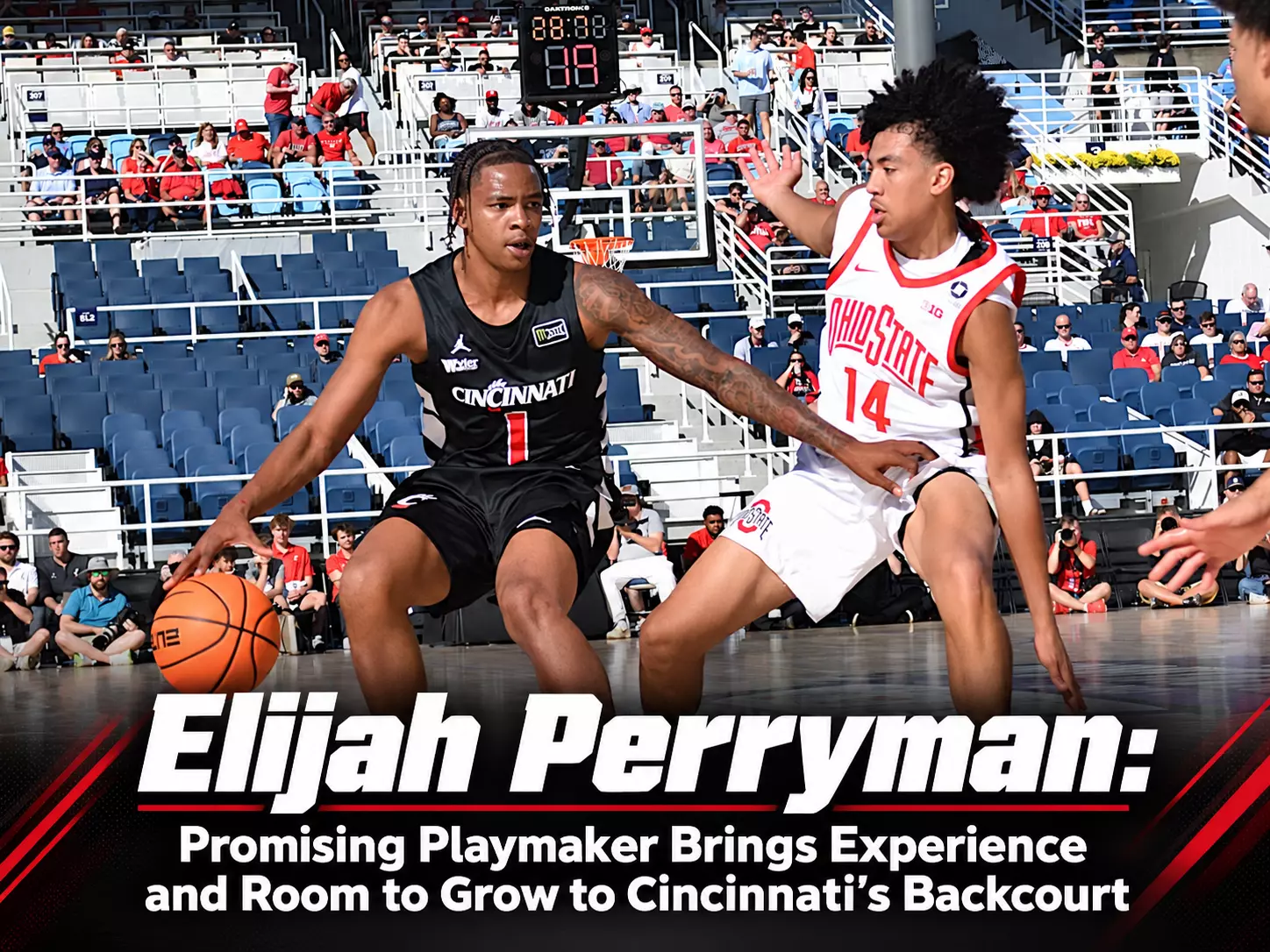
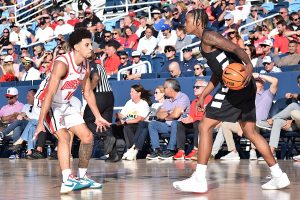
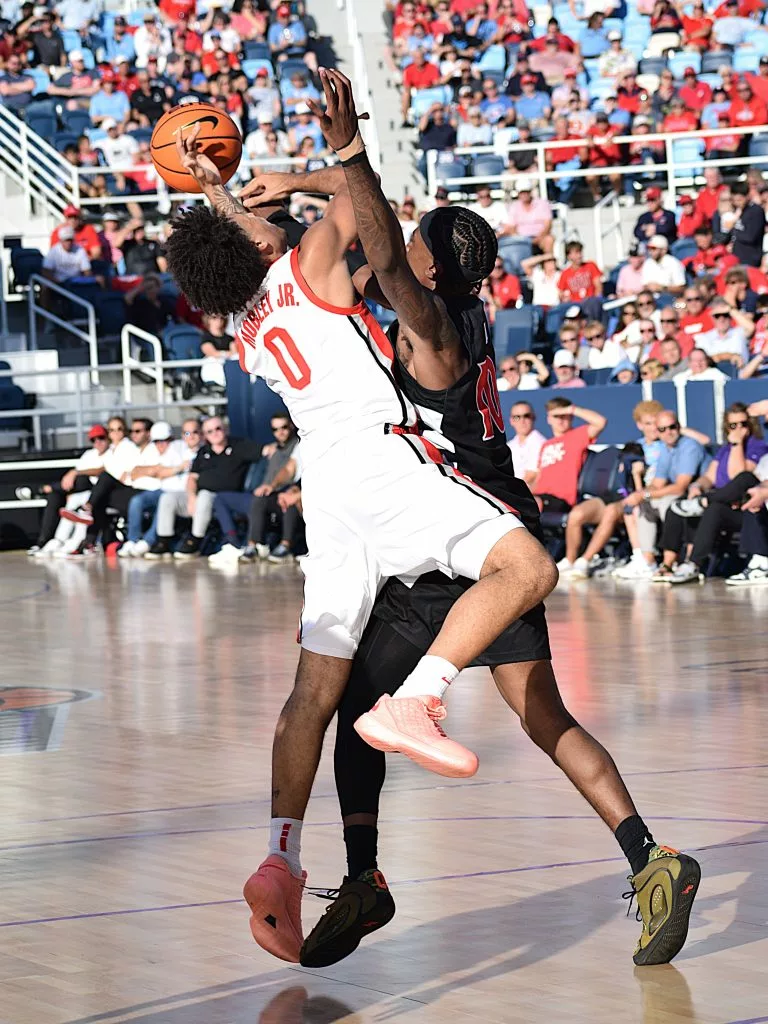
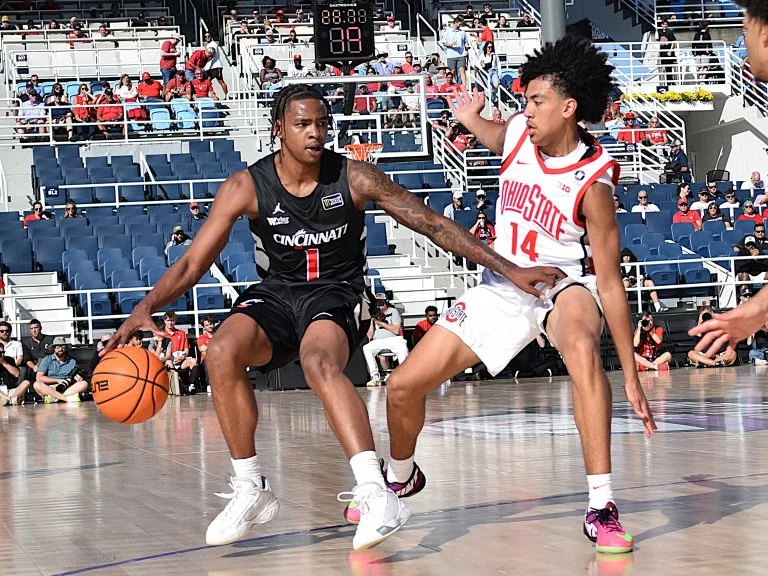
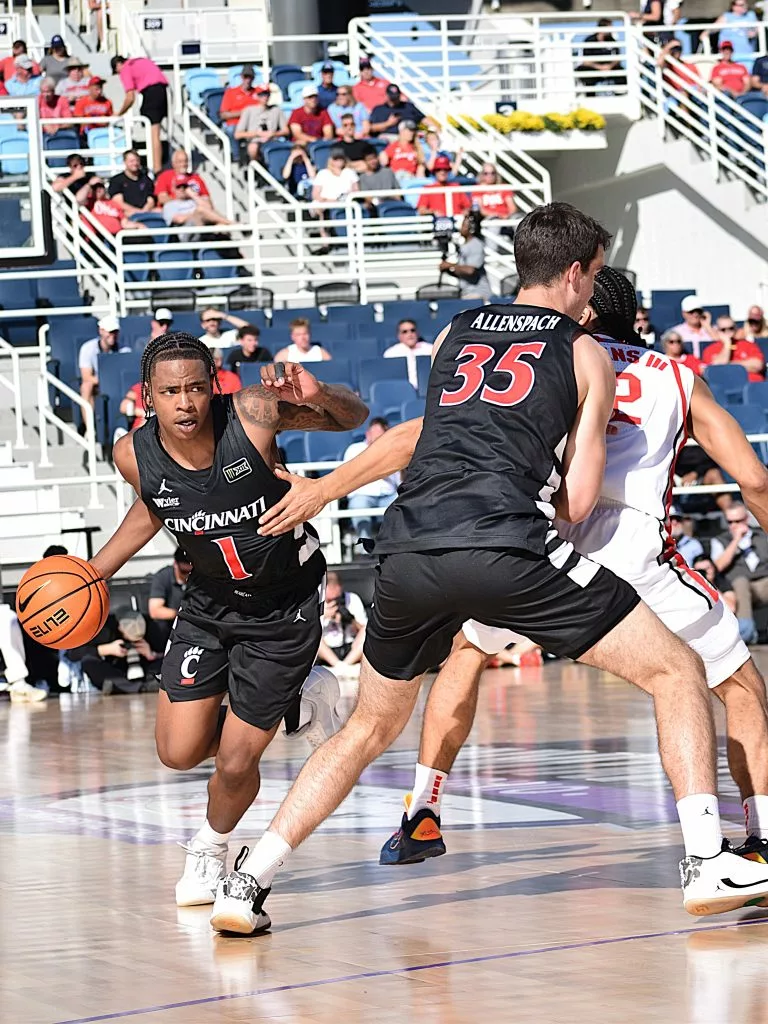
Elijah Perryman: Promising Playmaker Brings Experience and Room to Grow to Cincinnati’s Backcourt
Position:
Guard
Height:
6-foot-2
Weight:
190 pounds
Class:
Sophomore
Hometown:
San Francisco, California
High School:
Clayton Valley Charter
Current Team:
Cincinnati Bearcats
Previous School:
Utah State
Jersey Number:
1
Season:
2026–27
Elijah Perryman arrives at Cincinnati with a foundation built on distributing the basketball and making the most of limited minutes. After appearing in every game during his freshman season at Utah State, the sophomore guard brings the Bearcats college experience alongside considerable room for development.
His first season showed an ability to create opportunities for teammates, provide occasional scoring bursts, and contribute defensively. Cincinnati now offers the next challenge: turning those promising moments into dependable production against Big 12 competition.
The Past: Building an All-Around Game in California
A San Francisco native, Perryman established himself at Clayton Valley Charter High School in Concord, California. Across three varsity seasons and 77 games, he averaged 15.2 points, 5.2 rebounds, 4.3 assists, and 2.4 steals.
Those numbers reflect a player who contributed in several ways. Perryman scored, helped organize the offense, rebounded from the backcourt, and generated defensive opportunities.
He earned all-state recognition during his junior season, when he averaged 15.6 points and 5.3 rebounds. As a senior in 2024–25, he increased his scoring to 16.9 points per game while adding 5.3 rebounds and 4.2 assists, helping Clayton Valley Charter reach a regional final.
His production attracted recruiting attention. According to the supplied biography, 247Sports ranked him as the No. 29 point guard in the 2025 class and the No. 25 overall prospect in California.
That background prepared him for a different role at Utah State, where he would need to contribute within shorter stretches of playing time.
His Freshman Season: Playmaking in Limited Minutes
Perryman appeared in all 36 games for Utah State in 2025–26, making one start and averaging 13.9 minutes per game. He finished with averages of 4.4 points and 3.1 assists.
The assist production stands out in the context of his minutes. Although he primarily came off the bench, Perryman led Utah State in assists on eight occasions. His season-high 10 assists against San Jose State on January 3 provided a clear example of his ability to create scoring chances for others.
He also showed that he could supply offense himself. Perryman scored in double figures six times, highlighted by a season-high 16 points against Fresno State on February 10.
For the season, he shot 43.9 percent from the field, 29.6 percent from three-point range, and 80.0 percent at the free-throw line. He added 28 steals and nine blocks.
Those results give
Cincinnati
a useful starting point for evaluating his game. His passing already produced meaningful contributions, while his scoring efficiency and perimeter consistency leave identifiable areas for growth.
The Present: A New Opportunity With the Bearcats
Perryman enters
Cincinnati’s backcourt with experience playing throughout a full college season. Appearing in all 36 games at Utah State gave him repeated opportunities to adjust to the pace and demands of the college game.
His next task is to earn responsibility within a new roster and system. His precise role will depend on practice performance, lineup combinations, and how effectively he handles the transition to Big 12 opponents.
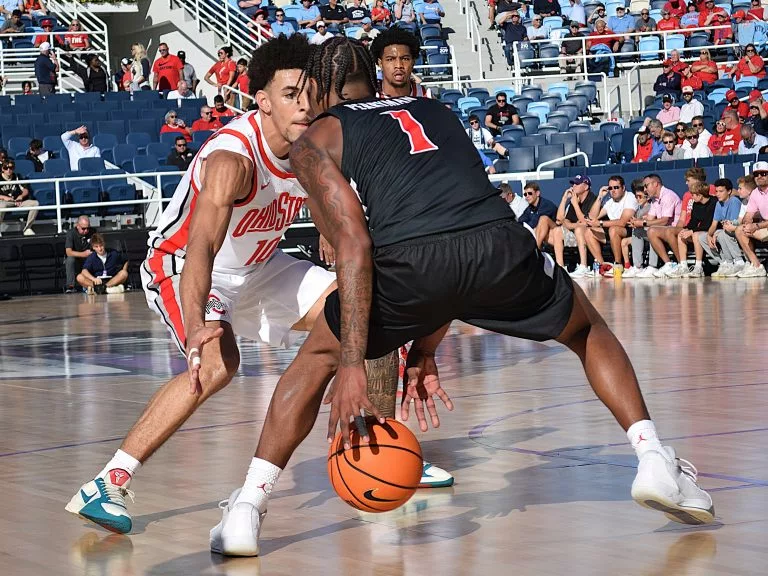
Passing offers a clear route to contributing. A guard who can initiate offense, recognize an open teammate, and keep possessions moving can help several different lineup combinations function.
For Perryman, the key will be pairing that creativity with sound decisions. His biography does not include turnover totals, so his assist numbers alone cannot establish how securely he managed possessions. Demonstrating both playmaking and ball security will be important as he competes for minutes.
His Strengths: Distribution, Versatility, and Free-Throw Touch
Perryman’s most established college strength is his ability to distribute the basketball. Averaging 3.1 assists in fewer than 14 minutes per game shows that he generated opportunities for teammates even in a supporting role.
His high school record adds evidence of a broader skill set. Consistent contributions in scoring, rebounding, assists, and steals suggest experience carrying responsibilities beyond a single offensive assignment.
At Utah State, his six double-figure scoring games showed that he could provide offense when opportunities developed. He has not yet established himself as a high-volume college scorer, but those performances give him something to build on.
His 80.0 percent free-throw shooting is another encouraging element, though it came on just 35 attempts. Maintaining that accuracy while earning more trips to the line would add value to his offensive game.
Defensively, his 28 steals demonstrate an ability to generate takeaways. Translating that activity into consistent positioning and reliable on-ball defense will matter against the guards he encounters in the Big 12.
Personal Goals and Future: Developing Into a More Complete Guard
Perryman’s supplied biography does not identify specific personal goals. His freshman results nevertheless point toward several practical development priorities.
The most obvious offensive opportunity is improving his three-point shooting. He made 16 of 54 attempts at Utah State, finishing at 29.6 percent. Greater consistency could encourage defenders to stay closer to him, potentially opening additional passing and driving opportunities.
Another priority is managing a larger role if he earns one. Production in short stretches does not automatically translate to extended minutes. Maintaining decision-making, defensive effort, and efficiency through longer appearances would represent a meaningful step.
His development as a scorer should also support his passing. Becoming a more credible threat to finish possessions can force defenders to make tougher choices, creating better opportunities for teammates.
As a sophomore, Perryman has time to build his college résumé. Any professional projection would be premature, but sustained growth at
Cincinnati
could establish a stronger foundation for his long-term basketball future.
Team Goals: Helping Cincinnati Create Better Shots
Perryman’s potential value to the Bearcats begins with the quality of possessions he helps create.
His passing could help
Cincinnati
find open perimeter shooters, deliver the ball to interior scorers, and capitalize on transition opportunities. To make that contribution dependable, he will need to understand teammates’ strengths and recognize when to push the pace or organize the offense.
Defensive consistency will be equally important. Staying in front of opposing guards and executing team assignments can help him contribute even when he is not scoring.
Competing successfully in the Big 12 and pursuing an NCAA Tournament berth are reasonable benchmarks for
Cincinnati, rather than documented team declarations in the supplied biography. Perryman can support that pursuit by providing reliable backcourt minutes and helping the offense generate good shots.
Conclusion
Elijah Perryman brings
Cincinnati
a promising combination of passing production, full-season college experience, and developmental upside. His freshman season at Utah State demonstrated that he could influence games through distribution while delivering occasional scoring contributions.
The next step is greater consistency across his game. If Perryman improves his perimeter shooting, protects possessions, and earns defensive trust, he could grow into a valuable contributor in the Bearcats’ backcourt.
New Users – Get $350 in Bonus Bets when you wager $5 for 7 days
T&Cs apply
4.6/5
Gambling Problem? Call 1-800-GAMBLER or 1-800-MY-RESET. Call 1-888-789-7777 or visit ccpgg.org/chat (CT). Hope is here. GamblingHelpLineMA.org or call (800) 327-5050 for 24/7 support (MA). Visit www.mdgamblinghelp.org (MD). Call 1-877-8HOPE-NY or text HOPENY (NY). 21+ (18+ DC, WY) and present in select states (for KS, in affiliation with Kansas Star Casino). Find online real money wagering only. Min $5 wager required for 7 consecutive days. $5 free play credit. Bonus issued as non-withdrawable bonus with cash withdrawable bonus with cash withdrawable. Bonus bets which expire 7 days after receipt. Restrictions apply. See terms at sportsbook.fanduel.com. Call 1-877-770-7867 (LA).
Up To $1500 in Bonus Bets Paid Back if your First Bet Does Not Win
T&Cs apply
4.5/5
Gambling problem? Call 1-800-GAMBLER or 1-800-MY-RESET (Available in the US) 877-8-HOPENY or text HOPENY (467369) (NY) 1-800-327-5050 (MA), 1-800-BETS-OFF (IA), 1-800-981-0023 (PR). 21+ only. Please Gamble Responsibly. See BetMGM.com for Terms. First Bet Offer for new customers only (if applicable). Subject to eligibility requirements. Bonus bets are non-withdrawable. In partnership with Kansas Crossing Casino and Hotel. Promotional offers not available in Mississippi, Massachusetts, New York, Ontario, or Puerto Rico.
New DraftKings Customers: Bet $5, Get $200 + 3 Months of NBA League Pass!
T&Cs apply
4.5/5
GAMBLING PROBLEM? CALL 1-800-GAMBLER or 1-800-MY-RESET, (800) 327-5050 or visit gamblinghelplinema.org (MA). Please Gamble Responsibly. 888-789-7777/visit ccpg.org (CT), or visit www.mdgamblinghelp.org (MD), 1-800-981-0023 (PR). 21+ and present in most states. (18+ DC/NH/PR/WY). Void in CAN. Eligibility restrictions apply. On behalf of Boot Hill Casino (KS). Pass-thru of per wager tax may apply in IL. 1 per new Sportsbook customer. $5+ first-time bet req. Max. $200 issued as non-withdrawable Bonus Bets. Stake removed from payout. Reward issued as $50 in Bonus Bets every 7 days via click-to-claim for 21 days. Bonus Bets and click-to-claims expire 7 days (168hrs) after issuance. Terms: dkng.co/offer. Get 1 promo code to redeem a 3-month NBA League Pass subscription, complimentary of DraftKings. Subscription auto-renews monthly at then-current price (currently $16.99/mo); cancel anytime. Terms, restrictions, and eligibility requirements apply. Redeem League Pass by 12/19/26 at 11:59 PM ET. Addt’l terms: support.watch.nba.com/hc/en-us/articles/9165532876183-League-Pass-Terms-of-Use_. Ends 11/29/26 at 11:59 PM ET. Sponsored by DK.
Must be 21+. GAMBLING PROBLEM? CALL 1-800-GAMBLER OR CALL 1-800-MY-RESET, www.mdgamblinghelp.org (MD), (800)-327-5050 or gamblinghelplinema.org (MA), Call (877)8-HOPENY or text HOPENY (467369) (NY), (888) 789-7777 or ccpg.org (CT), morethanagame.nc.gov (NC), 1800gambler.net (WV)
Bet $1 and get double the winnings up to $25 for your next 10 bets
T&Cs apply
4.4/5
21+ New users only. Must register using eligible promo code. First bet after registration must qualify. Max. Bonus Bet: $1,000. Bonus Bet expires 14 days after receipt. Void where prohibited. See Caesars.com/promos for full terms. Gambling Problem? 1-800-GAMBLER (1-800-426-2537)
21+ and present in OH. Gambling Problem? Call 1-800-GAMBLER.
This site is using
Cloudflare
and adheres to the
Google Safe Browsing Program. We adapted
Google's Privacy Guidelines
to keep your data safe at all times.
Close
Ready to Win Big? Join the Elite with Our Sports Betting Deals!
FanDuel Promo
New Users – Get $350 in Bonus Bets when you wager $5 for 7 days
Our Favorite
T&Cs and 21+ apply
Gambling Problem? Call 1-800-GAMBLER or 1-800-MY-RESET. Call 1-888-789-7777 or visit ccpgg.org/chat (CT). Hope is here. GamblingHelpLineMA.org or call (800) 327-5050 for 24/7 support (MA). Visit www.mdgamblinghelp.org (MD). Call 1-877-8HOPE-NY or text HOPENY (NY). 21+ (18+ DC, WY) and present in select states (for KS, in affiliation with Kansas Star Casino). Find online real money wagering only. Min $5 wager required for 7 consecutive days. $5 free play credit. Bonus issued as non-withdrawable bonus with cash withdrawable bonus with cash withdrawable. Bonus bets which expire 7 days after receipt. Restrictions apply. See terms at sportsbook.fanduel.com. Call 1-877-770-7867 (LA).
Code:
Open FanDuel
Get Bonus
BetMGM Promo
Up To $1500 in Bonus Bets Paid Back if your First Bet Does Not Win
Best Slots
T&Cs and 21+ apply
Gambling problem? Call 1-800-GAMBLER or 1-800-MY-RESET (Available in the US) 877-8-HOPENY or text HOPENY (467369) (NY) 1-800-327-5050 (MA), 1-800-BETS-OFF (IA), 1-800-981-0023 (PR). 21+ only. Please Gamble Responsibly. See BetMGM.com for Terms. First Bet Offer for new customers only (if applicable). Subject to eligibility requirements. Bonus bets are non-withdrawable. In partnership with Kansas Crossing Casino and Hotel. Promotional offers not available in Mississippi, Massachusetts, New York, Ontario, or Puerto Rico.
Code:
Open BetMGM
Get Bonus
DraftKings Promo
New DraftKings Customers: Bet $5, Get $200 + 3 Months of NBA League Pass!
Newcomer
T&Cs and 21+ apply
GAMBLING PROBLEM? CALL 1-800-GAMBLER or 1-800-MY-RESET, (800) 327-5050 or visit gamblinghelplinema.org (MA). Please Gamble Responsibly. 888-789-7777/visit ccpg.org (CT), or visit www.mdgamblinghelp.org (MD), 1-800-981-0023 (PR). 21+ and present in most states. (18+ DC/NH/PR/WY). Void in CAN. Eligibility restrictions apply. On behalf of Boot Hill Casino (KS). Pass-thru of per wager tax may apply in IL. 1 per new Sportsbook customer. $5+ first-time bet req. Max. $200 issued as non-withdrawable Bonus Bets. Stake removed from payout. Reward issued as $50 in Bonus Bets every 7 days via click-to-claim for 21 days. Bonus Bets and click-to-claims expire 7 days (168hrs) after issuance. Terms: dkng.co/offer. Get 1 promo code to redeem a 3-month NBA League Pass subscription, complimentary of DraftKings. Subscription auto-renews monthly at then-current price (currently $16.99/mo); cancel anytime. Terms, restrictions, and eligibility requirements apply. Redeem League Pass by 12/19/26 at 11:59 PM ET. Addt’l terms: support.watch.nba.com/hc/en-us/articles/9165532876183-League-Pass-Terms-of-Use_. Ends 11/29/26 at 11:59 PM ET. Sponsored by DK.
Code:
Open DraftKings
Get Bonus
Find out what the legends have to say about sports this week....
New Users – Get $350 in Bonus Bets when you wager $5 for 7 days
Gambling Problem? Call 1-800-GAMBLER or 1-800-MY-RESET. Call 1-888-789-7777 or visit ccpgg.org/chat (CT). Hope is here. GamblingHelpLineMA.org or call (800) 327-5050 for 24/7 support (MA). Visit www.mdgamblinghelp.org (MD). Call 1-877-8HOPE-NY or text HOPENY (NY). 21+ (18+ DC, WY) and present in select states (for KS, in affiliation with Kansas Star Casino). Find online real money wagering only. Min $5 wager required for 7 consecutive days. $5 free play credit. Bonus issued as non-withdrawable bonus with cash withdrawable bonus with cash withdrawable. Bonus bets which expire 7 days after receipt. Restrictions apply. See terms at sportsbook.fanduel.com. Call 1-877-770-7867 (LA).