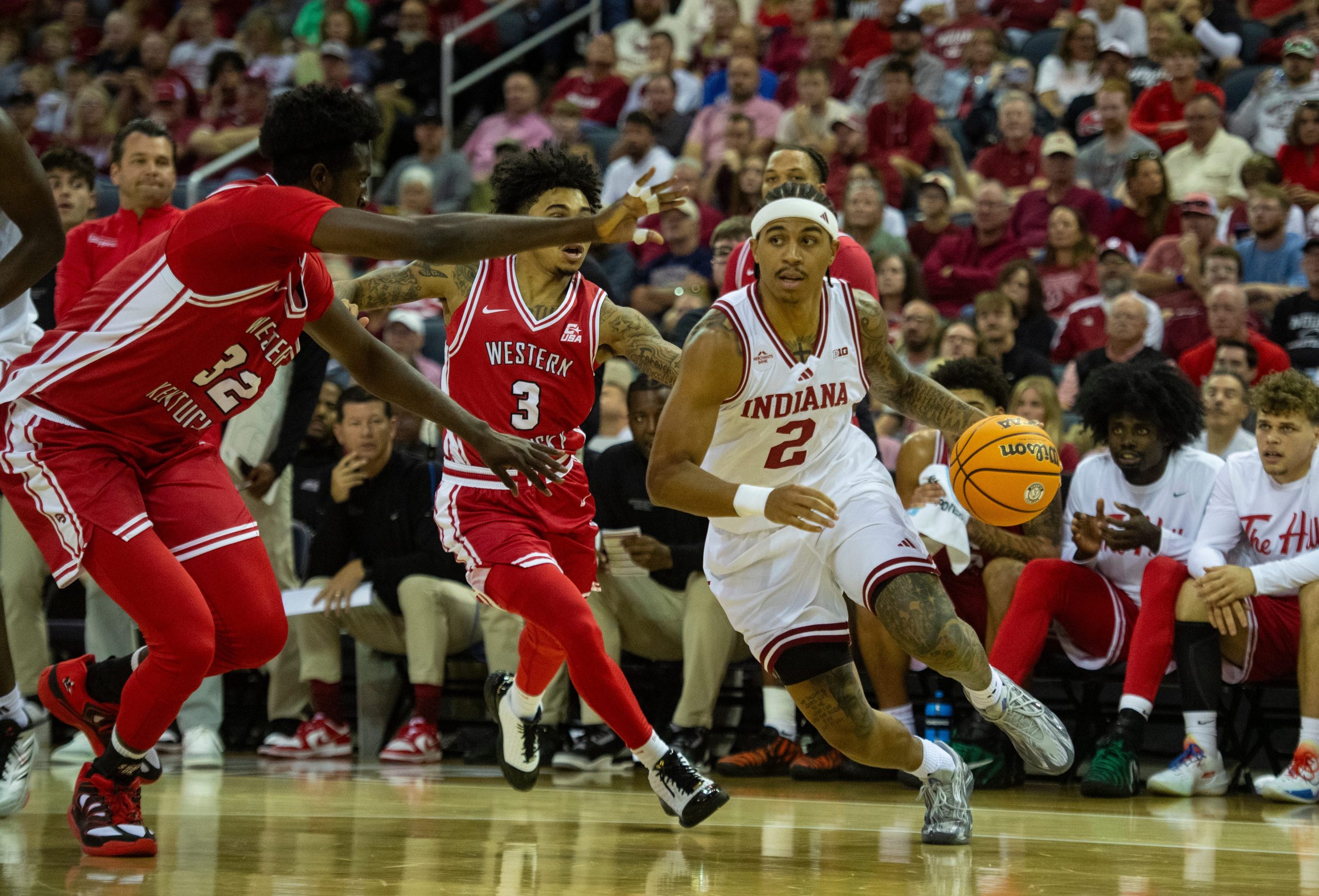
Indiana's Bryce Lindsay (2) drives as the Indiana Hoosiers play the Western Kentucky Hilltoppers in an exhibition game at Ford Center in Evansville, Ind., Sunday, Oct. 25, 2026.
Bryce Lindsay has given Indiana more than a hot shooting stretch. He has given Darian DeVries a decision worth thinking about.
After scoring
26 points against North Carolina, Lindsay followed with
20 against Western Kentucky, leading the Hoosiers in scoring in consecutive exhibition victories. He came off the bench in both games, making his impact difficult to ignore as Indiana prepares for the regular season.
The immediate question is whether he should start. The more important question is how Indiana can make the best use of his shooting across different combinations.
His preseason production has strengthened the case for a substantial offensive role. Whether that role begins at the opening tip or with an early substitution should depend on what makes the entire rotation work.
The Production Has Been Efficient
Lindsay’s scoring
has come without needing an excessive number of attempts.
Against North Carolina, he made
eight of 14 shots, including
four of nine three-pointers, and converted all six free throws. Against Western Kentucky, he finished
six of 11 from the field,
four of eight from three
and
four of six at the line.
Across those two games, that amounts to
46 points on 14-of-25 shooting, with
eight makes in 17 three-point attempts.
Those are encouraging numbers, particularly because they came in different kinds of games. Indiana controlled North Carolina in a
76–58 victory. Western Kentucky forced the Hoosiers to recover from an 11-point deficit before winning
79–74.
Lindsay contributed when Indiana was establishing an advantage and when it needed to recover one.
That does not establish a season-long scoring average. It does establish that his preseason influence has extended beyond one favorable matchup or one unusually productive half.
His Shooting Can Make Indiana’s Size More Effective
Indiana’s frontcourt gives opponents a reason to put bodies near the basket. Lindsay gives them a reason to hesitate.
That relationship matters.
An interior player can establish position, receive the ball and still face an unfavorable possession if help defenders feel comfortable abandoning the perimeter. A crowded paint reduces finishing space and makes the next pass harder to complete.
A respected shooter changes that calculation.
If Lindsay’s defender moves toward the post, Indiana has a potential three-point opportunity available. If that defender stays attached, the player inside may have more room to operate.
The benefit can also reach the guards. Driving lanes become more useful when a defender cannot comfortably step away from a shooter to crowd the ball.
This is the tactical case for Lindsay’s importance. His value is not limited to the shots he makes. It can include the attention he requires and the opportunities that attention leaves elsewhere.
The next step is sustaining enough shooting credibility that opponents continue to respect him when the schedule becomes more demanding.
Western Kentucky Showed Why Indiana Needs Alternatives
The exhibition finale offered a useful example of the need for offensive flexibility.
Western Kentucky’s pressure disrupted Indiana, and the Hoosiers ultimately leaned on a closing group of
Lindsay, Sam Alexis, Trevor Manhertz, Prince-Alexander Moody and Vaughn Karvala
to complete the comeback.
That combination is worth examining because it worked when the game remained competitive.
Lindsay provided an experienced scoring option alongside three freshmen and an interior finisher. Indiana did not need every player to create the same kind of shot. It needed their skills to complement one another.
That is a useful direction for DeVries as he evaluates combinations. The best five players in a particular stretch may be the five whose abilities fit the game’s demands, even if they were not the opening group.
Lindsay has made a strong case to be part of those decisions.
There Is a Credible Argument for Starting Him
The argument for moving Lindsay into the starting lineup is straightforward: Indiana should consider using one of its most productive preseason scorers from the beginning.
His shooting could help establish space immediately. It could also give the offense another scoring option before an opponent has settled into its preferred defensive approach.
Against North Carolina, Indiana opened with
Markus Burton, Jaeden Mustaf, Darren Harris, Aiden Sherrell and Samet Yigitoglu. Lindsay’s performance has given DeVries a reason to evaluate how a different balance of shooting and size might function.
That is not an argument for automatically removing a particular player. A starting lineup must account for defense, ball handling, rebounding and matchups as well as shooting.
But exhibition performance should influence the discussion. Lindsay has earned that consideration through what he has produced.
Keeping Him on the Bench Can Also Make Sense
There is an equally reasonable argument for retaining Lindsay as an early reserve.
A rotation needs offensive continuity after substitutions. If too much creation and shooting are concentrated in the opening group, the first changes can make the offense easier to defend.
Lindsay can help prevent that.
He can enter alongside starters, play with a younger group or provide scoring when another guard is struggling. His role can change within the same game without changing his importance.
The danger would be treating a bench designation as a reason to delay using him or limit his opportunities. Indiana can retain the flexibility of a reserve role while still giving Lindsay substantial responsibility.
Starting and finishing are separate decisions. So are starting and being central to the offense.
For DeVries, the objective should be finding the combinations in which Lindsay improves the team most consistently.
The Regular Season Will Ask More of Him
Two strong exhibitions do not guarantee the same efficiency against every opponent.
Defenses will build more specific plans. They can deny comfortable catches, challenge his release and force decisions after he puts the ball on the floor. Physical opponents may test whether he can maintain his effectiveness while being closely guarded.
His evaluation also must include possessions when he is not shooting.
Can he keep the ball moving when the first opportunity disappears? Can he contribute defensively enough to remain on the floor in demanding matchups? Can he help Indiana maintain its spacing without forcing an attempt simply because his recent numbers are strong?
Those questions are not reasons to discount his start. They are the next stages of determining how large his role should become.
Lindsay Has Earned Responsibility
The strongest conclusion from
Indiana’s preseason
is that Lindsay needs to be a significant part of the offensive plan.
He has supplied scoring, perimeter shooting and a productive option in games with very different demands. His presence offers a way to connect Indiana’s interior size with a more difficult perimeter attack.
The starting question deserves consideration, but it should not overshadow that larger point.
Lindsay has made his case for minutes and meaningful possessions. Now Indiana must find the combinations that turn his encouraging preseason into a dependable regular-season contribution.
New Users – Get $350 in Bonus Bets when you wager $5 for 7 days
T&Cs apply
4.6/5
Gambling Problem? Call 1-800-GAMBLER or 1-800-MY-RESET. Call 1-888-789-7777 or visit ccpgg.org/chat (CT). Hope is here. GamblingHelpLineMA.org or call (800) 327-5050 for 24/7 support (MA). Visit www.mdgamblinghelp.org (MD). Call 1-877-8HOPE-NY or text HOPENY (NY). 21+ (18+ DC, WY) and present in select states (for KS, in affiliation with Kansas Star Casino). Find online real money wagering only. Min $5 wager required for 7 consecutive days. $5 free play credit. Bonus issued as non-withdrawable bonus with cash withdrawable bonus with cash withdrawable. Bonus bets which expire 7 days after receipt. Restrictions apply. See terms at sportsbook.fanduel.com. Call 1-877-770-7867 (LA).
Get Up to $1,000 Back in Bonus Bets Over Your First 10 Days
T&Cs apply
4.5/5
Gambling problem? Call 1-800-GAMBLER or 1-800-MY-RESET (Available in the US) 877-8-HOPENY or text HOPENY (467369) (NY) 1-800-327-5050 (MA), 1-800-BETS-OFF (IA), 21+ only. Please Gamble Responsibly. Visit mdgamblinghelp.org (MD). See BetMGM.com for Terms. New Player Offer for new players only. Subject to eligibility requirements. Bonus bets are non-withdrawable. In partnership with Kansas Crossing Casino and Hotel. This promotional offer is not available in NJ, MA, MI, NV, NY, ON, PA, PR, and WV.
New DraftKings Customers: Bet $5, Get $200 + 3 Months of NBA League Pass!
T&Cs apply
4.5/5
GAMBLING PROBLEM? CALL 1-800-GAMBLER or 1-800-MY-RESET, (800) 327-5050 or visit gamblinghelplinema.org (MA). Please Gamble Responsibly. 888-789-7777/visit ccpg.org (CT), or visit www.mdgamblinghelp.org (MD), 1-800-981-0023 (PR). 21+ and present in most states. (18+ DC/NH/PR/WY). Void in CAN. Eligibility restrictions apply. On behalf of Boot Hill Casino (KS). Pass-thru of per wager tax may apply in IL. 1 per new Sportsbook customer. $5+ first-time bet req. Max. $200 issued as non-withdrawable Bonus Bets. Stake removed from payout. Reward issued as $50 in Bonus Bets every 7 days via click-to-claim for 21 days. Bonus Bets and click-to-claims expire 7 days (168hrs) after issuance. Terms: dkng.co/offer. Get 1 promo code to redeem a 3-month NBA League Pass subscription, complimentary of DraftKings. Subscription auto-renews monthly at then-current price (currently $16.99/mo); cancel anytime. Terms, restrictions, and eligibility requirements apply. Redeem League Pass by 12/19/26 at 11:59 PM ET. Addt’l terms: support.watch.nba.com/hc/en-us/articles/9165532876183-League-Pass-Terms-of-Use_. Ends 11/29/26 at 11:59 PM ET. Sponsored by DK.
Must be 21+. GAMBLING PROBLEM? CALL 1-800-GAMBLER OR CALL 1-800-MY-RESET, www.mdgamblinghelp.org (MD), (800)-327-5050 or gamblinghelplinema.org (MA), Call (877)8-HOPENY or text HOPENY (467369) (NY), (888) 789-7777 or ccpg.org (CT), morethanagame.nc.gov (NC), 1800gambler.net (WV)
Bet $1 and get double the winnings up to $25 for your next 10 bets
T&Cs apply
4.4/5
21+ New users only. Must register using eligible promo code. First bet after registration must qualify. Max. Bonus Bet: $1,000. Bonus Bet expires 14 days after receipt. Void where prohibited. See Caesars.com/promos for full terms. Gambling Problem? 1-800-GAMBLER (1-800-426-2537)
21+ and present in OH. Gambling Problem? Call 1-800-GAMBLER.
This site is using
Cloudflare
and adheres to the
Google Safe Browsing Program. We adapted
Google's Privacy Guidelines
to keep your data safe at all times.
Close
Ready to Win Big? Join the Elite with Our Sports Betting Deals!
FanDuel Promo
New Users – Get $350 in Bonus Bets when you wager $5 for 7 days
Our Favorite
T&Cs and 21+ apply
Gambling Problem? Call 1-800-GAMBLER or 1-800-MY-RESET. Call 1-888-789-7777 or visit ccpgg.org/chat (CT). Hope is here. GamblingHelpLineMA.org or call (800) 327-5050 for 24/7 support (MA). Visit www.mdgamblinghelp.org (MD). Call 1-877-8HOPE-NY or text HOPENY (NY). 21+ (18+ DC, WY) and present in select states (for KS, in affiliation with Kansas Star Casino). Find online real money wagering only. Min $5 wager required for 7 consecutive days. $5 free play credit. Bonus issued as non-withdrawable bonus with cash withdrawable bonus with cash withdrawable. Bonus bets which expire 7 days after receipt. Restrictions apply. See terms at sportsbook.fanduel.com. Call 1-877-770-7867 (LA).
Code:
Open FanDuel
Get Bonus
BetMGM Promo
Get Up to $1,000 Back in Bonus Bets Over Your First 10 Days
Best Slots
T&Cs and 21+ apply
Gambling problem? Call 1-800-GAMBLER or 1-800-MY-RESET (Available in the US) 877-8-HOPENY or text HOPENY (467369) (NY) 1-800-327-5050 (MA), 1-800-BETS-OFF (IA), 21+ only. Please Gamble Responsibly. Visit mdgamblinghelp.org (MD). See BetMGM.com for Terms. New Player Offer for new players only. Subject to eligibility requirements. Bonus bets are non-withdrawable. In partnership with Kansas Crossing Casino and Hotel. This promotional offer is not available in NJ, MA, MI, NV, NY, ON, PA, PR, and WV.
Code:
Open BetMGM
Get Bonus
DraftKings Promo
New DraftKings Customers: Bet $5, Get $200 + 3 Months of NBA League Pass!
Newcomer
T&Cs and 21+ apply
GAMBLING PROBLEM? CALL 1-800-GAMBLER or 1-800-MY-RESET, (800) 327-5050 or visit gamblinghelplinema.org (MA). Please Gamble Responsibly. 888-789-7777/visit ccpg.org (CT), or visit www.mdgamblinghelp.org (MD), 1-800-981-0023 (PR). 21+ and present in most states. (18+ DC/NH/PR/WY). Void in CAN. Eligibility restrictions apply. On behalf of Boot Hill Casino (KS). Pass-thru of per wager tax may apply in IL. 1 per new Sportsbook customer. $5+ first-time bet req. Max. $200 issued as non-withdrawable Bonus Bets. Stake removed from payout. Reward issued as $50 in Bonus Bets every 7 days via click-to-claim for 21 days. Bonus Bets and click-to-claims expire 7 days (168hrs) after issuance. Terms: dkng.co/offer. Get 1 promo code to redeem a 3-month NBA League Pass subscription, complimentary of DraftKings. Subscription auto-renews monthly at then-current price (currently $16.99/mo); cancel anytime. Terms, restrictions, and eligibility requirements apply. Redeem League Pass by 12/19/26 at 11:59 PM ET. Addt’l terms: support.watch.nba.com/hc/en-us/articles/9165532876183-League-Pass-Terms-of-Use_. Ends 11/29/26 at 11:59 PM ET. Sponsored by DK.
Code:
Open DraftKings
Get Bonus
Find out what the legends have to say about sports this week....
New Users – Get $350 in Bonus Bets when you wager $5 for 7 days
Gambling Problem? Call 1-800-GAMBLER or 1-800-MY-RESET. Call 1-888-789-7777 or visit ccpgg.org/chat (CT). Hope is here. GamblingHelpLineMA.org or call (800) 327-5050 for 24/7 support (MA). Visit www.mdgamblinghelp.org (MD). Call 1-877-8HOPE-NY or text HOPENY (NY). 21+ (18+ DC, WY) and present in select states (for KS, in affiliation with Kansas Star Casino). Find online real money wagering only. Min $5 wager required for 7 consecutive days. $5 free play credit. Bonus issued as non-withdrawable bonus with cash withdrawable bonus with cash withdrawable. Bonus bets which expire 7 days after receipt. Restrictions apply. See terms at sportsbook.fanduel.com. Call 1-877-770-7867 (LA).