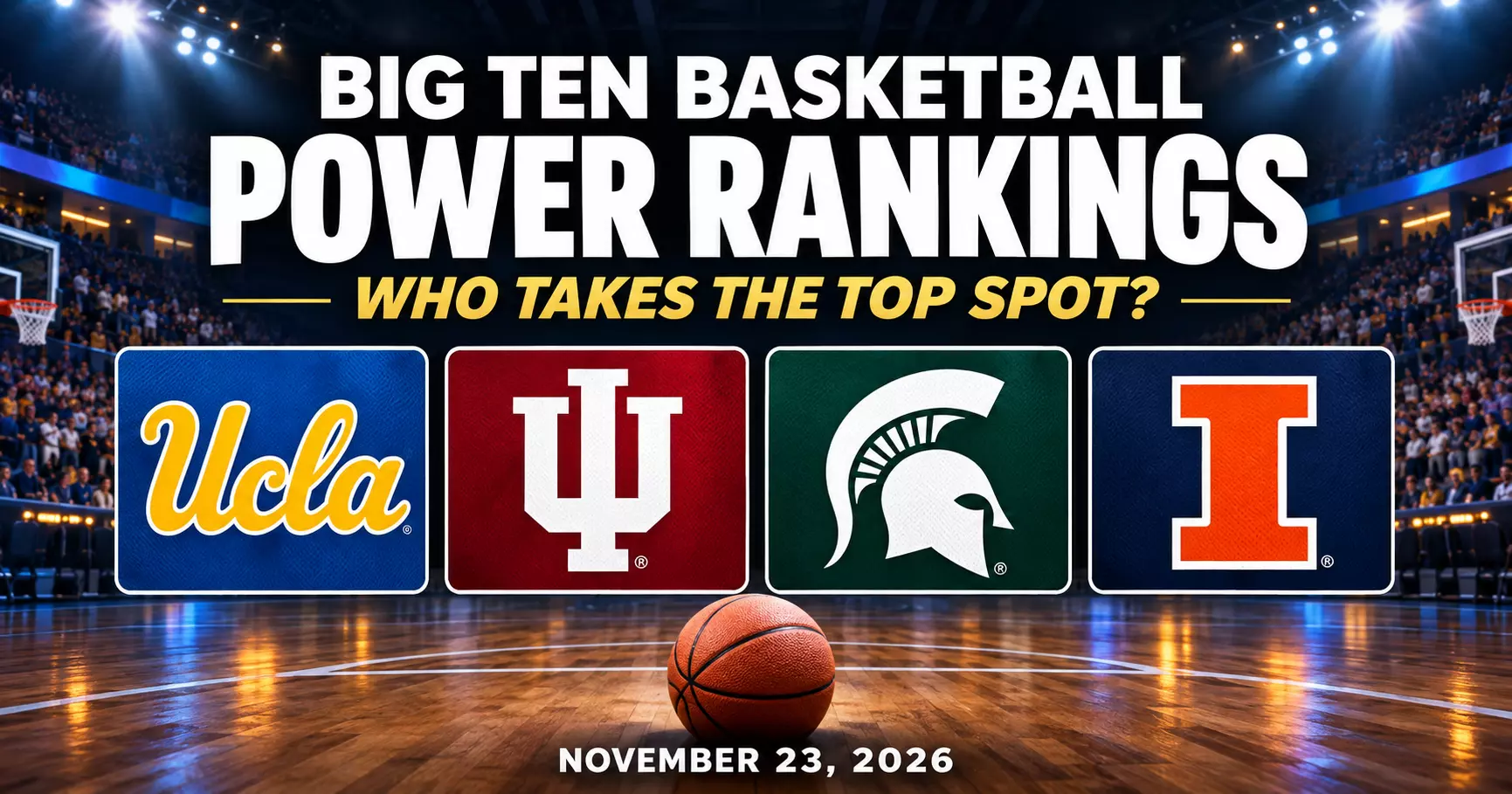
November is already separating the Big Ten’s contenders from teams with considerable work ahead. Sunday brought more Big Ten Action.
November is already separating the Big Ten’s contenders from teams with considerable work ahead. Sunday brought more wins for Minnesota, Nebraska, UCLA and USC, while Northwestern finally stopped its losing streak.
The toughest decision comes at the top. Illinois owns a spectacular victory at Duke, UCLA remains unbeaten, and Michigan State has already beaten the Blue Devils. Indiana gets the edge this week because the Hoosiers have combined an unbeaten record with victories over Syracuse, Arkansas and Kentucky away from Bloomington.
These rankings weigh results, opponent quality and recent form. They represent where teams stand today, rather than a prediction of the final conference standings. Here is the countdown from No. 18 to No. 1.
18. Northwestern Wildcats
Record: 4–3
Northwestern finally delivered the response it needed, beating Dayton 79–55 on Sunday behind 26 points from Jack Karasinski and 21 points and eight assists from Jake West. The Wildcats shot 58 percent and committed only eight turnovers. That combination gave them control of a game they badly needed.
One strong afternoon, however, does not erase the preceding stretch. Northwestern had lost three straight games, including damaging home defeats against DePaul and Columbia. Those results leave the Wildcats with the conference’s weakest overall body of work in these rankings.
West’s production gives this team something to build around, and Sunday showed how much better the offense can function when multiple players contribute. The next step is repeating that execution. Northwestern needs to establish a reliable offensive floor before it can climb out of the bottom tier.
17. Wisconsin Badgers
Record: 4–2
Wisconsin’s trip to the Bahamas raised serious questions. The Badgers lost 74–69 to Seton Hall and followed that with a 70–53 defeat against Murray State. The second result was especially troubling because Wisconsin never developed enough offensive consistency to take control.
Against Murray State, the Badgers shot 21-for-58 from the field, made five of 25 three-point attempts and committed 17 turnovers. Jackson Ball provided a positive with a career-high 12 points, but Wisconsin needs considerably more production across its rotation.
This placement reflects current performance. The Badgers have time to recover, but a four-win start at home carries less weight after consecutive neutral-court losses. Better shot selection, stronger ball security and more dependable scoring around Nolan Winter are immediate priorities. Until those areas improve, Wisconsin belongs near the bottom of this conference.
16. Maryland Terrapins
Record: 3–2
Pharrel Payne gave Maryland the kind of interior performance that can anchor an offense, finishing with 25 points, 13 rebounds and four blocks in Friday’s 62–45 victory over Wagner. Andre Mills added 13 points, and the Terrapins held their opponent to 32 percent shooting.
The concern is how that translates against stronger competition. Maryland has already lost to Georgetown and Virginia, leaving it without the significant victory needed to move ahead of the conference’s more convincing teams.
Payne gives the Terrapins a clear offensive starting point. Feeding him early can force defensive help and create cleaner perimeter opportunities. Maryland also needs its guards to convert those chances consistently. Against Wagner, the Terps made only five of 22 three-point attempts. An offense leaning heavily on one interior scorer becomes much easier to defend when outside shots stop falling.
15. Penn State Nittany Lions
Record: 5–1
Penn State has collected wins, and Ivan Jurić has provided a dependable foundation. He recorded 21 points and 16 rebounds against IU Indy, extending his season-opening run to six consecutive double-doubles as the Nittany Lions won 81–74.
The record deserves acknowledgment, but the schedule and margins keep Penn State in the lower portion of these rankings. Its only game against a major-conference opponent ended in a loss to Pittsburgh. Narrow home wins over Chattanooga and IU Indy also leave questions about how comfortably this team can handle stronger opponents.
Jurić’s rebounding gives Penn State possessions it can build around. The challenge is making those possessions count without needing a second-half rescue. Better starts and more consistent perimeter defense would make the Nittany Lions easier to trust. For now, they have established a winning start without establishing an upper-half résumé.
14. Ohio State Buckeyes
Record: 4–2
Ohio State handled UMBC 101–62 on Thursday, with Justin Pippen producing 17 points, seven assists and six rebounds. All five starters reached double figures, and the Buckeyes made 16 three-pointers. John Mobley Jr. also reached 1,000 career points during the victory.
That was an encouraging offensive performance, but Ohio State’s stronger tests have exposed the gap it still needs to close. The Buckeyes lost to BYU and UConn, allowing at least 84 points in each game.
The offense has enough shooting to punish opponents that lose track of cutters and perimeter threats. Moving upward requires defending well enough to stay competitive when that shooting cools. Ohio State must turn its comfortable home performances into evidence against better opposition. Until then, its four victories provide a foundation without answering the biggest questions about its ceiling.
13. Oregon Ducks
Record: 3–1
Oregon’s first loss brought its opening stretch into sharper focus. The Ducks fell 82–71 to Oregon State in Portland despite 18 points from Jasper Johnson and a productive all-around performance from Malique Ewin, who finished with 15 points, 14 rebounds and seven assists.
Ewin’s ability to rebound and facilitate gives Oregon an appealing offensive hub. Johnson supplies another scoring option, and Fred Payne contributed 13 points against the Beavers. There is enough production here to believe the Ducks can move upward.
The problem is the supporting evidence. Oregon opened with three home wins against lower-profile opposition before losing its rivalry matchup. That leaves the Ducks short of a result that establishes their place among the conference’s better teams. Their next meaningful test must produce stronger late-game execution and more complete defensive possessions.
12. Rutgers Scarlet Knights
Record: 4–2
Rutgers finished its Las Vegas trip with something useful to take home. Darin Smith Jr. scored 23 points on eight-of-nine shooting, Christian Gurdak added 20, and the Scarlet Knights beat UNLV 89–70 without trailing.
That response matters after losses to Houston and Notre Dame earlier in the event. Rutgers showed it could regroup, establish an early advantage and finish a game without letting frustration from previous defeats carry over.
Gurdak’s interior scoring gives the offense a reliable option, while Smith’s breakout offers hope for a more balanced attack. Rutgers also recorded 20 assists against UNLV, an encouraging sign that the ball was finding productive opportunities. The defense still needs to become more dependable against stronger opponents. A good closing performance earns the Scarlet Knights some credit, but one victory cannot carry an entire week’s evaluation.
11. Washington Huskies
Record: 4–0
Washington remains unbeaten after an 82–69 victory over Utah Tech, highlighted by Steele Venters’ career night. He scored 35 points and made nine three-pointers, supplying the shooting that carried the Huskies through their latest test.
That kind of perimeter threat changes how opponents must defend. When Venters stretches the floor, Washington can create more room for drives and interior touches. His performance also showed the value of having a shooter capable of taking over a game.
The ranking remains cautious because Washington has played all four games at home and has yet to record a major-conference victory. Its start also includes a game against Simon Fraser, a Division II opponent. The Huskies have earned credit for avoiding a loss. Establishing how high they belong requires proving that their offense travels and that they can win against a stronger level of opposition.
10. Purdue Boilermakers
Record: 4–2
Purdue is rebuilding confidence after its 0–2 start. Friday’s 95–49 demolition of Oakland was its fourth consecutive victory, and the Boilermakers made a school-record 21 three-pointers. Luke Ertel scored 24 points, making eight of his 10 attempts from beyond the arc.
The ball movement was equally encouraging. Purdue finished with 30 assists, and its bench contributed 49 points. Those numbers suggest an offense finding greater comfort and more ways to generate useful possessions.
The early home loss to Valparaiso still matters, as does the opening defeat against Gonzaga. Four victories against more manageable opposition do not completely erase those results. They do, however, show that Purdue has responded. The Boilermakers now need to carry that execution into a game where the opponent can pressure their guards and punish mistakes at the other end.
9. Iowa Hawkeyes
Record: 3–2
Iowa’s record undersells the value of its latest performance. The
Hawkeyes went into Xavier’s building
and won 83–65, handing the Musketeers their first loss. Iowa shot 60 percent from the field and made 14 of 22 three-point attempts.
That was an impressive response after defeats against Virginia Tech and Creighton. The latter was a one-point game, and the Xavier victory showed how effective this offense can become when the ball moves and shooters receive clean opportunities.
Expecting that level of three-point accuracy every night would be unrealistic. The more useful takeaway is Iowa’s ability to create and convert shots in a difficult road setting. Its ranking rises because that victory carries more weight than another comfortable home win. The next challenge is sustaining efficient offense when opponents disrupt the passing lanes and force Iowa deeper into possessions.
8. Michigan Wolverines
Record: 3–2
Michigan has shown enough quality to remain in the upper half, but Saturday’s 79–73 loss to Villanova keeps the Wolverines outside the leading group. A previous victory over Marquette helps their case, while defeats against UConn and Villanova show the work still required.
The Villanova game offered a clear example of possessions outweighing raw rebounding totals. Michigan held a 47–40 edge on the boards but committed 16 turnovers to Villanova’s seven. The Wolverines also made only seven of 31 three-point attempts.
That combination makes winning much harder, even when a team creates second chances. Michigan needs cleaner guard play and more disciplined decisions when an opponent takes away the first scoring option. There is room for this team to climb quickly, but its best performances must become repeatable against opponents capable of controlling the tempo.
7. USC Trojans
Record: 6–0
USC continued its unbeaten start with an 82–56 victory over Louisiana on Sunday. Rodney Rice and Alijah Arenas scored 18 points apiece, while Darius Ratliff added 17 points, six rebounds and four blocks. Adonis Ratliff contributed 14 points and eight rebounds.
The Trojans have several ways to pressure a defense. Their guards can attack, their frontcourt can finish possessions, and their defensive activity creates opportunities before opponents establish their half-court coverage. USC forced 20 turnovers against Louisiana and scored 30 points off those mistakes.
The remaining question concerns the strength of the schedule. A win at California gives the résumé some substance, but the teams above USC have stronger victories or more convincing collections of results. The Trojans have handled their assignments. A successful next step against tougher opposition could move them into the top five.
6. Nebraska Cornhuskers
Record: 6–0
Nebraska protected its unbeaten record the hard way Sunday. Cale Jacobsen banked in the winning shot with 0.4 seconds remaining to beat Butler 76–74 in Chicago. The Huskers had trailed by seven with less than five minutes left before closing on a 12–3 run.
Braden Frager and Damon Wilkinson each scored 17 points, while Jacob Lanier supplied 15 off the bench. That distribution matters because Nebraska found enough answers to survive a game that did not unfold comfortably.
The Huskers also have wins over Providence and Boise State, giving their start substance beyond the latest dramatic finish. They deserve a position close to the leading group. Minnesota gets a narrow edge this week for its collection of victories, but Nebraska is firmly in the conversation. Continued scoring balance will help when opponents focus on taking away its preferred actions.
5. Minnesota Golden Gophers
Record: 7–0
Minnesota has earned a serious place in the conference discussion. The Gophers beat Utah 77–62 on Sunday, completing a Charleston trip that also included an 85–70 victory over Oklahoma State. Add an earlier win at Cincinnati, and this unbeaten start has meaningful substance.
Jaylen Crocker-Johnson delivered Sunday’s headline performance with a career-high 31 points and a perfect eight-for-eight afternoon from three-point range. Minnesota made 17 threes overall and outscored Utah 52–34 after halftime.
The shooting was exceptional, but the broader argument extends beyond one hot game. Minnesota has won in different settings and against multiple major-conference opponents. That earns more respect than its preseason reputation might suggest. The next challenge is maintaining offensive quality when the perimeter shots become harder to find. Through seven games, the Gophers have done enough to belong in the top five.
4. Michigan State Spartans
Record: 5–1
Michigan State responded to its disappointing loss at Tennessee by beating Detroit Mercy 91–70 on Saturday. Kur Teng scored a career-high 24 points, giving the Spartans an encouraging perimeter performance after their offense had struggled badly in Knoxville.
The Tennessee game remains the reason Michigan State sits fourth. Scoring 46 points in a 61–46 loss exposed concerns about offensive execution against a physical, organized defense. That performance matters even with an earlier 79–73 victory over Duke on the résumé.
The Spartans have already demonstrated that they can beat a high-level opponent. Their challenge is establishing enough offensive consistency to avoid prolonged droughts against another one. Teng’s shooting gives the rotation another useful answer, but the offense needs dependable creation throughout the lineup. Michigan State remains a contender, with the Tennessee loss providing a clear reason to keep it behind this week’s top three.
3. UCLA Bruins
Record: 6–0
UCLA answered its narrow escape against Cal State Fullerton with an 85–48 victory over Delaware on Sunday. Filip Jović made his official Bruins debut and scored 17 points on seven-of-eight shooting, providing another productive option for an already unbeaten team.
Trent Perry added 15 points, and UCLA forced 22 turnovers while committing nine. That defensive pressure helped the Bruins control the game and prevented Delaware from establishing a dependable scorer.
The opening victory over Arizona remains the strongest result supporting UCLA’s position. The close Fullerton game is a reminder that the Bruins still have work ahead, but Sunday’s response was convincing. Jović’s availability adds another dimension to the rotation, and UCLA’s defensive activity gives it a way to win without relying entirely on shooting. The Bruins have a legitimate argument for the top spot and sit only narrowly behind Illinois.
2. Indiana Hoosiers
Record: 6–0
Indiana earns at least consideration for the top spot after a week that changed the evaluation of this team. The
Hoosiers beat Arkansas 81–76
at Madison Square Garden, then defeated Kentucky 90–76 at Lucas Oil Stadium. Combined with their earlier victory over Syracuse, that gives them three major-conference wins outside Bloomington.
The Kentucky performance showed why this group deserves attention. Bryce Lindsay scored 20 points, Aiden Sherrell added 16, and Indiana finished with a 35–27 rebounding advantage. The Hoosiers also made 28 of 31 free throws, converting the opportunities they created.
Darian DeVries has a team that can win through shooting, interior size and productive extra possessions. Defensive improvement remains necessary, especially after Kentucky’s efficient first half. Still, Indiana has answered meaningful tests while remaining unbeaten. The Hoosiers may finally be back on the national stage.
1. Illinois Fighting Illini
Record: 5–1
Illinois owns the most emphatic signature victory among the conference’s leading contenders. Going into Cameron Indoor Stadium and beating Duke 99–78 made a national statement, with Andrej Stojakovic scoring 46 points and Quentin Coleman adding 27.
That combination gives Illinois a dangerous offensive identity. Stojakovic can create difficult shots and force contact, while Coleman’s emergence supplies another scorer opponents must account for. A defense that loads up on one player risks giving the other too much space.
The Illini followed the Duke victory with a 114–52 win over Eastern Illinois, avoiding a letdown. Their only loss came at Texas Tech, which keeps them narrowly behind unbeaten Indiana here. There is a strong case for Illinois at No. 1 based on its best performance. For this edition, Indiana’s combination of multiple substantial wins and an unblemished record earns the smallest edge.
Get $250 in Bonus Bets when you wager $5 for 5 days
T&Cs apply
4.6/5
Gambling Problem? Call 1-800-GAMBLER or 1-800-MY-RESET. Visit www.mdgamblinghelp.org (MD). 1-888-789-7777 or ccpg.org/chat (CT). Hope is here. GamblingHelpLineMA.org or (800) 327-5050 for 24/7 support (MA). 1-877-8-HOPENY or text HOPENY (467369) (NY). 21+ (18+ D.C., WY) and present in select states (for KS, in affiliation with Kansas Star Casino). First online real money wager only. Min $5 wager required for 4 consecutive days. $5 first deposit required. Bonus issued as nonwithdrawable bonus bets which expire 5 days after receipt. Restrictions apply. See terms at sportsbook.fanduel.com. Call 1-877-770-7867 (LA).
Get Up to $1,000 Back in Bonus Bets Over Your First 10 Days
T&Cs apply
4.5/5
Gambling problem? Call 1-800-GAMBLER or 1-800-MY-RESET (Available in the US) 877-8-HOPENY or text HOPENY (467369) (NY) 1-800-327-5050 (MA), 1-800-BETS-OFF (IA), 21+ only. Please Gamble Responsibly. Visit mdgamblinghelp.org (MD). See BetMGM.com for Terms. New Player Offer for new players only. Subject to eligibility requirements. Bonus bets are non-withdrawable. In partnership with Kansas Crossing Casino and Hotel. This promotional offer is not available in NJ, MA, MI, NV, NY, ON, PA, PR, and WV.
GAMBLING PROBLEM? CALL 1-800-GAMBLER or 1-800-MY-RESET, (800) 327-5050 or visit gamblinghelplinema.org (MA). Please Gamble Responsibly. 888-789-7777/visit ccpg.org (CT), or visit www.mdgamblinghelp.org (MD), 1-800-981-0023 (PR). 21+ and present in most states. (18+ DC/NH/PR/WY). Void in CAN. Eligibility restrictions apply. On behalf of Boot Hill Casino (KS). Pass-thru of per wager tax may apply in IL. 1 per new Sportsbook customer. $5+ first-time bet req. Max. $200 issued as non-withdrawable Bonus Bets. Stake removed from payout. Reward issued as $50 in Bonus Bets every 7 days via click-to-claim for 21 days. Bonus Bets and click-to-claims expire 7 days (168hrs) after issuance. Terms: dkng.co/offer. Get 1 promo code to redeem a 3-month NBA League Pass subscription, complimentary of DraftKings. Subscription auto-renews monthly at then-current price (currently $16.99/mo); cancel anytime. Terms, restrictions, and eligibility requirements apply. Redeem League Pass by 12/19/26 at 11:59 PM ET. Addt’l terms: support.watch.nba.com/hc/en-us/articles/9165532876183-League-Pass-Terms-of-Use_. Ends 11/29/26 at 11:59 PM ET. Sponsored by DK.
Must be 21+. GAMBLING PROBLEM? CALL 1-800-GAMBLER OR CALL 1-800-MY-RESET, www.mdgamblinghelp.org (MD), (800)-327-5050 or gamblinghelplinema.org (MA), Call (877)8-HOPENY or text HOPENY (467369) (NY), (888) 789-7777 or ccpg.org (CT), morethanagame.nc.gov (NC), 1800gambler.net (WV)
Bet $1 and get double the winnings up to $25 for your next 10 bets
T&Cs apply
4.4/5
21+ New users only. Must register using eligible promo code. First bet after registration must qualify. Max. Bonus Bet: $1,000. Bonus Bet expires 14 days after receipt. Void where prohibited. See Caesars.com/promos for full terms. Gambling Problem? 1-800-GAMBLER (1-800-426-2537)
21+ and present in OH. Gambling Problem? Call 1-800-GAMBLER.
The sweepstakes and social casinos featured here are for adults aged 18 or over. No purchase is necessary to enter or win, and every operator offers a free way to get Sweeps Coins. Availability in Ohio varies by operator. Offers are subject to each operator's terms. Need a break? Call or text 1-800-MY-RESET (24/7) or visit https://ncpgambling.org. We may earn a commission when you sign up through links on this site. This does not change how we review operators.
This site is using
Cloudflare
and adheres to the
Google Safe Browsing Program. We adapted
Google's Privacy Guidelines
to keep your data safe at all times.
Close
Ready to Win Big? Join the Elite with Our Sports Betting Deals!
FanDuel Promo
Get $250 in Bonus Bets when you wager $5 for 5 days
Our Favorite
T&Cs and 21+ apply
Gambling Problem? Call 1-800-GAMBLER or 1-800-MY-RESET. Visit www.mdgamblinghelp.org (MD). 1-888-789-7777 or ccpg.org/chat (CT). Hope is here. GamblingHelpLineMA.org or (800) 327-5050 for 24/7 support (MA). 1-877-8-HOPENY or text HOPENY (467369) (NY). 21+ (18+ D.C., WY) and present in select states (for KS, in affiliation with Kansas Star Casino). First online real money wager only. Min $5 wager required for 4 consecutive days. $5 first deposit required. Bonus issued as nonwithdrawable bonus bets which expire 5 days after receipt. Restrictions apply. See terms at sportsbook.fanduel.com. Call 1-877-770-7867 (LA).
Code:
Open FanDuel
Get Bonus
BetMGM Promo
Get Up to $1,000 Back in Bonus Bets Over Your First 10 Days
Best Slots
T&Cs and 21+ apply
Gambling problem? Call 1-800-GAMBLER or 1-800-MY-RESET (Available in the US) 877-8-HOPENY or text HOPENY (467369) (NY) 1-800-327-5050 (MA), 1-800-BETS-OFF (IA), 21+ only. Please Gamble Responsibly. Visit mdgamblinghelp.org (MD). See BetMGM.com for Terms. New Player Offer for new players only. Subject to eligibility requirements. Bonus bets are non-withdrawable. In partnership with Kansas Crossing Casino and Hotel. This promotional offer is not available in NJ, MA, MI, NV, NY, ON, PA, PR, and WV.
Code:
Open BetMGM
Get Bonus
DraftKings Promo
Bet $5, Get $200 + 3 Months of NBA League Pass
Newcomer
T&Cs and 21+ apply
GAMBLING PROBLEM? CALL 1-800-GAMBLER or 1-800-MY-RESET, (800) 327-5050 or visit gamblinghelplinema.org (MA). Please Gamble Responsibly. 888-789-7777/visit ccpg.org (CT), or visit www.mdgamblinghelp.org (MD), 1-800-981-0023 (PR). 21+ and present in most states. (18+ DC/NH/PR/WY). Void in CAN. Eligibility restrictions apply. On behalf of Boot Hill Casino (KS). Pass-thru of per wager tax may apply in IL. 1 per new Sportsbook customer. $5+ first-time bet req. Max. $200 issued as non-withdrawable Bonus Bets. Stake removed from payout. Reward issued as $50 in Bonus Bets every 7 days via click-to-claim for 21 days. Bonus Bets and click-to-claims expire 7 days (168hrs) after issuance. Terms: dkng.co/offer. Get 1 promo code to redeem a 3-month NBA League Pass subscription, complimentary of DraftKings. Subscription auto-renews monthly at then-current price (currently $16.99/mo); cancel anytime. Terms, restrictions, and eligibility requirements apply. Redeem League Pass by 12/19/26 at 11:59 PM ET. Addt’l terms: support.watch.nba.com/hc/en-us/articles/9165532876183-League-Pass-Terms-of-Use_. Ends 11/29/26 at 11:59 PM ET. Sponsored by DK.
Code:
Open DraftKings
Get Bonus
Find out what the legends have to say about sports this week....
Get $250 in Bonus Bets when you wager $5 for 5 days
Gambling Problem? Call 1-800-GAMBLER or 1-800-MY-RESET. Visit www.mdgamblinghelp.org (MD). 1-888-789-7777 or ccpg.org/chat (CT). Hope is here. GamblingHelpLineMA.org or (800) 327-5050 for 24/7 support (MA). 1-877-8-HOPENY or text HOPENY (467369) (NY). 21+ (18+ D.C., WY) and present in select states (for KS, in affiliation with Kansas Star Casino). First online real money wager only. Min $5 wager required for 4 consecutive days. $5 first deposit required. Bonus issued as nonwithdrawable bonus bets which expire 5 days after receipt. Restrictions apply. See terms at sportsbook.fanduel.com. Call 1-877-770-7867 (LA).