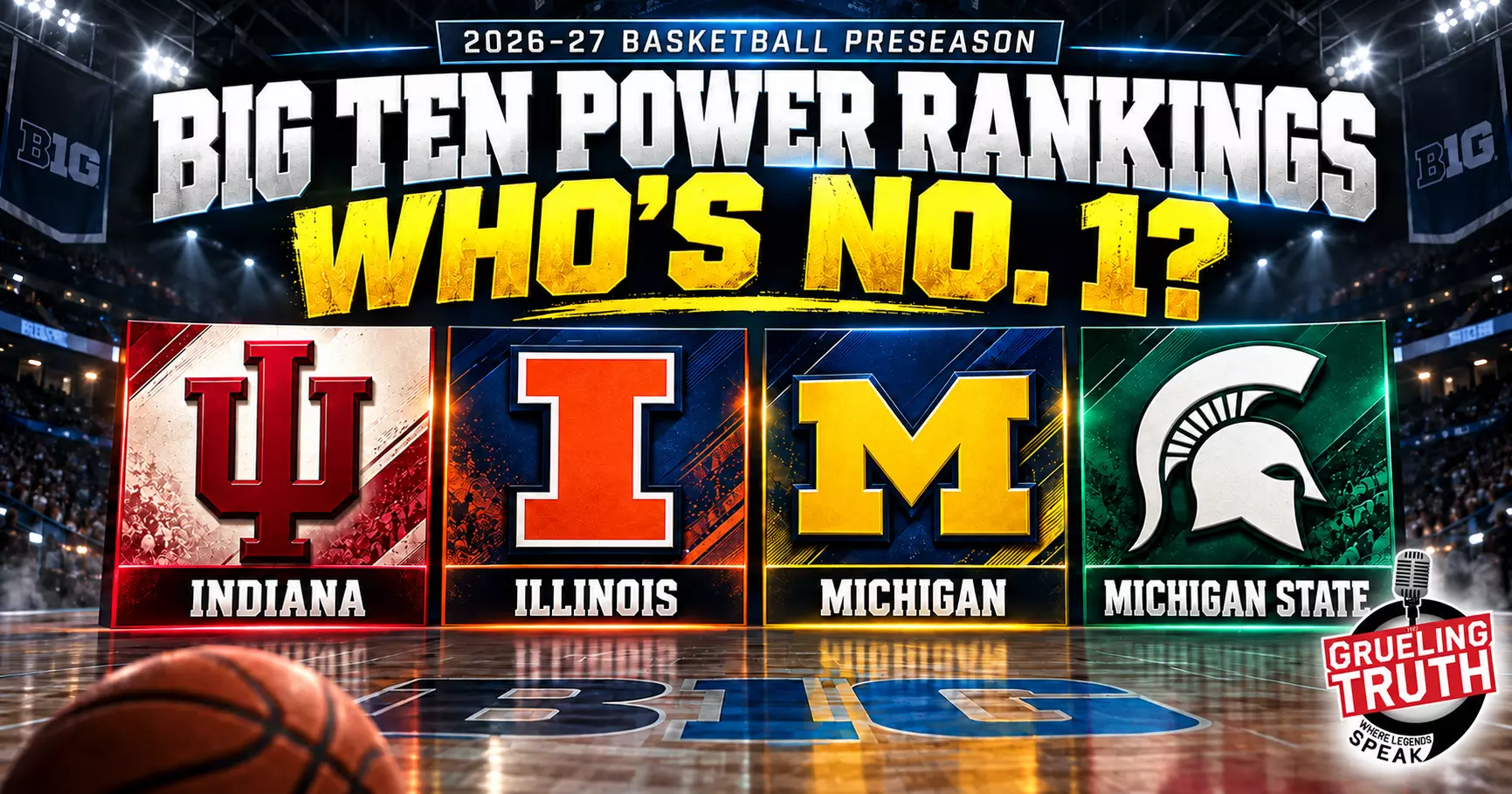
The Big Ten enters the season with a crowded championship race and plenty of uncertainty behind its leading contenders.
The Big Ten’s championship race begins with two familiar requirements: dependable guard play and enough frontcourt depth to survive the conference schedule. Illinois and Michigan State enter with compelling combinations of returning talent and established leadership, but the teams chasing them have legitimate reasons to believe they can close the gap.
Michigan begins a new coaching chapter, Indiana brings a substantially rebuilt roster into
Darian DeVries’
second season, and programs such as UCLA, Nebraska and USC have the personnel to challenge the favorites.
These rankings reflect my preseason assessment of each team’s roster, balance and potential weaknesses. Player names and roster membership were checked against official athletics websites. Projected roles and finishes are analysis rather than announced starting lineups.
18. Penn State Nittany Lions
Penn State’s path toward respectability begins with building a dependable offensive partnership around
Ivan Jurić and Jay Rodgers. Jurić gives the Nittany Lions a returning interior piece, while Rodgers arrives from Central Connecticut State to help organize the backcourt. Miami (Ohio) transfer Brant Byers and Davidson transfer Roberts Blums provide additional perimeter options on Mike Rhoades’ roster.
The central question is whether those pieces can generate quality possessions against defenses that take away the initial action. Penn State needs guards who can enter the ball cleanly, handle pressure and create opportunities without allowing turnovers to become the opponent’s easiest source of offense.
Defensively, the Nittany Lions must finish possessions with rebounds. Creating an uncomfortable first shot accomplishes little if an opponent immediately gets another opportunity.
There is a reasonable route toward improvement, particularly if Jurić develops into a more influential presence. However, this roster still requires too many successful transitions to justify placing Penn State above teams with more established conference foundations.
17. Northwestern Wildcats
Northwestern needs to establish a new offensive hierarchy, and
Jack Karasinski
is an important part of that process. The Bellarmine transfer joins a roster that includes Jake West, LA Pratt and Angelo Ciaravino. Those players give Chris Collins several possible combinations, but the Wildcats must determine which group can consistently create efficient shots.
My biggest concern is possession quality when the first scoring option disappears. Northwestern cannot afford long stretches of perimeter passing that end with a difficult attempt as the shot clock expires. West’s development and Karasinski’s adjustment to conference competition will matter considerably.
The defensive approach must help protect the offense. Northwestern needs to limit transition opportunities, communicate through screening actions and avoid surrendering unnecessary second chances.
The Wildcats can outperform this ranking if their guards establish clear responsibilities and Karasinski becomes a dependable scoring option. For now, there is more uncertainty surrounding their offensive ceiling than the teams immediately ahead of them. Competitive stretches must become complete performances.
16. Oregon Ducks
Oregon faces a significant transition following
Dana Altman’s retirement, with Tony Stubblefield serving as interim head coach. The Ducks’ current roster includes Fred Payne, Tyrone Riley IV, Andrew Meadow, Pharaoh Compton, Sean Stewart and freshman Tajh Ariza, among others. There is enough personnel variety to experiment with different approaches, but establishing cohesion is a substantial assignment.
Payne’s ability to help stabilize the backcourt is especially important. Oregon needs consistent decisions at the point of attack so its forwards receive the ball in positions where they can contribute without manufacturing everything themselves.
The defensive challenge involves making athleticism useful within a connected system. Length alone will not prevent breakdowns when opponents reverse the ball, force switches or attack a second driving lane.
I see a team capable of climbing if its perimeter play settles quickly. However, the coaching transition and the number of developing relationships make Oregon difficult to trust above this position before meaningful games begin.
15. Washington Huskies
Washington’s starting point is
Wesley Yates III, with Ryan Beasley and LeJuan Watts among the other important names on Danny Sprinkle’s roster. Beasley arrives from San Francisco, while Watts’ previous stops include Texas Tech. Their integration gives Washington several possible ways to distribute perimeter responsibility.
My concern is whether the Huskies can turn those individual options into a coherent offense. Yates should not have to rescue possessions repeatedly after an initial action stalls. Washington needs secondary creation, purposeful spacing and enough movement to prevent defenders from loading toward the basketball.
The other requirement is defensive consistency. A team trying to establish new offensive relationships cannot continually compensate for easy baskets at the other end. Containing dribble penetration and securing rebounds would make every offensive improvement more valuable.
Washington has enough potential to challenge teams ranked higher here. Still, I want to see the Huskies establish dependable lineup combinations and a reliable method for winning when perimeter shots stop falling. That remains the difference between an interesting roster and a trustworthy conference team.
14. Rutgers Scarlet Knights
Rutgers has a credible starting point in
Tariq Francis, supported by a roster that includes Jamichael Davis, Darren Buchanan Jr., Darin Smith Jr. and Christian Gurdak. Francis and Davis provide experienced backcourt options, while Gurdak arrives from Virginia Tech to join the interior group.
The offensive priority is ensuring Francis receives help before opposing defenses force the issue. Rutgers needs multiple players capable of attacking an advantage, rather than asking one scorer to produce against a defense already positioned to stop him.
Smith’s adjustment and Buchanan’s contributions could help determine whether that balance develops. Inside, the Scarlet Knights need dependable screening, rebounding and finishing so their guards have more choices than contested jump shots.
I place Rutgers slightly above the bottom group because there is an identifiable backcourt foundation. The next step is converting experience into better decisions and more complete possessions. If the supporting offense becomes consistent, Rutgers can move toward the middle of the league. Until then, its margin for error remains relatively narrow.
13. Minnesota Golden Gophers
Minnesota’s case begins with a group that includes
Isaac Asuma, Jaylen Crocker-Johnson and Bobby Durkin, supplemented by North Carolina transfer Kyan Evans. Those names give Niko Medved several useful options as he determines the best balance between ball handling, perimeter size and frontcourt responsibility.
Asuma’s development is particularly important because reliable guard play can make the entire roster function more efficiently. Minnesota needs an offense that creates advantages early enough for its supporting players to attack them, rather than requiring difficult individual plays late in possessions.
Crocker-Johnson’s involvement should help provide an interior reference point, while Durkin’s perimeter contributions will influence how opponents defend the floor. Evans offers another route toward improving the backcourt, provided the fit produces consistent execution.
My hesitation concerns the overall offensive ceiling against stronger defensive teams. Minnesota has the ingredients to become organized and competitive, but it must demonstrate that it can generate enough quality opportunities to win close games. There is a believable path upward from this position.
12. Maryland Terrapins
Maryland’s roster has more potential than a No. 12 ranking might suggest.
Pharrel Payne
provides a frontcourt centerpiece, with Andre Mills returning and DJ Wagner joining a group that also includes Tomislav Buljan and freshman Baba Oladotun. Buzz Williams has several ways to build a more balanced team around that personnel.
The first question is how consistently Maryland can connect its perimeter play to its interior strengths. Payne becomes more difficult to defend when entry passes arrive on time and teammates punish help. When possessions become disconnected, opponents can crowd the paint and force the Terrapins into less favorable attempts.
Wagner’s role in organizing the offense will therefore carry considerable importance. Oladotun adds another developmental variable, but Maryland should avoid needing its freshman to solve every difficult situation immediately.
I see a team capable of moving several positions higher. This placement reflects uncertainty about the finished product, particularly perimeter execution, rather than a lack of intriguing talent. Maryland must turn its options into a dependable identity.
11. Wisconsin Badgers
Wisconsin has a clear frontcourt foundation in
Nolan Winter and Austin Rapp, while its perimeter group includes Owen Foxwell, Eian Elmer and Braeden Carrington. Greg Gard’s challenge is determining how those pieces can provide enough creation and spacing to complement the size available inside.
The Badgers should have opportunities to involve their forwards in different parts of the offense. The important question is whether their guards can consistently deliver the ball, attack pressure and prevent opponents from dictating where possessions begin.
Winter’s involvement must extend beyond simply giving Wisconsin someone to throw the ball toward when trouble develops. The offense needs connected actions that allow its frontcourt to create opportunities for teammates as well.
I am cautious about the backcourt’s collective ceiling until the roles become clearer. However, Wisconsin has a reasonable route toward outperforming this ranking if its guards make sound decisions and the frontcourt controls the glass. That combination could make the Badgers particularly difficult to beat in slower, possession-by-possession games.
10. Iowa Hawkeyes
Iowa enters with
Cooper Koch, Kael Combs, Tate Sage and Cam Manyawu
among the recognizable pieces on Ben McCollum’s roster. The Hawkeyes must adjust following Bennett Stirtz’s departure, making the distribution of offensive responsibility one of the conference’s more consequential questions.
Replacing a central creator involves more than finding someone to match his scoring. Iowa needs players who can initiate actions, recognize defensive adjustments and make reliable decisions when a game becomes uncomfortable.
Combs’ responsibilities and Sage’s development will be important parts of that process. Koch also has an opportunity to become more influential within an offense that must obtain contributions from several directions.
My confidence starts with McCollum’s ability to establish clear expectations. My caution concerns whether the roster produces enough individual creation when opponents disrupt those expectations. Iowa can finish higher if its returning pieces become comfortable taking greater responsibility. Until that happens, I view the Hawkeyes as a competitive middle-tier team with room to improve, rather than a secure championship contender.
9. Ohio State Buckeyes
Ohio State has an appealing collection of pieces led by
John Mobley Jr., with Justin Pippen, Amare Bynum and freshman Anthony Thompson among the other important names. Pippen arrives after playing at Michigan and California, giving Jake Diebler another backcourt option alongside Mobley.
The offensive challenge is making those options complement one another. Mobley should benefit from possessions in which someone else creates the initial advantage, while Pippen’s integration could help distribute the burden of initiating offense.
Bynum and Thompson give Ohio State additional ways to shape its frontcourt combinations. Their development will influence how much flexibility Diebler has when opponents present different sizes and styles.
My concern is whether the Buckeyes establish a dependable defensive and rebounding foundation alongside their offensive promise. Scoring talent can win individual games, but moving into the league’s upper tier requires more consistent control of possessions. Ohio State has the potential to rise several spots if those fundamentals develop. Ninth reflects the remaining uncertainty about the collective performance.
8. Purdue Boilermakers
Purdue’s next chapter
centers on players such as
C.J. Cox, Daniel Jacobsen, Omer Mayer and Caden Pierce, with Jack Benter and freshman Luke Ertel among the additional options. Pierce arrives from Princeton, while Jacobsen gives Matt Painter a 7-foot-4 presence in the middle.
The Boilermakers must establish a new distribution of responsibility following the departures of Braden Smith, Fletcher Loyer and Trey Kaufman-Renn. That involves rebuilding the relationships that determine who initiates, who finishes and who creates an acceptable shot when the planned action fails.
Cox and Mayer will be important to that transition. Purdue needs assertive guard play without sacrificing the decision-making that allows its offense to remain connected.
Jacobsen’s ability to influence the defensive end could help support the adjustment. Purdue would benefit greatly from a reliable source of rim protection and defensive rebounds.
Painter earns the benefit of the doubt as a developer. However, I need to see this group handle its expanded responsibilities before placing Purdue among the preseason championship favorites.
7. USC Trojans
USC has substantial offensive potential with
Rodney Rice, Alijah Arenas and KJ Lewis
in its backcourt mix. Jacob Cofie gives the Trojans an established frontcourt option, while freshmen Christian Collins, Adonis Ratliff and Darius Ratliff add further possibilities to Eric Musselman’s roster.
The attraction is obvious: USC has several players who could become important scoring options. The challenge is determining how the team functions when everyone cannot control the same possession. Shot selection, movement away from the ball and an acceptance of complementary roles will matter.
I am particularly interested in whether the Trojans can maintain offensive organization against teams that slow the game and force repeated decisions. Athletic talent becomes more valuable when supported by patience and clear spacing.
Defensively, USC needs consistent communication and rebounding across its preferred combinations. I can envision this team climbing into the top four if its talent produces a connected style. Seventh reflects the uncertainty surrounding that process, rather than a shortage of capable players.
6. Nebraska Cornhuskers
Nebraska has an identifiable centerpiece in
Pryce Sandfort, with Braden Frager and Connor Essegian among the other perimeter options. Trevan Leonhardt arrives from Utah Valley, while Sam Orme joins from Belmont. That group gives Fred Hoiberg several possible routes toward sustaining a productive offense.
Sandfort’s presence should help establish the starting point for opposing scouting reports. Nebraska’s task is making defensive attention toward him beneficial for everyone else. That requires timely movement, confident decisions and contributions from players who receive the ball after the initial advantage develops.
Leonhardt’s integration is particularly relevant because offensive organization can determine whether a collection of scoring options becomes difficult to guard consistently. Frager’s continued development also influences how much pressure Nebraska can place on opponents from multiple positions.
My remaining questions concern the balance of the finished lineup and its ability to defend and rebound against the strongest frontcourts. Nebraska belongs in the upper tier, but reaching championship level requires more than perimeter production. The supporting structure must remain dependable when games become physical.
5. UCLA Bruins
UCLA’s returning foundation includes
Trent Perry, Eric Dailey Jr. and Xavier Booker. Jaylen Petty arrives from Texas Tech, while freshman Nikola Kusturica adds another intriguing option. Mick Cronin has enough variety to construct several combinations around that core.
Perry’s development is central to the Bruins’ ceiling. UCLA needs dependable initiation and the ability to create something useful after opponents defend the first action. A strong defense becomes considerably more valuable when the offense avoids empty possessions and gives it time to get organized.
Dailey’s involvement and Booker’s interior contributions should help determine how balanced that offense becomes. Kusturica offers additional upside, although UCLA should benefit from having returning players who can carry responsibilities while its newcomers adjust.
I give the Bruins a slight edge over Nebraska because I trust the potential for a defined defensive approach. The remaining question is whether UCLA can consistently produce enough quality offense against the conference’s strongest opponents. If Perry becomes a more commanding creator, the Bruins could challenge the teams above them.
4. Indiana Hoosiers
Indiana’s rebuilt roster
offers
Markus Burton, Bryce Lindsay, Aiden Sherrell and Samet Yigitoglu
as important pieces. Darren Harris and Jaeden Mustaf expand the perimeter options, while freshmen Trevor Manhertz, Prince-Alexander Moody and Vaughn Karvala give Darian DeVries additional developmental possibilities. The official roster lists Lindsay with that spelling and Sherrell as a 7-foot forward.
The appeal is balance. Burton gives Indiana a player around whom to organize its creation, while Lindsay’s perimeter involvement could influence how aggressively opponents help toward the ball. Sherrell and Yigitoglu provide size that should allow DeVries to explore different interior combinations.
The challenge is making those pieces function together defensively. Indiana must contain penetration, communicate through screens and rebound without needing every possession to become an individual recovery effort.
I place the Hoosiers fourth because the roster offers several plausible answers to different problems. That remains a projection, however. Indiana must establish consistent execution and identify its most dependable combinations before the personnel translates into a serious championship challenge.
3. Michigan Wolverines
Michigan’s strongest starting point is its returning backcourt pairing of
Elliot Cadeau and Trey McKenney. Roddy Gayle Jr. provides another experienced option, while the current roster also includes J.P. Estrella, Jalen Reed and Oscar Goodman in its frontcourt group.
Mike Boynton Jr. takes over following Dusty May’s departure, making the development of this team’s identity a central storyline. Michigan cannot simply assume that last season’s accomplishments will transfer automatically to a different roster and coaching arrangement.
Cadeau’s management of possessions should help provide stability. McKenney’s continued development could determine whether Michigan possesses another player capable of creating advantages against the conference’s best defenses.
My questions focus on frontcourt cohesion and the overall defensive structure. The Wolverines need their interior combinations to complement the guards, finish possessions and provide dependable answers against size.
I rank Michigan third because the backcourt offers a strong foundation for high-level performance. The ceiling remains substantial, but the number of adjustments keeps the Wolverines behind the two teams with stronger preseason cases.
2. Michigan State Spartans
Michigan State’s championship argument begins with
Jeremy Fears Jr., the conference’s preseason player of the year. The official roster lists him as a redshirt junior. Coen Carr, Kur Teng, Jordan Scott and Cam Ward give Tom Izzo a substantial returning group, with Charlotte transfer Anton Bonke adding another interior option.
Fears provides the kind of offensive organization that becomes especially valuable in difficult road environments. Michigan State should have an advantage when he can control the pace, recognize mismatches and involve teammates before the defense becomes comfortable.
Carr’s contributions and the development of the surrounding perimeter group will influence how opponents defend those actions. The Spartans need enough scoring support to prevent teams from concentrating their entire plan on disrupting Fears.
The remaining question is the frontcourt’s collective reliability against elite size. Bonke and the other interior options must help establish rebounding and defensive consistency.
Michigan State is close to No. 1. I give Illinois a narrow edge in overall offensive variety, but the Spartans possess a convincing path to the championship.
1. Illinois Fighting Illini
Illinois earns the preseason top spot with a core that includes
David Mirkovic, Andrej Stojakovic, Tomislav Ivisic, Zvonimir Ivisic and Jake Davis. Providence transfer Stefan Vaaks adds another perimeter option, while freshman Quentin Coleman joins Brad Underwood’s backcourt.
The Illini’s appeal comes from the range of ways they could construct a productive offense. Their combination of perimeter size and frontcourt options should allow Underwood to adjust when opponents change defensive approaches. That flexibility matters over a conference season in which familiar opponents repeatedly attack the same weaknesses.
The responsibility is making the pieces complement one another. Illinois needs purposeful ball movement, consistent creation and an offensive hierarchy that remains clear during difficult stretches. Having several capable options only helps when players recognize where the best opportunity exists.
Defensively, the Illini must ensure their size translates into completed possessions through communication and rebounding.
I give Illinois the narrow preseason advantage because its roster offers the strongest combination of continuity, size and offensive possibilities. Michigan State can challenge that judgment immediately, but the Illini begin the season with the most complete case.
New Users – Get $350 in Bonus Bets when you wager $5 for 7 days
T&Cs apply
4.6/5
Gambling Problem? Call 1-800-GAMBLER or 1-800-MY-RESET. Call 1-888-789-7777 or visit ccpgg.org/chat (CT). Hope is here. GamblingHelpLineMA.org or call (800) 327-5050 for 24/7 support (MA). Visit www.mdgamblinghelp.org (MD). Call 1-877-8HOPE-NY or text HOPENY (NY). 21+ (18+ DC, WY) and present in select states (for KS, in affiliation with Kansas Star Casino). Find online real money wagering only. Min $5 wager required for 7 consecutive days. $5 free play credit. Bonus issued as non-withdrawable bonus with cash withdrawable bonus with cash withdrawable. Bonus bets which expire 7 days after receipt. Restrictions apply. See terms at sportsbook.fanduel.com. Call 1-877-770-7867 (LA).
Get Up to $1,000 Back in Bonus Bets Over Your First 10 Days
T&Cs apply
4.5/5
Gambling problem? Call 1-800-GAMBLER or 1-800-MY-RESET (Available in the US) 877-8-HOPENY or text HOPENY (467369) (NY) 1-800-327-5050 (MA), 1-800-BETS-OFF (IA), 21+ only. Please Gamble Responsibly. Visit mdgamblinghelp.org (MD). See BetMGM.com for Terms. New Player Offer for new players only. Subject to eligibility requirements. Bonus bets are non-withdrawable. In partnership with Kansas Crossing Casino and Hotel. This promotional offer is not available in NJ, MA, MI, NV, NY, ON, PA, PR, and WV.
New DraftKings Customers: Bet $5, Get $200 + 3 Months of NBA League Pass!
T&Cs apply
4.5/5
GAMBLING PROBLEM? CALL 1-800-GAMBLER or 1-800-MY-RESET, (800) 327-5050 or visit gamblinghelplinema.org (MA). Please Gamble Responsibly. 888-789-7777/visit ccpg.org (CT), or visit www.mdgamblinghelp.org (MD), 1-800-981-0023 (PR). 21+ and present in most states. (18+ DC/NH/PR/WY). Void in CAN. Eligibility restrictions apply. On behalf of Boot Hill Casino (KS). Pass-thru of per wager tax may apply in IL. 1 per new Sportsbook customer. $5+ first-time bet req. Max. $200 issued as non-withdrawable Bonus Bets. Stake removed from payout. Reward issued as $50 in Bonus Bets every 7 days via click-to-claim for 21 days. Bonus Bets and click-to-claims expire 7 days (168hrs) after issuance. Terms: dkng.co/offer. Get 1 promo code to redeem a 3-month NBA League Pass subscription, complimentary of DraftKings. Subscription auto-renews monthly at then-current price (currently $16.99/mo); cancel anytime. Terms, restrictions, and eligibility requirements apply. Redeem League Pass by 12/19/26 at 11:59 PM ET. Addt’l terms: support.watch.nba.com/hc/en-us/articles/9165532876183-League-Pass-Terms-of-Use_. Ends 11/29/26 at 11:59 PM ET. Sponsored by DK.
Must be 21+. GAMBLING PROBLEM? CALL 1-800-GAMBLER OR CALL 1-800-MY-RESET, www.mdgamblinghelp.org (MD), (800)-327-5050 or gamblinghelplinema.org (MA), Call (877)8-HOPENY or text HOPENY (467369) (NY), (888) 789-7777 or ccpg.org (CT), morethanagame.nc.gov (NC), 1800gambler.net (WV)
Bet $1 and get double the winnings up to $25 for your next 10 bets
T&Cs apply
4.4/5
21+ New users only. Must register using eligible promo code. First bet after registration must qualify. Max. Bonus Bet: $1,000. Bonus Bet expires 14 days after receipt. Void where prohibited. See Caesars.com/promos for full terms. Gambling Problem? 1-800-GAMBLER (1-800-426-2537)
21+ and present in OH. Gambling Problem? Call 1-800-GAMBLER.
This site is using
Cloudflare
and adheres to the
Google Safe Browsing Program. We adapted
Google's Privacy Guidelines
to keep your data safe at all times.
Close
Ready to Win Big? Join the Elite with Our Sports Betting Deals!
FanDuel Promo
New Users – Get $350 in Bonus Bets when you wager $5 for 7 days
Our Favorite
T&Cs and 21+ apply
Gambling Problem? Call 1-800-GAMBLER or 1-800-MY-RESET. Call 1-888-789-7777 or visit ccpgg.org/chat (CT). Hope is here. GamblingHelpLineMA.org or call (800) 327-5050 for 24/7 support (MA). Visit www.mdgamblinghelp.org (MD). Call 1-877-8HOPE-NY or text HOPENY (NY). 21+ (18+ DC, WY) and present in select states (for KS, in affiliation with Kansas Star Casino). Find online real money wagering only. Min $5 wager required for 7 consecutive days. $5 free play credit. Bonus issued as non-withdrawable bonus with cash withdrawable bonus with cash withdrawable. Bonus bets which expire 7 days after receipt. Restrictions apply. See terms at sportsbook.fanduel.com. Call 1-877-770-7867 (LA).
Code:
Open FanDuel
Get Bonus
BetMGM Promo
Get Up to $1,000 Back in Bonus Bets Over Your First 10 Days
Best Slots
T&Cs and 21+ apply
Gambling problem? Call 1-800-GAMBLER or 1-800-MY-RESET (Available in the US) 877-8-HOPENY or text HOPENY (467369) (NY) 1-800-327-5050 (MA), 1-800-BETS-OFF (IA), 21+ only. Please Gamble Responsibly. Visit mdgamblinghelp.org (MD). See BetMGM.com for Terms. New Player Offer for new players only. Subject to eligibility requirements. Bonus bets are non-withdrawable. In partnership with Kansas Crossing Casino and Hotel. This promotional offer is not available in NJ, MA, MI, NV, NY, ON, PA, PR, and WV.
Code:
Open BetMGM
Get Bonus
DraftKings Promo
New DraftKings Customers: Bet $5, Get $200 + 3 Months of NBA League Pass!
Newcomer
T&Cs and 21+ apply
GAMBLING PROBLEM? CALL 1-800-GAMBLER or 1-800-MY-RESET, (800) 327-5050 or visit gamblinghelplinema.org (MA). Please Gamble Responsibly. 888-789-7777/visit ccpg.org (CT), or visit www.mdgamblinghelp.org (MD), 1-800-981-0023 (PR). 21+ and present in most states. (18+ DC/NH/PR/WY). Void in CAN. Eligibility restrictions apply. On behalf of Boot Hill Casino (KS). Pass-thru of per wager tax may apply in IL. 1 per new Sportsbook customer. $5+ first-time bet req. Max. $200 issued as non-withdrawable Bonus Bets. Stake removed from payout. Reward issued as $50 in Bonus Bets every 7 days via click-to-claim for 21 days. Bonus Bets and click-to-claims expire 7 days (168hrs) after issuance. Terms: dkng.co/offer. Get 1 promo code to redeem a 3-month NBA League Pass subscription, complimentary of DraftKings. Subscription auto-renews monthly at then-current price (currently $16.99/mo); cancel anytime. Terms, restrictions, and eligibility requirements apply. Redeem League Pass by 12/19/26 at 11:59 PM ET. Addt’l terms: support.watch.nba.com/hc/en-us/articles/9165532876183-League-Pass-Terms-of-Use_. Ends 11/29/26 at 11:59 PM ET. Sponsored by DK.
Code:
Open DraftKings
Get Bonus
Find out what the legends have to say about sports this week....
New Users – Get $350 in Bonus Bets when you wager $5 for 7 days
Gambling Problem? Call 1-800-GAMBLER or 1-800-MY-RESET. Call 1-888-789-7777 or visit ccpgg.org/chat (CT). Hope is here. GamblingHelpLineMA.org or call (800) 327-5050 for 24/7 support (MA). Visit www.mdgamblinghelp.org (MD). Call 1-877-8HOPE-NY or text HOPENY (NY). 21+ (18+ DC, WY) and present in select states (for KS, in affiliation with Kansas Star Casino). Find online real money wagering only. Min $5 wager required for 7 consecutive days. $5 free play credit. Bonus issued as non-withdrawable bonus with cash withdrawable bonus with cash withdrawable. Bonus bets which expire 7 days after receipt. Restrictions apply. See terms at sportsbook.fanduel.com. Call 1-877-770-7867 (LA).