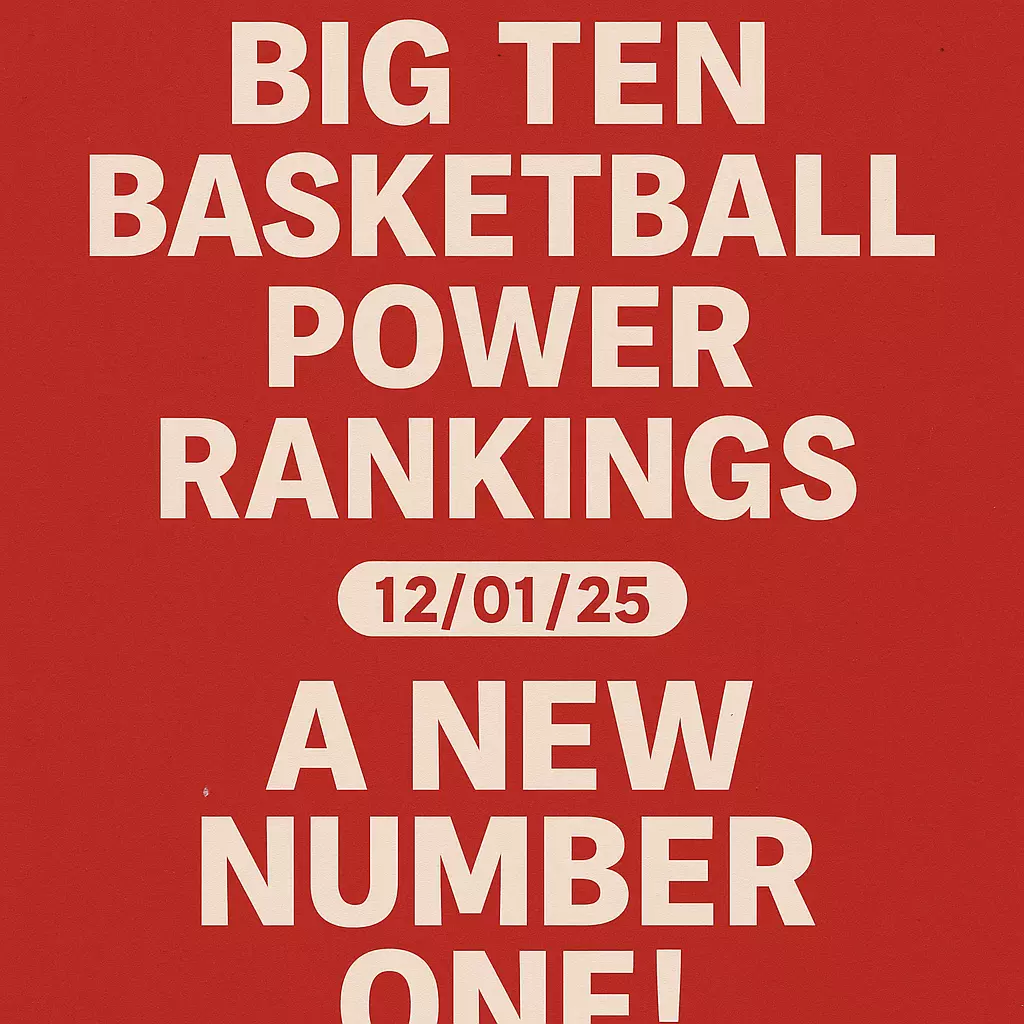
Minnesota has slid hard in the last week and now sits at .500 with a three-game losing streak. The Gophers’ early optimism under their new regime has been tempered by turnovers, inconsistent shot creation, and stretches where the offense simply goes dark. The record says it all: four wins, all at home, and nothing resembling a signature result yet. With the rest of the league stacking up neutral-site trophies and top-25 wins, Minnesota’s résumé is clearly the thinnest. The upside is that they’ve at least shown they can defend in spurts, but until they stop the skid and prove they can beat high-major competition, they’re firmly at the bottom of the Big Ten hierarchy.
Check out last week’s rankings!
17. Oregon Ducks (4–3, L3)
Oregon’s overall talent level still looks like mid-tier NCAA at worst, but the trajectory is bad: the Ducks are
4–3
and on a
three-game losing streak. Early buy-game wins have been washed out by a rough Feast Week stretch, during which defensive breakdowns and scoring droughts showed up against better competition. They’re not getting blown out of the water, but they’re not closing games, either. The length and positional versatility you expect from an Oregon roster are still there; the cohesion and late-game execution are not. Until they steady themselves and bank a respectable non-conference win, they sit below the middle of the league despite a decent ceiling.
16. Rutgers Scarlet Knights (5–3, W1)
Rutgers is sitting at
5–3
with a
W1
streak, but the profile is uneven. Early on, they blasted Rider behind a breakout from
Tariq Francis, who dropped 20 in the opener, and flashed a trademark grinding defense. Since then, the Knights have mixed in solid defensive showings with some really choppy half-court offense and a couple of results that don’t scream “top-half Big Ten.” The good news: the guard play is improving, Francis looks like a real Big Ten scorer, and they’re starting to stack comfortable wins again. The bad news: the strength of schedule and margin for error in this league keep them closer to the bubble line than to any serious contention.
15. Maryland Terrapins (5–3, L2)
Maryland is
5–3
and on a
two-game skid
after a start that suggested they might climb faster. The Terps have shown the physical, guard-oriented identity you’d expect, but they haven’t quite found the right balance offensively. They’ve beaten the teams they were supposed to beat, yet every step up in competition has exposed issues in shot selection and late-clock creation. Defensively, Maryland still makes life hard with ball pressure and toughness on the glass, which is why the underlying metrics aren’t terrible. But in a week where several Big Ten peers bagged neutral-site hardware or marquee top-25 wins, Maryland’s résumé and current form just don’t stack up.
14. Washington Huskies (5–2, L1)
Washington is
5–2
with a
L1
streak and feels like a solid, but not yet scary, new Big Ten entrant. The Huskies upgraded their talent base via the portal and have been more organized and physical than last year, especially on the defensive end. They’ve handled their buy-games and shown intermittent flashes of being a tough, switchable group. The problem is schedule context: the record is fine, but they lack a real headliner win, and their most recent outing was a step back. As a result, they land just outside the top-half conversation. The good news for Husky fans: the tools are there to jump a tier once they start capitalizing on higher-profile opportunities.
13. Northwestern Wildcats (5–2, L1)
Northwestern at
5–2
with a
L1
feels very on-brand: tough, disciplined, and just pesky enough to give everyone in the league headaches. They’ve defended at a high level in low-possession games and taken care of business at home, but like Washington, they haven’t yet put a truly notable scalp on the board. Their style — grind you down, win in the margins, lean on experience — is built to steal games in February. In late November, when résumés are still thin and neutral-site events define perception, it leaves them in this lower-middle tier. Nobody wants to see them on their schedule, but the overall body of work trails the teams above.
12. UCLA Bruins (5–2, L1, AP No. 18 last week)
UCLA is
5–2, coming off an
80–72
loss to California in the Empire Classic title game, where the Bruins fell behind by 13, made a late push, but couldn’t close. Their two losses are to respectable competition. Under Mick Cronin, they still defend at a high level — last season they led the Big Ten in scoring defense, edging Michigan State and Maryland. UCLA The issue right now is consistent offensive pop and late-game shot-making; when they see real length and athleticism, the half-court offense can bog down. They still project as a top-25-caliber team, but this week’s stumble combined with impressive surges elsewhere bumps them just outside the top 10 of the league power stack.
11. Wisconsin Badgers (5–2, L1)
Wisconsin is
5–2
with a
L1
streak and very much looks like the rugged, efficient outfit we’re used to. They’ve handled most of their early schedule and still excel at grinding opponents into low-scoring, mistake-heavy games. An early neutral-site loss to a high-end opponent keeps them from the inner circle for now, and the lack of a top-shelf, statement victory during Feast Week doesn’t help. That said, Wisconsin’s style and floor are so reliable that it’s hard to see them falling too far. Their defense travels, they value the ball, and they’ve got enough shooting to punish sagging defenses. On a pure “who do you trust in a rock fight?” scale, they’re higher than 11th — but in a league with multiple undefeated, trophy-collecting starts, someone solid has to live here.
10. Penn State Nittany Lions (7–1, W2)
Penn State’s
7–1
start, with a
W2
streak, deserves real respect. The Nittany Lions just obliterated Sacred Heart
90–59, forcing 24 turnovers and turning them into 34 points.
Diaries+1
Five players hit double figures, led by
Ivan Juric
(14 points, 9 boards) and
Kayden Mingo, who filled the box score with 13 points, 8 steals, and 5 assists.The depth and defensive intensity are obvious, and the offense is starting to look more free-flowing with multiple ball-handlers. The one ding: like many in this tier, Penn State hasn’t yet stacked multiple top-25 wins, so the ranking is more about strong underlying play than résumé heft. Still, at 7–1 with increasingly dominant performances, they’re clearly above the bubble-scrap pack behind them.
9. Ohio State Buckeyes (6–1, L1)
Here’s the big correction you flagged:
Ohio State is 6–1, and they
did
just lose
67–66 at Pittsburgh
on a 30-footer at the horn from
Damarco Minor. That result snaps their unbeaten start and drops them a notch in the pecking order. The Buckeyes had quietly put together a perfect record with solid wins and efficient offense before running into that gut-punch in the Petersen Events Center. The good news is they were right there on the road against an ACC foe; the bad news is it exposed some late-game execution issues and defensive lapses on the final possession. Overall,
Ohio State
still looks like a top-25 caliber team with a balanced attack, but in a week where others brought home trophies, a buzzer-beater loss sends them just outside the league’s top eight.
8. USC Trojans (7–0, W7, Maui champs)
USC’s transition into the Big Ten has started with real fireworks. The Trojans are
7–0
with a
W7
streak and just won the
Southwest Maui Invitational, beating Arizona State
88–75
in the title game. They’ve shown the ability to blow teams out in early buy-games and then scale their game up against high-major opposition with better defense and more disciplined shot selection. The Maui run, against a solid field, is exactly the kind of résumé piece that jumps off the page in November. If you’re nitpicking, you’d still like to see how they handle true road environments in the Midwest winter, but on pure form and results, USC looks like a dark-horse league contender and comfortably top-10 in this ranking.
Iowa is
7–0, riding a
W7
streak and fresh off winning the
Acrisure Classic, where they beat Grand Canyon
59–46
in a slow-paced, defensive battle. That game was a nice data point: the Hawkeyes, known for offense, proved they could win ugly by dictating tempo and forcing the Lopes into 19 turnovers. Their offense has been one of the most efficient in the country, and the ability to now grind out wins in tournament settings raises the ceiling. Like Nebraska, they haven’t yet run into the very top of the national ladder, but unlike Nebraska they’ve already shown they can adapt their style against a rugged mid-major. Iowa’s blend of shooting, spacing, and a more physical defensive approach earns them a spot firmly in the top third of the league.
Nebraska is the numbers darling of the moment:
8–0,
W8, and carrying what’s currently described as the
nation’s longest active winning streak, extended by a
72–63
win over USC Upstate.
Pryce Sandfort
(20 points, 9 boards, 4 assists) and
Rienk Mast
(15 points vs USC Upstate; 31 with seven threes vs Winthrop) have been outstanding, while
Cale Jacobsen
and
Braden Frager
give them depth and energy. Nebraska has shown the ability to rally from double-digit deficits with big runs and win even when the threes aren’t falling, which is a huge evolution for this program. Why only sixth? The schedule still leans soft; they’ve yet to beat a top-25 opponent, and Hoiberg himself called the Upstate win their “most disappointing” performance so far. The ceiling is rising, but they’re a half-step behind the ranked heavyweights above them.
5. Indiana Hoosiers (7–0, W7, AP No. 25)
Indiana is
7–0, on a
W7
streak, and just hung
100–56
on Bethune-Cookman in a game that underscored how transformed they are under
Darian DeVries.
Tucker DeVries
led the way with 20 points,
Lamar Wilkerson
added 18, and the bench trio of
Sam Alexis,
Trent Sisley, and
Nick Dorn
all hit 14 while dominating the glass and shooting efficiently. Indiana has already recorded multiple 100-point games before the end of November, and the shot profile is ultra-modern: threes, paint, free throws, and almost no dead-zone mid-range. Defensively, they’re forcing opponents into those inefficient looks and winning the rebounding battle with depth and size. Ranked
No. 25
in last week’s league update, they look better than that now. Still, compared to the top four, their marquee-win volume is a tad lighter, so they land fifth — but clearly with top 10 national upside.
4. Illinois Fighting Illini (6–2, L1, AP No. 13)
Illinois is
6–2
with a
L1
streak, but both losses are to top-15 opponents away from home (Alabama at the United Center and UConn at Madison Square Garden). Against UConn,
Kylan Boswell
poured in 25 points with 9 rebounds and
Tomislav Ivišić
added a double-double, but the Huskies’ defense smothered the rest of the roster and Illinois shot just 20.7% from three. On the flip side, Illinois already owns a home win over ranked Texas Tech and sits as a clear top-15 team nationally in both polls and efficiency metrics. They’ve got high-end shot creation, size, and a tough defensive backbone; they just ran into a UConn team playing like a title favorite. Adjusting for opponent quality, Illinois still grades out as one of the league’s best — just a tick behind the three undefeated juggernauts above.
3. Michigan State Spartans (7–0, W7, AP No. 11)
Michigan State is
7–0, on a
W7
run, and just delivered one of the statement wins of the week: a
74–58
domination of
No. 16 North Carolina
at the Fort Myers Tip-Off.
Jeremy Fears Jr.
was spectacular with 19 points and a flurry of big shots, while the Spartans’ defense held UNC to 38% from the field and 17% from three, winning the glass and controlling the second half. It’s already their third win over a ranked opponent this season. MSU looks exactly like an Izzo team: physical, connected, deep, and elite on the defensive end. The offense is still a work in progress, but it’s more than good enough when paired with this level of toughness. With that UNC win on top of a perfect record, they edge into the top three.
2. Purdue Boilermakers (7–0, W7, AP No. 1)
Purdue remains the clear No. 1, both nationally and in this league. The Boilers are
7–0,
W7, and just destroyed Eastern Illinois
109–62, powered by a career-high
24 points and 9 boards from Daniel Jacobsen. Earlier this month they beat
No. 8 Alabama 87–80
on a neutral floor and followed it with a 97–79 win over Akron, showing they’ve seamlessly transitioned from the Zach Edey era to a more balanced, guard-driven attack without losing their edge. They opened the season ranked
No. 1
and have done nothing but validate that status, pairing an efficient, multi-layered offense with a physical, connected defense.
1. Michigan Wolverines (7–0, W7, AP No. 7)
Michigan has one of the best résumés in the country right now. At
7–0, with a
W7
streak, they just wrecked the field at the Players Era Festival: a
40-point win over San Diego State, a
30-point win over No. 21 Auburn, and then a
101–61
demolition of
No. 12 Gonzaga.
Yaxel Lendeborg
was named tournament MVP, and
Trey McKenney
added 17 in the Gonzaga beatdown as Michigan outclassed high-major opponents on both ends.
The Wolverines
are ranked
No. 7
nationally and have the kind of length, athleticism, and depth that screams Final Four contender. I thought the Boilermakers would be number one all year in this ranking, but what the Wolverines did over the last week was too impressive to ignore.
Up To $1500 in Bonus Bets Paid Back if your First Bet Does Not Win
T&Cs apply
4.5/5
Gambling problem? Call 1-800-GAMBLER or 1-800-MY-RESET (Available in the US) 877-8-HOPENY or text HOPENY (467369) (NY) 1-800-327-5050 (MA), 1-800-BETS-OFF (IA), 1-800-981-0023 (PR). 21+ only. Please Gamble Responsibly. See BetMGM.com for Terms. First Bet Offer for new customers only (if applicable). Subject to eligibility requirements. Bonus bets are non-withdrawable. In partnership with Kansas Crossing Casino and Hotel. Promotional offers not available in Mississippi, Massachusetts, New York, Ontario, or Puerto Rico.
New DraftKings Customers: Spend $5+ Get $150 in Bonuses
T&Cs apply
4.5/5
GAMBLING PROBLEM? CALL 1-800-GAMBLER or 1-800-MY-RESET, (800) 327-5050 or visit gamblinghelplinema.org (MA). Please Gamble Responsibly. 888-789-7777/visit ccpg.org (CT), or visit www.mdgamblinghelp.org (MD), 1-800-981-0023 (PR). 21+ and present in most states. (18+ DC/NH/PR/WY). Void in CAN. Eligibility restrictions apply. On behalf of Boot Hill Casino (KS). Pass-thru of per wager tax may apply in IL. 1 per new DraftKings customer. $5+ first-time bet req. Max. $150 issued as non-withdrawable Bonus Bets. Stake removed from payout. Reward issued as $50 in Bonus Bets every 7 days via click-to-claim for 14 days. Bonus Bets and click-to-claims expire 7 days (168hrs) after issuance. Terms: sportsbook.draftkings.com/promos. Ends 10/11/26 at 11:59 PM ET. Sponsored by DK.
Must be 21+. GAMBLING PROBLEM? CALL 1-800-GAMBLER OR CALL 1-800-MY-RESET, www.mdgamblinghelp.org (MD), (800)-327-5050 or gamblinghelplinema.org (MA), Call (877)8-HOPENY or text HOPENY (467369) (NY), (888) 789-7777 or ccpg.org (CT), morethanagame.nc.gov (NC), 1800gambler.net (WV)
Bet $1 and get double the winnings up to $25 for your next 10 bets
T&Cs apply
4.4/5
21+ New users only. Must register using eligible promo code. First bet after registration must qualify. Max. Bonus Bet: $1,000. Bonus Bet expires 14 days after receipt. Void where prohibited. See Caesars.com/promos for full terms. Gambling Problem? 1-800-GAMBLER (1-800-426-2537)
21+ and present in OH. Gambling Problem? Call 1-800-GAMBLER.
This site is using
Cloudflare
and adheres to the
Google Safe Browsing Program. We adapted
Google's Privacy Guidelines
to keep your data safe at all times.
Close
Ready to Win Big? Join the Elite with Our Sports Betting Deals!
FanDuel Promo
New Users – Get $250 in Bonus Bets when you wager $5 for 5 days
Up To $1500 in Bonus Bets Paid Back if your First Bet Does Not Win
Best Slots
T&Cs and 21+ apply
Gambling problem? Call 1-800-GAMBLER or 1-800-MY-RESET (Available in the US) 877-8-HOPENY or text HOPENY (467369) (NY) 1-800-327-5050 (MA), 1-800-BETS-OFF (IA), 1-800-981-0023 (PR). 21+ only. Please Gamble Responsibly. See BetMGM.com for Terms. First Bet Offer for new customers only (if applicable). Subject to eligibility requirements. Bonus bets are non-withdrawable. In partnership with Kansas Crossing Casino and Hotel. Promotional offers not available in Mississippi, Massachusetts, New York, Ontario, or Puerto Rico.
Code:
Open BetMGM
Get Bonus
DraftKings Promo
New DraftKings Customers: Spend $5+ Get $150 in Bonuses
Newcomer
T&Cs and 21+ apply
GAMBLING PROBLEM? CALL 1-800-GAMBLER or 1-800-MY-RESET, (800) 327-5050 or visit gamblinghelplinema.org (MA). Please Gamble Responsibly. 888-789-7777/visit ccpg.org (CT), or visit www.mdgamblinghelp.org (MD), 1-800-981-0023 (PR). 21+ and present in most states. (18+ DC/NH/PR/WY). Void in CAN. Eligibility restrictions apply. On behalf of Boot Hill Casino (KS). Pass-thru of per wager tax may apply in IL. 1 per new DraftKings customer. $5+ first-time bet req. Max. $150 issued as non-withdrawable Bonus Bets. Stake removed from payout. Reward issued as $50 in Bonus Bets every 7 days via click-to-claim for 14 days. Bonus Bets and click-to-claims expire 7 days (168hrs) after issuance. Terms: sportsbook.draftkings.com/promos. Ends 10/11/26 at 11:59 PM ET. Sponsored by DK.
Code:
Open DraftKings
Get Bonus
Find out what the legends have to say about sports this week....