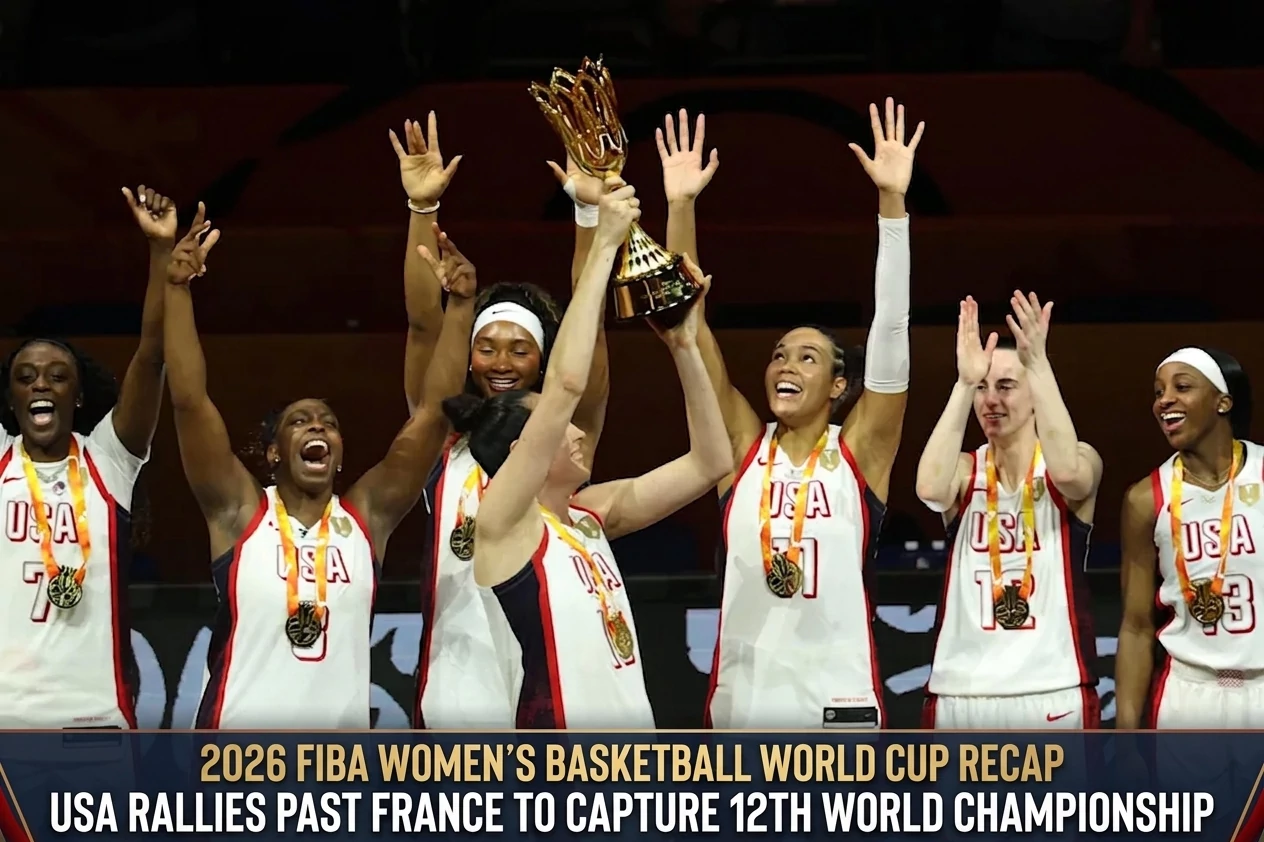
2026 FIBA Women’s Basketball World Cup Recap: USA Rallies Past France to Capture 12th World Championship
The
2026 FIBA Women’s Basketball World Cup
delivered upsets, historic performances, breakthrough stars and record crowds in Berlin, Germany. When the tournament ended on September 13, however, the result at the top of the podium remained familiar.
Team USA defeated France 97-79 in the championship game, completing another unbeaten World Cup run and securing its
12th Women’s Basketball World Cup championship and fifth consecutive title.
The Americans did not cruise through every game. Italy nearly produced one of the biggest upsets in international basketball history, Spain pushed the United States deep into the semifinals, and France built a 14-point lead in the championship game.
But when the pressure reached its highest point,
Breanna Stewart, Jackie Young and the rest of Team USA answered.
USA Completes Another Championship Run
The United States opened its tournament on September 4 with a convincing
94-61 victory over China, setting the tone for what initially looked like another dominant American march through international competition.
The narrative changed two days later.
Italy nearly stunned the basketball world, holding the powerful American offense in check before Team USA escaped with a remarkably close
55-52 victory. The three-point margin provided the clearest indication that the defending champions were not untouchable.
USA responded exactly as a championship team would.
The Americans closed group play with a
105-64 victory over Czechia
before delivering perhaps their most impressive performance of the tournament in the quarterfinals.
Against Hungary, Team USA exploded for a
108-56 victory.
The 108 points established a record for the most points scored in a Women’s World Cup quarterfinal, while the Americans also became the first team to record at least 30 assists in a quarterfinal game. USA scored 59 first-half points and had five players finish in double figures. Napheesa Collier led the way with 19 points and six rebounds.
Suddenly, the team that had barely survived Italy looked overwhelming again.
Spain Gives USA a Semifinal Test
Spain provided a much different challenge in the semifinals.
The Americans led only
39-36 at halftime, and Spain actually outscored USA in the third quarter to leave the game tied at 58 entering the final period.
That was when the defending champions separated themselves.
USA won the fourth quarter
18-8, finishing off a
76-66 victory
and advancing to another World Cup championship game.
Stewart supplied the stabilizing presence Team USA needed, finishing with
16 points, six rebounds and two assists. Spanish rising star
Iyana Martin scored 17 points while adding three rebounds, three assists and three steals, continuing one of the tournament’s biggest individual breakout performances.
Meanwhile, France was making history on the other side of the bracket.
France Reaches Its First World Cup Final
France
entered the tournament as one of the teams capable of challenging the United States, and it backed up that reputation throughout the competition.
France overwhelmed Hungary
99-53, Korea
95-69
and Nigeria
111-56
during group play.
In the quarterfinals, France defeated China
90-61, setting up a semifinal against host Germany.
The French controlled that matchup, winning
86-64
and reaching the Women’s Basketball World Cup championship game for the
first time in program history.
Gabby Williams
delivered one of the tournament’s signature individual performances in the semifinal, recording
22 points, five rebounds, five assists and four steals
against Germany.
That victory created the championship matchup basketball fans wanted: the defending world champions against a French team playing some of the best basketball in the tournament.
And for a while, France looked capable of ending American supremacy.
Championship Game: France Lands the First Punch
France came into the final with confidence and attacked immediately.
The French built a
14-point first-half advantage, putting the United States into its most difficult position of the tournament.
Instead of panicking, the Americans slowly worked their way back.
A late
Caitlin Clark three-pointer
helped USA cut the French advantage to
45-43 at halftime. The two-point difference represented the narrowest halftime margin in a Women’s World Cup championship game.
Then the game changed.
USA’s offense had already scored 26 points during the second quarter. The Americans followed that with
30 points in the third, turning what had been a potential French celebration into another demonstration of American depth and adaptability.
When the final horn sounded:
USA 97, France 79.
Another gold medal belonged to the United States.
Breanna Stewart Takes Over When It Matters Most
No player was more important during Team USA’s
biggest moments than
Breanna Stewart.
Stewart produced her best performance of the tournament in the championship game, finishing with:
22 points, 10 rebounds and four assists, while shooting
7-of-10 from the field.
Jackie Young was equally important, recording
18 points, six rebounds and five assists.
Stewart’s combination of production and leadership earned her the tournament’s
TISSOT MVP award.
It also placed her in FIBA history.
Stewart became the
first player ever to win two FIBA Women’s Basketball World Cup MVP awards, adding the 2026 honor to the MVP award she captured in 2018.
Across the tournament, Stewart averaged
12.8 points, 7.3 rebounds and 2.8 assists per game
while posting an average efficiency rating of 18.8.
More importantly, she delivered her biggest performances when USA’s championship streak was most threatened.
France Leaves Berlin With a Historic Silver Medal
France did not win the championship, but its tournament represented a major achievement for the program.
The silver medal was
France’s best finish in Women’s World Cup history
and its first appearance in the championship game.
Gabby Williams emerged as France’s centerpiece.
Williams averaged
18.7 points, 4.8 rebounds, four assists and 2.8 steals per game, producing an efficiency rating of 22.8. She was selected to the tournament’s All-Star Five and received the
Best Defensive Player
award.
France may have fallen one game short of the title, but its run established the country among the tournament’s elite.
Spain Takes Bronze Behind Iyana Martin
Spain recovered quickly after its semifinal loss.
Facing host Germany in the bronze-medal game, Spain controlled the contest and earned an
81-58 victory.
Once again, Iyana Martin was at the center of everything.
The 20-year-old scored
22 points
in the third-place game, completing an outstanding tournament in which she averaged
17.5 points, 4.2 assists, 3.3 rebounds and 2.2 steals per game.
Martin was selected to the tournament’s
All-Star Five
and named the
2026 Women’s World Cup Rising Star.
Spain’s bronze gave the program its
fourth medal in the last five Women’s World Cup tournaments.
Germany’s Historic Home Tournament
Although Germany missed the podium, the host country’s fourth-place finish represented its
best Women’s World Cup result ever.
Germany’s tournament began badly with an
83-53 loss to Spain, but the hosts recovered with victories that eventually carried them into the knockout round.
Germany then defeated Korea
94-56
to advance and produced one of the quarterfinal round’s biggest results by knocking out Belgium
93-74.
Leonie Fiebich
became Germany’s most consistent performer, averaging
9.9 points, 8.6 rebounds and 3.6 assists per game
while earning a place on the tournament’s All-Star Five.
Germany ultimately finished fourth after losses to France and Spain, but the home team’s run became one of the defining stories of the competition.
Belgium’s Emma Meesseman Produces Another Outstanding Tournament
Belgium did not reach the semifinals, but
Emma Meesseman
remained one of the tournament’s most productive players.
She averaged
21.0 points, eight rebounds and 4.8 assists per game, leading the tournament in scoring according to
FIBA’s
competition statistics.
Belgium went unbeaten during group play—including an
80-68 victory over Australia—before Germany ended its tournament in the quarterfinals.
An Emerging Generation Makes Its Mark
One of the biggest themes in Berlin was the emergence of young talent.
Martin was the obvious headliner, but Spain’s
Awa Fam, Japan’s
Kokora Tanaka
and several other young players gave the tournament a glimpse of what international women’s basketball could look like over the next several years.
Spain’s young core was particularly impressive. Martin already looked capable of becoming one of international basketball’s premier guards, while Fam averaged
10.8 points and 7.2 rebounds
during the tournament.
Berlin Sets World Cup Attendance Record
The action on the court was matched by unprecedented interest in the stands.
FIBA announced that
236,015 spectators attended games in Berlin, shattering the previous Women’s World Cup attendance record of 145,519 established in 2022.
The tournament also averaged
6,556 spectators per game, another competition record.
More than 12,000 fans attended each of several major games, including
12,223 for the championship game.
Those numbers helped make the 2026 edition one of the most significant Women’s Basketball World Cups both competitively and commercially.
2026 FIBA Women’s Basketball World Cup Final Standings
The official final standings were
USA, France, Spain, Germany, Belgium, Australia, China, Hungary, Italy, Korea, Puerto Rico, Japan, Mali, Türkiye, Czechia and Nigeria, in that order.
All-Star Five
The tournament’s All-Star Five featured
Breanna Stewart and Jackie Young of the United States, Gabby Williams of France, Iyana Martin of Spain and Leonie Fiebich of Germany.
Stewart earned tournament MVP honors, Williams was recognized as the top defensive player, and Martin took home the Rising Star award.
The Final Word
The 2026 FIBA Women’s Basketball World Cup showed that the gap at the top of women’s international basketball continues to become more competitive.
Italy nearly stunned Team USA. Spain remained within striking distance entering the fourth quarter of the semifinal. France led the Americans by 14 points in the championship game.
Yet the United States continued finding answers.
When the tournament reached its biggest moments, Stewart and Young helped turn close games into victories. USA finished the job against France, extended its Women’s World Cup winning streak to
36 games, captured a
fifth consecutive World Cup, and raised the trophy for the
12th time.
France achieved its greatest finish. Spain uncovered another emerging superstar in Iyana Martin. Germany produced its best World Cup ever in front of its home fans. And Berlin delivered record-setting crowds.
The rest of the world may be getting closer, but in
2026, Team USA remained the standard in women’s international basketball.
Up To $1500 in Bonus Bets Paid Back if your First Bet Does Not Win
T&Cs apply
4.5/5
Gambling problem? Call 1-800-GAMBLER or 1-800-MY-RESET (Available in the US) 877-8-HOPENY or text HOPENY (467369) (NY) 1-800-327-5050 (MA), 1-800-BETS-OFF (IA), 1-800-981-0023 (PR). 21+ only. Please Gamble Responsibly. See BetMGM.com for Terms. First Bet Offer for new customers only (if applicable). Subject to eligibility requirements. Bonus bets are non-withdrawable. In partnership with Kansas Crossing Casino and Hotel. Promotional offers not available in Mississippi, Massachusetts, New York, Ontario, or Puerto Rico.
New DraftKings Customers: Spend $5+ Get $150 in Bonuses
T&Cs apply
4.5/5
GAMBLING PROBLEM? CALL 1-800-GAMBLER or 1-800-MY-RESET, (800) 327-5050 or visit gamblinghelplinema.org (MA). Please Gamble Responsibly. 888-789-7777/visit ccpg.org (CT), or visit www.mdgamblinghelp.org (MD), 1-800-981-0023 (PR). 21+ and present in most states. (18+ DC/NH/PR/WY). Void in CAN. Eligibility restrictions apply. On behalf of Boot Hill Casino (KS). Pass-thru of per wager tax may apply in IL. 1 per new DraftKings customer. $5+ first-time bet req. Max. $150 issued as non-withdrawable Bonus Bets. Stake removed from payout. Reward issued as $50 in Bonus Bets every 7 days via click-to-claim for 14 days. Bonus Bets and click-to-claims expire 7 days (168hrs) after issuance. Terms: sportsbook.draftkings.com/promos. Ends 10/11/26 at 11:59 PM ET. Sponsored by DK.
Must be 21+. GAMBLING PROBLEM? CALL 1-800-GAMBLER OR CALL 1-800-MY-RESET, www.mdgamblinghelp.org (MD), (800)-327-5050 or gamblinghelplinema.org (MA), Call (877)8-HOPENY or text HOPENY (467369) (NY), (888) 789-7777 or ccpg.org (CT), morethanagame.nc.gov (NC), 1800gambler.net (WV)
Bet $1 and get double the winnings up to $25 for your next 10 bets
T&Cs apply
4.4/5
21+ New users only. Must register using eligible promo code. First bet after registration must qualify. Max. Bonus Bet: $1,000. Bonus Bet expires 14 days after receipt. Void where prohibited. See Caesars.com/promos for full terms. Gambling Problem? 1-800-GAMBLER (1-800-426-2537)
21+ and present in OH. Gambling Problem? Call 1-800-GAMBLER.
This site is using
Cloudflare
and adheres to the
Google Safe Browsing Program. We adapted
Google's Privacy Guidelines
to keep your data safe at all times.
Close
Ready to Win Big? Join the Elite with Our Sports Betting Deals!
FanDuel Promo
New Users – Get $250 in Bonus Bets when you wager $5 for 5 days
Up To $1500 in Bonus Bets Paid Back if your First Bet Does Not Win
Best Slots
T&Cs and 21+ apply
Gambling problem? Call 1-800-GAMBLER or 1-800-MY-RESET (Available in the US) 877-8-HOPENY or text HOPENY (467369) (NY) 1-800-327-5050 (MA), 1-800-BETS-OFF (IA), 1-800-981-0023 (PR). 21+ only. Please Gamble Responsibly. See BetMGM.com for Terms. First Bet Offer for new customers only (if applicable). Subject to eligibility requirements. Bonus bets are non-withdrawable. In partnership with Kansas Crossing Casino and Hotel. Promotional offers not available in Mississippi, Massachusetts, New York, Ontario, or Puerto Rico.
Code:
Open BetMGM
Get Bonus
DraftKings Promo
New DraftKings Customers: Spend $5+ Get $150 in Bonuses
Newcomer
T&Cs and 21+ apply
GAMBLING PROBLEM? CALL 1-800-GAMBLER or 1-800-MY-RESET, (800) 327-5050 or visit gamblinghelplinema.org (MA). Please Gamble Responsibly. 888-789-7777/visit ccpg.org (CT), or visit www.mdgamblinghelp.org (MD), 1-800-981-0023 (PR). 21+ and present in most states. (18+ DC/NH/PR/WY). Void in CAN. Eligibility restrictions apply. On behalf of Boot Hill Casino (KS). Pass-thru of per wager tax may apply in IL. 1 per new DraftKings customer. $5+ first-time bet req. Max. $150 issued as non-withdrawable Bonus Bets. Stake removed from payout. Reward issued as $50 in Bonus Bets every 7 days via click-to-claim for 14 days. Bonus Bets and click-to-claims expire 7 days (168hrs) after issuance. Terms: sportsbook.draftkings.com/promos. Ends 10/11/26 at 11:59 PM ET. Sponsored by DK.
Code:
Open DraftKings
Get Bonus
Find out what the legends have to say about sports this week....