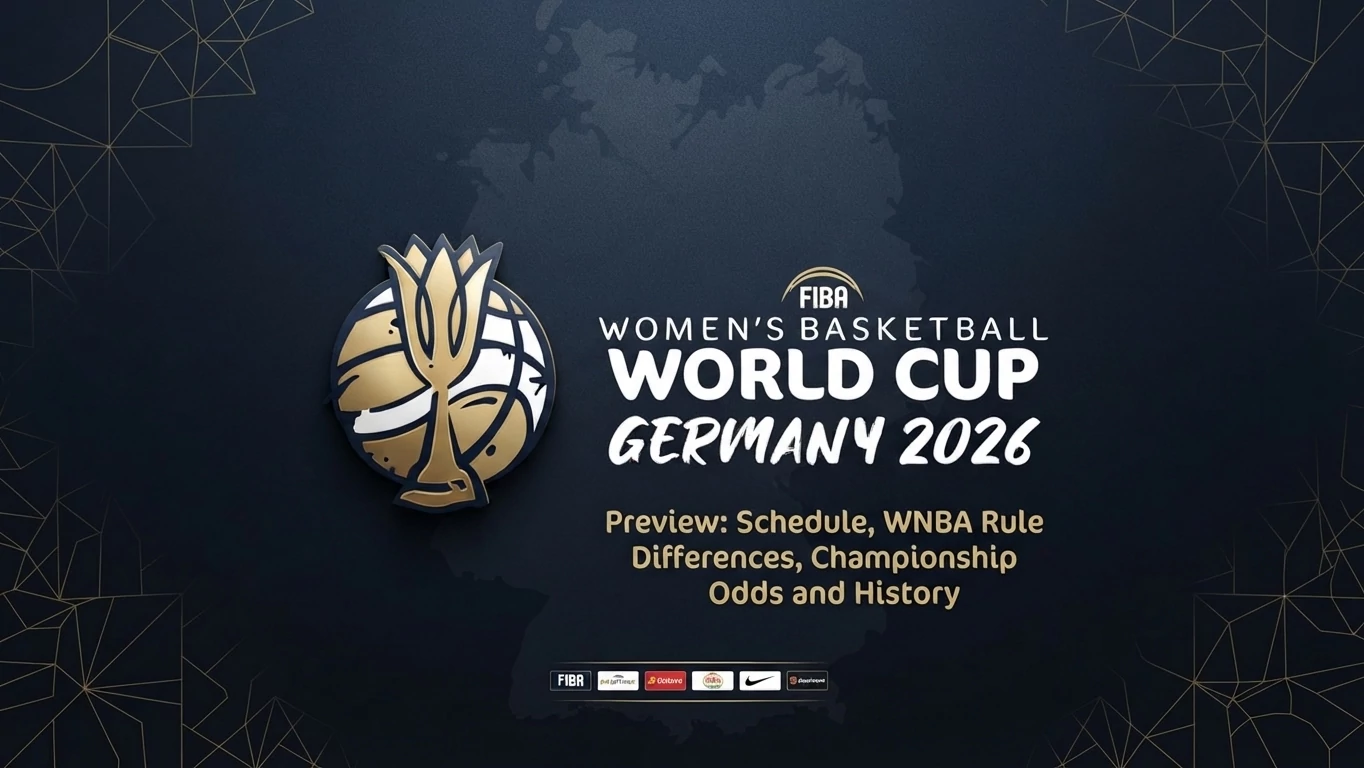
2026 FIBA Women’s Basketball World Cup Preview: Schedule, WNBA Rule Differences, Championship Odds and History
The best women’s basketball players in the world are headed to Berlin for one of the biggest international sporting events of 2026.
The
FIBA Women’s Basketball World Cup
will be held
September 4-13, 2026, in Berlin, Germany, bringing together 16 national teams for 36 games over 10 days. The tournament is especially relevant to American basketball fans because the WNBA has built a break into its regular-season schedule to allow players to represent their countries.
For the United States, the mission is familiar: win gold. Team USA has captured the last four World Cups and enters Berlin pursuing a fifth consecutive championship and its 12th overall.
However, this year’s tournament could be more unpredictable than the betting odds initially suggested. On August 31,
A’ja Wilson and Kelsey Plum withdrew from Team USA for health reasons, with Sonia Citron and Kiki Iriafen added to the roster. Even after those changes, the Americans remain overwhelming favorites.
What Is the FIBA Women’s Basketball World Cup?
The FIBA Women’s Basketball World Cup is essentially the world championship of women’s national-team basketball.
Unlike the WNBA, where players represent professional franchises, World Cup players compete for their countries. The field features powers from Europe, Asia, Africa, the Americas and Oceania, creating matchups that basketball fans rarely get to see during the WNBA season.
The 2026 tournament is the
20th edition
of the Women’s World Cup. It also expands the competition from the 12-team format used in 2022 to a
16-team field divided into four groups of four.
The groups are:
Group Teams
Group A
Spain, Germany, Japan, Mali
Group B
France, Korea Republic, Hungary, Nigeria
Group C
Australia, Belgium, Puerto Rico, Türkiye
Group D
China, Czechia, Italy, United States
The format makes winning a group extremely valuable. Each group winner advances
directly to the quarterfinals. The teams finishing second and third must survive an additional qualification game on September 8 or 9, while the fourth-place team in each group is eliminated.
From the quarterfinals forward, it is straightforward elimination basketball: lose and the dream of becoming world champion is over.
2026 FIBA Women’s Basketball World Cup Schedule
The tournament begins Friday, September 4 and concludes with the championship game Sunday, September 13.
Group Phase
Date Games
Friday, Sept. 4
Japan vs. Mali; Australia vs. Puerto Rico;
USA vs. China; Korea vs. Nigeria; Belgium vs. Türkiye; Spain vs. Germany; Czechia vs. Italy; Hungary vs. France
Saturday, Sept. 5
Mali vs. Spain; Nigeria vs. Hungary; Germany vs. Japan; France vs. Korea
Sunday, Sept. 6
Türkiye vs. Australia; China vs. Czechia; Puerto Rico vs. Belgium;
Italy vs. USA
Monday, Sept. 7
Belgium vs. Australia; Puerto Rico vs. Türkiye; Hungary vs. Korea; Nigeria vs. France; Japan vs. Spain; Germany vs. Mali;
USA vs. Czechia; Italy vs. China
The official FIBA schedule confirms group play runs from September 4-7.
For American fans following Team USA, the Americans open against
China on September 4, a rematch of the 2022 World Cup championship game. They then face Italy on September 6 and Czechia on September 7.
Knockout Schedule
Date Round
Sept. 8-9
Qualification for Quarterfinals
Sept. 10
Quarterfinals
Sept. 11
No games
Sept. 12
Semifinals
Sept. 13
Third-Place Game and World Cup Final
That makes the tournament unusually unforgiving. A second- or third-place group finish means a team may have to win four consecutive elimination games to become world champion.
How Are FIBA Rules Different From the WNBA?
WNBA fans should recognize most of the basketball immediately. Both competitions use
four 10-minute quarters and a 24-second shot clock, so the basic rhythm of the game is similar.
But several important FIBA rules can noticeably change how the game is played.
The foul difference is particularly significant. Under FIBA rules, a player must leave after committing
five fouls, compared with six in the WNBA.
Defensive strategy is another major adjustment. The WNBA has a defensive three-second rule requiring a defender in the lane to be actively guarding an opponent. FIBA’s three-second violation instead applies to an offensive player remaining in the opponent’s restricted area. That means international teams can station rim protectors around the paint in ways that would trigger a defensive-three-seconds call in the WNBA.
FIBA also uses an
alternating-possession arrow
for most jump-ball situations after the opening tip rather than repeatedly conducting jump balls as the WNBA does.
These differences may seem small on paper, but they can affect spacing, post play, defensive schemes, late-game strategy and foul management.
One other important detail for 2026: although FIBA has already published a new 2026 rules edition, those changes do not take effect until
October 1, 2026. Therefore, the September World Cup is governed by the currently effective FIBA rules rather than the upcoming October changes.
Ranking the 2026 World Cup Teams by Odds to Win
There is little disagreement about the favorite.
There is considerably more disagreement about everyone behind the United States.
The following ranking uses the
FanDuel outright championship prices reported on the morning of August 31. Because futures markets move and Team USA’s Wilson-Plum roster news broke the same day, these should be treated as a snapshot rather than guaranteed current prices.
Rank Team Championship Odds
1🇺🇸 United States-360
2🇫🇷 France+750
3🇧🇪 Belgium+1800
4🇦🇺 Australia+2000
5🇨🇳 China+3000
6🇪🇸 Spain+4000
7🇩🇪 Germany+5500
8🇮🇹 Italy+70009🇯🇵 Japan+8000
10🇳🇬 Nigeria+12500
11🇹🇷 Türkiye+17500
12🇰🇷 Korea Republic+20000T-
13🇭🇺 Hungary+40000
T-13🇨🇿 Czechia+40000
T-13🇲🇱 Mali+40000
T-13🇵🇷 Puerto Rico+40000
Odds vary significantly between sportsbooks. For example, the same August 31 market showed BetRivers pricing the United States at -670 while FanDuel had -360. France, Belgium and Australia also had dramatically different prices depending on the book.
1. United States — The Team to Beat
Even without Wilson and Plum, the Americans have extraordinary depth.
Breanna Stewart provides championship experience while
Caitlin Clark, Paige Bueckers,
Aliyah Boston, Angel Reese, Napheesa Collier, Chelsea Gray and others give the U.S. a combination of shooting, size and playmaking few countries can duplicate.
A separate August 31 market update published after the Wilson-Plum announcement still listed the United States around
-400, showing that bookmakers continued to view Team USA as the overwhelming favorite.
2. France — The Biggest Threat
France may be the best candidate to end America’s run.
Gabby Williams, Dominique Malonga, Marine Johannès, Janelle Salaün and Valériane Ayayi give France length, athleticism and high-level international experience.
France nearly defeated the United States in the gold-medal game at the 2024 Paris Olympics, and the French have the talent to make another championship run.
3. Belgium — A Dangerous Dark Horse
Belgium is no longer merely an interesting European team. The Belgian Cats are legitimate contenders.
Emma Meesseman remains one of international basketball’s elite frontcourt players, while Julie Allemand gives Belgium an experienced playmaker. Belgium enters Berlin as the reigning Women’s EuroBasket champion and is looking for its first Women’s World Cup medal.
4. Australia — Never Count Out the Opals
Australia has one of the strongest World Cup traditions outside the United States.
The Opals feature Ezi Magbegor, Alanna Smith, Stephanie Talbot and Jade Melbourne and should once again be dangerous defensively. Their September 7 matchup with Belgium could be one of the best games of the group stage.
The Next Tier
China should command respect after reaching the
2022 World Cup championship game, while Spain has a long history of international success.
Host Germany will have a home-court advantage but enters the tournament dealing with important injury questions. Nigeria, meanwhile, has developed into one of the strongest women’s basketball programs in Africa and could be a dangerous knockout opponent.
History of the FIBA Women’s Basketball World Cup
The Women’s World Cup goes back much further than the
WNBA.
The inaugural competition was played in
Santiago, Chile, in March 1953, more than four decades before the
WNBA
began play in 1997.
Only 10 countries participated in that first tournament, with eight coming from the Americas and two from Europe. Games were even played outdoors at the Estadio Nacional, creating problems whenever rain made the court slippery.
The rules were dramatically different as well. The inaugural World Cup used two 16-minute halves rather than today’s four-quarter system.
One thing, however, has remained remarkably consistent: American success.
The United States won the inaugural championship, defeating host Chile 49-36 in its final game.
World Cup Championships by Country
Country Gold Medals
United States11Soviet Union6Australia1Brazil1
That is one of the most remarkable statistics in international sports:
only four nations have ever won the Women’s Basketball World Cup.
The Soviet Union dominated much of the tournament’s early history, winning five consecutive championships from 1959 through 1975 and six overall.
Brazil finally broke through in
1994, led by a legendary generation featuring Hortência Marcari, Janeth Arcain and “Magic” Paula.
Australia joined the champions’ club in
2006, when Lauren Jackson and Penny Taylor powered the Opals to their first world championship.
Since then, it has been all United States.
The Americans won in 2010, 2014, 2018 and 2022 and now arrive in Berlin attempting to make it
five consecutive World Cup championships.
The 2022 final saw the United States defeat China 83-61 in Sydney. China took silver and Australia won bronze.
Conclusion: Can Anyone Stop Team USA?
The 2026 FIBA Women’s Basketball World Cup arrives at a fascinating moment for women’s basketball.
The
WNBA
is filled with established stars and a rapidly growing generation of young talent, and many of those players will now trade their professional uniforms for national colors.
Team USA remains the standard. Eleven championships, four consecutive gold medals and arguably the deepest talent pool in women’s basketball make the Americans deserving favorites.
But Berlin may provide a stronger test than the odds imply.
The withdrawals of A’ja Wilson and Kelsey Plum remove two accomplished international veterans. France possesses the size and athleticism to challenge the Americans. Belgium has Emma Meesseman and championship confidence. Australia is always dangerous on the international stage, while China, Spain, Germany and Nigeria provide additional potential obstacles.
The expanded 16-team format adds another strategic element. Win your group and you receive direct entry into the quarterfinals. Finish second or third and an additional elimination game stands between you and the medal rounds.
And FIBA basketball itself creates challenges that WNBA stars must quickly adjust to: five fouls instead of six, different paint-defense rules, alternating possession and different timeout procedures.
From the opening
USA-China rematch on September 4
to the championship game on
September 13, Berlin will determine whether American dominance continues — or whether another country can produce one of the biggest upsets in the history of international women’s basketball.
For the United States, anything short of gold will be considered an upset.
For everyone else, the goal is simple: finally find a way to bring the American dynasty to an end.
New Users – Get $350 in Bonus Bets when you wager $5 for 7 days
T&Cs apply
4.6/5
Gambling Problem? Call 1-800-GAMBLER or 1-800-MY-RESET. Call 1-888-789-7777 or visit ccpgg.org/chat (CT). Hope is here. GamblingHelpLineMA.org or call (800) 327-5050 for 24/7 support (MA). Visit www.mdgamblinghelp.org (MD). Call 1-877-8HOPE-NY or text HOPENY (NY). 21+ (18+ DC, WY) and present in select states (for KS, in affiliation with Kansas Star Casino). Find online real money wagering only. Min $5 wager required for 7 consecutive days. $5 free play credit. Bonus issued as non-withdrawable bonus with cash withdrawable bonus with cash withdrawable. Bonus bets which expire 7 days after receipt. Restrictions apply. See terms at sportsbook.fanduel.com. Call 1-877-770-7867 (LA).
Up To $1500 in Bonus Bets Paid Back if your First Bet Does Not Win
T&Cs apply
4.5/5
Gambling problem? Call 1-800-GAMBLER or 1-800-MY-RESET (Available in the US) 877-8-HOPENY or text HOPENY (467369) (NY) 1-800-327-5050 (MA), 1-800-BETS-OFF (IA), 1-800-981-0023 (PR). 21+ only. Please Gamble Responsibly. See BetMGM.com for Terms. First Bet Offer for new customers only (if applicable). Subject to eligibility requirements. Bonus bets are non-withdrawable. In partnership with Kansas Crossing Casino and Hotel. Promotional offers not available in Mississippi, Massachusetts, New York, Ontario, or Puerto Rico.
New DraftKings Customers: Bet $5, Get $200 + 3 Months of NBA League Pass!
T&Cs apply
4.5/5
GAMBLING PROBLEM? CALL 1-800-GAMBLER or 1-800-MY-RESET, (800) 327-5050 or visit gamblinghelplinema.org (MA). Please Gamble Responsibly. 888-789-7777/visit ccpg.org (CT), or visit www.mdgamblinghelp.org (MD), 1-800-981-0023 (PR). 21+ and present in most states. (18+ DC/NH/PR/WY). Void in CAN. Eligibility restrictions apply. On behalf of Boot Hill Casino (KS). Pass-thru of per wager tax may apply in IL. 1 per new Sportsbook customer. $5+ first-time bet req. Max. $200 issued as non-withdrawable Bonus Bets. Stake removed from payout. Reward issued as $50 in Bonus Bets every 7 days via click-to-claim for 21 days. Bonus Bets and click-to-claims expire 7 days (168hrs) after issuance. Terms: dkng.co/offer. Get 1 promo code to redeem a 3-month NBA League Pass subscription, complimentary of DraftKings. Subscription auto-renews monthly at then-current price (currently $16.99/mo); cancel anytime. Terms, restrictions, and eligibility requirements apply. Redeem League Pass by 12/19/26 at 11:59 PM ET. Addt’l terms: support.watch.nba.com/hc/en-us/articles/9165532876183-League-Pass-Terms-of-Use_. Ends 11/29/26 at 11:59 PM ET. Sponsored by DK.
Must be 21+. GAMBLING PROBLEM? CALL 1-800-GAMBLER OR CALL 1-800-MY-RESET, www.mdgamblinghelp.org (MD), (800)-327-5050 or gamblinghelplinema.org (MA), Call (877)8-HOPENY or text HOPENY (467369) (NY), (888) 789-7777 or ccpg.org (CT), morethanagame.nc.gov (NC), 1800gambler.net (WV)
Bet $1 and get double the winnings up to $25 for your next 10 bets
T&Cs apply
4.4/5
21+ New users only. Must register using eligible promo code. First bet after registration must qualify. Max. Bonus Bet: $1,000. Bonus Bet expires 14 days after receipt. Void where prohibited. See Caesars.com/promos for full terms. Gambling Problem? 1-800-GAMBLER (1-800-426-2537)
21+ and present in OH. Gambling Problem? Call 1-800-GAMBLER.
This site is using
Cloudflare
and adheres to the
Google Safe Browsing Program. We adapted
Google's Privacy Guidelines
to keep your data safe at all times.
Close
Ready to Win Big? Join the Elite with Our Sports Betting Deals!
FanDuel Promo
New Users – Get $350 in Bonus Bets when you wager $5 for 7 days
Our Favorite
T&Cs and 21+ apply
Gambling Problem? Call 1-800-GAMBLER or 1-800-MY-RESET. Call 1-888-789-7777 or visit ccpgg.org/chat (CT). Hope is here. GamblingHelpLineMA.org or call (800) 327-5050 for 24/7 support (MA). Visit www.mdgamblinghelp.org (MD). Call 1-877-8HOPE-NY or text HOPENY (NY). 21+ (18+ DC, WY) and present in select states (for KS, in affiliation with Kansas Star Casino). Find online real money wagering only. Min $5 wager required for 7 consecutive days. $5 free play credit. Bonus issued as non-withdrawable bonus with cash withdrawable bonus with cash withdrawable. Bonus bets which expire 7 days after receipt. Restrictions apply. See terms at sportsbook.fanduel.com. Call 1-877-770-7867 (LA).
Code:
Open FanDuel
Get Bonus
BetMGM Promo
Up To $1500 in Bonus Bets Paid Back if your First Bet Does Not Win
Best Slots
T&Cs and 21+ apply
Gambling problem? Call 1-800-GAMBLER or 1-800-MY-RESET (Available in the US) 877-8-HOPENY or text HOPENY (467369) (NY) 1-800-327-5050 (MA), 1-800-BETS-OFF (IA), 1-800-981-0023 (PR). 21+ only. Please Gamble Responsibly. See BetMGM.com for Terms. First Bet Offer for new customers only (if applicable). Subject to eligibility requirements. Bonus bets are non-withdrawable. In partnership with Kansas Crossing Casino and Hotel. Promotional offers not available in Mississippi, Massachusetts, New York, Ontario, or Puerto Rico.
Code:
Open BetMGM
Get Bonus
DraftKings Promo
New DraftKings Customers: Bet $5, Get $200 + 3 Months of NBA League Pass!
Newcomer
T&Cs and 21+ apply
GAMBLING PROBLEM? CALL 1-800-GAMBLER or 1-800-MY-RESET, (800) 327-5050 or visit gamblinghelplinema.org (MA). Please Gamble Responsibly. 888-789-7777/visit ccpg.org (CT), or visit www.mdgamblinghelp.org (MD), 1-800-981-0023 (PR). 21+ and present in most states. (18+ DC/NH/PR/WY). Void in CAN. Eligibility restrictions apply. On behalf of Boot Hill Casino (KS). Pass-thru of per wager tax may apply in IL. 1 per new Sportsbook customer. $5+ first-time bet req. Max. $200 issued as non-withdrawable Bonus Bets. Stake removed from payout. Reward issued as $50 in Bonus Bets every 7 days via click-to-claim for 21 days. Bonus Bets and click-to-claims expire 7 days (168hrs) after issuance. Terms: dkng.co/offer. Get 1 promo code to redeem a 3-month NBA League Pass subscription, complimentary of DraftKings. Subscription auto-renews monthly at then-current price (currently $16.99/mo); cancel anytime. Terms, restrictions, and eligibility requirements apply. Redeem League Pass by 12/19/26 at 11:59 PM ET. Addt’l terms: support.watch.nba.com/hc/en-us/articles/9165532876183-League-Pass-Terms-of-Use_. Ends 11/29/26 at 11:59 PM ET. Sponsored by DK.
Code:
Open DraftKings
Get Bonus
Find out what the legends have to say about sports this week....
New Users – Get $350 in Bonus Bets when you wager $5 for 7 days
Gambling Problem? Call 1-800-GAMBLER or 1-800-MY-RESET. Call 1-888-789-7777 or visit ccpgg.org/chat (CT). Hope is here. GamblingHelpLineMA.org or call (800) 327-5050 for 24/7 support (MA). Visit www.mdgamblinghelp.org (MD). Call 1-877-8HOPE-NY or text HOPENY (NY). 21+ (18+ DC, WY) and present in select states (for KS, in affiliation with Kansas Star Casino). Find online real money wagering only. Min $5 wager required for 7 consecutive days. $5 free play credit. Bonus issued as non-withdrawable bonus with cash withdrawable bonus with cash withdrawable. Bonus bets which expire 7 days after receipt. Restrictions apply. See terms at sportsbook.fanduel.com. Call 1-877-770-7867 (LA).