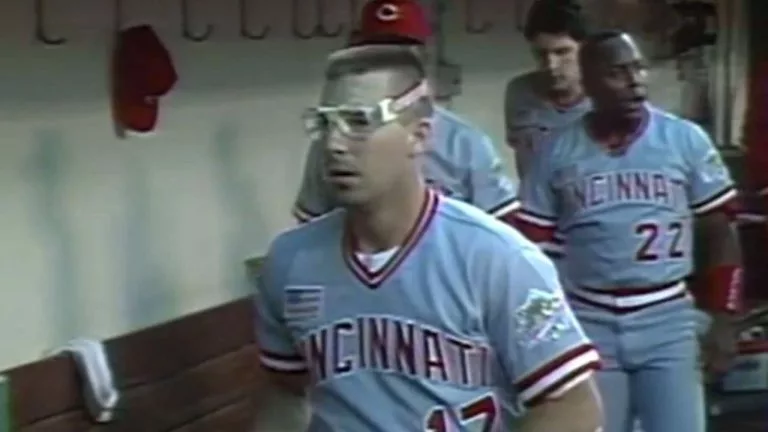
Few championships in baseball history carried as much catharsis, chaos, and surprise as the Cincinnati Reds’ 1990 World Series run. It wasn’t just a title—it was a redemption story for a franchise rocked by scandal, reshaped by change, and galvanized by a fearless manager who refused to back down.
The Shadow of Pete Rose
The late 1980s were supposed to be the Reds’ return to prominence.
Pete Rose, the hometown hero and embodiment of Cincinnati baseball, had taken over as player-manager in 1984 and led a young, talented roster that finished second in the National League West four straight years (1985–88). With stars like Eric Davis, Dave Parker, and Tom Browning, the Reds seemed perpetually on the verge of breaking through—until Rose’s gambling scandal tore the organization apart.
In August 1989, Rose accepted a lifetime ban from baseball after being caught betting on games while managing the Reds. It was a devastating blow to the franchise and city. The once-proud Reds, synonymous with professionalism and tradition, became a national embarrassment. For a team that had come so close for so long, it seemed the final nail in their competitive window. But out of that chaos came renewal.
A New Era: Lou Piniella and the 1990 Roster Overhaul
The Reds made a bold move in 1990 by hiring fiery former Yankee outfielder Lou Piniella as manager. Where Rose had emphasized discipline and history, Piniella brought intensity, emotion, and an unwavering will to win. He inherited a roster reshaped by then–general manager Bob Quinn and built for balance rather than star power.
Gone was Dave Parker, the aging slugger and clubhouse presence. In his place stood a deeper, faster, and more defensively sound roster. Barry Larkin emerged as the quiet leader at shortstop, Eric Davis returned healthy and explosive in center field, and Chris Sabo brought energy at third. Rookie Hal Morris took over at first base and immediately became a clutch performer.
But the true backbone of the 1990 Reds was their pitching—specifically, the bullpen trio known as the
“Nasty Boys.”
Randy Myers, Rob Dibble, and Norm Charlton formed a dominant late-inning force unlike anything baseball had seen in years. They combined for 44 saves, 351 strikeouts, and countless psychological victories over opponents who knew the game was over once the seventh inning ended.
Anchored by José Rijo, Danny Jackson, and Tom Browning in the rotation, the Reds had every component of a championship club—even if no one realized it yet.
MLB: Nasty Boys (The 1990 Cincinnati Reds)
Wire to Wire: The Season of Resilience
From Opening Day, the Reds shocked the league. They jumped out to a 9–0 start and never looked back, becoming the first National League team in 75 years to go “wire to wire” — leading their division every single day of the season. Piniella’s fiery leadership, combined with the team’s unity after years of turmoil, created a palpable sense of destiny.
Eric Davis returned to superstardom with 24 homers and 86 RBIs despite injuries. Larkin hit .301 and set the tone with his steadiness. Sabo chipped in 25 home runs, and Paul O’Neill became a consistent offensive force. But the Reds’ identity was clear—pitching, defense, and relentless hustle.
They finished 91–71, comfortably ahead of the Dodgers, and earned their first postseason berth since the Big Red Machine era.
The Road to the Fall Classic
In the NLCS, the Reds faced the powerful Pittsburgh Pirates, led by Barry Bonds, Bobby Bonilla, and Andy Van Slyke. It was a tense, low-scoring series dominated by pitching. José Rijo was magnificent, while the Nasty Boys silenced the Pirates’ bats in crucial late innings. Cincinnati took the series in six games, earning a trip to their first World Series since 1976.
Their opponent? The Oakland Athletics — a juggernaut.
1990 Cincinnati Reds postseason highlights HD
The Historic Upset: Reds vs. A’s
The 1990 World Series was expected to be a coronation for the A’s. Tony La Russa’s team had swept the Giants in 1989, possessed the most feared lineup in baseball with Jose Canseco and Mark McGwire, and featured the game’s best closer, Dennis Eckersley. Most experts predicted another Oakland sweep—just in the opposite direction.
Instead, the Reds flipped the script.
Game 1 set the tone: José Rijo outdueled Dave Stewart, Eric Davis homered and made a spectacular catch crashing into the wall, and the Reds rolled 7–0. That blow seemed to stun the A’s, who never recovered.
WS1990 Gm1: Davis’ homer gives Reds 2-0 lead in first
Game 2
was a tense extra-inning thriller, with utility man Billy Bates beating out an infield single and Joe Oliver lining a walk-off hit off Eckersley. The underdogs were suddenly up 2–0 heading to Oakland.
1990 WS Gm2: Oliver’s single off Eckersley wins game
Game 3
saw Rijo shine again, pitching shutout baseball while Chris Sabo launched two home runs.
WS1990 Gm3: Sabo hits two homers in Reds’ victory
By
Game 4, the mighty A’s looked broken. Rijo once again baffled their sluggers, allowing just two hits over eight innings before handing it off to Myers to finish the sweep.
The Reds had done the unthinkable: swept the defending champions in one of the biggest World Series upsets in modern baseball history.
1990 WS Gm4: Reds sweep 1990 World Series
Why the 1990 Reds Shocked the World
The upset’s magnitude cannot be overstated. The A’s were a dynasty-in-progress, winners of three straight AL pennants, and boasting the sport’s highest payroll and deepest talent. The Reds, on the other hand, were still rebuilding their credibility after the Rose scandal, had no .300 hitters or 30-HR men, and were dismissed as “nice little overachievers.”
What made their victory historic was how completely they outplayed the A’s in every facet—pitching, defense, energy, and even swagger. The Nasty Boys overwhelmed Oakland’s offense, and Rijo, named
World Series MVP, cemented his place in Reds lore.
Redemption for a Franchise
The 1990 championship meant more to Cincinnati than just a trophy—it was redemption. The Reds had lived through the disgrace of Pete Rose’s downfall, endured years of “almosts,” and rebuilt from within. This was not the Big Red Machine, but it captured the same heart and soul of the Queen City.
Lou Piniella’s passionate leadership, Barry Larkin’s quiet excellence, and the bullpen’s intimidating fire combined to give Cincinnati its first title in 14 years and its last to date.
The 1990 Reds proved that even amid chaos, greatness can emerge—and that sometimes, the teams no one believes in write the stories we remember forever.
Final Record:
91–71 (NL West Champions)
Postseason:
Def. Pirates (NLCS, 4–2); Def. A’s (World Series, 4–0)
World Series MVP:
José Rijo
Up To $1500 in Bonus Bets Paid Back if your First Bet Does Not Win
T&Cs apply
4.5/5
Gambling problem? Call 1-800-GAMBLER or 1-800-MY-RESET (Available in the US) 877-8-HOPENY or text HOPENY (467369) (NY) 1-800-327-5050 (MA), 1-800-BETS-OFF (IA), 1-800-981-0023 (PR). 21+ only. Please Gamble Responsibly. See BetMGM.com for Terms. First Bet Offer for new customers only (if applicable). Subject to eligibility requirements. Bonus bets are non-withdrawable. In partnership with Kansas Crossing Casino and Hotel. Promotional offers not available in Mississippi, Massachusetts, New York, Ontario, or Puerto Rico.
New DraftKings Customers: Spend $5+ Get $150 in Bonuses
T&Cs apply
4.5/5
GAMBLING PROBLEM? CALL 1-800-GAMBLER or 1-800-MY-RESET, (800) 327-5050 or visit gamblinghelplinema.org (MA). Please Gamble Responsibly. 888-789-7777/visit ccpg.org (CT), or visit www.mdgamblinghelp.org (MD), 1-800-981-0023 (PR). 21+ and present in most states. (18+ DC/NH/PR/WY). Void in CAN. Eligibility restrictions apply. On behalf of Boot Hill Casino (KS). Pass-thru of per wager tax may apply in IL. 1 per new DraftKings customer. $5+ first-time bet req. Max. $150 issued as non-withdrawable Bonus Bets. Stake removed from payout. Reward issued as $50 in Bonus Bets every 7 days via click-to-claim for 14 days. Bonus Bets and click-to-claims expire 7 days (168hrs) after issuance. Terms: sportsbook.draftkings.com/promos. Ends 10/11/26 at 11:59 PM ET. Sponsored by DK.
Must be 21+. GAMBLING PROBLEM? CALL 1-800-GAMBLER OR CALL 1-800-MY-RESET, www.mdgamblinghelp.org (MD), (800)-327-5050 or gamblinghelplinema.org (MA), Call (877)8-HOPENY or text HOPENY (467369) (NY), (888) 789-7777 or ccpg.org (CT), morethanagame.nc.gov (NC), 1800gambler.net (WV)
Bet $1 and get double the winnings up to $25 for your next 10 bets
T&Cs apply
4.4/5
21+ New users only. Must register using eligible promo code. First bet after registration must qualify. Max. Bonus Bet: $1,000. Bonus Bet expires 14 days after receipt. Void where prohibited. See Caesars.com/promos for full terms. Gambling Problem? 1-800-GAMBLER (1-800-426-2537)
21+ and present in OH. Gambling Problem? Call 1-800-GAMBLER.
This site is using
Cloudflare
and adheres to the
Google Safe Browsing Program. We adapted
Google's Privacy Guidelines
to keep your data safe at all times.
Close
Ready to Win Big? Join the Elite with Our Sports Betting Deals!
FanDuel Promo
New Users – Get $250 in Bonus Bets when you wager $5 for 5 days
Up To $1500 in Bonus Bets Paid Back if your First Bet Does Not Win
Best Slots
T&Cs and 21+ apply
Gambling problem? Call 1-800-GAMBLER or 1-800-MY-RESET (Available in the US) 877-8-HOPENY or text HOPENY (467369) (NY) 1-800-327-5050 (MA), 1-800-BETS-OFF (IA), 1-800-981-0023 (PR). 21+ only. Please Gamble Responsibly. See BetMGM.com for Terms. First Bet Offer for new customers only (if applicable). Subject to eligibility requirements. Bonus bets are non-withdrawable. In partnership with Kansas Crossing Casino and Hotel. Promotional offers not available in Mississippi, Massachusetts, New York, Ontario, or Puerto Rico.
Code:
Open BetMGM
Get Bonus
DraftKings Promo
New DraftKings Customers: Spend $5+ Get $150 in Bonuses
Newcomer
T&Cs and 21+ apply
GAMBLING PROBLEM? CALL 1-800-GAMBLER or 1-800-MY-RESET, (800) 327-5050 or visit gamblinghelplinema.org (MA). Please Gamble Responsibly. 888-789-7777/visit ccpg.org (CT), or visit www.mdgamblinghelp.org (MD), 1-800-981-0023 (PR). 21+ and present in most states. (18+ DC/NH/PR/WY). Void in CAN. Eligibility restrictions apply. On behalf of Boot Hill Casino (KS). Pass-thru of per wager tax may apply in IL. 1 per new DraftKings customer. $5+ first-time bet req. Max. $150 issued as non-withdrawable Bonus Bets. Stake removed from payout. Reward issued as $50 in Bonus Bets every 7 days via click-to-claim for 14 days. Bonus Bets and click-to-claims expire 7 days (168hrs) after issuance. Terms: sportsbook.draftkings.com/promos. Ends 10/11/26 at 11:59 PM ET. Sponsored by DK.
Code:
Open DraftKings
Get Bonus
Find out what the legends have to say about sports this week....