Few experiences in sports are as timeless as listening to baseball on the radio.Long before every game was televised
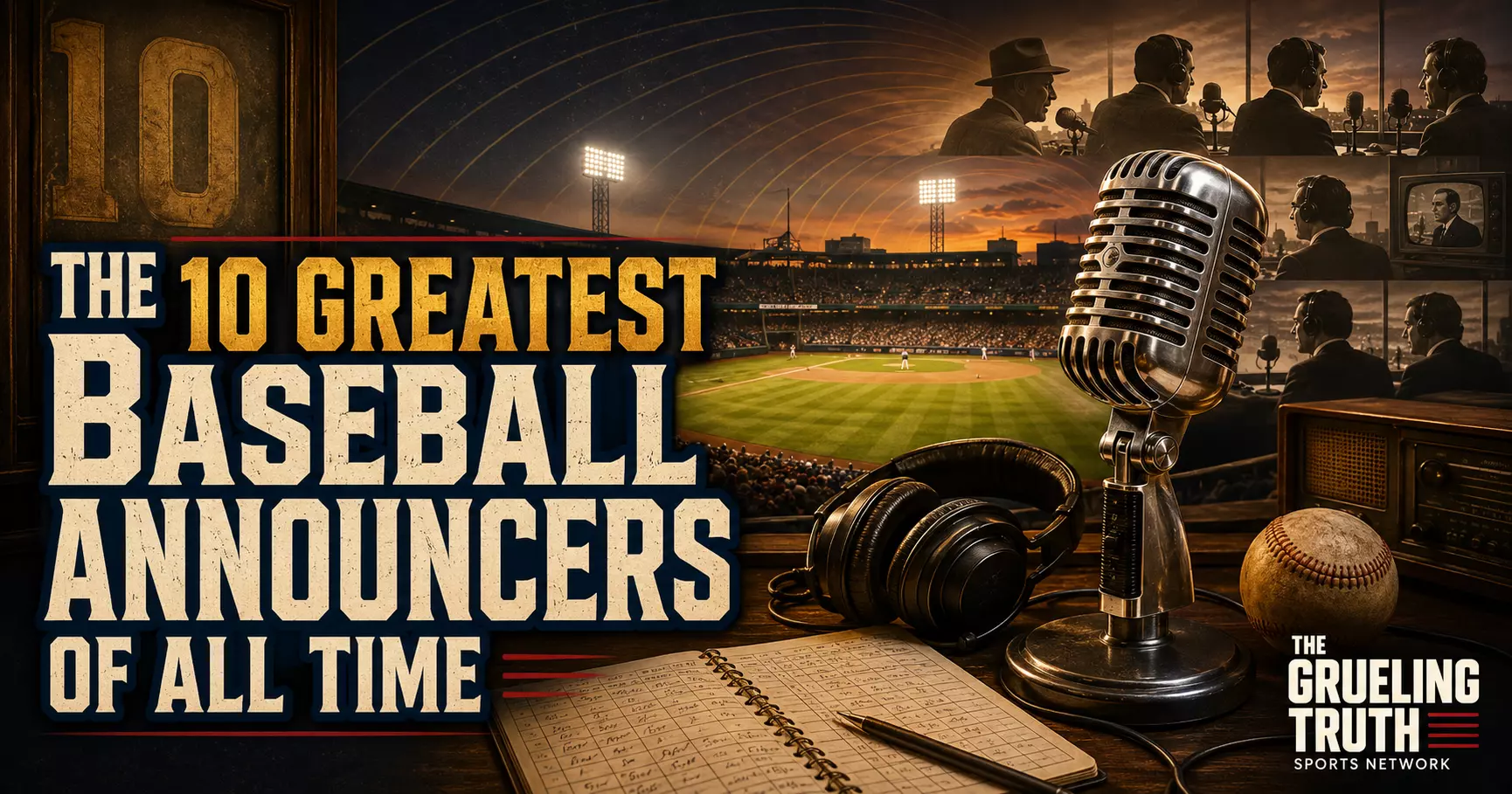
Few experiences in sports are as timeless as listening to baseball on the radio.
Long before every game was televised, streamed and reduced to instant highlights, fans depended on a broadcaster to carry them into the ballpark. One voice supplied the weather, described the crowd, positioned every fielder and followed the flight of every ball. When that voice was exceptional, listeners did not feel as though they were receiving a report from the game. They felt as though they were sitting inside the stadium.
Baseball has always provided the perfect canvas for great broadcasters. Its deliberate pace leaves space for history, humor and conversation, while its sudden moments of drama demand impeccable timing. The finest announcers understood both sides of that equation. They knew how to fill the quiet without overwhelming it and how to rise with a historic moment without making themselves bigger than the play.
This ranking is not based solely on fame or the number of games called. It considers longevity, influence, storytelling, command of the sport and the emotional connection each broadcaster created with generations of fans.
10) Tony Kubek
Tony Kubek brought the instincts of a championship player and the honesty of an independent observer into the broadcast booth.
Before beginning his broadcasting career, Kubek won three
World Series championships
with the New York Yankees. That experience gave him an understanding of strategy, pressure and clubhouse dynamics that few analysts of his era could match. What separated Kubek, however, was his ability to translate that knowledge clearly. He did not bury viewers beneath technical language or attempt to prove he was smarter than everyone else. He identified the important detail and explained why it mattered.
Kubek became a central figure in NBC’s baseball coverage, working 11 World Series and 10 All-Star Games. His partnership with Joe Garagiola blended Kubek’s sharp analysis with Garagiola’s easy humor, producing one of television’s most natural baseball pairings.
He was also willing to criticize players, managers and organizations when he believed criticism was deserved. That candor sometimes created friction, but it also made his analysis credible. Fans trusted that Kubek would tell them what he saw rather than protect old relationships.
Kubek helped define what a modern color commentator could be: informed, direct and capable of teaching the game without interrupting its flow.
10/8/1972 ALCS Game 2 (Campy Bat-Throwing Incident)
9) Jon Miller
Jon Miller possesses one of the most naturally pleasing voices baseball has ever heard.
His delivery has warmth, rhythm and a subtle musical quality that fits the sport perfectly. Miller can make a routine summer game feel inviting without manufacturing drama, then effortlessly lift his energy when the action demands it. He never sounds as though he is waiting to deliver a rehearsed catchphrase. His calls grow organically from the game.
Miller became a national institution during his years alongside Joe Morgan on ESPN’s
Sunday Night Baseball. The assignment placed him in the homes of millions of fans each week and established him as one of the defining national voices of his generation. His work with the San Francisco Giants has been equally important, allowing him to build the deeper relationship with a local audience that only daily baseball can create.
Preparation is evident in every broadcast. Miller is especially respected for learning the proper pronunciation of names and honoring the backgrounds of the players he covers. His humor is clever without being forced, and his stories add personality without distracting from the field.
Miller does more than accurately describe baseball. He gives each game texture, movement and life.
LAD@SF: Miller calls Pagan’s home run off Kershaw
8) Harry Kalas
Harry Kalas did not merely announce Philadelphia Phillies games. For almost four decades, he sounded like Philadelphia baseball.
His deep, resonant voice was immediately recognizable and seemed created for the sport’s grandest moments. Kalas could deliver a simple lineup change with authority, yet when a home run disappeared into the seats, his excitement rose with the crowd. His famous home-run calls never sounded artificial because the emotion behind them was genuine.
Kalas joined the Phillies in 1971 and became part of the daily lives of several generations of fans. His partnership with Richie Ashburn was one of baseball broadcasting’s greatest relationships. Kalas supplied the powerful play-by-play voice, while Ashburn added wit, experience and an understated charm. Together, they made even an uneventful game worth hearing.
The defining call of Kalas’ career came when the Phillies completed their 2008 World Series championship. It was more than a description of the final out. His voice carried the release of a city that had waited 28 years for another title.
Kalas understood that a local broadcaster becomes part historian, part storyteller and part family companion. Philadelphia did not simply listen to him. It grew up with him.
Harry Kalas call of Wild Thing’s walk-off hit
7) Red Barber
Modern baseball broadcasting owes an enormous debt to Red Barber.
Barber entered the profession when announcers were still determining how best to describe a game to an audience that could not see it. He established standards for preparation, accuracy and language that influenced nearly everyone who followed. Rather than shouting through the action, Barber created clear images and trusted listeners to understand the significance of what he described.
His career placed him at the center of several broadcasting milestones. Barber called Major League Baseball’s first night game in 1935 and handled the first televised major-league game in 1939. He later became identified with the Brooklyn Dodgers and then the New York Yankees, bringing a polished Southern voice to the country’s largest media market.
Barber’s colorful expressions—his famous “catbird seat” among them—gave his work personality, but his lasting contribution was professionalism. He prepared carefully, described events honestly and believed the broadcaster’s first responsibility was to the audience.
He also became an important mentor to a young Vin Scully. That alone would give Barber a permanent place in baseball history, but his own career requires no borrowed greatness. He helped invent the language through which generations experienced the game.
Roger Maris 1961 – 61st Home Run as Called by Red Barber, WPIX-TV, 10/1/1961
6) Bob Costas
Bob Costas approached baseball with the knowledge of a historian and the precision of a master broadcaster.
Although his career extended far beyond the sport, some of Costas’ finest work came on baseball broadcasts. He understood that every game belongs to a much larger story, and he could connect a current player or situation to the game’s past without sounding like he was reciting trivia. His historical references supplied context rather than nostalgia for its own sake.
Costas’ voice was polished, controlled and perfectly suited to national television. He never needed to scream to establish the magnitude of a moment. His choice of words, sense of timing and respect for silence allowed important plays to retain their natural power.
His work on NBC’s
Game of the Week, postseason coverage and Major League Baseball Network demonstrated an uncommon versatility. Costas could handle play-by-play, conduct a revealing interview, lead a studio discussion or deliver an essay about the state of the sport.
Unlike many names on this list, he was not permanently attached to one franchise. His relationship was with baseball itself. Costas treated the game as both competition and cultural history, and his broadcasts consistently made viewers feel that what they were watching belonged to something larger.
With that familiar greeting, Mel Allen welcomed millions of listeners and viewers into the world of baseball.
Allen became best known as the longtime voice of the New York Yankees during an era when the franchise dominated the sport. His calls accompanied the achievements of Joe DiMaggio, Mickey Mantle, Yogi Berra and numerous championship teams. Because the Yankees occupied baseball’s largest stage, Allen’s voice became familiar far beyond New York.
He combined a smooth delivery with unmistakable enthusiasm. His famous “How about that?” captured astonishment without requiring an elaborate speech. Allen understood how to add importance to a play while allowing the event itself to remain at the center of the broadcast.
A later generation came to know him through
This Week in Baseball. Allen’s narration tied together highlights from across the major leagues and helped fans follow teams and players they rarely saw on local television. The program extended his influence and made his voice part of Saturday mornings for young baseball followers around the country.
Allen bridged radio’s golden age and the growth of sports television. In both formats, his excitement made baseball seem grand, welcoming and endlessly important.
Roger Maris 1961 – 60th Home Run as Called by Mel Allen, WPIX-TV, 9/26/1961
4) Marty Brennaman
For 46 seasons, Marty Brennaman told Cincinnati Reds fans exactly what he thought.
That honesty became the foundation of his relationship with the audience. Brennaman loved the Reds, but he was never employed as a cheerleader. When the club played intelligently and competed hard, his admiration was obvious. When it performed poorly, ignored fundamentals or made questionable decisions, he did not disguise his frustration.
Fans respected him because his praise had to be earned.
Brennaman arrived in Cincinnati in 1974, just as the Big Red Machine was becoming a dynasty. His first major assignment included calling Hank Aaron’s 714th career home run, and he soon became the voice attached to some of the most successful teams in franchise history.
His partnership with former Reds pitcher Joe Nuxhall developed into one of baseball’s most beloved radio pairings. Their contrasting personalities worked beautifully: Brennaman was direct and precise, while Nuxhall brought the relaxed warmth of a former player and hometown favorite.
Brennaman could handle dramatic moments with power, but his greater achievement was consistency. Night after night, through championship seasons and long rebuilding years, he made Reds baseball worth hearing. For Cincinnati fans, he was not simply in the booth. He was part of summer.
Reds/Indians: 6/30/2006 – Bottom of the 9th classic by Marty Brennaman
3) Ernie Harwell
Ernie Harwell possessed the rare ability to make a broadcast feel like a private conversation shared with an old friend.
For more than four decades, he served as the voice most closely associated with the Detroit Tigers. His gentle Georgia cadence, literary sensibility and deep affection for baseball gave his work a warmth that transcended wins and losses.
Harwell never seemed hurried. He understood that baseball’s pauses were not empty spaces that had to be filled at any cost. They were opportunities to describe the setting, share a story or simply allow the sounds of the ballpark to reach the listener.
His familiar expressions became part of Detroit’s baseball language. A called third strike meant the batter “stood there like the house by the side of the road.” A fan who caught a foul ball might be identified as someone “from” a Michigan town selected by Harwell. These touches were charming because they sounded natural rather than rehearsed.
Harwell called Bobby Thomson’s pennant-winning home run in 1951 for a national television audience before beginning his legendary Detroit run. Yet his greatness was not defined by a single call. It came from thousands of evenings in which he made baseball feel peaceful, personal and permanent.
The Definition of Baseball – Ernie Harwell
2) Jack Buck
Jack Buck’s voice belongs to some of the most unforgettable moments in American sports.
For St. Louis Cardinals fans, he was the steady presence who documented the franchise for nearly half a century. National audiences also heard him call World Series games, NFL contests and other major events. Whatever the assignment, Buck delivered the action with authority and economy.
His most famous baseball calls demonstrate his extraordinary timing. When Ozzie Smith stunned the Dodgers with a walk-off home run in the 1985 National League Championship Series, Buck shouted, “Go crazy, folks! Go crazy!” The words captured the disbelief inside Busch Stadium without burying the moment beneath unnecessary description.
Three years later, after Kirk Gibson’s improbable World Series home run, Buck offered another perfect line: “I don’t believe what I just saw!” Once again, he said exactly what millions of viewers were feeling.
Buck knew how to build excitement, but he also knew when to stop talking. His strong voice never became more important than the game. He brought credibility, emotional intelligence and exceptional timing to every broadcast.
His son Joe continued the family’s broadcasting legacy, but Jack Buck remains an American original—the voice of St. Louis and one of the greatest big-moment announcers the sport has known.
Jack Buck Montage
1) Vin Scully
Vin Scully stands alone.
His 67 seasons with the Dodgers—from Brooklyn through the 2016 season in Los Angeles—represent one of the most remarkable relationships between a broadcaster, a team and its audience in sports history. Generations changed, the franchise moved across the country and baseball transformed around him, yet Scully remained unmistakably himself.
He worked without a traditional radio partner for much of his career, carrying the broadcast through observation, research and storytelling. Scully could introduce a historical detail, a piece of literature or a story about a player’s family, then return to the pitch at precisely the right instant. His preparation was exhaustive, but his delivery made everything sound effortless.
Scully was present for an astonishing collection of historic events: Don Larsen’s perfect game, Sandy Koufax’s perfect game,
Hank Aaron’s 715th home run, Bill Buckner’s error in the 1986 World Series and Kirk Gibson’s home run in 1988.
His call of Aaron’s record-breaking homer illustrated his genius. After describing the ball leaving the park, Scully stopped speaking and allowed the crowd to tell the story. When he returned, he placed the achievement within the history of the country and the burden Aaron had carried.
Scully never fought the game for attention. He illuminated it. His intelligence never felt condescending, his emotion never felt manufactured and his stories never seemed to arrive at the expense of the action.
When he retired in 2016, baseball did not merely lose a broadcaster. It lost its greatest storyteller.
Vin Scully recites famous ‘Field of Dreams’ speech
Honorable Mentions
Bob Uecker
Bob Uecker understood that knowledge and humor could strengthen each other. The former major-league catcher never pretended he had been a superstar, instead turning his modest playing career into an endless supply of self-deprecating stories. As the longtime voice of the Milwaukee Brewers, he could make a slow game entertaining without losing track of the action. His appearances in commercials, television and the film
Major League
made him a national celebrity, but Milwaukee fans knew the complete broadcaster: funny, observant, prepared and capable of meeting a serious moment with genuine emotion.
Bob Uecker is inducted into the Baseball Hall of Fame
Phil Rizzuto
Phil Rizzuto brought the personality of a beloved former Yankee directly into the booth. His broadcasts were unpredictable mixtures of play-by-play, personal stories, birthday wishes and sudden explosions of “Holy cow!” Traditionalists could complain that he occasionally wandered away from the game, but that informality was precisely why so many fans adored him. Rizzuto did not sound like a detached professional describing baseball from above. He sounded like an enthusiastic family member reacting beside you. His warmth and authenticity made Yankees broadcasts feel alive, even when the action on the field was ordinary.
Top 5 Phil Rizzuto Calls
Harry Caray
Harry Caray turned baseball broadcasting into a public celebration. Whether calling the Cardinals, White Sox or Cubs, he gave every game the energy of someone who could not believe he was being paid to watch baseball. His gravelly voice, emotional reactions and willingness to criticize made him unlike anyone else in the booth. At Wrigley Field, his seventh-inning rendition of “Take Me Out to the Ball Game” became a Chicago tradition. Caray’s style was never polished in the conventional sense, but it was completely authentic. Fans responded because he sounded like one of them—only louder, funnier and armed with a microphone.
Harry Caray “Someday the Chicago Cubs are going to be in the World Series”
Joe Garagiola
Joe Garagiola made national baseball broadcasts accessible, warm and entertaining. A former catcher, he understood the details of the game but rarely allowed analysis to become heavy. He explained strategy through stories, humor and the perspective of someone who had lived inside a major-league clubhouse. His work with Tony Kubek on NBC created an excellent contrast, with Garagiola supplying personality alongside Kubek’s direct technical insight. He could laugh at baseball’s absurdities while maintaining deep respect for the sport. Garagiola made viewers feel included in the conversation, which is one of the greatest gifts a broadcaster can possess.
1980 Joe Garagiola: Baseball Funny Side Up
Curt Gowdy
Curt Gowdy represented the
classic national sports broadcaster: composed, versatile and trustworthy. He called baseball, football, basketball and the Olympics without allowing his personality to overwhelm the event. In baseball, his calm delivery and strong command of the moment made him a natural choice for World Series and All-Star Game assignments. Gowdy understood that history did not require theatrical shouting. When an important play unfolded, he described it cleanly and allowed the crowd and pictures to supply the rest. His professionalism helped establish the standard for network sports coverage during television’s formative decades.
MLB – 1975 – Curt Gowdy Features World Series Red Sox Vs Reds Game 6 As Greatest Game He Ever Called
Final Word
Baseball’s greatest announcers did much more than identify pitches, count runs or describe where a ball landed.
They became the connection between the game and the people who loved it. They carried baseball across long summer evenings, through car radios, living rooms and generations of families. Their words gave shape to moments fans could not see and added meaning to the moments they could.
Styles changed from one broadcaster to the next. Some were poetic, others blunt. Some relied on humor, while others brought the authority of a historian. The best of them shared an understanding that the game—not the person holding the microphone—must remain the star.
The final scores have long since faded, but the greatest calls remain instantly recognizable. One phrase can return a fan to a particular ballpark, inning or childhood summer.
That is the enduring power of a great baseball voice.
The game ends. The broadcast signs off. The memory remains.
New Users – Get $350 in Bonus Bets when you wager $5 for 7 days
T&Cs apply
4.6/5
Gambling Problem? Call 1-800-GAMBLER or 1-800-MY-RESET. Call 1-888-789-7777 or visit ccpgg.org/chat (CT). Hope is here. GamblingHelpLineMA.org or call (800) 327-5050 for 24/7 support (MA). Visit www.mdgamblinghelp.org (MD). Call 1-877-8HOPE-NY or text HOPENY (NY). 21+ (18+ DC, WY) and present in select states (for KS, in affiliation with Kansas Star Casino). Find online real money wagering only. Min $5 wager required for 7 consecutive days. $5 free play credit. Bonus issued as non-withdrawable bonus with cash withdrawable bonus with cash withdrawable. Bonus bets which expire 7 days after receipt. Restrictions apply. See terms at sportsbook.fanduel.com. Call 1-877-770-7867 (LA).
Up To $1500 in Bonus Bets Paid Back if your First Bet Does Not Win
T&Cs apply
4.5/5
Gambling problem? Call 1-800-GAMBLER or 1-800-MY-RESET (Available in the US) 877-8-HOPENY or text HOPENY (467369) (NY) 1-800-327-5050 (MA), 1-800-BETS-OFF (IA), 1-800-981-0023 (PR). 21+ only. Please Gamble Responsibly. See BetMGM.com for Terms. First Bet Offer for new customers only (if applicable). Subject to eligibility requirements. Bonus bets are non-withdrawable. In partnership with Kansas Crossing Casino and Hotel. Promotional offers not available in Mississippi, Massachusetts, New York, Ontario, or Puerto Rico.
New DraftKings Customers: Bet $5, Get $200 + 3 Months of NBA League Pass!
T&Cs apply
4.5/5
GAMBLING PROBLEM? CALL 1-800-GAMBLER or 1-800-MY-RESET, (800) 327-5050 or visit gamblinghelplinema.org (MA). Please Gamble Responsibly. 888-789-7777/visit ccpg.org (CT), or visit www.mdgamblinghelp.org (MD), 1-800-981-0023 (PR). 21+ and present in most states. (18+ DC/NH/PR/WY). Void in CAN. Eligibility restrictions apply. On behalf of Boot Hill Casino (KS). Pass-thru of per wager tax may apply in IL. 1 per new Sportsbook customer. $5+ first-time bet req. Max. $200 issued as non-withdrawable Bonus Bets. Stake removed from payout. Reward issued as $50 in Bonus Bets every 7 days via click-to-claim for 21 days. Bonus Bets and click-to-claims expire 7 days (168hrs) after issuance. Terms: dkng.co/offer. Get 1 promo code to redeem a 3-month NBA League Pass subscription, complimentary of DraftKings. Subscription auto-renews monthly at then-current price (currently $16.99/mo); cancel anytime. Terms, restrictions, and eligibility requirements apply. Redeem League Pass by 12/19/26 at 11:59 PM ET. Addt’l terms: support.watch.nba.com/hc/en-us/articles/9165532876183-League-Pass-Terms-of-Use_. Ends 11/29/26 at 11:59 PM ET. Sponsored by DK.
Must be 21+. GAMBLING PROBLEM? CALL 1-800-GAMBLER OR CALL 1-800-MY-RESET, www.mdgamblinghelp.org (MD), (800)-327-5050 or gamblinghelplinema.org (MA), Call (877)8-HOPENY or text HOPENY (467369) (NY), (888) 789-7777 or ccpg.org (CT), morethanagame.nc.gov (NC), 1800gambler.net (WV)
Bet $1 and get double the winnings up to $25 for your next 10 bets
T&Cs apply
4.4/5
21+ New users only. Must register using eligible promo code. First bet after registration must qualify. Max. Bonus Bet: $1,000. Bonus Bet expires 14 days after receipt. Void where prohibited. See Caesars.com/promos for full terms. Gambling Problem? 1-800-GAMBLER (1-800-426-2537)
21+ and present in OH. Gambling Problem? Call 1-800-GAMBLER.
This site is using
Cloudflare
and adheres to the
Google Safe Browsing Program. We adapted
Google's Privacy Guidelines
to keep your data safe at all times.
Close
Ready to Win Big? Join the Elite with Our Sports Betting Deals!
FanDuel Promo
New Users – Get $350 in Bonus Bets when you wager $5 for 7 days
Our Favorite
T&Cs and 21+ apply
Gambling Problem? Call 1-800-GAMBLER or 1-800-MY-RESET. Call 1-888-789-7777 or visit ccpgg.org/chat (CT). Hope is here. GamblingHelpLineMA.org or call (800) 327-5050 for 24/7 support (MA). Visit www.mdgamblinghelp.org (MD). Call 1-877-8HOPE-NY or text HOPENY (NY). 21+ (18+ DC, WY) and present in select states (for KS, in affiliation with Kansas Star Casino). Find online real money wagering only. Min $5 wager required for 7 consecutive days. $5 free play credit. Bonus issued as non-withdrawable bonus with cash withdrawable bonus with cash withdrawable. Bonus bets which expire 7 days after receipt. Restrictions apply. See terms at sportsbook.fanduel.com. Call 1-877-770-7867 (LA).
Code:
Open FanDuel
Get Bonus
BetMGM Promo
Up To $1500 in Bonus Bets Paid Back if your First Bet Does Not Win
Best Slots
T&Cs and 21+ apply
Gambling problem? Call 1-800-GAMBLER or 1-800-MY-RESET (Available in the US) 877-8-HOPENY or text HOPENY (467369) (NY) 1-800-327-5050 (MA), 1-800-BETS-OFF (IA), 1-800-981-0023 (PR). 21+ only. Please Gamble Responsibly. See BetMGM.com for Terms. First Bet Offer for new customers only (if applicable). Subject to eligibility requirements. Bonus bets are non-withdrawable. In partnership with Kansas Crossing Casino and Hotel. Promotional offers not available in Mississippi, Massachusetts, New York, Ontario, or Puerto Rico.
Code:
Open BetMGM
Get Bonus
DraftKings Promo
New DraftKings Customers: Bet $5, Get $200 + 3 Months of NBA League Pass!
Newcomer
T&Cs and 21+ apply
GAMBLING PROBLEM? CALL 1-800-GAMBLER or 1-800-MY-RESET, (800) 327-5050 or visit gamblinghelplinema.org (MA). Please Gamble Responsibly. 888-789-7777/visit ccpg.org (CT), or visit www.mdgamblinghelp.org (MD), 1-800-981-0023 (PR). 21+ and present in most states. (18+ DC/NH/PR/WY). Void in CAN. Eligibility restrictions apply. On behalf of Boot Hill Casino (KS). Pass-thru of per wager tax may apply in IL. 1 per new Sportsbook customer. $5+ first-time bet req. Max. $200 issued as non-withdrawable Bonus Bets. Stake removed from payout. Reward issued as $50 in Bonus Bets every 7 days via click-to-claim for 21 days. Bonus Bets and click-to-claims expire 7 days (168hrs) after issuance. Terms: dkng.co/offer. Get 1 promo code to redeem a 3-month NBA League Pass subscription, complimentary of DraftKings. Subscription auto-renews monthly at then-current price (currently $16.99/mo); cancel anytime. Terms, restrictions, and eligibility requirements apply. Redeem League Pass by 12/19/26 at 11:59 PM ET. Addt’l terms: support.watch.nba.com/hc/en-us/articles/9165532876183-League-Pass-Terms-of-Use_. Ends 11/29/26 at 11:59 PM ET. Sponsored by DK.
Code:
Open DraftKings
Get Bonus
Find out what the legends have to say about sports this week....
New Users – Get $350 in Bonus Bets when you wager $5 for 7 days
Gambling Problem? Call 1-800-GAMBLER or 1-800-MY-RESET. Call 1-888-789-7777 or visit ccpgg.org/chat (CT). Hope is here. GamblingHelpLineMA.org or call (800) 327-5050 for 24/7 support (MA). Visit www.mdgamblinghelp.org (MD). Call 1-877-8HOPE-NY or text HOPENY (NY). 21+ (18+ DC, WY) and present in select states (for KS, in affiliation with Kansas Star Casino). Find online real money wagering only. Min $5 wager required for 7 consecutive days. $5 free play credit. Bonus issued as non-withdrawable bonus with cash withdrawable bonus with cash withdrawable. Bonus bets which expire 7 days after receipt. Restrictions apply. See terms at sportsbook.fanduel.com. Call 1-877-770-7867 (LA).