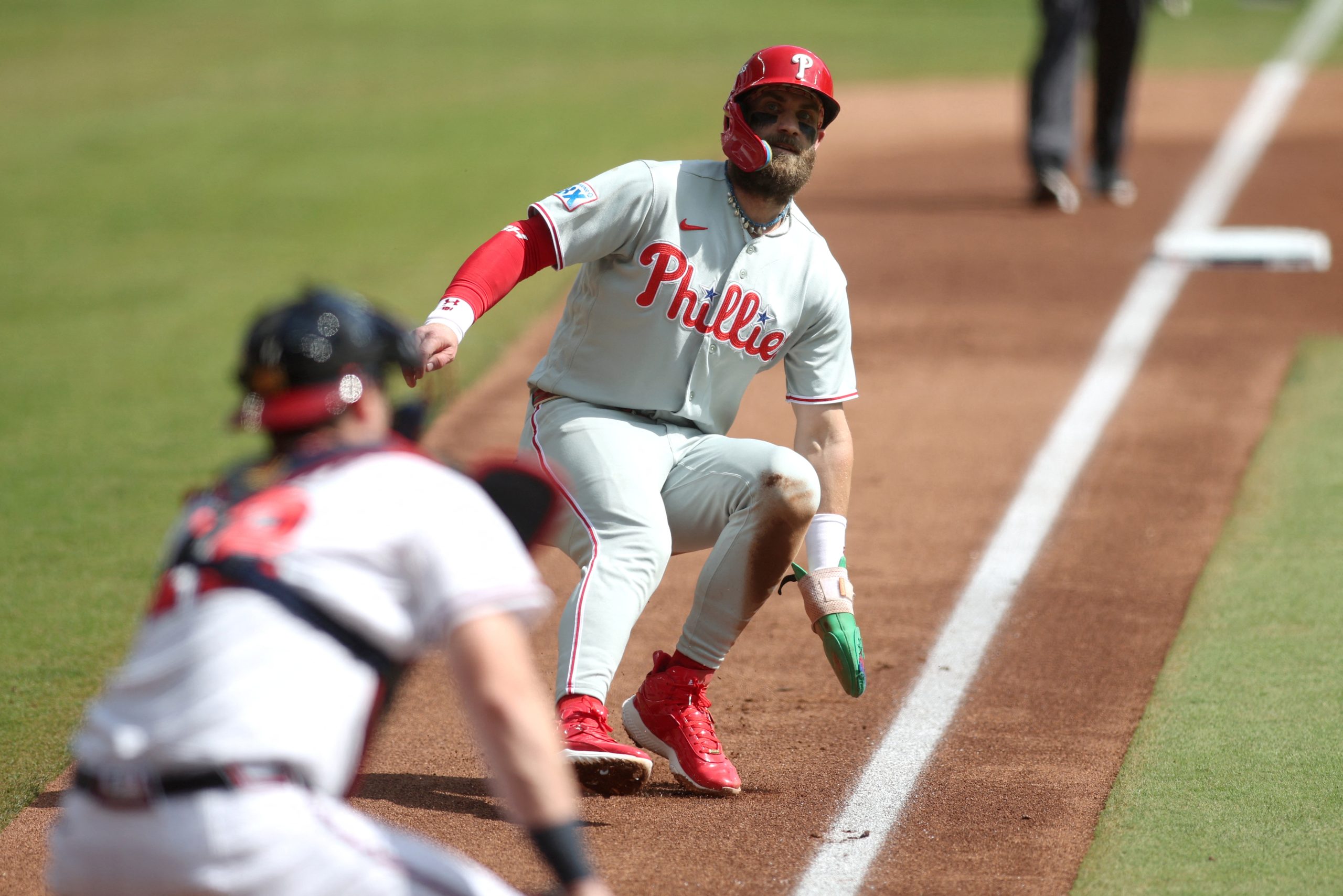
Sep 30, 2026; Cumberland, Georgia, USA; Philadelphia Phillies outfielder Bryce Harper (3) is caught between third base and homeplate in a rundown against the Atlanta Braves in the first inning during game two of the Wildcard round for the 2026 MLB Playoffs at Truist Park. Mandatory Credit: Brett Davis-Imagn Images
The Philadelphia Phillies entered Thursday Night in Atlanta needing one win to keep their World Series hopes alive. Instead, they left with another postseason defeat and a question they can no longer postpone:
How many more times can this group run it back?
The Braves beat Philadelphia 6–2 in Thursday’s decisive Wild Card Game 3. Michael Harris II hit a three-run homer in the first inning, Ozzie Albies added a two-run shot off Zack Wheeler in the fourth, and Atlanta moved on to face the Dodgers. For the Phillies, it was their fourth consecutive postseason series loss.
A single October loss can be explained away. Four straight exits trace a pattern. Philadelphia reached the World Series in 2022, lost the NL Championship Series in 2023, fell in the Division Series in both 2024 and 2025, and failed to survive the Wild Card round this year. The destination has moved farther away each season, even as the organization has continued to invest in winning now.
Game 3 showed how thin the margin had become
The Phillies’ postseason pitching plan was compromised before the series began. They needed Wheeler on the final day of the regular season to clinch their berth, leaving him unavailable to start Wild Card Game 1. Jesús Luzardo took that assignment, Cristopher Sánchez pitched the Game 2 win, and Aaron Nola started the decider.
Nola’s first-inning pitch to Harris put Philadelphia down three runs almost immediately. Wheeler then entered in relief and surrendered Albies’ homer. Those swings do not erase what either pitcher has given the Phillies. They do show what happens when a team has to fight to reach October and arrives without the pitching sequence it wanted.
Atlanta also found an answer Philadelphia could not solve. Ray Kerr, used as an opener, held the Phillies to one hit over 3⅓ scoreless innings. Chris Sale later came out of the bullpen to record the final four outs. The Braves adapted to the stakes and executed. Philadelphia spent most of the night trying to recover from the first inning.
“Run it back” has stopped being a plan
The Phillies
had reason to believe in this core after 2022. Bryce Harper, Kyle Schwarber, Trea Turner, J.T. Realmuto, Wheeler, Nola and the rest had taken Philadelphia to the World Series. Keeping a proven group together made sense. The problem is that each subsequent season has supplied less evidence that continuity alone will deliver a title.
This year offered a warning well before Thursday. Philadelphia opened 9–19, fired manager Rob Thomson in April and improved under Don Mattingly. That recovery showed the roster still had ability. But an inconsistent offense and unreliable bullpen resurfaced late in the season, and the Phillies had to use Wheeler to secure the last National League Wild Card spot. They reached the postseason; they did not reach it in a position of strength.
Age is part of the discussion, though it should not become an excuse to dismiss every veteran. Realmuto rejected the idea that age explains the club’s failure, arguing that the talent remains. He is right that good players do not become incapable simply because another October ends badly. The larger issue is
how the roster fits together: whether it has enough dependable offense throughout the order, enough bullpen depth and enough flexibility when injuries force a change of plan.
Philadelphia’s recent additions have not consistently solved those problems. Injuries disrupted some of this year’s acquisitions, and several other moves failed to provide the help the club expected. When a team carries one of baseball’s highest payrolls and still has to piece together its most important games, the front office has to examine its decisions as closely as the players’ performances.
The next Phillies team should look different
This does not require tearing down the club. Harper remains central to Philadelphia’s future, and there are younger players who can help shape the next version of the roster. Schwarber pointed to the experience gained by rookies Andrew Painter, Justin Crawford and Alex McFarlane. That is a reason to make room for growth, not another reason to bring back every familiar name and hope for a different ending.
The coming offseason gives the Phillies real choices. Luis Arraez, Alec Bohm, José Alvarado and Edmundo Sosa are among the key players headed toward free agency, and trades could change the club further. Philadelphia needs to decide where it can get younger, where it must get more reliable and which veteran contributions remain essential.
The window is closing because time keeps moving while the postseason results keep getting worse. That does not mean the Phillies cannot contend in 2027. It means they should stop treating the 2022 pennant as proof that the same approach will eventually work again.
After the loss, Harper said he expected the team to look “a lot different next year.” Philadelphia should take that possibility seriously. The best way to honor what this core accomplished is to give the Phillies their strongest chance to win the World Series while its remaining stars can still lead them there.
New Users – Get $350 in Bonus Bets when you wager $5 for 7 days
T&Cs apply
4.6/5
Gambling Problem? Call 1-800-GAMBLER or 1-800-MY-RESET. Call 1-888-789-7777 or visit ccpgg.org/chat (CT). Hope is here. GamblingHelpLineMA.org or call (800) 327-5050 for 24/7 support (MA). Visit www.mdgamblinghelp.org (MD). Call 1-877-8HOPE-NY or text HOPENY (NY). 21+ (18+ DC, WY) and present in select states (for KS, in affiliation with Kansas Star Casino). Find online real money wagering only. Min $5 wager required for 7 consecutive days. $5 free play credit. Bonus issued as non-withdrawable bonus with cash withdrawable bonus with cash withdrawable. Bonus bets which expire 7 days after receipt. Restrictions apply. See terms at sportsbook.fanduel.com. Call 1-877-770-7867 (LA).
Up To $1500 in Bonus Bets Paid Back if your First Bet Does Not Win
T&Cs apply
4.5/5
Gambling problem? Call 1-800-GAMBLER or 1-800-MY-RESET (Available in the US) 877-8-HOPENY or text HOPENY (467369) (NY) 1-800-327-5050 (MA), 1-800-BETS-OFF (IA), 1-800-981-0023 (PR). 21+ only. Please Gamble Responsibly. See BetMGM.com for Terms. First Bet Offer for new customers only (if applicable). Subject to eligibility requirements. Bonus bets are non-withdrawable. In partnership with Kansas Crossing Casino and Hotel. Promotional offers not available in Mississippi, Massachusetts, New York, Ontario, or Puerto Rico.
New DraftKings Customers: Bet $5, Get $200 + 3 Months of NBA League Pass!
T&Cs apply
4.5/5
GAMBLING PROBLEM? CALL 1-800-GAMBLER or 1-800-MY-RESET, (800) 327-5050 or visit gamblinghelplinema.org (MA). Please Gamble Responsibly. 888-789-7777/visit ccpg.org (CT), or visit www.mdgamblinghelp.org (MD), 1-800-981-0023 (PR). 21+ and present in most states. (18+ DC/NH/PR/WY). Void in CAN. Eligibility restrictions apply. On behalf of Boot Hill Casino (KS). Pass-thru of per wager tax may apply in IL. 1 per new Sportsbook customer. $5+ first-time bet req. Max. $200 issued as non-withdrawable Bonus Bets. Stake removed from payout. Reward issued as $50 in Bonus Bets every 7 days via click-to-claim for 21 days. Bonus Bets and click-to-claims expire 7 days (168hrs) after issuance. Terms: dkng.co/offer. Get 1 promo code to redeem a 3-month NBA League Pass subscription, complimentary of DraftKings. Subscription auto-renews monthly at then-current price (currently $16.99/mo); cancel anytime. Terms, restrictions, and eligibility requirements apply. Redeem League Pass by 12/19/26 at 11:59 PM ET. Addt’l terms: support.watch.nba.com/hc/en-us/articles/9165532876183-League-Pass-Terms-of-Use_. Ends 11/29/26 at 11:59 PM ET. Sponsored by DK.
Must be 21+. GAMBLING PROBLEM? CALL 1-800-GAMBLER OR CALL 1-800-MY-RESET, www.mdgamblinghelp.org (MD), (800)-327-5050 or gamblinghelplinema.org (MA), Call (877)8-HOPENY or text HOPENY (467369) (NY), (888) 789-7777 or ccpg.org (CT), morethanagame.nc.gov (NC), 1800gambler.net (WV)
Bet $1 and get double the winnings up to $25 for your next 10 bets
T&Cs apply
4.4/5
21+ New users only. Must register using eligible promo code. First bet after registration must qualify. Max. Bonus Bet: $1,000. Bonus Bet expires 14 days after receipt. Void where prohibited. See Caesars.com/promos for full terms. Gambling Problem? 1-800-GAMBLER (1-800-426-2537)
21+ and present in OH. Gambling Problem? Call 1-800-GAMBLER.
This site is using
Cloudflare
and adheres to the
Google Safe Browsing Program. We adapted
Google's Privacy Guidelines
to keep your data safe at all times.
Close
Ready to Win Big? Join the Elite with Our Sports Betting Deals!
FanDuel Promo
New Users – Get $350 in Bonus Bets when you wager $5 for 7 days
Our Favorite
T&Cs and 21+ apply
Gambling Problem? Call 1-800-GAMBLER or 1-800-MY-RESET. Call 1-888-789-7777 or visit ccpgg.org/chat (CT). Hope is here. GamblingHelpLineMA.org or call (800) 327-5050 for 24/7 support (MA). Visit www.mdgamblinghelp.org (MD). Call 1-877-8HOPE-NY or text HOPENY (NY). 21+ (18+ DC, WY) and present in select states (for KS, in affiliation with Kansas Star Casino). Find online real money wagering only. Min $5 wager required for 7 consecutive days. $5 free play credit. Bonus issued as non-withdrawable bonus with cash withdrawable bonus with cash withdrawable. Bonus bets which expire 7 days after receipt. Restrictions apply. See terms at sportsbook.fanduel.com. Call 1-877-770-7867 (LA).
Code:
Open FanDuel
Get Bonus
BetMGM Promo
Up To $1500 in Bonus Bets Paid Back if your First Bet Does Not Win
Best Slots
T&Cs and 21+ apply
Gambling problem? Call 1-800-GAMBLER or 1-800-MY-RESET (Available in the US) 877-8-HOPENY or text HOPENY (467369) (NY) 1-800-327-5050 (MA), 1-800-BETS-OFF (IA), 1-800-981-0023 (PR). 21+ only. Please Gamble Responsibly. See BetMGM.com for Terms. First Bet Offer for new customers only (if applicable). Subject to eligibility requirements. Bonus bets are non-withdrawable. In partnership with Kansas Crossing Casino and Hotel. Promotional offers not available in Mississippi, Massachusetts, New York, Ontario, or Puerto Rico.
Code:
Open BetMGM
Get Bonus
DraftKings Promo
New DraftKings Customers: Bet $5, Get $200 + 3 Months of NBA League Pass!
Newcomer
T&Cs and 21+ apply
GAMBLING PROBLEM? CALL 1-800-GAMBLER or 1-800-MY-RESET, (800) 327-5050 or visit gamblinghelplinema.org (MA). Please Gamble Responsibly. 888-789-7777/visit ccpg.org (CT), or visit www.mdgamblinghelp.org (MD), 1-800-981-0023 (PR). 21+ and present in most states. (18+ DC/NH/PR/WY). Void in CAN. Eligibility restrictions apply. On behalf of Boot Hill Casino (KS). Pass-thru of per wager tax may apply in IL. 1 per new Sportsbook customer. $5+ first-time bet req. Max. $200 issued as non-withdrawable Bonus Bets. Stake removed from payout. Reward issued as $50 in Bonus Bets every 7 days via click-to-claim for 21 days. Bonus Bets and click-to-claims expire 7 days (168hrs) after issuance. Terms: dkng.co/offer. Get 1 promo code to redeem a 3-month NBA League Pass subscription, complimentary of DraftKings. Subscription auto-renews monthly at then-current price (currently $16.99/mo); cancel anytime. Terms, restrictions, and eligibility requirements apply. Redeem League Pass by 12/19/26 at 11:59 PM ET. Addt’l terms: support.watch.nba.com/hc/en-us/articles/9165532876183-League-Pass-Terms-of-Use_. Ends 11/29/26 at 11:59 PM ET. Sponsored by DK.
Code:
Open DraftKings
Get Bonus
Find out what the legends have to say about sports this week....
New Users – Get $350 in Bonus Bets when you wager $5 for 7 days
Gambling Problem? Call 1-800-GAMBLER or 1-800-MY-RESET. Call 1-888-789-7777 or visit ccpgg.org/chat (CT). Hope is here. GamblingHelpLineMA.org or call (800) 327-5050 for 24/7 support (MA). Visit www.mdgamblinghelp.org (MD). Call 1-877-8HOPE-NY or text HOPENY (NY). 21+ (18+ DC, WY) and present in select states (for KS, in affiliation with Kansas Star Casino). Find online real money wagering only. Min $5 wager required for 7 consecutive days. $5 free play credit. Bonus issued as non-withdrawable bonus with cash withdrawable bonus with cash withdrawable. Bonus bets which expire 7 days after receipt. Restrictions apply. See terms at sportsbook.fanduel.com. Call 1-877-770-7867 (LA).