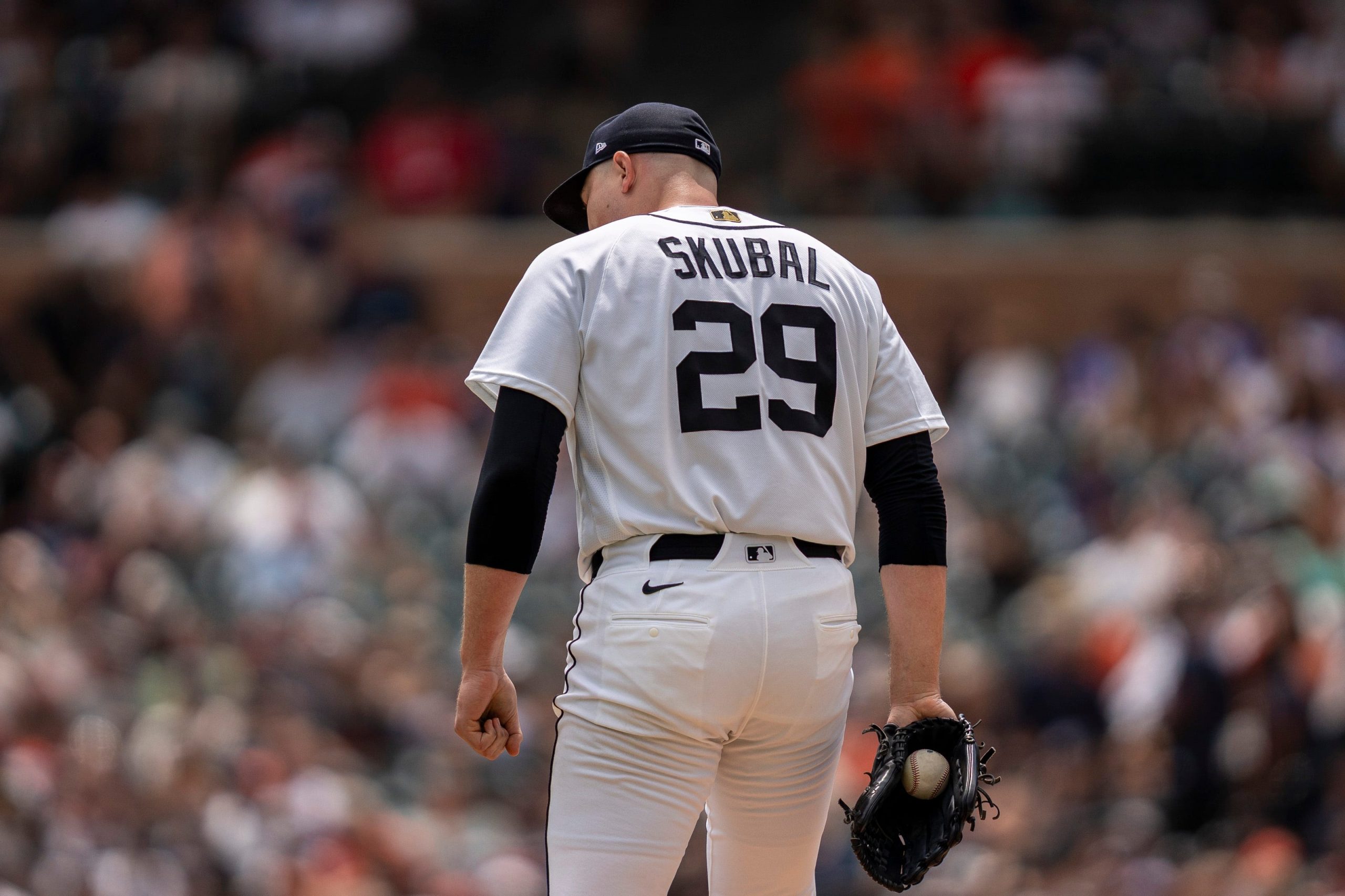
Detroit Tigers starting pitcher Tarik Skubal (29) stands on the mound against the Baltimore Orioles at Comerica Park in Detroit on Wednesday, July 29, 2026.
The Los Angeles Dodgers have done it again.
Already the two-time defending World Series champions, the Dodgers acquired two-time reigning American League Cy Young Award winner Tarik Skubal from the Detroit Tigers. Los Angeles sent outfielder Zyhir Hope and right-handed pitchers River Ryan and Brady Smith to Detroit in exchange for one of the best pitchers in baseball.
It is an excellent return for the Tigers considering Skubal can become a free agent after the season. Hope is one of baseball’s top outfield prospects, Ryan possesses considerable major-league upside and Smith is an ascending young arm.
But this was not an untouchable, once-in-a-generation trade package. The Dodgers did not surrender their entire farm system. They did not mortgage the next decade. They gave Detroit three promising players for an opportunity to place Skubal at the front of an already imposing rotation and chase a third consecutive championship.
The Milwaukee Brewers and Tampa Bay Rays could have made the same kind of trade. Both organizations possessed enough prospect capital to satisfy Detroit. Both entered the deadline as legitimate contenders. Both had a chance to acquire the type of starting pitcher who can single-handedly alter a postseason series.
Instead, they allowed the richest and most talented organization in baseball to become even more powerful.
This is not simply another story about the Dodgers buying everybody. It is also a story about small-market contenders refusing to recognize when their championship window is open.
The Dodgers Added an Ace They Did Not Even Need
The Dodgers entered the deadline with a rotation that included Yoshinobu Yamamoto and was expecting Blake Snell and Tyler Glasnow to return. Shohei Ohtani’s pitching status created some uncertainty, but Los Angeles already possessed enough talent to win another championship.
That did not prevent the Dodgers from pursuing Skubal.
Skubal has established himself as one of the most dominant pitchers of his generation. He won consecutive American League Cy Young Awards after posting a 2.39 ERA in 2024 and a 2.21 ERA in 2025. Despite returning from elbow surgery this season, he recorded a 2.79 ERA with 116 strikeouts in 96⅔ innings for Detroit.
The Dodgers understood that October is not about having enough. It is about eliminating uncertainty.
Adding Skubal gives
Los Angeles
another pitcher capable of starting Game 1 of a postseason series, pitching on short rest or ending a losing streak before it begins. A rotation involving Skubal, Yamamoto, Snell, Glasnow and potentially Ohtani borders on absurd.
The Dodgers already had the best starting-pitching ERA in the majors when they made the trade. They still went out and acquired the best available starter because championship organizations do not ask whether they can survive without a player. They ask whether that player makes it more difficult for anyone else to beat them.
The answer with Skubal was obvious.
Milwaukee Had the Players to Beat the Dodgers’ Offer
The Brewers cannot claim Skubal was unavailable to them.
Milwaukee possessed enough young talent to construct a package comparable to—or potentially better than—the one Detroit accepted from Los Angeles. One proposed package had the Brewers sending Brandon Sproat, Jett Williams, Josh Knoth and Quinn Priester to the Tigers.
That would have been painful. It also would have been entirely reasonable.
Sproat is a young major-league pitcher who previously ranked among the best prospects in the Mets’ organization. Williams is a talented infielder with power, speed and on-base ability. Knoth is one of Milwaukee’s better pitching prospects, while Priester demonstrated major-league value before his shoulder injury.
Milwaukee would have been surrendering four potential contributors. In return, the Brewers would have received a pitcher who could have transformed their postseason outlook.
A playoff rotation led by Skubal and Jacob Misiorowski would have given Milwaukee a legitimate answer to Los Angeles. Kyle Harrison and Logan Henderson would have provided additional depth behind them. The Brewers might have entered October with the only rotation in the National League capable of matching the Dodgers at the top.
Instead, Milwaukee protected its future.
That is understandable during an ordinary season. This is not an ordinary season. The Brewers are legitimate contenders, and opportunities like this do not arrive every year. Milwaukee has never won a World Series. The franchise has reached the Fall Classic only once, losing to the St. Louis Cardinals in 1982.
How many prospects must a small-market organization collect before it decides the purpose of developing them is to win a championship?
The Brewers’ front office deserves tremendous credit for consistently building competitive rosters with limited financial resources. Milwaukee drafts well, develops pitchers and identifies undervalued players better than most organizations. That model has made the Brewers successful.
But constantly protecting the next wave of prospects can become its own form of complacency. At some point, a contender must stop celebrating organizational depth and use that depth to acquire someone capable of changing its history.
Skubal was that player.
Tampa Bay Also Had Enough to Make the Trade
The Rays had an equally compelling opportunity.
Tampa Bay could have built a package around catcher Caden Bodine and right-handed pitcher Brody Hopkins. Bodine was one of the organization’s best prospects, while Hopkins was Tampa Bay’s top minor-league pitcher and nearing major-league readiness.
Would losing both have hurt? Absolutely.
Would Skubal have been worth it? For a legitimate American League contender still seeking its first World Series championship, the answer should have been yes.
Imagine an October rotation featuring Skubal, Shane McClanahan and Drew Rasmussen. That group could have carried Tampa Bay through a short series against anyone in the American League. More importantly, acquiring Skubal would have kept him away from the Dodgers if the Rays eventually reached the World Series.
Tampa Bay’s entire reputation is built on finding talent before other organizations recognize it, maximizing player value and moving players before they become expensive. That strategy has allowed the Rays to remain competitive despite operating with one of baseball’s smallest payrolls.
It has also contributed to the franchise’s failure to finish the job.
The Rays reached the World Series in 2008 and 2020 but lost both times. Ironically, the Dodgers defeated them in 2020. Tampa Bay has repeatedly constructed excellent teams without making the aggressive final move that might turn an impressive season into a championship parade.
A front office cannot evaluate every decision entirely through long-term surplus value. Flags fly forever; prospect rankings do not.
This Was Not Primarily About Skubal’s Salary
Some will argue that Milwaukee and Tampa Bay could not afford Skubal. That explanation is not convincing.
Skubal is earning $32 million this season, but the acquiring team is responsible only for the remaining portion of that salary. Los Angeles reportedly owes approximately $9.8 million for the rest of 2026. That is meaningful money for the Brewers or Rays, but it is not an impossible financial commitment for a contender making a serious championship push.
The teams also could have asked Detroit to include cash in exchange for a slightly improved prospect package.
This was not a nine-year, $400 million commitment. It was a two-month rental with postseason access. Milwaukee and Tampa Bay did not need to promise Skubal anything beyond this season. They needed to pay for August, September and, they hoped, October.
There is no guarantee either team could have re-signed him. There is also no guarantee the Dodgers will retain him. Skubal is expected to test free agency this winter, assuming baseball’s labor situation allows the market to proceed normally.
The trade was about maximizing the 2026 season. The Dodgers understood that. Milwaukee and Tampa Bay apparently did not value the opportunity as aggressively.
The Dodgers Did Not Overpay
The most frustrating part for the rest of baseball is what Los Angeles retained.
The Dodgers acquired a two-time Cy Young winner without emptying their farm system. Hope was the centerpiece and a legitimate premium prospect, but Los Angeles did not surrender all its best young talent.
Ryan has major-league upside but also an injury history. Smith is promising but remains years away from proving himself at the highest level. Detroit received a respectable return for an impending free agent, but this was hardly an offer that Milwaukee or Tampa Bay were incapable of matching.
The Brewers and Rays might not have been able to duplicate the Dodgers’ exact three-player package. That is not the point. They could have matched or surpassed its overall value with players from their own organizations.
Los Angeles did not win because nobody else had enough prospects. The Dodgers won because they were willing to use their prospects.
The current collective bargaining agreement expires on December 1, 2026. Unless Major League Baseball and the Players Association reach another agreement, the owners are widely expected to lock out the players. The possibility of games being lost in 2027 is real.
One of the central issues will be competitive balance. Some owners are expected to push for a salary cap, arguing that baseball’s financial structure allows organizations such as the Dodgers to collect stars in a manner smaller-market teams cannot match.
The Dodgers certainly demonstrate why the discussion is coming.
Los Angeles can absorb large contracts, pay luxury-tax penalties, maintain an elite farm system and continue pursuing expensive players. If one high-priced pitcher is injured, the Dodgers can acquire or sign another. Smaller-market teams cannot recover from expensive mistakes nearly as easily.
Baseball needs a more balanced financial structure. A salary floor should be part of that discussion because limiting the biggest spenders without requiring the lowest-spending owners to invest in their teams would accomplish little. Revenue sharing, local television disparities and luxury-tax rules must also be addressed.
However, the Skubal trade complicates the small-market owners’ argument.
Milwaukee and Tampa Bay did not lose Skubal because Los Angeles offered him a $400 million contract. They lost him because the Dodgers offered three players in a trade. The Brewers and Rays possessed comparable prospect capital and decided not to use it.
A salary cap cannot create courage.
A salary cap cannot force a conservative front office to trade future assets for a present opportunity. It cannot make an owner spend an additional $10 million during a championship season. It cannot prevent a contender from treating every highly rated prospect as though he will become a future All-Star.
Competitive balance is a legitimate concern, but so is competitive intent.
Small-Market Teams Cannot Have It Both Ways
Small-market organizations frequently argue that the system prevents them from competing with the Dodgers, Yankees, Mets and other financial powers. There is truth in that argument. Baseball’s economic landscape is profoundly uneven.
But those same organizations cannot demand structural protection while refusing to act when they possess the resources necessary to acquire an elite player.
The Brewers and Rays could not guarantee Skubal would lead them to a championship. No transaction comes with that promise. He could have pitched brilliantly and watched his offense disappear. He could have struggled. He could have been injured again.
The Dodgers faced the same risks.
The difference is that Los Angeles accepted them.
If Milwaukee had acquired Skubal and lost in the Division Series, critics would have complained about the prospects it surrendered. If Tampa Bay had traded Bodine and Hopkins, fans would have worried about how the move affected 2027 and beyond.
That mentality is exactly why the Dodgers keep getting stronger. Los Angeles is trying to win the World Series that will be played this October. Too many other organizations are trying to win an imaginary championship three years from now.
There will always be another prospect class. There will not always be a realistic path to a title.
The Tigers Made a Defensible Decision
Detroit’s role must also be separated from the failures of Milwaukee and Tampa Bay.
Trading Skubal was painful, especially after he expressed his desire to win a championship with the Tigers. Detroit was 50–57 and fading from the American League wild-card race. Skubal was approaching free agency, and the organization risked losing him for substantially less compensation during the offseason.
The Tigers converted a short-term asset into three significant pieces. Hope could become a middle-of-the-order outfielder. Ryan could contribute to the major-league pitching staff relatively soon, and Smith adds another high-upside arm to the system.
Fans can criticize Detroit for failing to build a championship-caliber roster around Skubal or for not extending him sooner. But once the relationship reached this point, trading him was understandable.
The real question is why the best offer—or at least the offer Detroit accepted—came from the organization that needed Skubal the least.
Los Angeles Is Playing a Different Game
The Dodgers
understand something every contender should understand: windows close without warning.
Injuries happen. Prospects fail. Divisions become stronger. An unexpected team gets hot. Labor disputes interrupt seasons. Nothing about the future is guaranteed.
Los Angeles has the sport’s deepest roster and greatest financial advantages, but the organization does not use those advantages as an excuse to become passive. It remains relentlessly aggressive.
Milwaukee and Tampa Bay are praised for doing more with less. They deserve that praise. But there is a difference between building a contender and doing everything possible to win a championship.
By allowing Skubal to land in Los Angeles, the Brewers and Rays showed that they were still thinking like resource-conscious organizations instead of championship-or-bust contenders.
The Dodgers did not steal Tarik Skubal because the rules prohibited anyone else from entering the room. They stole him because other contenders refused to pay a price they could afford.
If small-market owners use the Dodgers’ growing dominance to argue for a salary cap during the coming labor fight, this trade should be remembered. Baseball’s financial system needs reform, but no new collective bargaining agreement can save cautious organizations from themselves.
The Brewers and Rays had the talent to make this trade. They had teams worth betting on. They had an opportunity to acquire one of baseball’s best pitchers for the most important two months of the season.
New Users – Get $350 in Bonus Bets when you wager $5 for 7 days
T&Cs apply
4.6/5
Gambling Problem? Call 1-800-GAMBLER or 1-800-MY-RESET. Call 1-888-789-7777 or visit ccpgg.org/chat (CT). Hope is here. GamblingHelpLineMA.org or call (800) 327-5050 for 24/7 support (MA). Visit www.mdgamblinghelp.org (MD). Call 1-877-8HOPE-NY or text HOPENY (NY). 21+ (18+ DC, WY) and present in select states (for KS, in affiliation with Kansas Star Casino). Find online real money wagering only. Min $5 wager required for 7 consecutive days. $5 free play credit. Bonus issued as non-withdrawable bonus with cash withdrawable bonus with cash withdrawable. Bonus bets which expire 7 days after receipt. Restrictions apply. See terms at sportsbook.fanduel.com. Call 1-877-770-7867 (LA).
Up To $1500 in Bonus Bets Paid Back if your First Bet Does Not Win
T&Cs apply
4.5/5
Gambling problem? Call 1-800-GAMBLER or 1-800-MY-RESET (Available in the US) 877-8-HOPENY or text HOPENY (467369) (NY) 1-800-327-5050 (MA), 1-800-BETS-OFF (IA), 1-800-981-0023 (PR). 21+ only. Please Gamble Responsibly. See BetMGM.com for Terms. First Bet Offer for new customers only (if applicable). Subject to eligibility requirements. Bonus bets are non-withdrawable. In partnership with Kansas Crossing Casino and Hotel. Promotional offers not available in Mississippi, Massachusetts, New York, Ontario, or Puerto Rico.
New DraftKings Customers: Bet $5, Get $200 + 3 Months of NBA League Pass!
T&Cs apply
4.5/5
GAMBLING PROBLEM? CALL 1-800-GAMBLER or 1-800-MY-RESET, (800) 327-5050 or visit gamblinghelplinema.org (MA). Please Gamble Responsibly. 888-789-7777/visit ccpg.org (CT), or visit www.mdgamblinghelp.org (MD), 1-800-981-0023 (PR). 21+ and present in most states. (18+ DC/NH/PR/WY). Void in CAN. Eligibility restrictions apply. On behalf of Boot Hill Casino (KS). Pass-thru of per wager tax may apply in IL. 1 per new Sportsbook customer. $5+ first-time bet req. Max. $200 issued as non-withdrawable Bonus Bets. Stake removed from payout. Reward issued as $50 in Bonus Bets every 7 days via click-to-claim for 21 days. Bonus Bets and click-to-claims expire 7 days (168hrs) after issuance. Terms: dkng.co/offer. Get 1 promo code to redeem a 3-month NBA League Pass subscription, complimentary of DraftKings. Subscription auto-renews monthly at then-current price (currently $16.99/mo); cancel anytime. Terms, restrictions, and eligibility requirements apply. Redeem League Pass by 12/19/26 at 11:59 PM ET. Addt’l terms: support.watch.nba.com/hc/en-us/articles/9165532876183-League-Pass-Terms-of-Use_. Ends 11/29/26 at 11:59 PM ET. Sponsored by DK.
Must be 21+. GAMBLING PROBLEM? CALL 1-800-GAMBLER OR CALL 1-800-MY-RESET, www.mdgamblinghelp.org (MD), (800)-327-5050 or gamblinghelplinema.org (MA), Call (877)8-HOPENY or text HOPENY (467369) (NY), (888) 789-7777 or ccpg.org (CT), morethanagame.nc.gov (NC), 1800gambler.net (WV)
Bet $1 and get double the winnings up to $25 for your next 10 bets
T&Cs apply
4.4/5
21+ New users only. Must register using eligible promo code. First bet after registration must qualify. Max. Bonus Bet: $1,000. Bonus Bet expires 14 days after receipt. Void where prohibited. See Caesars.com/promos for full terms. Gambling Problem? 1-800-GAMBLER (1-800-426-2537)
21+ and present in OH. Gambling Problem? Call 1-800-GAMBLER.
This site is using
Cloudflare
and adheres to the
Google Safe Browsing Program. We adapted
Google's Privacy Guidelines
to keep your data safe at all times.
Close
Ready to Win Big? Join the Elite with Our Sports Betting Deals!
FanDuel Promo
New Users – Get $350 in Bonus Bets when you wager $5 for 7 days
Our Favorite
T&Cs and 21+ apply
Gambling Problem? Call 1-800-GAMBLER or 1-800-MY-RESET. Call 1-888-789-7777 or visit ccpgg.org/chat (CT). Hope is here. GamblingHelpLineMA.org or call (800) 327-5050 for 24/7 support (MA). Visit www.mdgamblinghelp.org (MD). Call 1-877-8HOPE-NY or text HOPENY (NY). 21+ (18+ DC, WY) and present in select states (for KS, in affiliation with Kansas Star Casino). Find online real money wagering only. Min $5 wager required for 7 consecutive days. $5 free play credit. Bonus issued as non-withdrawable bonus with cash withdrawable bonus with cash withdrawable. Bonus bets which expire 7 days after receipt. Restrictions apply. See terms at sportsbook.fanduel.com. Call 1-877-770-7867 (LA).
Code:
Open FanDuel
Get Bonus
BetMGM Promo
Up To $1500 in Bonus Bets Paid Back if your First Bet Does Not Win
Best Slots
T&Cs and 21+ apply
Gambling problem? Call 1-800-GAMBLER or 1-800-MY-RESET (Available in the US) 877-8-HOPENY or text HOPENY (467369) (NY) 1-800-327-5050 (MA), 1-800-BETS-OFF (IA), 1-800-981-0023 (PR). 21+ only. Please Gamble Responsibly. See BetMGM.com for Terms. First Bet Offer for new customers only (if applicable). Subject to eligibility requirements. Bonus bets are non-withdrawable. In partnership with Kansas Crossing Casino and Hotel. Promotional offers not available in Mississippi, Massachusetts, New York, Ontario, or Puerto Rico.
Code:
Open BetMGM
Get Bonus
DraftKings Promo
New DraftKings Customers: Bet $5, Get $200 + 3 Months of NBA League Pass!
Newcomer
T&Cs and 21+ apply
GAMBLING PROBLEM? CALL 1-800-GAMBLER or 1-800-MY-RESET, (800) 327-5050 or visit gamblinghelplinema.org (MA). Please Gamble Responsibly. 888-789-7777/visit ccpg.org (CT), or visit www.mdgamblinghelp.org (MD), 1-800-981-0023 (PR). 21+ and present in most states. (18+ DC/NH/PR/WY). Void in CAN. Eligibility restrictions apply. On behalf of Boot Hill Casino (KS). Pass-thru of per wager tax may apply in IL. 1 per new Sportsbook customer. $5+ first-time bet req. Max. $200 issued as non-withdrawable Bonus Bets. Stake removed from payout. Reward issued as $50 in Bonus Bets every 7 days via click-to-claim for 21 days. Bonus Bets and click-to-claims expire 7 days (168hrs) after issuance. Terms: dkng.co/offer. Get 1 promo code to redeem a 3-month NBA League Pass subscription, complimentary of DraftKings. Subscription auto-renews monthly at then-current price (currently $16.99/mo); cancel anytime. Terms, restrictions, and eligibility requirements apply. Redeem League Pass by 12/19/26 at 11:59 PM ET. Addt’l terms: support.watch.nba.com/hc/en-us/articles/9165532876183-League-Pass-Terms-of-Use_. Ends 11/29/26 at 11:59 PM ET. Sponsored by DK.
Code:
Open DraftKings
Get Bonus
Find out what the legends have to say about sports this week....
New Users – Get $350 in Bonus Bets when you wager $5 for 7 days
Gambling Problem? Call 1-800-GAMBLER or 1-800-MY-RESET. Call 1-888-789-7777 or visit ccpgg.org/chat (CT). Hope is here. GamblingHelpLineMA.org or call (800) 327-5050 for 24/7 support (MA). Visit www.mdgamblinghelp.org (MD). Call 1-877-8HOPE-NY or text HOPENY (NY). 21+ (18+ DC, WY) and present in select states (for KS, in affiliation with Kansas Star Casino). Find online real money wagering only. Min $5 wager required for 7 consecutive days. $5 free play credit. Bonus issued as non-withdrawable bonus with cash withdrawable bonus with cash withdrawable. Bonus bets which expire 7 days after receipt. Restrictions apply. See terms at sportsbook.fanduel.com. Call 1-877-770-7867 (LA).