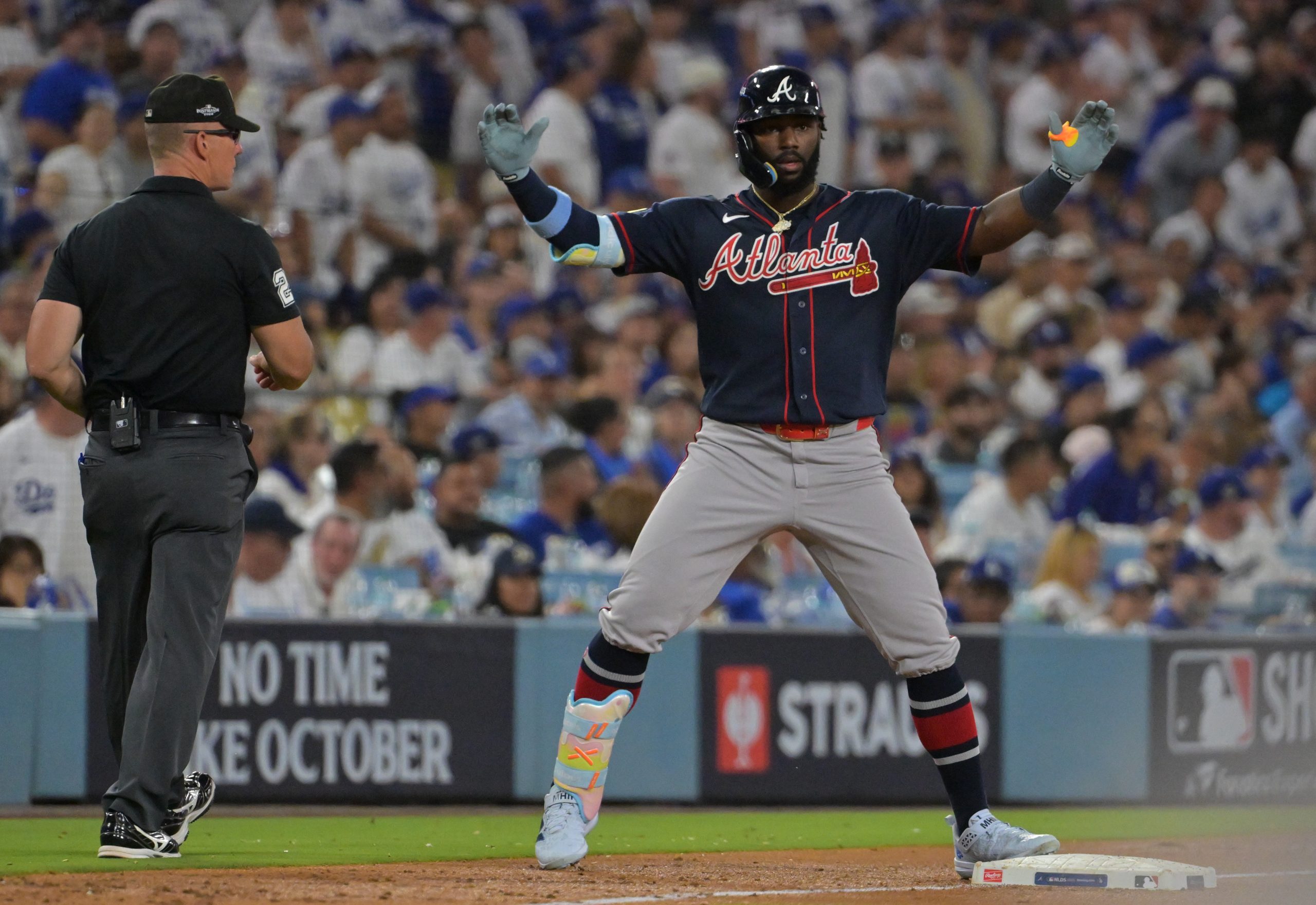
Oct 4, 2026; Los Angeles, California, USA; Atlanta Braves outfielder Michael Harris II (23) celebrates after hitting a triple during the fifth inning against the Los Angeles Dodgers in game two of the NLDS for the 2026 MLB Playoffs at Uniqlo Field at Dodger Stadium. Mandatory Credit: Jayne Kamin-Oncea-Imagn Images
The Dodgers had an opportunity to take control of this series.
Instead, they let Atlanta take it back to Georgia tied.
The Braves’ 3–2 victory Sunday evened the National League Division Series at one game apiece. Los Angeles hit two home runs but went 0-for-8 with runners in scoring position, wasting opportunities to turn a close game into a commanding series advantage.
The Dodgers are still capable of winning this matchup. A tied series is hardly a postseason catastrophe.
But the difference between leading 2–0 and heading to Atlanta at 1–1 is enormous. Los Angeles could have forced the Braves to win three consecutive games. Now either team can advance by winning the next two.
Atlanta has earned a real opening. The Dodgers helped provide it.
The Dodgers Cannot Keep Waiting for the Home Run
Freddie Freeman and Max Muncy
supplied Los Angeles’ runs with solo home runs. The Dodgers could not produce the additional hit needed to change the outcome.
There is nothing wrong with relying on power. Home runs are valuable in October precisely because good pitching makes sustained rallies difficult.
The problem comes when power becomes the only way an offense can score.
A lineup must also capitalize when a walk, a single or an extra-base hit creates an opportunity. Those situations cannot repeatedly end with the runner still standing on base.
Sunday did not require an offensive explosion. One productive plate appearance could have changed the game.
That makes the defeat especially frustrating. The Dodgers were close enough to win, but their offense failed at the moments that carried the most weight.
Missed Opportunities Become Expensive in a Short Series
Eight unsuccessful at-bats with runners in scoring position do not establish a permanent weakness. Baseball produces stretches like that, even for excellent hitters.
But postseason games do not give teams much time to wait for those stretches to end.
The Dodgers need to respond without turning every scoring opportunity into a desperate attempt to deliver a game-changing swing. Chasing pitches and expanding the strike zone would only make Atlanta’s assignment easier.
The answer is better execution within individual plate appearances: identify a pitch to attack, resist the temptation to force the result and make the pitcher work.
Los Angeles has enough ability to correct this. The urgency comes from how little time remains to do it.
Blake Snell’s Short Outing Added Another Problem
Blake Snell issued five walks and needed 90 pitches to record 11 outs. He left after 3⅔ innings, pushing a substantial workload onto the Dodgers’ bullpen.
That kind of start complicates a game even when the damage on the scoreboard remains manageable.
Walks create traffic, increase pitch counts and make every mistake more dangerous. A starter who cannot work efficiently also forces the manager to begin making relief decisions earlier than planned.
The Dodgers stayed within reach. But staying close is different from controlling the game.
Against an opponent as capable as Atlanta, Los Angeles needs its pitching to reduce opportunities rather than repeatedly navigate around them. The offense’s missed chances were the clearest problem Sunday, but the pitching did not make the evening easy.
Atlanta Deserves Credit for Creating This Opening
This was more than a game the Dodgers failed to finish.
The Braves executed a pitching plan that gave them a chance to win, then received a major offensive contribution from Michael Harris II. Harris went 3-for-5 with a double, a triple, a run scored and an RBI.
Atlanta found ways to generate enough offense without needing a barrage of home runs. Harris’ extra-base hits put pressure on the Dodgers and helped make the difference in a one-run game.
That is a dangerous quality in a postseason opponent.
The Braves demonstrated that they could win a close matchup in Los Angeles even when their pitching required several contributors. They now return home with evidence that their approach can work against this lineup.
Confidence alone does not win a series. Successful execution gives that confidence substance.
Chris Sale Makes Game 3 More Demanding
Atlanta is scheduled to start Chris Sale in Game 3 on Tuesday, while Los Angeles has named Yoshinobu Yamamoto.
The two met in Atlanta on August 27, when Sale threw a complete-game shutout in a 1–0 Braves victory.
That previous result does not dictate what happens next. Yamamoto gives the Dodgers a strong opportunity to answer, and every postseason start presents different circumstances.
Still, this is an uncomfortable assignment for an offense coming off a night of missed scoring chances.
Los Angeles cannot assume there will be plentiful opportunities against Sale. If he is locating effectively, the Dodgers may need to capitalize on the first opening they create.
That raises the importance of disciplined plate appearances and avoiding unnecessary outs. Against a pitcher capable of controlling a game, wasting a promising inning can have consequences that last all night.
Home Field Has Given Atlanta an Opportunity, Not a Guarantee
The Braves now have the next two games at home. Winning both would end the series before the Dodgers could return to Los Angeles.
That puts meaningful pressure on the Dodgers, but it should not encourage overreaction.
Los Angeles does not need to reinvent its offense or treat the next game as already lost. It needs to play well enough to reclaim an advantage that was available Sunday.
Yamamoto can help establish control. The lineup can support him by turning baserunners into runs. The bullpen can protect a lead if the game develops in that direction.
Those are realistic paths to victory.
What the Dodgers have lost is the cushion that would have made an uneven performance easier to survive. Another night of poor execution could leave them facing elimination.
The Dodgers Need a Response, Not an Explanation
There will be reasonable explanations for Sunday’s defeat. Atlanta pitched well. Snell struggled with command. A few important at-bats went the Braves’ way.
None of those explanations changes the task ahead.
The Dodgers
need to produce when a scoring opportunity arrives. They need efficient innings on the mound. They need to avoid giving Atlanta extra chances through preventable mistakes.
Their talent remains an advantage, but talent has to become production during the remaining games.
Atlanta has already shown it can keep the matchup close enough for a handful of plays to decide it. Los Angeles must approach Game 3 with that reality in mind.
Atlanta Has Made This a Much More Dangerous Series
The Dodgers had a chance to put Atlanta in a desperate position.
Now the pressure is shared, and the Braves have the opportunity to apply more of it at home.
Sunday’s loss does not mean Los Angeles is headed for elimination. It means the Dodgers can no longer count on room to absorb another game full of missed chances.
Atlanta took the opening it was given and earned its way back into the series.
The Dodgers’ response will determine whether Game 2 becomes a brief setback—or the night they allowed a dangerous opponent to take control.
New Users – Get $350 in Bonus Bets when you wager $5 for 7 days
T&Cs apply
4.6/5
Gambling Problem? Call 1-800-GAMBLER or 1-800-MY-RESET. Call 1-888-789-7777 or visit ccpgg.org/chat (CT). Hope is here. GamblingHelpLineMA.org or call (800) 327-5050 for 24/7 support (MA). Visit www.mdgamblinghelp.org (MD). Call 1-877-8HOPE-NY or text HOPENY (NY). 21+ (18+ DC, WY) and present in select states (for KS, in affiliation with Kansas Star Casino). Find online real money wagering only. Min $5 wager required for 7 consecutive days. $5 free play credit. Bonus issued as non-withdrawable bonus with cash withdrawable bonus with cash withdrawable. Bonus bets which expire 7 days after receipt. Restrictions apply. See terms at sportsbook.fanduel.com. Call 1-877-770-7867 (LA).
Up To $1500 in Bonus Bets Paid Back if your First Bet Does Not Win
T&Cs apply
4.5/5
Gambling problem? Call 1-800-GAMBLER or 1-800-MY-RESET (Available in the US) 877-8-HOPENY or text HOPENY (467369) (NY) 1-800-327-5050 (MA), 1-800-BETS-OFF (IA), 1-800-981-0023 (PR). 21+ only. Please Gamble Responsibly. See BetMGM.com for Terms. First Bet Offer for new customers only (if applicable). Subject to eligibility requirements. Bonus bets are non-withdrawable. In partnership with Kansas Crossing Casino and Hotel. Promotional offers not available in Mississippi, Massachusetts, New York, Ontario, or Puerto Rico.
New DraftKings Customers: Bet $5, Get $200 + 3 Months of NBA League Pass!
T&Cs apply
4.5/5
GAMBLING PROBLEM? CALL 1-800-GAMBLER or 1-800-MY-RESET, (800) 327-5050 or visit gamblinghelplinema.org (MA). Please Gamble Responsibly. 888-789-7777/visit ccpg.org (CT), or visit www.mdgamblinghelp.org (MD), 1-800-981-0023 (PR). 21+ and present in most states. (18+ DC/NH/PR/WY). Void in CAN. Eligibility restrictions apply. On behalf of Boot Hill Casino (KS). Pass-thru of per wager tax may apply in IL. 1 per new Sportsbook customer. $5+ first-time bet req. Max. $200 issued as non-withdrawable Bonus Bets. Stake removed from payout. Reward issued as $50 in Bonus Bets every 7 days via click-to-claim for 21 days. Bonus Bets and click-to-claims expire 7 days (168hrs) after issuance. Terms: dkng.co/offer. Get 1 promo code to redeem a 3-month NBA League Pass subscription, complimentary of DraftKings. Subscription auto-renews monthly at then-current price (currently $16.99/mo); cancel anytime. Terms, restrictions, and eligibility requirements apply. Redeem League Pass by 12/19/26 at 11:59 PM ET. Addt’l terms: support.watch.nba.com/hc/en-us/articles/9165532876183-League-Pass-Terms-of-Use_. Ends 11/29/26 at 11:59 PM ET. Sponsored by DK.
Must be 21+. GAMBLING PROBLEM? CALL 1-800-GAMBLER OR CALL 1-800-MY-RESET, www.mdgamblinghelp.org (MD), (800)-327-5050 or gamblinghelplinema.org (MA), Call (877)8-HOPENY or text HOPENY (467369) (NY), (888) 789-7777 or ccpg.org (CT), morethanagame.nc.gov (NC), 1800gambler.net (WV)
Bet $1 and get double the winnings up to $25 for your next 10 bets
T&Cs apply
4.4/5
21+ New users only. Must register using eligible promo code. First bet after registration must qualify. Max. Bonus Bet: $1,000. Bonus Bet expires 14 days after receipt. Void where prohibited. See Caesars.com/promos for full terms. Gambling Problem? 1-800-GAMBLER (1-800-426-2537)
21+ and present in OH. Gambling Problem? Call 1-800-GAMBLER.
This site is using
Cloudflare
and adheres to the
Google Safe Browsing Program. We adapted
Google's Privacy Guidelines
to keep your data safe at all times.
Close
Ready to Win Big? Join the Elite with Our Sports Betting Deals!
FanDuel Promo
New Users – Get $350 in Bonus Bets when you wager $5 for 7 days
Our Favorite
T&Cs and 21+ apply
Gambling Problem? Call 1-800-GAMBLER or 1-800-MY-RESET. Call 1-888-789-7777 or visit ccpgg.org/chat (CT). Hope is here. GamblingHelpLineMA.org or call (800) 327-5050 for 24/7 support (MA). Visit www.mdgamblinghelp.org (MD). Call 1-877-8HOPE-NY or text HOPENY (NY). 21+ (18+ DC, WY) and present in select states (for KS, in affiliation with Kansas Star Casino). Find online real money wagering only. Min $5 wager required for 7 consecutive days. $5 free play credit. Bonus issued as non-withdrawable bonus with cash withdrawable bonus with cash withdrawable. Bonus bets which expire 7 days after receipt. Restrictions apply. See terms at sportsbook.fanduel.com. Call 1-877-770-7867 (LA).
Code:
Open FanDuel
Get Bonus
BetMGM Promo
Up To $1500 in Bonus Bets Paid Back if your First Bet Does Not Win
Best Slots
T&Cs and 21+ apply
Gambling problem? Call 1-800-GAMBLER or 1-800-MY-RESET (Available in the US) 877-8-HOPENY or text HOPENY (467369) (NY) 1-800-327-5050 (MA), 1-800-BETS-OFF (IA), 1-800-981-0023 (PR). 21+ only. Please Gamble Responsibly. See BetMGM.com for Terms. First Bet Offer for new customers only (if applicable). Subject to eligibility requirements. Bonus bets are non-withdrawable. In partnership with Kansas Crossing Casino and Hotel. Promotional offers not available in Mississippi, Massachusetts, New York, Ontario, or Puerto Rico.
Code:
Open BetMGM
Get Bonus
DraftKings Promo
New DraftKings Customers: Bet $5, Get $200 + 3 Months of NBA League Pass!
Newcomer
T&Cs and 21+ apply
GAMBLING PROBLEM? CALL 1-800-GAMBLER or 1-800-MY-RESET, (800) 327-5050 or visit gamblinghelplinema.org (MA). Please Gamble Responsibly. 888-789-7777/visit ccpg.org (CT), or visit www.mdgamblinghelp.org (MD), 1-800-981-0023 (PR). 21+ and present in most states. (18+ DC/NH/PR/WY). Void in CAN. Eligibility restrictions apply. On behalf of Boot Hill Casino (KS). Pass-thru of per wager tax may apply in IL. 1 per new Sportsbook customer. $5+ first-time bet req. Max. $200 issued as non-withdrawable Bonus Bets. Stake removed from payout. Reward issued as $50 in Bonus Bets every 7 days via click-to-claim for 21 days. Bonus Bets and click-to-claims expire 7 days (168hrs) after issuance. Terms: dkng.co/offer. Get 1 promo code to redeem a 3-month NBA League Pass subscription, complimentary of DraftKings. Subscription auto-renews monthly at then-current price (currently $16.99/mo); cancel anytime. Terms, restrictions, and eligibility requirements apply. Redeem League Pass by 12/19/26 at 11:59 PM ET. Addt’l terms: support.watch.nba.com/hc/en-us/articles/9165532876183-League-Pass-Terms-of-Use_. Ends 11/29/26 at 11:59 PM ET. Sponsored by DK.
Code:
Open DraftKings
Get Bonus
Find out what the legends have to say about sports this week....
New Users – Get $350 in Bonus Bets when you wager $5 for 7 days
Gambling Problem? Call 1-800-GAMBLER or 1-800-MY-RESET. Call 1-888-789-7777 or visit ccpgg.org/chat (CT). Hope is here. GamblingHelpLineMA.org or call (800) 327-5050 for 24/7 support (MA). Visit www.mdgamblinghelp.org (MD). Call 1-877-8HOPE-NY or text HOPENY (NY). 21+ (18+ DC, WY) and present in select states (for KS, in affiliation with Kansas Star Casino). Find online real money wagering only. Min $5 wager required for 7 consecutive days. $5 free play credit. Bonus issued as non-withdrawable bonus with cash withdrawable bonus with cash withdrawable. Bonus bets which expire 7 days after receipt. Restrictions apply. See terms at sportsbook.fanduel.com. Call 1-877-770-7867 (LA).