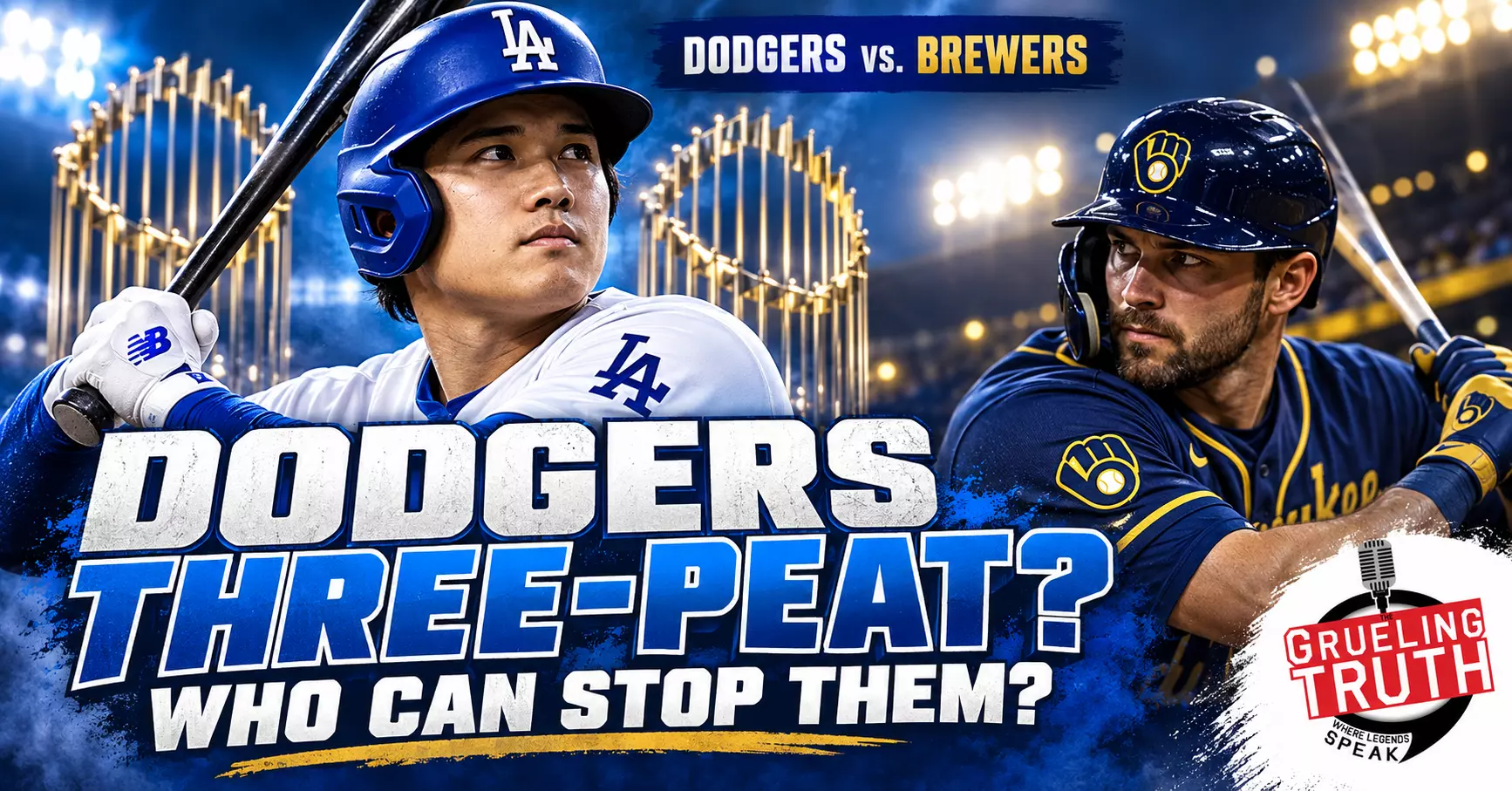
The Los Angeles Dodgers are eight victories from turning another championship pursuit into baseball history.
The Los Angeles Dodgers are eight victories from turning another championship pursuit into baseball history.
Their 4–1 win over Atlanta on Wednesday finished the National League Division Series in four games and kept alive the opportunity to become the first National League franchise to win three consecutive World Series. Milwaukee now stands between Los Angeles and another appearance in the Fall Classic.
The temptation is to treat this as another inevitable Dodgers march through October. They have the talent, the experience and enough different ways to win that an opponent can play well and still find itself packing for the offseason.
But Atlanta also exposed weaknesses that Milwaukee should study closely.
The Dodgers
survived inconsistent situational hitting and stretches of shaky command. Against a team capable of turning those openings into runs, the same problems could produce a different result.
Los Angeles remains my championship favorite. Milwaukee, however, has a credible path to stopping the three-peat before it reaches the World Series.
The Dodgers Advanced Without Their Offense Fully Clicking
Andy Pages delivered the decisive swing in Game 4, a two-run single in the seventh inning. Remarkably, it was Los Angeles’ first hit with runners in scoring position in the series after an 0-for-14 start.
That statistic supports two competing interpretations.
The optimistic view is that the Dodgers eliminated a dangerous opponent without producing anywhere near their best situational offense. If those opportunities begin turning into hits, their next opponent could face a much more difficult assignment.
The concerning view is that Los Angeles left games close enough for a single opposing swing to change everything.
Both interpretations have merit. What the Dodgers cannot assume is that their pitching will keep rescuing an offense that fails to capitalize.
Milwaukee’s assignment should be to make Los Angeles assemble rallies. Limit the damaging extra-base hit, avoid unnecessary walks and force the Dodgers to deliver repeatedly with runners aboard.
A lineup this talented will eventually punish mistakes. The challenge is to make it earn its runs through consecutive quality at-bats.
Free Passes Are the Clearest Warning Sign
Tyler Glasnow walked five hitters in Game 4 and lasted 4⅔ innings. Across the series, Atlanta drew 18 walks, yet none of those runners scored.
That is an extraordinary escape act. It is also a warning.
Giving away baserunners increases pitch counts, brings the bullpen into games earlier and creates opportunities that require no offensive contribution from the opponent.
Los Angeles deserves credit for getting out of trouble. However, pitching out of trouble is a harder way to navigate a seven-game series than avoiding it.
For Milwaukee, plate discipline should be central to the approach. When a Dodgers starter struggles to locate, the Brewers cannot bail him out by chasing pitches simply because they want to manufacture a big moment.
Take the walk. Extend the inning. Make the next hitter’s opportunity more valuable.
The Dodgers’ stuff can overpower hitters. Their opponents have a better chance when they force that stuff into the strike zone.
The Bullpen Is a Strength—and Workload Still Matters
Los Angeles’ relievers covered the final 4⅓ innings of the clincher without allowing a run. The Dodgers surrendered only eight runs across the entire series.
That performance explains why they could withstand offensive frustration and advance anyway.
Yet even an excellent bullpen becomes more complicated to manage when starters consistently leave early. Dave Roberts must consider who is available today, who can work tomorrow and which matchup is worth using a particular reliever to secure.
Milwaukee should try to make those decisions uncomfortable.
That does not require chasing an enormous inning every night. Long plate appearances and sustained traffic can gradually change a series. A reliever who dominates on Sunday may be less effective after repeated appearances later in the week.
The Brewers’ best opportunity is to make the Dodgers work for every inning, even in games Milwaukee ultimately loses.
Milwaukee Has Multiple Ways to Win a Close Game
The Brewers’ 3–1 clinching victory over San Diego offered a useful illustration of their threat.
Jackson Chourio supplied the go-ahead single. Aaron Ashby delivered three scoreless, hitless relief innings. Garrett Mitchell robbed a potential tying home run in the eighth.
Those contributions matter because beating Los Angeles requires more than matching its biggest offensive names.
Milwaukee can win through run prevention, timely contact and defense. It can protect a narrow lead without needing another home run to create breathing room.
Mitchell’s catch also illustrates how thin October margins become. A ball that clears the wall changes the entire conversation. A defender who brings it back preserves a lead and helps finish a series.
Against the Dodgers, Milwaukee will need that level of execution. Extra outs, careless throws and avoidable walks are invitations Los Angeles is equipped to exploit.
Last Year’s Sweep Is a Warning, Not a Forecast
The Dodgers swept Milwaukee in last year’s NLCS, holding the Brewers to four total runs.
Milwaukee should take the offensive lesson seriously. Keeping games close means little if the lineup cannot produce enough to win them.
But last October does not determine this October.
The Brewers have earned another opportunity, and they will have home-field advantage in this matchup. Game 1 is scheduled for Sunday in Milwaukee.
The practical challenge is to capitalize on their chances before Los Angeles settles into control. Milwaukee cannot leave repeated openings unused and expect its pitching to hold indefinitely.
The Brewers do not need to prove they belong through speeches about revenge. They need disciplined at-bats, clean defense and productive innings against pitchers who offer very little room for error.
Who Can Actually Stop the Dodgers?
My answer begins with Milwaukee.
That does not mean the Brewers are certain to win, or that the eventual American League champion would be an easier opponent. It means Milwaukee presents an immediate, plausible challenge to the weaknesses
Los Angeles
showed against Atlanta.
The Brewers can make command problems expensive. They can defend a narrow lead. They can force the Dodgers to win extended games rather than coast through comfortable ones.
Los Angeles still gets my edge because of its pitching depth and the number of hitters capable of deciding a game. Pages’ clinching hit reinforced how difficult it is to contain an offense when the decisive contribution can come from beyond its most celebrated stars.
But a three-peat will require sharper execution than the Dodgers displayed in several important situations during the NLDS.
Milwaukee can stop them. The Brewers’ task is to turn the opportunities Atlanta wasted into the runs that finally make Los Angeles pay.
Up To $1500 in Bonus Bets Paid Back if your First Bet Does Not Win
T&Cs apply
4.5/5
Gambling problem? Call 1-800-GAMBLER or 1-800-MY-RESET (Available in the US) 877-8-HOPENY or text HOPENY (467369) (NY) 1-800-327-5050 (MA), 1-800-BETS-OFF (IA), 1-800-981-0023 (PR). 21+ only. Please Gamble Responsibly. See BetMGM.com for Terms. First Bet Offer for new customers only (if applicable). Subject to eligibility requirements. Bonus bets are non-withdrawable. In partnership with Kansas Crossing Casino and Hotel. Promotional offers not available in Mississippi, Massachusetts, New York, Ontario, or Puerto Rico.
New DraftKings Customers: Spend $5+ Get $150 in Bonuses
T&Cs apply
4.5/5
GAMBLING PROBLEM? CALL 1-800-GAMBLER or 1-800-MY-RESET, (800) 327-5050 or visit gamblinghelplinema.org (MA). Please Gamble Responsibly. 888-789-7777/visit ccpg.org (CT), or visit www.mdgamblinghelp.org (MD), 1-800-981-0023 (PR). 21+ and present in most states. (18+ DC/NH/PR/WY). Void in CAN. Eligibility restrictions apply. On behalf of Boot Hill Casino (KS). Pass-thru of per wager tax may apply in IL. 1 per new DraftKings customer. $5+ first-time bet req. Max. $150 issued as non-withdrawable Bonus Bets. Stake removed from payout. Reward issued as $50 in Bonus Bets every 7 days via click-to-claim for 14 days. Bonus Bets and click-to-claims expire 7 days (168hrs) after issuance. Terms: sportsbook.draftkings.com/promos. Ends 10/11/26 at 11:59 PM ET. Sponsored by DK.
Must be 21+. GAMBLING PROBLEM? CALL 1-800-GAMBLER OR CALL 1-800-MY-RESET, www.mdgamblinghelp.org (MD), (800)-327-5050 or gamblinghelplinema.org (MA), Call (877)8-HOPENY or text HOPENY (467369) (NY), (888) 789-7777 or ccpg.org (CT), morethanagame.nc.gov (NC), 1800gambler.net (WV)
Bet $1 and get double the winnings up to $25 for your next 10 bets
T&Cs apply
4.4/5
21+ New users only. Must register using eligible promo code. First bet after registration must qualify. Max. Bonus Bet: $1,000. Bonus Bet expires 14 days after receipt. Void where prohibited. See Caesars.com/promos for full terms. Gambling Problem? 1-800-GAMBLER (1-800-426-2537)
21+ and present in OH. Gambling Problem? Call 1-800-GAMBLER.
This site is using
Cloudflare
and adheres to the
Google Safe Browsing Program. We adapted
Google's Privacy Guidelines
to keep your data safe at all times.
Close
Ready to Win Big? Join the Elite with Our Sports Betting Deals!
FanDuel Promo
New Users – Get $250 in Bonus Bets when you wager $5 for 5 days
Up To $1500 in Bonus Bets Paid Back if your First Bet Does Not Win
Best Slots
T&Cs and 21+ apply
Gambling problem? Call 1-800-GAMBLER or 1-800-MY-RESET (Available in the US) 877-8-HOPENY or text HOPENY (467369) (NY) 1-800-327-5050 (MA), 1-800-BETS-OFF (IA), 1-800-981-0023 (PR). 21+ only. Please Gamble Responsibly. See BetMGM.com for Terms. First Bet Offer for new customers only (if applicable). Subject to eligibility requirements. Bonus bets are non-withdrawable. In partnership with Kansas Crossing Casino and Hotel. Promotional offers not available in Mississippi, Massachusetts, New York, Ontario, or Puerto Rico.
Code:
Open BetMGM
Get Bonus
DraftKings Promo
New DraftKings Customers: Spend $5+ Get $150 in Bonuses
Newcomer
T&Cs and 21+ apply
GAMBLING PROBLEM? CALL 1-800-GAMBLER or 1-800-MY-RESET, (800) 327-5050 or visit gamblinghelplinema.org (MA). Please Gamble Responsibly. 888-789-7777/visit ccpg.org (CT), or visit www.mdgamblinghelp.org (MD), 1-800-981-0023 (PR). 21+ and present in most states. (18+ DC/NH/PR/WY). Void in CAN. Eligibility restrictions apply. On behalf of Boot Hill Casino (KS). Pass-thru of per wager tax may apply in IL. 1 per new DraftKings customer. $5+ first-time bet req. Max. $150 issued as non-withdrawable Bonus Bets. Stake removed from payout. Reward issued as $50 in Bonus Bets every 7 days via click-to-claim for 14 days. Bonus Bets and click-to-claims expire 7 days (168hrs) after issuance. Terms: sportsbook.draftkings.com/promos. Ends 10/11/26 at 11:59 PM ET. Sponsored by DK.
Code:
Open DraftKings
Get Bonus
Find out what the legends have to say about sports this week....