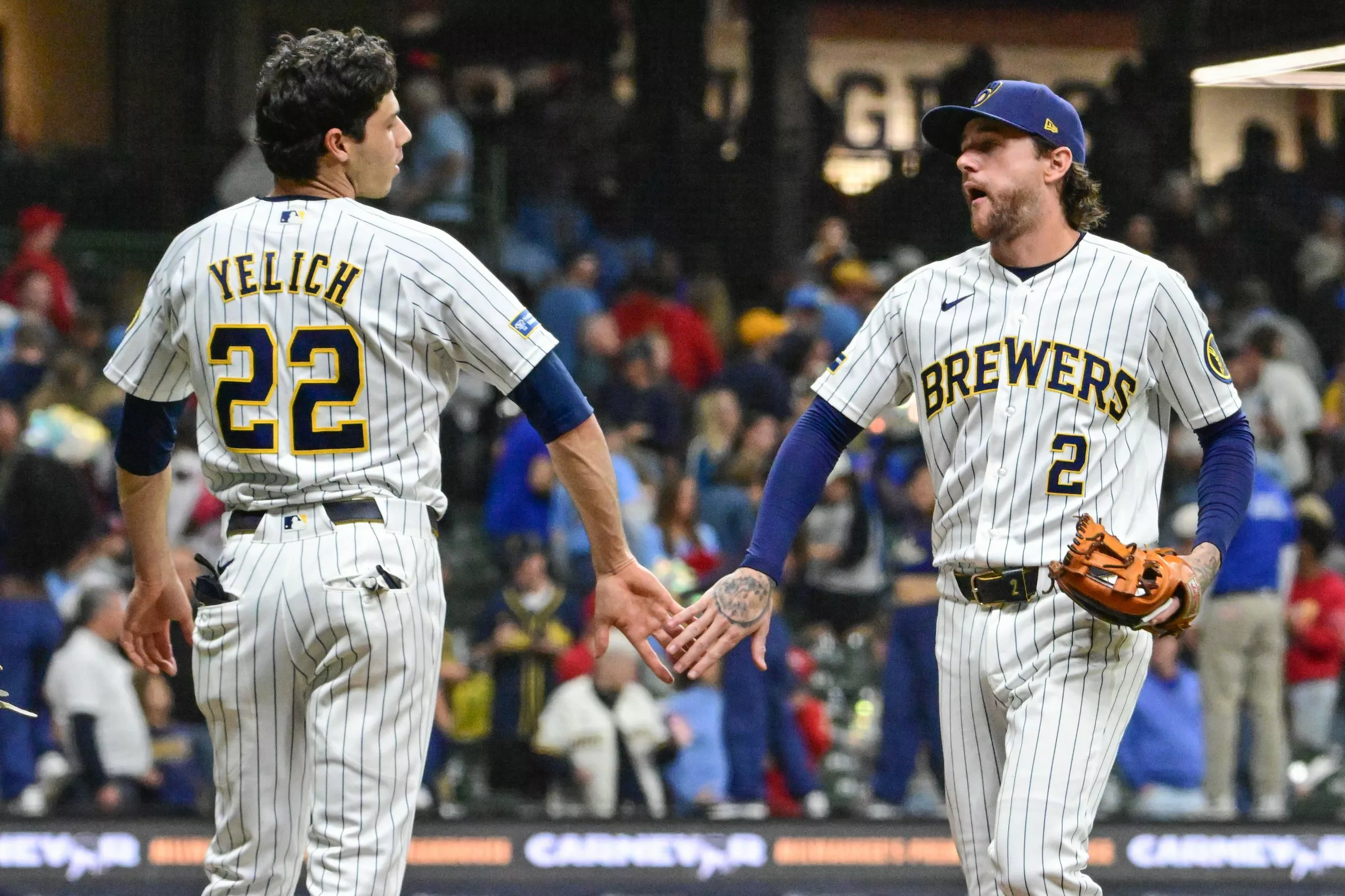
Sep 26, 2026; Milwaukee, Wisconsin, USA; Milwaukee Brewers second baseman Brice Turang (2) celebrates with designated hitter Christian Yelich (22) after beating the St. Louis Cardinals at American Family Field. Mandatory Credit: Benny Sieu-Imagn Images
The Milwaukee Brewers won 103 games, earned home-field advantage throughout the postseason and have San Diego one loss from elimination.
Yet the championship conversation still seems more comfortable revolving around the familiar names.
The Dodgers have their championship pedigree. The Yankees command attention whenever they play in October. Other contenders have recognizable stars who make it easy to build a national storyline.
Milwaukee has something that should matter at least as much: an extraordinary season backed by a balanced, dangerous baseball team.
The Brewers enter tonight’s Game 3 against the Padres with a 2–0 series lead and an opportunity to advance. Their franchise-record regular season has become a strong postseason start.
They deserve to be discussed among the World Series favorites. Their performance has earned that position.
A 103-Win Season Is Substantial Evidence
A short postseason series can produce surprising results. Over 162 games, however, teams have to demonstrate their quality repeatedly.
Milwaukee finished 103–59, scoring 832 runs while allowing 618. That is a run differential of plus-214.
Those numbers describe sustained superiority.
The Brewers could win when the offense carried them. They could win when pitching controlled the game. Their championship case does not depend on pretending one particular strength will overcome every weakness.
That balance matters because October creates different demands from night to night. A slugfest requires enough offense to keep pace. A tight game requires pitching that gives the lineup time to find a breakthrough.
Milwaukee spent the regular season establishing that it could handle both.
The playoffs remain a separate test, but the evidence from six months of baseball should inform our expectations.
This Offense Has More Than One Way to Score
Milwaukee scored its 832 runs despite hitting just 154 home runs. The Brewers also drew 668 walks, stole 162 bases and finished with a .341 on-base percentage.
That combination explains much of their appeal.
Home runs are valuable, especially against pitchers who make sustained rallies difficult. But an offense that can reach base, extend innings and create pressure has additional routes to scoring.
A walk can start a rally. A stolen base can change the value of the next single. Consecutive quality plate appearances can force a manager to make a pitching change sooner than planned.
Milwaukee’s regular-season production shows that its offense does not need an endless parade of home runs to generate runs.
That approach offers flexibility. It also gives the Brewers opportunities to capitalize when an opponent’s command slips or its defense makes a mistake.
Their First Playoff Win Showed They Have Power, Too
Anyone treating Milwaukee’s offensive style as evidence that it cannot hit important October home runs should review Game 1.
Jackson Chourio hit a game-tying two-run homer in the third inning. William Contreras supplied the decisive homer in the seventh as Milwaukee beat San Diego, 3–2.
The Brewers do not have to lead baseball in home runs to possess hitters capable of changing a postseason game with one swing.
That distinction matters.
Their offense has multiple ways to create opportunities, and it still has players who can finish those opportunities with power. Opposing pitchers cannot assume they can safely challenge the middle of the order simply because Milwaukee’s season was built on more than slugging.
The first game offered an immediate demonstration.
Chourio Gives Milwaukee a Star Who Can Change a Series
Chourio followed his Game 1 homer with the defining swing of Game 2.
With Milwaukee trailing in the ninth, he delivered a two-out, two-run single against Mason Miller to secure a 4–3 walk-off victory. San Diego had asked its elite closer to complete a six-out save. The Brewers found a way through him.
That result does not guarantee future success against every dominant reliever. It does show why Chourio belongs near the center of Milwaukee’s championship argument.
His regular season included a .291 batting average, 25 home runs and 23 stolen bases. Brice Turang added 21 homers, 100 RBIs and a .366 on-base percentage.
Milwaukee has players who can produce substantial offense over a full season and deliver in the moments that decide a playoff game.
The Brewers’ stars deserve attention because of what they contribute, regardless of how frequently they appear in national debates.
The Pitching Gives the Championship Case Weight
Milwaukee finished the regular season with a 3.51 team ERA and 1,544 strikeouts. Its staff allowed fewer hits than innings pitched and posted a 1.178 WHIP.
That is a strong foundation for postseason baseball.
Limiting baserunners reduces the damage a single mistake can cause. Strikeouts remove the possibility of a ball finding a hole or a defensive play going wrong. A staff that consistently does both gives its offense more manageable games.
At the front, Jacob Misiorowski won MLB’s ERA title and combined at least 250 strikeouts with a WHIP no higher than 0.80.
Milwaukee has the pitching credentials to support its impressive record.
Its championship case is much stronger than a story about a lineup getting hot at the right time. The Brewers have spent the season preventing runs as well as producing them.
Home-Field Advantage Is an Earned Benefit
Milwaukee’s regular season secured home-field advantage throughout the postseason.
That does not promise a championship. Opponents can win at American Family Field, and a deciding game remains unpredictable.
But the advantage belongs in any serious evaluation of the Brewers’ chances.
If Milwaukee keeps advancing, it will retain the opportunity to play potential deciding games at home. The Brewers earned that benefit through their regular-season performance.
It makes little sense to acknowledge their record while ignoring one of its most useful postseason consequences.
San Diego Has Already Made Milwaukee Earn It
The first two games were decided by one run. The Padres have challenged Milwaukee, and neither victory came easily.
San Diego entered the postseason having won 17 of its final 20 regular-season games before sweeping the Cubs in the Wild Card Series.
The Brewers’ lead has come against a dangerous opponent.
That strengthens the meaning of their start without making the series finished. Milwaukee still needs another win, and tonight’s matchup sends Dustin May against Nick Pivetta in San Diego.
A championship contender must be respected before it clinches. It must also be expected to finish the work.
Both standards apply to the Brewers.
Milwaukee Has Earned a Place Among the Favorites
There is a reasonable case for other contenders. Championship experience matters. Exceptional players matter. A team’s health and pitching availability can reshape its chances quickly.
The Brewers do not need every rival dismissed to make their own argument.
They have 103 victories, a substantial run differential, an offense with several ways to score, excellent pitching and home-field advantage. Their first two playoff games have added timely power and a ninth-inning comeback to that résumé.
Those are meaningful reasons to believe.
Milwaukee still has to turn its opportunity into a championship. The difficult work lies ahead.
But the Brewers should enter that work carrying the expectations their season deserves.
They have earned more than a mention as a dangerous outsider. They have earned a place among the teams we expect to see playing for the
World Series.
New Users – Get $350 in Bonus Bets when you wager $5 for 7 days
T&Cs apply
4.6/5
Gambling Problem? Call 1-800-GAMBLER or 1-800-MY-RESET. Call 1-888-789-7777 or visit ccpgg.org/chat (CT). Hope is here. GamblingHelpLineMA.org or call (800) 327-5050 for 24/7 support (MA). Visit www.mdgamblinghelp.org (MD). Call 1-877-8HOPE-NY or text HOPENY (NY). 21+ (18+ DC, WY) and present in select states (for KS, in affiliation with Kansas Star Casino). Find online real money wagering only. Min $5 wager required for 7 consecutive days. $5 free play credit. Bonus issued as non-withdrawable bonus with cash withdrawable bonus with cash withdrawable. Bonus bets which expire 7 days after receipt. Restrictions apply. See terms at sportsbook.fanduel.com. Call 1-877-770-7867 (LA).
Up To $1500 in Bonus Bets Paid Back if your First Bet Does Not Win
T&Cs apply
4.5/5
Gambling problem? Call 1-800-GAMBLER or 1-800-MY-RESET (Available in the US) 877-8-HOPENY or text HOPENY (467369) (NY) 1-800-327-5050 (MA), 1-800-BETS-OFF (IA), 1-800-981-0023 (PR). 21+ only. Please Gamble Responsibly. See BetMGM.com for Terms. First Bet Offer for new customers only (if applicable). Subject to eligibility requirements. Bonus bets are non-withdrawable. In partnership with Kansas Crossing Casino and Hotel. Promotional offers not available in Mississippi, Massachusetts, New York, Ontario, or Puerto Rico.
New DraftKings Customers: Bet $5, Get $200 + 3 Months of NBA League Pass!
T&Cs apply
4.5/5
GAMBLING PROBLEM? CALL 1-800-GAMBLER or 1-800-MY-RESET, (800) 327-5050 or visit gamblinghelplinema.org (MA). Please Gamble Responsibly. 888-789-7777/visit ccpg.org (CT), or visit www.mdgamblinghelp.org (MD), 1-800-981-0023 (PR). 21+ and present in most states. (18+ DC/NH/PR/WY). Void in CAN. Eligibility restrictions apply. On behalf of Boot Hill Casino (KS). Pass-thru of per wager tax may apply in IL. 1 per new Sportsbook customer. $5+ first-time bet req. Max. $200 issued as non-withdrawable Bonus Bets. Stake removed from payout. Reward issued as $50 in Bonus Bets every 7 days via click-to-claim for 21 days. Bonus Bets and click-to-claims expire 7 days (168hrs) after issuance. Terms: dkng.co/offer. Get 1 promo code to redeem a 3-month NBA League Pass subscription, complimentary of DraftKings. Subscription auto-renews monthly at then-current price (currently $16.99/mo); cancel anytime. Terms, restrictions, and eligibility requirements apply. Redeem League Pass by 12/19/26 at 11:59 PM ET. Addt’l terms: support.watch.nba.com/hc/en-us/articles/9165532876183-League-Pass-Terms-of-Use_. Ends 11/29/26 at 11:59 PM ET. Sponsored by DK.
Must be 21+. GAMBLING PROBLEM? CALL 1-800-GAMBLER OR CALL 1-800-MY-RESET, www.mdgamblinghelp.org (MD), (800)-327-5050 or gamblinghelplinema.org (MA), Call (877)8-HOPENY or text HOPENY (467369) (NY), (888) 789-7777 or ccpg.org (CT), morethanagame.nc.gov (NC), 1800gambler.net (WV)
Bet $1 and get double the winnings up to $25 for your next 10 bets
T&Cs apply
4.4/5
21+ New users only. Must register using eligible promo code. First bet after registration must qualify. Max. Bonus Bet: $1,000. Bonus Bet expires 14 days after receipt. Void where prohibited. See Caesars.com/promos for full terms. Gambling Problem? 1-800-GAMBLER (1-800-426-2537)
21+ and present in OH. Gambling Problem? Call 1-800-GAMBLER.
This site is using
Cloudflare
and adheres to the
Google Safe Browsing Program. We adapted
Google's Privacy Guidelines
to keep your data safe at all times.
Close
Ready to Win Big? Join the Elite with Our Sports Betting Deals!
FanDuel Promo
New Users – Get $350 in Bonus Bets when you wager $5 for 7 days
Our Favorite
T&Cs and 21+ apply
Gambling Problem? Call 1-800-GAMBLER or 1-800-MY-RESET. Call 1-888-789-7777 or visit ccpgg.org/chat (CT). Hope is here. GamblingHelpLineMA.org or call (800) 327-5050 for 24/7 support (MA). Visit www.mdgamblinghelp.org (MD). Call 1-877-8HOPE-NY or text HOPENY (NY). 21+ (18+ DC, WY) and present in select states (for KS, in affiliation with Kansas Star Casino). Find online real money wagering only. Min $5 wager required for 7 consecutive days. $5 free play credit. Bonus issued as non-withdrawable bonus with cash withdrawable bonus with cash withdrawable. Bonus bets which expire 7 days after receipt. Restrictions apply. See terms at sportsbook.fanduel.com. Call 1-877-770-7867 (LA).
Code:
Open FanDuel
Get Bonus
BetMGM Promo
Up To $1500 in Bonus Bets Paid Back if your First Bet Does Not Win
Best Slots
T&Cs and 21+ apply
Gambling problem? Call 1-800-GAMBLER or 1-800-MY-RESET (Available in the US) 877-8-HOPENY or text HOPENY (467369) (NY) 1-800-327-5050 (MA), 1-800-BETS-OFF (IA), 1-800-981-0023 (PR). 21+ only. Please Gamble Responsibly. See BetMGM.com for Terms. First Bet Offer for new customers only (if applicable). Subject to eligibility requirements. Bonus bets are non-withdrawable. In partnership with Kansas Crossing Casino and Hotel. Promotional offers not available in Mississippi, Massachusetts, New York, Ontario, or Puerto Rico.
Code:
Open BetMGM
Get Bonus
DraftKings Promo
New DraftKings Customers: Bet $5, Get $200 + 3 Months of NBA League Pass!
Newcomer
T&Cs and 21+ apply
GAMBLING PROBLEM? CALL 1-800-GAMBLER or 1-800-MY-RESET, (800) 327-5050 or visit gamblinghelplinema.org (MA). Please Gamble Responsibly. 888-789-7777/visit ccpg.org (CT), or visit www.mdgamblinghelp.org (MD), 1-800-981-0023 (PR). 21+ and present in most states. (18+ DC/NH/PR/WY). Void in CAN. Eligibility restrictions apply. On behalf of Boot Hill Casino (KS). Pass-thru of per wager tax may apply in IL. 1 per new Sportsbook customer. $5+ first-time bet req. Max. $200 issued as non-withdrawable Bonus Bets. Stake removed from payout. Reward issued as $50 in Bonus Bets every 7 days via click-to-claim for 21 days. Bonus Bets and click-to-claims expire 7 days (168hrs) after issuance. Terms: dkng.co/offer. Get 1 promo code to redeem a 3-month NBA League Pass subscription, complimentary of DraftKings. Subscription auto-renews monthly at then-current price (currently $16.99/mo); cancel anytime. Terms, restrictions, and eligibility requirements apply. Redeem League Pass by 12/19/26 at 11:59 PM ET. Addt’l terms: support.watch.nba.com/hc/en-us/articles/9165532876183-League-Pass-Terms-of-Use_. Ends 11/29/26 at 11:59 PM ET. Sponsored by DK.
Code:
Open DraftKings
Get Bonus
Find out what the legends have to say about sports this week....
New Users – Get $350 in Bonus Bets when you wager $5 for 7 days
Gambling Problem? Call 1-800-GAMBLER or 1-800-MY-RESET. Call 1-888-789-7777 or visit ccpgg.org/chat (CT). Hope is here. GamblingHelpLineMA.org or call (800) 327-5050 for 24/7 support (MA). Visit www.mdgamblinghelp.org (MD). Call 1-877-8HOPE-NY or text HOPENY (NY). 21+ (18+ DC, WY) and present in select states (for KS, in affiliation with Kansas Star Casino). Find online real money wagering only. Min $5 wager required for 7 consecutive days. $5 free play credit. Bonus issued as non-withdrawable bonus with cash withdrawable bonus with cash withdrawable. Bonus bets which expire 7 days after receipt. Restrictions apply. See terms at sportsbook.fanduel.com. Call 1-877-770-7867 (LA).