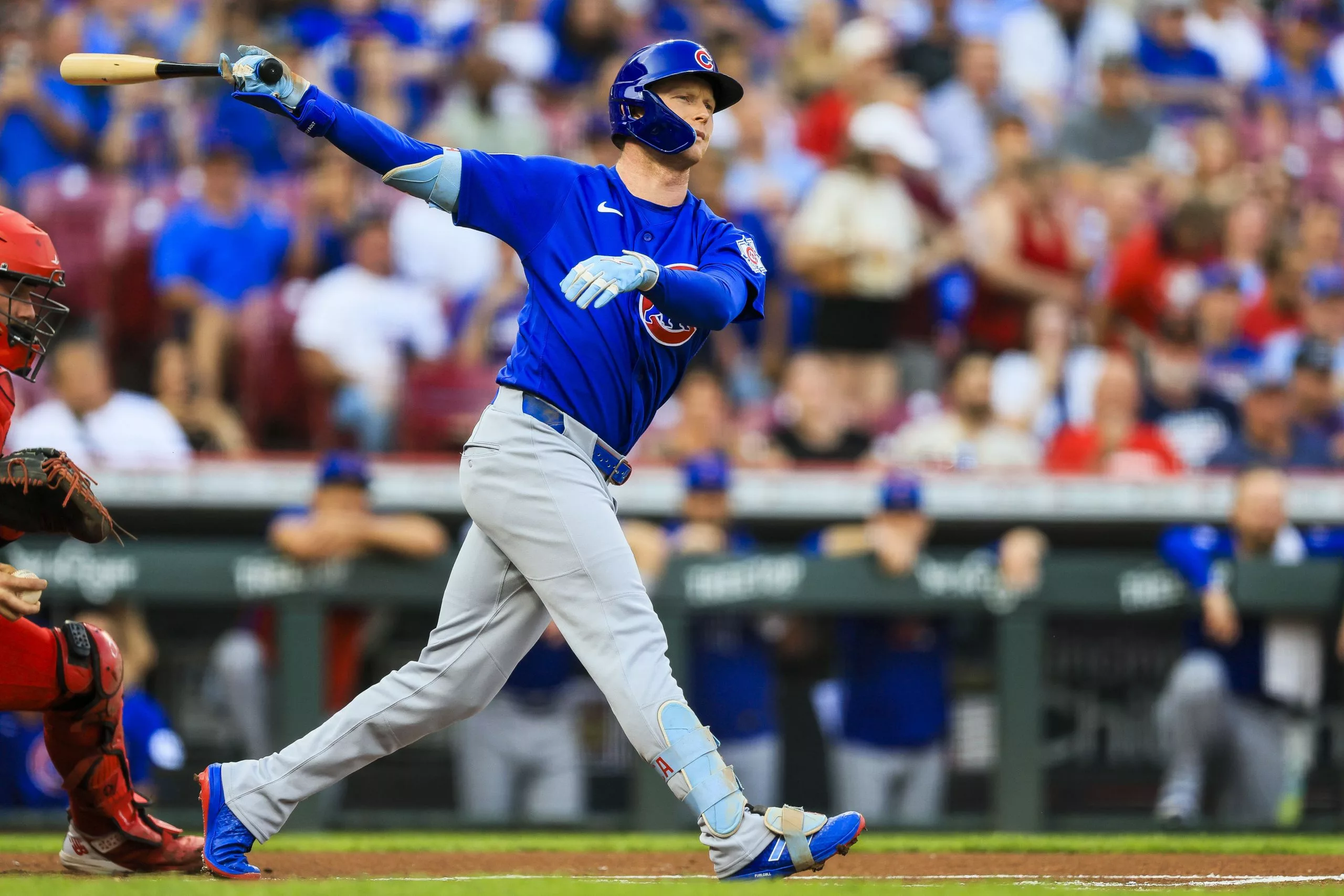
Sep 19, 2026; Cincinnati, Ohio, USA; Chicago Cubs outfielder Pete Crow-Armstrong (4) bats against the Cincinnati Reds in the first inning at Great American Ball Park. Mandatory Credit: Katie Stratman-Imagn Images
Pete Crow-Armstrong entered the major leagues known primarily for spectacular defense, elite speed and the possibility that he might eventually become a dependable hitter.
He has become something considerably greater.
Crow-Armstrong now has 45 home runs and 38 stolen bases as the Chicago Cubs prepare for the postseason. Two more steals would place him in baseball’s exclusive 40–40 club, but even that historic combination fails to capture everything he has accomplished.
He is already the first center fielder in Major League Baseball history to record at least 40 home runs, 30 doubles and 30 stolen bases in the same season.
Add his elite defense at one of baseball’s most demanding positions, and Crow-Armstrong has developed into something baseball almost never sees: a player who can dominate a game with his power, speed, glove and arm.
He is no longer merely an exciting young player.
Crow-Armstrong may be the most complete player in the National League.
Crow-Armstrong Is Two Steals from History
The 40–40 club
remains one of baseball’s most exclusive groups because the skills required to reach it rarely exist in the same player.
Power hitters are generally not fast enough to steal 40 bases. Elite base stealers rarely possess the strength to hit 40 home runs.
Crow-Armstrong has brought those abilities together while playing Gold Glove-caliber defense in center field.
His 45th home run came during Chicago’s 9–1 victory over the Cincinnati Reds. Crow-Armstrong finished that game 3-for-5 with a double, two RBIs, three runs and a stolen base.
That performance made him the first center fielder in MLB history to produce 40 home runs, 30 doubles and 30 stolen bases in one season. It also moved him to 38 steals, leaving him two short of completing a 40–40 campaign.
Crow-Armstrong has already moved beyond simply reaching 40 home runs. He has hit 45, tying for the major-league lead entering the season’s final stretch.
With another strong week, 45–40 is possible.
The milestone would place him alongside some of the most athletically gifted players baseball has ever produced. But unlike many members of the 40–40 club, Crow-Armstrong is also providing premium defense at a position that requires exceptional range and instincts.
That separates his season from almost every other great power-speed campaign.
The Power Development Has Been Remarkable
Crow-Armstrong’s speed and defensive talent were never questioned.
The Chicago Cubs acquired him from the New York Mets in the 2021 trade that sent Javier Báez and Trevor Williams to New York. At the time, Crow-Armstrong was viewed as a potential Gold Glove center fielder with questions about how much he would hit.
Those questions followed him into the major leagues.
Crow-Armstrong displayed significant progress in 2025, finishing with 31 home runs and 35 stolen bases. But his season contained two dramatically different halves. He produced an .847 OPS with 25 home runs and 27 steals before the All-Star break, then struggled during the second half.
That inconsistency created an important question entering 2026: Which version of Crow-Armstrong was real?
The answer has been emphatic.
His power has not merely survived. It has increased dramatically.
Crow-Armstrong’s 45 home runs are not the product of one fortunate month or a collection of wind-assisted fly balls at Wrigley Field. He has made meaningful mechanical changes that transformed his offensive approach.
After a slow beginning to the season, Crow-Armstrong narrowed his stance, changed the position of his hands and bat, and moved closer to the plate. Since making those adjustments in late May, he has produced at an MVP level while also improving his plate discipline.
The mechanical transformation matters because it suggests this is not an accidental career season.
Crow-Armstrong has found an approach that allows his natural athleticism and bat speed to produce consistent damage.
He Has Become More Than an Aggressive Free-Swinger
Crow-Armstrong’s offensive development is not limited to home runs.
His greatest weakness had been an overly aggressive approach that allowed pitchers to exploit him outside the strike zone. He could punish mistakes, but experienced pitchers understood how to expand the zone and force weak contact.
That has changed.
Crow-Armstrong has shown greater patience and a better understanding of how opponents are trying to attack him. His improved strike-zone control has allowed him to reach base more frequently, creating additional opportunities to use his speed.
Earlier this season, his on-base percentage was nearly 100 points higher than it had been the previous year. He had also drawn more walks in 87 games than he managed over 157 games in 2025.
That development may be more important than the home-run total.
Physical talent can create a spectacular season. Improved plate discipline creates a sustainable superstar.
Crow-Armstrong no longer needs to chase production. He can wait for pitchers to enter the area where his swing does the most damage.
That makes him much more difficult to attack.
His Speed Changes Games Beyond the Stolen-Base Total
Crow-Armstrong
needs two more stolen bases to reach 40, but his speed affects games in ways that cannot be fully measured by that number.
He pressures infielders on routine ground balls. He takes an extra base when outfielders hesitate. He can score from first on a ball into the gap and force defenses to rush throws that would otherwise be comfortable.
Pitchers also must divide their attention whenever he reaches base.
That creates better hitting situations for the batters behind him and can prevent pitchers from using their complete delivery. Even when Crow-Armstrong does not attempt a steal, the possibility changes how opponents operate.
Reaching 40 steals would give the season a memorable label. It would provide an accomplishment casual fans immediately understand.
But Crow-Armstrong’s real value is that his speed remains dangerous on every pitch and every ball put into play.
His Defense Makes the MVP Case Different
Home runs and stolen bases will dominate the headlines. Crow-Armstrong’s defense is what makes his National League MVP case so compelling.
Center field requires a player to cover enormous territory, track balls from difficult angles and make decisions immediately after contact. Crow-Armstrong does all of those things at an elite level.
His first step allows him to reach balls most center fielders cannot. His closing speed turns potential extra-base hits into outs. His arm discourages runners from taking extra bases.
Crow-Armstrong does not merely avoid hurting Chicago defensively while producing historic offensive numbers.
He actively changes games with his glove.
That makes him fundamentally different from a designated hitter or an average defender putting up similar offensive statistics.
Every run he creates at the plate matters. So does every run he prevents in the outfield.
Crow-Armstrong’s overall value has placed him at or near the top of the league’s wins-above-replacement measurements. At one point this season, his WAR had climbed above Shohei Ohtani’s, strengthening the argument that Crow-Armstrong was producing more complete value.
Ohtani’s two-way ability makes every MVP comparison complicated. But injuries have prevented him from pitching since July, reducing much of his recent value to what he provides as a hitter.
Crow-Armstrong plays center field almost every day—and frequently plays it better than anyone.
He Has Carried the Cubs Into October
Individual accomplishments become more meaningful when they help produce team success.
The Cubs are tied with San Diego for the National League’s top Wild Card position at 87–69. Chicago also owns important tiebreaker advantages and remains in position to host a Wild Card Series at Wrigley Field.
Crow-Armstrong has been the center of that success.
The Cubs have received important contributions from Alex Bregman, Seiya Suzuki, Nico Hoerner and others. Bregman has been particularly productive during the second half.
But Crow-Armstrong is the player who changes Chicago’s identity.
He gives the lineup elite power and speed. He anchors the outfield defense. He brings energy to the stadium and gives the Cubs a player capable of deciding a postseason game in multiple ways.
Chicago’s pitching remains a potential October concern. That places additional responsibility on the offense to create runs and on the defense to convert every possible out.
Crow-Armstrong directly addresses both needs.
The Pressure of Chasing 40–40
Crow-Armstrong will enter the final games knowing exactly how close he is.
Every time he reaches first base, fans will expect him to run. Every opposing pitcher and catcher will know the same thing.
That creates an unusual challenge.
The Cubs are still playing for Wild Card positioning and home-field advantage. Crow-Armstrong cannot pursue an individual milestone at the expense of the team. Forcing a stolen-base attempt in the wrong situation could eliminate an important baserunner.
At the same time, the opportunity may never be this close again.
Forty stolen bases require health, opportunity and a willingness to accept risk. Crow-Armstrong already has the power portion of the milestone comfortably secured. He needs only two successful attempts to complete one of baseball’s greatest statistical combinations.
Manager Craig Counsell should not manufacture opportunities, but he also should not discourage Crow-Armstrong from being aggressive when the situation allows it.
His speed is part of what made Chicago successful.
The Cubs should not ask him to become a different player because October is approaching.
Crow-Armstrong Has Become the Face of the Cubs
Chicago has spent several seasons searching for the next player capable of defining the franchise.
The 2016 championship team featured Kris Bryant, Anthony Rizzo, Báez and a collection of young stars who turned the Cubs into one of baseball’s most recognizable teams.
Crow-Armstrong now has an opportunity to become the centerpiece of the next era.
He has the talent, personality and playing style required for that responsibility. He plays aggressively, produces highlights and contributes in every phase of the game.
Most importantly, he is delivering while the Cubs are winning.
A 40–40 season would give Crow-Armstrong a permanent place in baseball history. An MVP award would confirm his arrival as one of the sport’s biggest stars.
A deep postseason run could make him an icon in Chicago.
Baseball Almost Never Produces a Player Like This
Crow-Armstrong is not the
best hitter in baseball
solely because of his 45 home runs. He is not the fastest player solely because he is approaching 40 stolen bases. Other outfielders may match individual pieces of his game.
Almost nobody combines all of them.
He hits for power. He creates havoc on the bases. He saves runs in center field. He throws well, plays with energy and has helped lead the Cubs back into postseason contention.
That is why his MVP case should extend beyond the usual offensive comparison.
The award is supposed to recognize value, and Crow-Armstrong provides it everywhere.
Two more stolen bases would give the season an unforgettable statistical achievement. But even if he finishes with 39, the larger conclusion will remain unchanged.
Pete Crow-Armstrong has become one of baseball’s most complete players.
And at only 24 years old, this historic season may be the beginning—not the peak.
New Users – Get $350 in Bonus Bets when you wager $5 for 7 days
T&Cs apply
4.6/5
Gambling Problem? Call 1-800-GAMBLER or 1-800-MY-RESET. Call 1-888-789-7777 or visit ccpgg.org/chat (CT). Hope is here. GamblingHelpLineMA.org or call (800) 327-5050 for 24/7 support (MA). Visit www.mdgamblinghelp.org (MD). Call 1-877-8HOPE-NY or text HOPENY (NY). 21+ (18+ DC, WY) and present in select states (for KS, in affiliation with Kansas Star Casino). Find online real money wagering only. Min $5 wager required for 7 consecutive days. $5 free play credit. Bonus issued as non-withdrawable bonus with cash withdrawable bonus with cash withdrawable. Bonus bets which expire 7 days after receipt. Restrictions apply. See terms at sportsbook.fanduel.com. Call 1-877-770-7867 (LA).
Up To $1500 in Bonus Bets Paid Back if your First Bet Does Not Win
T&Cs apply
4.5/5
Gambling problem? Call 1-800-GAMBLER or 1-800-MY-RESET (Available in the US) 877-8-HOPENY or text HOPENY (467369) (NY) 1-800-327-5050 (MA), 1-800-BETS-OFF (IA), 1-800-981-0023 (PR). 21+ only. Please Gamble Responsibly. See BetMGM.com for Terms. First Bet Offer for new customers only (if applicable). Subject to eligibility requirements. Bonus bets are non-withdrawable. In partnership with Kansas Crossing Casino and Hotel. Promotional offers not available in Mississippi, Massachusetts, New York, Ontario, or Puerto Rico.
New DraftKings Customers: Bet $5, Get $200 + 3 Months of NBA League Pass!
T&Cs apply
4.5/5
GAMBLING PROBLEM? CALL 1-800-GAMBLER or 1-800-MY-RESET, (800) 327-5050 or visit gamblinghelplinema.org (MA). Please Gamble Responsibly. 888-789-7777/visit ccpg.org (CT), or visit www.mdgamblinghelp.org (MD), 1-800-981-0023 (PR). 21+ and present in most states. (18+ DC/NH/PR/WY). Void in CAN. Eligibility restrictions apply. On behalf of Boot Hill Casino (KS). Pass-thru of per wager tax may apply in IL. 1 per new Sportsbook customer. $5+ first-time bet req. Max. $200 issued as non-withdrawable Bonus Bets. Stake removed from payout. Reward issued as $50 in Bonus Bets every 7 days via click-to-claim for 21 days. Bonus Bets and click-to-claims expire 7 days (168hrs) after issuance. Terms: dkng.co/offer. Get 1 promo code to redeem a 3-month NBA League Pass subscription, complimentary of DraftKings. Subscription auto-renews monthly at then-current price (currently $16.99/mo); cancel anytime. Terms, restrictions, and eligibility requirements apply. Redeem League Pass by 12/19/26 at 11:59 PM ET. Addt’l terms: support.watch.nba.com/hc/en-us/articles/9165532876183-League-Pass-Terms-of-Use_. Ends 11/29/26 at 11:59 PM ET. Sponsored by DK.
Must be 21+. GAMBLING PROBLEM? CALL 1-800-GAMBLER OR CALL 1-800-MY-RESET, www.mdgamblinghelp.org (MD), (800)-327-5050 or gamblinghelplinema.org (MA), Call (877)8-HOPENY or text HOPENY (467369) (NY), (888) 789-7777 or ccpg.org (CT), morethanagame.nc.gov (NC), 1800gambler.net (WV)
Bet $1 and get double the winnings up to $25 for your next 10 bets
T&Cs apply
4.4/5
21+ New users only. Must register using eligible promo code. First bet after registration must qualify. Max. Bonus Bet: $1,000. Bonus Bet expires 14 days after receipt. Void where prohibited. See Caesars.com/promos for full terms. Gambling Problem? 1-800-GAMBLER (1-800-426-2537)
21+ and present in OH. Gambling Problem? Call 1-800-GAMBLER.
This site is using
Cloudflare
and adheres to the
Google Safe Browsing Program. We adapted
Google's Privacy Guidelines
to keep your data safe at all times.
Close
Ready to Win Big? Join the Elite with Our Sports Betting Deals!
FanDuel Promo
New Users – Get $350 in Bonus Bets when you wager $5 for 7 days
Our Favorite
T&Cs and 21+ apply
Gambling Problem? Call 1-800-GAMBLER or 1-800-MY-RESET. Call 1-888-789-7777 or visit ccpgg.org/chat (CT). Hope is here. GamblingHelpLineMA.org or call (800) 327-5050 for 24/7 support (MA). Visit www.mdgamblinghelp.org (MD). Call 1-877-8HOPE-NY or text HOPENY (NY). 21+ (18+ DC, WY) and present in select states (for KS, in affiliation with Kansas Star Casino). Find online real money wagering only. Min $5 wager required for 7 consecutive days. $5 free play credit. Bonus issued as non-withdrawable bonus with cash withdrawable bonus with cash withdrawable. Bonus bets which expire 7 days after receipt. Restrictions apply. See terms at sportsbook.fanduel.com. Call 1-877-770-7867 (LA).
Code:
Open FanDuel
Get Bonus
BetMGM Promo
Up To $1500 in Bonus Bets Paid Back if your First Bet Does Not Win
Best Slots
T&Cs and 21+ apply
Gambling problem? Call 1-800-GAMBLER or 1-800-MY-RESET (Available in the US) 877-8-HOPENY or text HOPENY (467369) (NY) 1-800-327-5050 (MA), 1-800-BETS-OFF (IA), 1-800-981-0023 (PR). 21+ only. Please Gamble Responsibly. See BetMGM.com for Terms. First Bet Offer for new customers only (if applicable). Subject to eligibility requirements. Bonus bets are non-withdrawable. In partnership with Kansas Crossing Casino and Hotel. Promotional offers not available in Mississippi, Massachusetts, New York, Ontario, or Puerto Rico.
Code:
Open BetMGM
Get Bonus
DraftKings Promo
New DraftKings Customers: Bet $5, Get $200 + 3 Months of NBA League Pass!
Newcomer
T&Cs and 21+ apply
GAMBLING PROBLEM? CALL 1-800-GAMBLER or 1-800-MY-RESET, (800) 327-5050 or visit gamblinghelplinema.org (MA). Please Gamble Responsibly. 888-789-7777/visit ccpg.org (CT), or visit www.mdgamblinghelp.org (MD), 1-800-981-0023 (PR). 21+ and present in most states. (18+ DC/NH/PR/WY). Void in CAN. Eligibility restrictions apply. On behalf of Boot Hill Casino (KS). Pass-thru of per wager tax may apply in IL. 1 per new Sportsbook customer. $5+ first-time bet req. Max. $200 issued as non-withdrawable Bonus Bets. Stake removed from payout. Reward issued as $50 in Bonus Bets every 7 days via click-to-claim for 21 days. Bonus Bets and click-to-claims expire 7 days (168hrs) after issuance. Terms: dkng.co/offer. Get 1 promo code to redeem a 3-month NBA League Pass subscription, complimentary of DraftKings. Subscription auto-renews monthly at then-current price (currently $16.99/mo); cancel anytime. Terms, restrictions, and eligibility requirements apply. Redeem League Pass by 12/19/26 at 11:59 PM ET. Addt’l terms: support.watch.nba.com/hc/en-us/articles/9165532876183-League-Pass-Terms-of-Use_. Ends 11/29/26 at 11:59 PM ET. Sponsored by DK.
Code:
Open DraftKings
Get Bonus
Find out what the legends have to say about sports this week....
New Users – Get $350 in Bonus Bets when you wager $5 for 7 days
Gambling Problem? Call 1-800-GAMBLER or 1-800-MY-RESET. Call 1-888-789-7777 or visit ccpgg.org/chat (CT). Hope is here. GamblingHelpLineMA.org or call (800) 327-5050 for 24/7 support (MA). Visit www.mdgamblinghelp.org (MD). Call 1-877-8HOPE-NY or text HOPENY (NY). 21+ (18+ DC, WY) and present in select states (for KS, in affiliation with Kansas Star Casino). Find online real money wagering only. Min $5 wager required for 7 consecutive days. $5 free play credit. Bonus issued as non-withdrawable bonus with cash withdrawable bonus with cash withdrawable. Bonus bets which expire 7 days after receipt. Restrictions apply. See terms at sportsbook.fanduel.com. Call 1-877-770-7867 (LA).