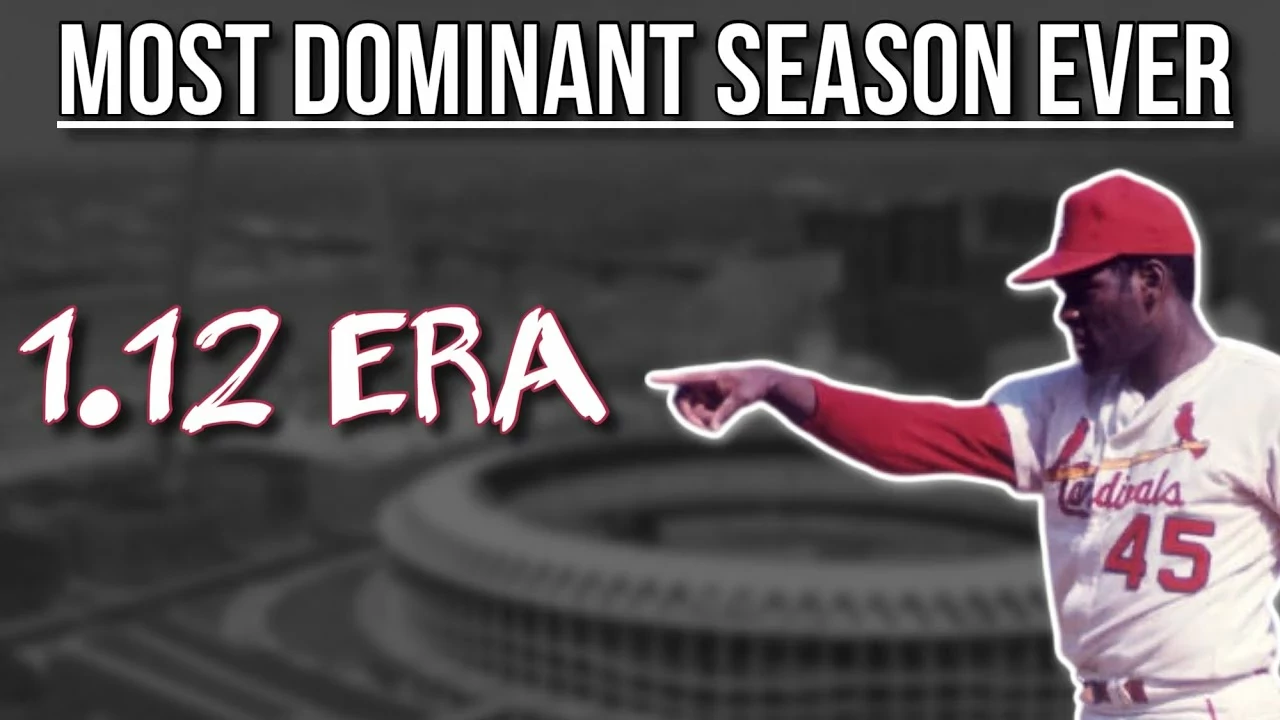
The 1968 Major League Baseball season is forever etched in history as “The Year of the Pitcher,” and no player personified that dominance more than
Bob Gibson
of the St. Louis Cardinals. In a year where pitchers ruled the mound and hitters looked helpless, Gibson’s performance stood out even among the best — a campaign so dominant that it directly led to MLB altering the rules of the game.
Bob Gibson Was So Dominant That Baseball Had To Change
Season Overview
Bob Gibson’s numbers from 1968 still seem almost mythical over half a century later:
Record:
22–9
ERA:
1.12 (modern era record)
Complete Games:
28
Shutouts:
13
Innings Pitched:
304.2
Strikeouts:
268
WHIP:
0.853
Hits Allowed:
Only 198 in over 300 innings
Gibson’s 1.12 ERA is the lowest in the modern era (post-1900) and has stood unchallenged for more than 55 years. For context, the next best post-deadball season ERA belongs to Dwight Gooden in 1985 at 1.53.
The Most Dominant Stretch in MLB History
Perhaps the most jaw-dropping part of Gibson’s year was a 15-game stretch from June 2 to August 19:
15 Starts:
15 Complete Games
Record:
15–0
ERA:
0.50
Shutouts:
8
Runs Allowed:
6 in 135 innings
During this run, opposing hitters batted just .144 against him. It wasn’t simply good pitching — it was complete mastery over every batter he faced.
Postseason Performance
Gibson’s dominance carried into the 1968 World Series against the Detroit Tigers. In Game 1, he struck out 17 batters, breaking Sandy Koufax’s Series record. He also pitched complete games in Games 4 and 7, finishing the Series with 35 strikeouts in 27 innings and a 1.67 ERA — though the Cardinals lost in seven games.
How Gibson’s 1968 Season Compares to Today’s Pitchers
The game Gibson played in 1968 is vastly different from the one we see today.
1. ERA Context
Gibson 1968:
1.12 ERA in 304.2 innings.
Best ERA in 2024:
Kyle Bradish, 2.46 in 128.1 innings.
Best ERA in a full modern-season workload (200+ IP) since 2000:
Pedro Martínez, 1.74 in 2000.
Today’s game is built for offense: smaller strike zones, lower mounds, livelier baseballs, and hitter-friendly ballparks. A 1.12 ERA over 300 innings today would be almost unthinkable. Even if you adjust Gibson’s ERA to modern run environments using ERA+, his 1968 ERA+ of 258 means he was 158% better than the league average pitcher — the highest in history for a full season.
2. Innings Pitched and Durability
Gibson 1968:
304.2 innings, 28 complete games.
2024 MLB Leader in IP:
Logan Webb, 216.0 innings (2023 numbers for reference).
2024 MLB Leader in Complete Games:
Usually 3 or fewer for the entire league.
In today’s era of pitch counts, bullpen specialization, and injury prevention, no pitcher approaches 300 innings. Gibson averaged more than 9 innings per start during his 15-game winning streak, which is unheard of now.
3. Strikeouts and Whiffs
Interestingly, Gibson’s strikeout totals (268) wouldn’t lead the league today. Modern pitchers like Gerrit Cole or Spencer Strider can surpass 250 strikeouts in far fewer innings because strikeouts are more common now. But Gibson’s strikeout-to-walk ratio (268 K / 62 BB = 4.32) was elite for an era where hitters were harder to strike out.
4. WHIP and Opponent Batting Average
Gibson 1968 WHIP:
0.853
Best WHIP in 2024:
Typically around 0.90–1.00 (over fewer innings).
Opponents hit just
.184
off Gibson. In a modern context, that’s comparable to a dominant reliever’s numbers — except Gibson maintained it over 300+ innings against the league’s best.
Rule Changes Prompted by Gibson’s Season
Gibson’s 1968 dominance was part of a larger trend — league-wide batting average was just .237, and Carl Yastrzemski led the AL with a .301 average. In response, MLB lowered the mound from 15 inches to 10 inches and shrank the strike zone in 1969 to boost offense. The league essentially rewrote the rules to keep pitchers from doing what Gibson did.
Legacy and Modern Perspective
Bob Gibson’s 1968 season isn’t just the gold standard for pitching dominance — it’s a statistical outlier that is almost impossible to imagine in today’s game.
Modern analytics, bullpen specialization, and injury management make his workload unrepeatable, while offensive-friendly conditions make a 1.12 ERA over a full season practically impossible.
In a modern environment, if a pitcher posted Gibson’s ERA+ of 258, it would be akin to a starter running a sub-1.50 ERA over 200 innings — something we have not seen in decades. Gibson’s season is the pitching equivalent of Wilt Chamberlain’s 50 points per game in 1962 — a record born of skill, mentality, and an environment that no longer exists.
Final Thought:
Gibson’s 1968 wasn’t just dominant for its time — it remains the most overpowering single-season pitching performance in MLB’s modern history. Comparing it to today’s numbers underscores how much the game has changed, and why Gibson’s record 1.12 ERA may be the most untouchable mark in baseball.
New Users – Get $350 in Bonus Bets when you wager $5 for 7 days
T&Cs apply
4.6/5
Gambling Problem? Call 1-800-GAMBLER or 1-800-MY-RESET. Call 1-888-789-7777 or visit ccpgg.org/chat (CT). Hope is here. GamblingHelpLineMA.org or call (800) 327-5050 for 24/7 support (MA). Visit www.mdgamblinghelp.org (MD). Call 1-877-8HOPE-NY or text HOPENY (NY). 21+ (18+ DC, WY) and present in select states (for KS, in affiliation with Kansas Star Casino). Find online real money wagering only. Min $5 wager required for 7 consecutive days. $5 free play credit. Bonus issued as non-withdrawable bonus with cash withdrawable bonus with cash withdrawable. Bonus bets which expire 7 days after receipt. Restrictions apply. See terms at sportsbook.fanduel.com. Call 1-877-770-7867 (LA).
Up To $1500 in Bonus Bets Paid Back if your First Bet Does Not Win
T&Cs apply
4.5/5
Gambling problem? Call 1-800-GAMBLER or 1-800-MY-RESET (Available in the US) 877-8-HOPENY or text HOPENY (467369) (NY) 1-800-327-5050 (MA), 1-800-BETS-OFF (IA), 1-800-981-0023 (PR). 21+ only. Please Gamble Responsibly. See BetMGM.com for Terms. First Bet Offer for new customers only (if applicable). Subject to eligibility requirements. Bonus bets are non-withdrawable. In partnership with Kansas Crossing Casino and Hotel. Promotional offers not available in Mississippi, Massachusetts, New York, Ontario, or Puerto Rico.
New DraftKings Customers: Bet $5, Get $200 + 3 Months of NBA League Pass!
T&Cs apply
4.5/5
GAMBLING PROBLEM? CALL 1-800-GAMBLER or 1-800-MY-RESET, (800) 327-5050 or visit gamblinghelplinema.org (MA). Please Gamble Responsibly. 888-789-7777/visit ccpg.org (CT), or visit www.mdgamblinghelp.org (MD), 1-800-981-0023 (PR). 21+ and present in most states. (18+ DC/NH/PR/WY). Void in CAN. Eligibility restrictions apply. On behalf of Boot Hill Casino (KS). Pass-thru of per wager tax may apply in IL. 1 per new Sportsbook customer. $5+ first-time bet req. Max. $200 issued as non-withdrawable Bonus Bets. Stake removed from payout. Reward issued as $50 in Bonus Bets every 7 days via click-to-claim for 21 days. Bonus Bets and click-to-claims expire 7 days (168hrs) after issuance. Terms: dkng.co/offer. Get 1 promo code to redeem a 3-month NBA League Pass subscription, complimentary of DraftKings. Subscription auto-renews monthly at then-current price (currently $16.99/mo); cancel anytime. Terms, restrictions, and eligibility requirements apply. Redeem League Pass by 12/19/26 at 11:59 PM ET. Addt’l terms: support.watch.nba.com/hc/en-us/articles/9165532876183-League-Pass-Terms-of-Use_. Ends 11/29/26 at 11:59 PM ET. Sponsored by DK.
Must be 21+. GAMBLING PROBLEM? CALL 1-800-GAMBLER OR CALL 1-800-MY-RESET, www.mdgamblinghelp.org (MD), (800)-327-5050 or gamblinghelplinema.org (MA), Call (877)8-HOPENY or text HOPENY (467369) (NY), (888) 789-7777 or ccpg.org (CT), morethanagame.nc.gov (NC), 1800gambler.net (WV)
Bet $1 and get double the winnings up to $25 for your next 10 bets
T&Cs apply
4.4/5
21+ New users only. Must register using eligible promo code. First bet after registration must qualify. Max. Bonus Bet: $1,000. Bonus Bet expires 14 days after receipt. Void where prohibited. See Caesars.com/promos for full terms. Gambling Problem? 1-800-GAMBLER (1-800-426-2537)
21+ and present in OH. Gambling Problem? Call 1-800-GAMBLER.
This site is using
Cloudflare
and adheres to the
Google Safe Browsing Program. We adapted
Google's Privacy Guidelines
to keep your data safe at all times.
Close
Ready to Win Big? Join the Elite with Our Sports Betting Deals!
FanDuel Promo
New Users – Get $350 in Bonus Bets when you wager $5 for 7 days
Our Favorite
T&Cs and 21+ apply
Gambling Problem? Call 1-800-GAMBLER or 1-800-MY-RESET. Call 1-888-789-7777 or visit ccpgg.org/chat (CT). Hope is here. GamblingHelpLineMA.org or call (800) 327-5050 for 24/7 support (MA). Visit www.mdgamblinghelp.org (MD). Call 1-877-8HOPE-NY or text HOPENY (NY). 21+ (18+ DC, WY) and present in select states (for KS, in affiliation with Kansas Star Casino). Find online real money wagering only. Min $5 wager required for 7 consecutive days. $5 free play credit. Bonus issued as non-withdrawable bonus with cash withdrawable bonus with cash withdrawable. Bonus bets which expire 7 days after receipt. Restrictions apply. See terms at sportsbook.fanduel.com. Call 1-877-770-7867 (LA).
Code:
Open FanDuel
Get Bonus
BetMGM Promo
Up To $1500 in Bonus Bets Paid Back if your First Bet Does Not Win
Best Slots
T&Cs and 21+ apply
Gambling problem? Call 1-800-GAMBLER or 1-800-MY-RESET (Available in the US) 877-8-HOPENY or text HOPENY (467369) (NY) 1-800-327-5050 (MA), 1-800-BETS-OFF (IA), 1-800-981-0023 (PR). 21+ only. Please Gamble Responsibly. See BetMGM.com for Terms. First Bet Offer for new customers only (if applicable). Subject to eligibility requirements. Bonus bets are non-withdrawable. In partnership with Kansas Crossing Casino and Hotel. Promotional offers not available in Mississippi, Massachusetts, New York, Ontario, or Puerto Rico.
Code:
Open BetMGM
Get Bonus
DraftKings Promo
New DraftKings Customers: Bet $5, Get $200 + 3 Months of NBA League Pass!
Newcomer
T&Cs and 21+ apply
GAMBLING PROBLEM? CALL 1-800-GAMBLER or 1-800-MY-RESET, (800) 327-5050 or visit gamblinghelplinema.org (MA). Please Gamble Responsibly. 888-789-7777/visit ccpg.org (CT), or visit www.mdgamblinghelp.org (MD), 1-800-981-0023 (PR). 21+ and present in most states. (18+ DC/NH/PR/WY). Void in CAN. Eligibility restrictions apply. On behalf of Boot Hill Casino (KS). Pass-thru of per wager tax may apply in IL. 1 per new Sportsbook customer. $5+ first-time bet req. Max. $200 issued as non-withdrawable Bonus Bets. Stake removed from payout. Reward issued as $50 in Bonus Bets every 7 days via click-to-claim for 21 days. Bonus Bets and click-to-claims expire 7 days (168hrs) after issuance. Terms: dkng.co/offer. Get 1 promo code to redeem a 3-month NBA League Pass subscription, complimentary of DraftKings. Subscription auto-renews monthly at then-current price (currently $16.99/mo); cancel anytime. Terms, restrictions, and eligibility requirements apply. Redeem League Pass by 12/19/26 at 11:59 PM ET. Addt’l terms: support.watch.nba.com/hc/en-us/articles/9165532876183-League-Pass-Terms-of-Use_. Ends 11/29/26 at 11:59 PM ET. Sponsored by DK.
Code:
Open DraftKings
Get Bonus
Find out what the legends have to say about sports this week....
New Users – Get $350 in Bonus Bets when you wager $5 for 7 days
Gambling Problem? Call 1-800-GAMBLER or 1-800-MY-RESET. Call 1-888-789-7777 or visit ccpgg.org/chat (CT). Hope is here. GamblingHelpLineMA.org or call (800) 327-5050 for 24/7 support (MA). Visit www.mdgamblinghelp.org (MD). Call 1-877-8HOPE-NY or text HOPENY (NY). 21+ (18+ DC, WY) and present in select states (for KS, in affiliation with Kansas Star Casino). Find online real money wagering only. Min $5 wager required for 7 consecutive days. $5 free play credit. Bonus issued as non-withdrawable bonus with cash withdrawable bonus with cash withdrawable. Bonus bets which expire 7 days after receipt. Restrictions apply. See terms at sportsbook.fanduel.com. Call 1-877-770-7867 (LA).