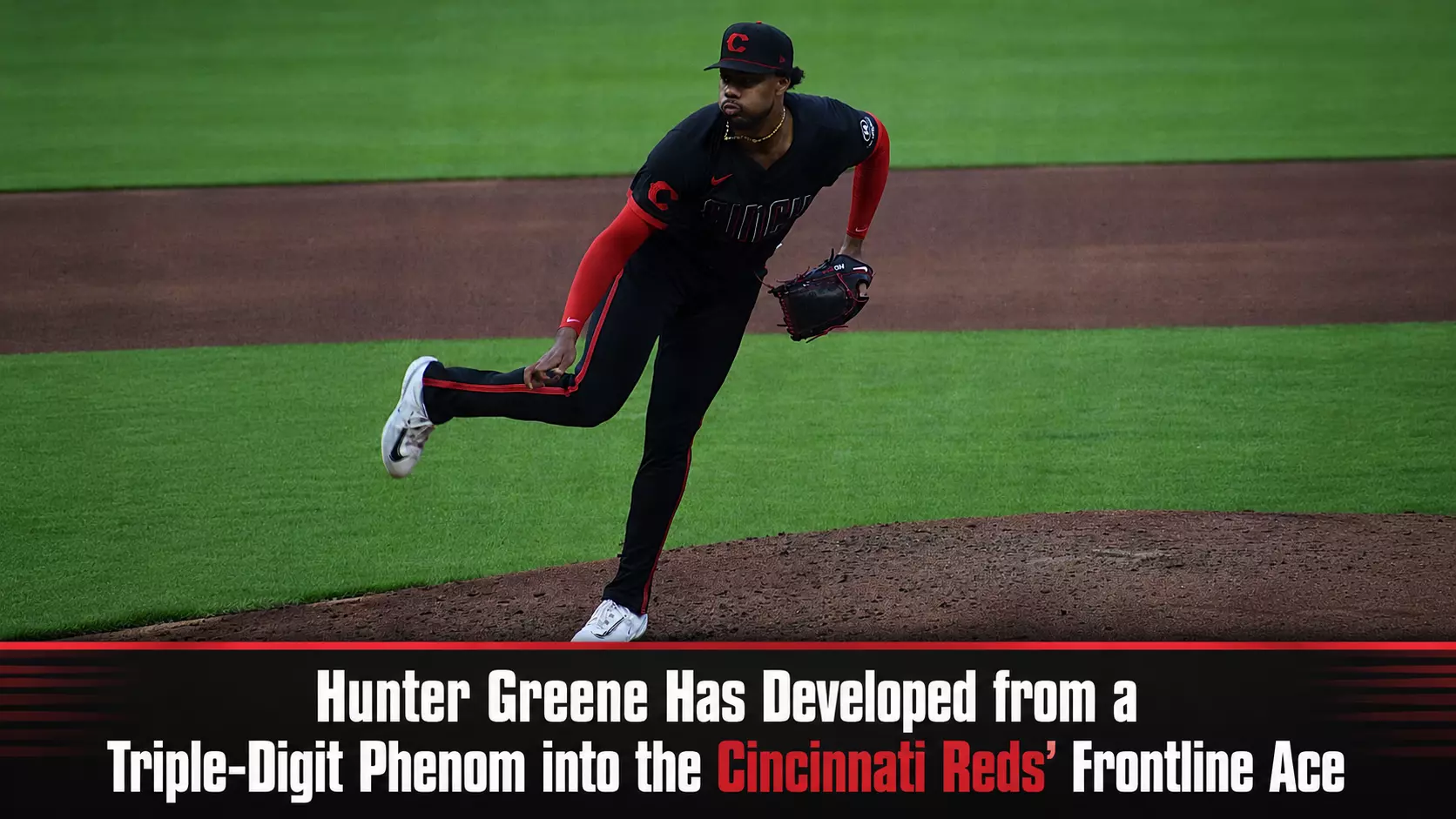
Hunter Greene Has Developed from a Triple-Digit Phenom into the Cincinnati Reds’ Frontline Ace
Hunter Greene has become one of the most important players in the Cincinnati Reds organization, developing from a nationally recognized high school phenomenon into an established Major League ace. His triple-digit fastball made him famous before he entered professional baseball, but Greene’s growth into a complete starting pitcher has required much more than overwhelming velocity.
Through injuries, Tommy John surgery, difficult rookie-season lessons and constant adjustments, Greene has gradually learned how to combine his extraordinary physical gifts with command, movement, sequencing and confidence. When healthy and locating his pitches, he possesses the ability to dominate any lineup in baseball.
Born Christian Hunter Greene on August 6, 1999, in Los Angeles, California, the 6-foot-5, 242-pound right-hander was selected second overall by Cincinnati in the 2017 MLB Draft. Through August 2, 2026, Greene has recorded a 27-31 career record, a 3.82 ERA and 650 strikeouts across 523⅓ innings.
Early Life and Amateur Career
Growing up in Southern California, Greene emerged as one of the most talented two-way baseball players of his generation. He attended Notre Dame High School in Sherman Oaks, where he starred both as a hard-throwing pitcher and a powerful shortstop.
Greene’s high school career demonstrated that he was more than an athlete with an exceptional arm. He posted a 1.62 ERA over 121⅓ innings while striking out approximately 30 percent of the batters he faced. As a senior, Greene went 3-0 with a 0.75 ERA, 43 strikeouts and only four walks in 28 innings.
At shortstop, Greene hit .324 with six home runs, 28 RBIs, six doubles and two triples during his senior season. His athleticism was so impressive that professional scouts believed he could have become a first-round selection as either a
pitcher
or position player.
Before his senior season, Greene received first-team Rawlings-Perfect Game All-America and California All-Region recognition. He also participated in the Perfect Game All-American Classic, the Perfect Game National Showcase and programs at the MLB Youth Academy in Compton.
Greene’s combination of triple-digit velocity, defensive ability and offensive potential made him one of the most celebrated high school prospects in recent baseball history. He became the 13th high school athlete to appear on the cover of
Sports Illustrated
and the first African American high school baseball player from California to receive that distinction.
Scouts were immediately impressed by Greene’s ability to:
Reach and exceed 100 mph with his fastball
Repeat his delivery despite his height and power
Compete as both a pitcher and shortstop
Generate swings and misses against advanced hitters
Demonstrate unusual maturity for a teenage prospect
Rather than attending college, Greene entered professional baseball directly from high school.
MLB Draft and Cincinnati Reds Organization
The Cincinnati Reds selected Greene with the second overall pick in the 2017 MLB Draft. He was widely considered the most talented player in the class, but Cincinnati ultimately decided that his greatest long-term value would come as a starting pitcher.
The Reds envisioned Greene becoming a future rotation cornerstone because of his:
Generational fastball velocity
Athletic delivery
High strikeout potential
Ability to develop quality secondary pitches
Frontline starting-pitcher ceiling
Greene signed with Cincinnati in July 2017 and began his professional career with the Billings Mustangs. He advanced to the Dayton Dragons in 2018 and quickly became one of baseball’s most closely followed prospects.
During the 2018 All-Star Futures Game, Greene threw 19 pitches, and every one of them was measured at 100 mph or faster. His fastball reached 103.1 mph, providing another glimpse of the rare arm talent that had made him a national sensation.
Tommy John Surgery and the Long Road Back
Greene’s rapid progression was interrupted during the 2018 season when he suffered an injury to the ulnar collateral ligament in his right elbow. Cincinnati initially attempted a rehabilitation program, but Greene eventually underwent Tommy John surgery in April 2019.
The surgery eliminated his entire 2019 season. The cancellation of the 2020 Minor League season then prevented him from pitching in official games for a second consecutive year, although he continued his development at Cincinnati’s alternate training site.
Greene finally returned to regular competition in 2021 and quickly reminded the organization why he had been drafted so highly. In seven starts for Double-A Chattanooga, he went 5-0 with a 1.98 ERA, a 1.00 WHIP and 60 strikeouts in 41 innings.
His performance earned him a promotion to Triple-A Louisville, where he experienced more adversity but continued developing his slider, changeup and overall command. Greene finished his Triple-A portion of the 2021 season with a 5-8 record and a 4.13 ERA in 14 starts.
The season represented an important step. Greene was no longer simply attempting to prove that his fastball had survived elbow surgery. He was learning how to become a complete pitcher capable of navigating professional lineups multiple times.
MLB Debut and Early Success
Hunter Greene made his Major League debut for the Cincinnati Reds on April 10, 2022, against the Atlanta Braves.
The velocity immediately attracted attention. Greene reached at least 100 mph on 20 pitches during his debut and recorded seven strikeouts. In his second Major League start, he threw 39 pitches at 100 mph or faster, establishing a pitch-tracking-era record for the most triple-digit pitches by one pitcher in a game.
Greene’s rookie season also demonstrated the challenges of succeeding against Major League hitters. Opponents occasionally took advantage when his fastball remained in the middle of the strike zone, and his reliance on two primary pitches made him vulnerable when his command was inconsistent.
He finished 2022 with a 5-13 record, a 4.44 ERA and 164 strikeouts in 125⅔ innings. Despite the losing record, Greene led the Reds in strikeouts and showed significant improvement during the second half of the season.
Those early struggles taught Greene several important lessons:
Velocity alone cannot consistently retire Major League hitters
Fastball location is as important as fastball speed
Secondary pitches must be trusted in difficult counts
Pitch efficiency determines how deeply a starter can work
Mistakes at Great American Ball Park can quickly become home runs
Development into a Complete Starting Pitcher
Greene continued progressing during the 2023 season, improving the quality of his slider and becoming more comfortable changing speeds. He also began developing greater confidence in his splitter, giving hitters another pitch to consider beneath the strike zone.
In April 2023, the Reds demonstrated their long-term commitment by signing Greene to a six-year, $53 million contract extension through the 2028 season. The agreement includes a $21 million club option for 2029 with a $2 million buyout.
Although a hip injury interrupted his 2023 season, Greene still recorded 152 strikeouts. His ability to miss bats was never in question. The next stage of his development involved staying healthy, limiting damaging contact and converting his raw ability into consistent run prevention.
2024 All-Star Breakthrough
Greene produced the best season of his young career in 2024.
He finished with a 9-5 record, a 2.75 ERA, a 1.02 WHIP and 169 strikeouts over career highs of 26 starts and 150⅓ innings. His performance earned him his first National League All-Star selection and an eighth-place finish in National League Cy Young Award voting.
One of Greene’s most dominant stretches came during July and early August. He produced a 24-inning scoreless streak and repeatedly delivered seven-inning performances while allowing minimal contact.
From July 11 through August 3, Greene became the first Reds pitcher since 1901 to record at least 40 strikeouts while allowing 10 hits or fewer over a five-start stretch. His growth showed that he was becoming more than a radar-gun attraction. He was developing into one of the National League’s most difficult starting pitchers to hit.
Greene’s 2024 success was built around:
Improved fastball location
Greater confidence using his slider
Better execution with two strikes
Fewer pitches in the center of the plate
Increased ability to control innings when runners reached base
Continued Excellence During the 2025 Season
Greene carried his 2024 breakthrough into 2025.
Despite two injured-list stints involving a right groin strain, he went 7-4 with a 2.76 ERA and 132 strikeouts across 107⅔ innings. His 5.08 strikeout-to-walk ratio was the best single-season mark by a Reds pitcher with at least 19 starts since 1900.
Greene also reached several important milestones. He became the fastest Reds pitcher by appearances to reach both 500 and 600 career strikeouts, demonstrating how consistently he had generated swings and misses since entering the majors.
His greatest performance came on September 18, 2025, when he threw a complete-game, one-hit shutout against the Chicago Cubs. Greene carried a no-hitter into the seventh inning, struck out nine and continued throwing above 100 mph in the ninth.
It was his first nine-inning complete-game shutout and the first by a Reds pitcher at Great American Ball Park since Scott Feldman accomplished the feat in 2017.
Greene later made his postseason debut as Cincinnati’s starting pitcher in Game 1 of the National League Wild Card Series against the Los Angeles Dodgers, becoming the youngest Reds pitcher to start a postseason game since Mat Latos in 2012.
2026 Season Snapshot
Greene’s 2026 season began with another physical setback. He underwent arthroscopic surgery on March 11 to remove bone chips from his right elbow and was placed on the 60-day injured list.
After three Minor League rehabilitation starts, Greene returned to Cincinnati’s rotation on July 4. His first appearance was difficult, as he allowed eight earned runs in 3⅓ innings against Baltimore while struggling to control his adrenaline and fastball command.
Six days later, Greene demonstrated his ace-level ceiling against the Chicago Cubs. He struck out 12 batters over seven scoreless innings, allowing only three hits and one walk. His four-seam fastball averaged 99.1 mph, and he threw first-pitch strikes to 19 of the 25 batters he faced.
Through his first five starts of 2026, Greene was 2-2 with a 6.83 ERA, 33 strikeouts and nine walks over 27⅔ innings. The elevated ERA reflected a small and uneven sample following surgery, including his difficult debut and a six-run outing against St. Louis.
In his July 31 start against Pittsburgh, Greene allowed four runs and seven hits over six innings while striking out four. After experiencing trouble in the opening innings, he retired his final six hitters and helped keep Cincinnati close enough to earn an 8-7 comeback victory.
2026 Highlights Through August 2
Returned from elbow surgery on July 4
Produced seven scoreless innings with 12 strikeouts against Chicago
Recorded 33 strikeouts through five starts
Continued averaging approximately 98 mph with his primary fastballs
Completed at least six innings in three consecutive starts from July 19 through July 31
The remainder of Greene’s season will be measured less by his early ERA and more by his health, command and ability to rebuild consistency following the lengthy absence.
Pitching Style and Arsenal
Hunter Greene is one of the hardest-throwing starting pitchers in Major League Baseball, but his arsenal has become more diverse as his career has progressed.
During the opening portion of his 2026 season, Greene used four primary pitches:
Four-Seam Fastball
Greene’s four-seam fastball remains the foundation of his arsenal. He used it approximately 52 percent of the time through his first five starts, averaging 98.3 mph.
At its best, the pitch features elite velocity and strong vertical action. Greene can overpower hitters at the top of the strike zone, especially when he establishes his secondary pitches early.
Slider
The slider is Greene’s primary breaking ball and most important strikeout weapon. He used it approximately 32 percent of the time in his first five 2026 starts, averaging 88.8 mph.
The pitch can generate late, sharp movement beneath the bats of right-handed hitters and away from left-handed hitters. Its effectiveness depends heavily on Greene starting it near the strike zone rather than leaving it over the plate.
Splitter
Greene’s splitter has become an increasingly important part of his development. The pitch averaged approximately 86.9 mph during the opening portion of 2026 and provided a significant speed difference from his fastball.
The splitter gives Greene a weapon against left-handed hitters and helps prevent opponents from sitting exclusively on velocity.
Sinker
Greene has also incorporated a sinker averaging approximately 98.3 mph. The pitch gives hitters a different fastball shape and can produce ground balls when located near the bottom of the strike zone.
Scouting Breakdown
Strengths
Elite Fastball Velocity
Few starting pitchers can maintain Greene’s level of velocity. His ability to reach triple digits deep into games gives him a weapon that can dominate hitters even when they know it is coming.
Strikeout Ability
Greene has recorded 650 strikeouts in his first 523⅓ Major League innings. His combination of fastball velocity and slider movement makes him one of the game’s most dangerous strikeout pitchers.
Athleticism
Greene’s background as an elite shortstop contributes to his body control, fielding ability and capacity to repeat a powerful delivery.
Competitive Mentality
Greene has repeatedly responded to difficult outings with dominant performances. His seven scoreless innings against Chicago immediately following his challenging 2026 debut provided another example.
Frontline-Pitcher Ceiling
When Greene commands his fastball and lands his slider near the strike zone, opposing hitters have few comfortable options. His best performances compare favorably with those of any starter in baseball.
Areas to Improve
Health and Durability
The greatest question surrounding Greene is availability. Shoulder, hip, elbow and groin issues have prevented him from completing a fully healthy Major League season. Establishing consistent 28-to-30-start seasons would significantly increase his value and Cy Young chances.
Fastball Location
Velocity cannot compensate for pitches left in the center of the plate. Greene must continue locating his fastball above the barrel or on the edges rather than allowing hitters to extend their arms.
Slider Consistency
Greene’s slider can be overpowering, but poorly located sliders can produce damaging contact. He must consistently finish the pitch beneath the strike zone.
Pitch Efficiency
Deep counts and extended innings can raise Greene’s pitch total. Getting ahead with first-pitch strikes allows him to use his complete arsenal and work deeper into games.
Secondary-Pitch Development
Continuing to improve his splitter and sinker will make Greene less dependent on his fastball-slider combination and create more favorable matchups against left-handed hitters.
All-Star and Cy Young Potential
Cy Young Outlook
Hunter Greene has already demonstrated that he possesses Cy Young-caliber ability. His 2024 season produced a 2.75 ERA, an All-Star selection and an eighth-place finish in National League Cy Young voting.
To become a serious candidate for the award, Greene will need to combine his dominance with a complete season featuring:
Approximately 28 or more starts
At least 170 to 190 innings
Consistent fastball command
Fewer injury-related interruptions
Stronger prevention of home runs and damaging innings
His strikeout ability gives him the necessary foundation. Durability will likely determine whether he can move from receiving Cy Young votes to competing for the award.
All-Star Status
Greene became a first-time All-Star in 2024 and possesses the talent to earn multiple additional selections.
A healthy Greene can provide dominant innings, elite strikeout totals and memorable performances. His combination of velocity, athleticism and national recognition also makes him one of Cincinnati’s most marketable players.
Future Projection
Hunter Greene remains one of the central figures in Cincinnati’s long-term plans. His contract runs through 2028, with a club option that could keep him with the organization through 2029.
His long-term outlook includes:
Frontline starter for the Cincinnati Reds
Potential multiple-time National League All-Star
Cy Young Award candidate during a healthy season
One of baseball’s leading strikeout pitchers
Postseason Game 1 or Game 2 starter
Veteran leader for Cincinnati’s young rotation
With Greene,
Andrew Abbott,
Chase Burns
and Cincinnati’s other developing
pitchers, the Reds possess the foundation for a potentially powerful rotation. Greene’s experience overcoming injuries and early-career struggles could also make him an important mentor for younger pitchers entering the organization.
Conclusion
Hunter Greene represents one of the most fascinating player-development stories in modern baseball.
He entered professional baseball as a teenage phenomenon capable of throwing more than 100 mph, but his journey has required patience, surgery, rehabilitation and significant pitching adjustments. Greene has learned that becoming an ace requires more than velocity. It requires command, preparation, movement, confidence and the ability to respond when circumstances become difficult.
For the Cincinnati Reds, Greene has developed into much more than a former top prospect. He is an All-Star, a postseason starter and a potential long-term rotation leader.
The remaining question is not whether Greene has enough talent to become one of baseball’s best
pitchers. He has already demonstrated that ability. The question is whether he can remain healthy long enough to sustain it across a complete season.
Should Greene combine durability with the command and dominance he displayed during 2024 and 2025, he has the opportunity to become a perennial All-Star, compete for a Cy Young Award and help lead the Reds into a new era of postseason contention.
New Users – Get $350 in Bonus Bets when you wager $5 for 7 days
T&Cs apply
4.6/5
Gambling Problem? Call 1-800-GAMBLER or 1-800-MY-RESET. Call 1-888-789-7777 or visit ccpgg.org/chat (CT). Hope is here. GamblingHelpLineMA.org or call (800) 327-5050 for 24/7 support (MA). Visit www.mdgamblinghelp.org (MD). Call 1-877-8HOPE-NY or text HOPENY (NY). 21+ (18+ DC, WY) and present in select states (for KS, in affiliation with Kansas Star Casino). Find online real money wagering only. Min $5 wager required for 7 consecutive days. $5 free play credit. Bonus issued as non-withdrawable bonus with cash withdrawable bonus with cash withdrawable. Bonus bets which expire 7 days after receipt. Restrictions apply. See terms at sportsbook.fanduel.com. Call 1-877-770-7867 (LA).
Up To $1500 in Bonus Bets Paid Back if your First Bet Does Not Win
T&Cs apply
4.5/5
Gambling problem? Call 1-800-GAMBLER or 1-800-MY-RESET (Available in the US) 877-8-HOPENY or text HOPENY (467369) (NY) 1-800-327-5050 (MA), 1-800-BETS-OFF (IA), 1-800-981-0023 (PR). 21+ only. Please Gamble Responsibly. See BetMGM.com for Terms. First Bet Offer for new customers only (if applicable). Subject to eligibility requirements. Bonus bets are non-withdrawable. In partnership with Kansas Crossing Casino and Hotel. Promotional offers not available in Mississippi, Massachusetts, New York, Ontario, or Puerto Rico.
New DraftKings Customers: Bet $5, Get $200 + 3 Months of NBA League Pass!
T&Cs apply
4.5/5
GAMBLING PROBLEM? CALL 1-800-GAMBLER or 1-800-MY-RESET, (800) 327-5050 or visit gamblinghelplinema.org (MA). Please Gamble Responsibly. 888-789-7777/visit ccpg.org (CT), or visit www.mdgamblinghelp.org (MD), 1-800-981-0023 (PR). 21+ and present in most states. (18+ DC/NH/PR/WY). Void in CAN. Eligibility restrictions apply. On behalf of Boot Hill Casino (KS). Pass-thru of per wager tax may apply in IL. 1 per new Sportsbook customer. $5+ first-time bet req. Max. $200 issued as non-withdrawable Bonus Bets. Stake removed from payout. Reward issued as $50 in Bonus Bets every 7 days via click-to-claim for 21 days. Bonus Bets and click-to-claims expire 7 days (168hrs) after issuance. Terms: dkng.co/offer. Get 1 promo code to redeem a 3-month NBA League Pass subscription, complimentary of DraftKings. Subscription auto-renews monthly at then-current price (currently $16.99/mo); cancel anytime. Terms, restrictions, and eligibility requirements apply. Redeem League Pass by 12/19/26 at 11:59 PM ET. Addt’l terms: support.watch.nba.com/hc/en-us/articles/9165532876183-League-Pass-Terms-of-Use_. Ends 11/29/26 at 11:59 PM ET. Sponsored by DK.
Must be 21+. GAMBLING PROBLEM? CALL 1-800-GAMBLER OR CALL 1-800-MY-RESET, www.mdgamblinghelp.org (MD), (800)-327-5050 or gamblinghelplinema.org (MA), Call (877)8-HOPENY or text HOPENY (467369) (NY), (888) 789-7777 or ccpg.org (CT), morethanagame.nc.gov (NC), 1800gambler.net (WV)
Bet $1 and get double the winnings up to $25 for your next 10 bets
T&Cs apply
4.4/5
21+ New users only. Must register using eligible promo code. First bet after registration must qualify. Max. Bonus Bet: $1,000. Bonus Bet expires 14 days after receipt. Void where prohibited. See Caesars.com/promos for full terms. Gambling Problem? 1-800-GAMBLER (1-800-426-2537)
21+ and present in OH. Gambling Problem? Call 1-800-GAMBLER.
This site is using
Cloudflare
and adheres to the
Google Safe Browsing Program. We adapted
Google's Privacy Guidelines
to keep your data safe at all times.
Close
Ready to Win Big? Join the Elite with Our Sports Betting Deals!
FanDuel Promo
New Users – Get $350 in Bonus Bets when you wager $5 for 7 days
Our Favorite
T&Cs and 21+ apply
Gambling Problem? Call 1-800-GAMBLER or 1-800-MY-RESET. Call 1-888-789-7777 or visit ccpgg.org/chat (CT). Hope is here. GamblingHelpLineMA.org or call (800) 327-5050 for 24/7 support (MA). Visit www.mdgamblinghelp.org (MD). Call 1-877-8HOPE-NY or text HOPENY (NY). 21+ (18+ DC, WY) and present in select states (for KS, in affiliation with Kansas Star Casino). Find online real money wagering only. Min $5 wager required for 7 consecutive days. $5 free play credit. Bonus issued as non-withdrawable bonus with cash withdrawable bonus with cash withdrawable. Bonus bets which expire 7 days after receipt. Restrictions apply. See terms at sportsbook.fanduel.com. Call 1-877-770-7867 (LA).
Code:
Open FanDuel
Get Bonus
BetMGM Promo
Up To $1500 in Bonus Bets Paid Back if your First Bet Does Not Win
Best Slots
T&Cs and 21+ apply
Gambling problem? Call 1-800-GAMBLER or 1-800-MY-RESET (Available in the US) 877-8-HOPENY or text HOPENY (467369) (NY) 1-800-327-5050 (MA), 1-800-BETS-OFF (IA), 1-800-981-0023 (PR). 21+ only. Please Gamble Responsibly. See BetMGM.com for Terms. First Bet Offer for new customers only (if applicable). Subject to eligibility requirements. Bonus bets are non-withdrawable. In partnership with Kansas Crossing Casino and Hotel. Promotional offers not available in Mississippi, Massachusetts, New York, Ontario, or Puerto Rico.
Code:
Open BetMGM
Get Bonus
DraftKings Promo
New DraftKings Customers: Bet $5, Get $200 + 3 Months of NBA League Pass!
Newcomer
T&Cs and 21+ apply
GAMBLING PROBLEM? CALL 1-800-GAMBLER or 1-800-MY-RESET, (800) 327-5050 or visit gamblinghelplinema.org (MA). Please Gamble Responsibly. 888-789-7777/visit ccpg.org (CT), or visit www.mdgamblinghelp.org (MD), 1-800-981-0023 (PR). 21+ and present in most states. (18+ DC/NH/PR/WY). Void in CAN. Eligibility restrictions apply. On behalf of Boot Hill Casino (KS). Pass-thru of per wager tax may apply in IL. 1 per new Sportsbook customer. $5+ first-time bet req. Max. $200 issued as non-withdrawable Bonus Bets. Stake removed from payout. Reward issued as $50 in Bonus Bets every 7 days via click-to-claim for 21 days. Bonus Bets and click-to-claims expire 7 days (168hrs) after issuance. Terms: dkng.co/offer. Get 1 promo code to redeem a 3-month NBA League Pass subscription, complimentary of DraftKings. Subscription auto-renews monthly at then-current price (currently $16.99/mo); cancel anytime. Terms, restrictions, and eligibility requirements apply. Redeem League Pass by 12/19/26 at 11:59 PM ET. Addt’l terms: support.watch.nba.com/hc/en-us/articles/9165532876183-League-Pass-Terms-of-Use_. Ends 11/29/26 at 11:59 PM ET. Sponsored by DK.
Code:
Open DraftKings
Get Bonus
Find out what the legends have to say about sports this week....
New Users – Get $350 in Bonus Bets when you wager $5 for 7 days
Gambling Problem? Call 1-800-GAMBLER or 1-800-MY-RESET. Call 1-888-789-7777 or visit ccpgg.org/chat (CT). Hope is here. GamblingHelpLineMA.org or call (800) 327-5050 for 24/7 support (MA). Visit www.mdgamblinghelp.org (MD). Call 1-877-8HOPE-NY or text HOPENY (NY). 21+ (18+ DC, WY) and present in select states (for KS, in affiliation with Kansas Star Casino). Find online real money wagering only. Min $5 wager required for 7 consecutive days. $5 free play credit. Bonus issued as non-withdrawable bonus with cash withdrawable bonus with cash withdrawable. Bonus bets which expire 7 days after receipt. Restrictions apply. See terms at sportsbook.fanduel.com. Call 1-877-770-7867 (LA).