Professional Photo Restoration & Upscaling Prompt Enhance and upscale this photograph to a high-quality 8×10 print format at 4K resolution (3840×2160 minimum, higher if needed to maintain print quality). Preserve the exact composition, camera angle, subject proportions, materials, lighting direction, colors, and background of the original image. Improve overall image quality by: Eliminating image noise, grain, and compression artifacts Correcting motion blur while maintaining natural detail Restoring missed focus and improving overall sharpness Enhancing edge definition and fine details Recovering realistic textures, fabric details, skin details, surface grain, and material characteristics Improving contrast and tonal range without overprocessing Increasing clarity while preserving a natural photographic appearance Do not alter facial features, body proportions, object shapes, colors, clothing, background elements, or perspective. Avoid artificial smoothing, oversharpening, halos, artifacts, or AI-generated distortions. Maintain the photograph's original authenticity while producing a clean, professional, print-ready 8×10 image with exceptional sharpness, realistic detail, and natural color fidelity. The final result should look as if it were captured with a high-end professional camera in perfect focus and optimal lighting conditions.
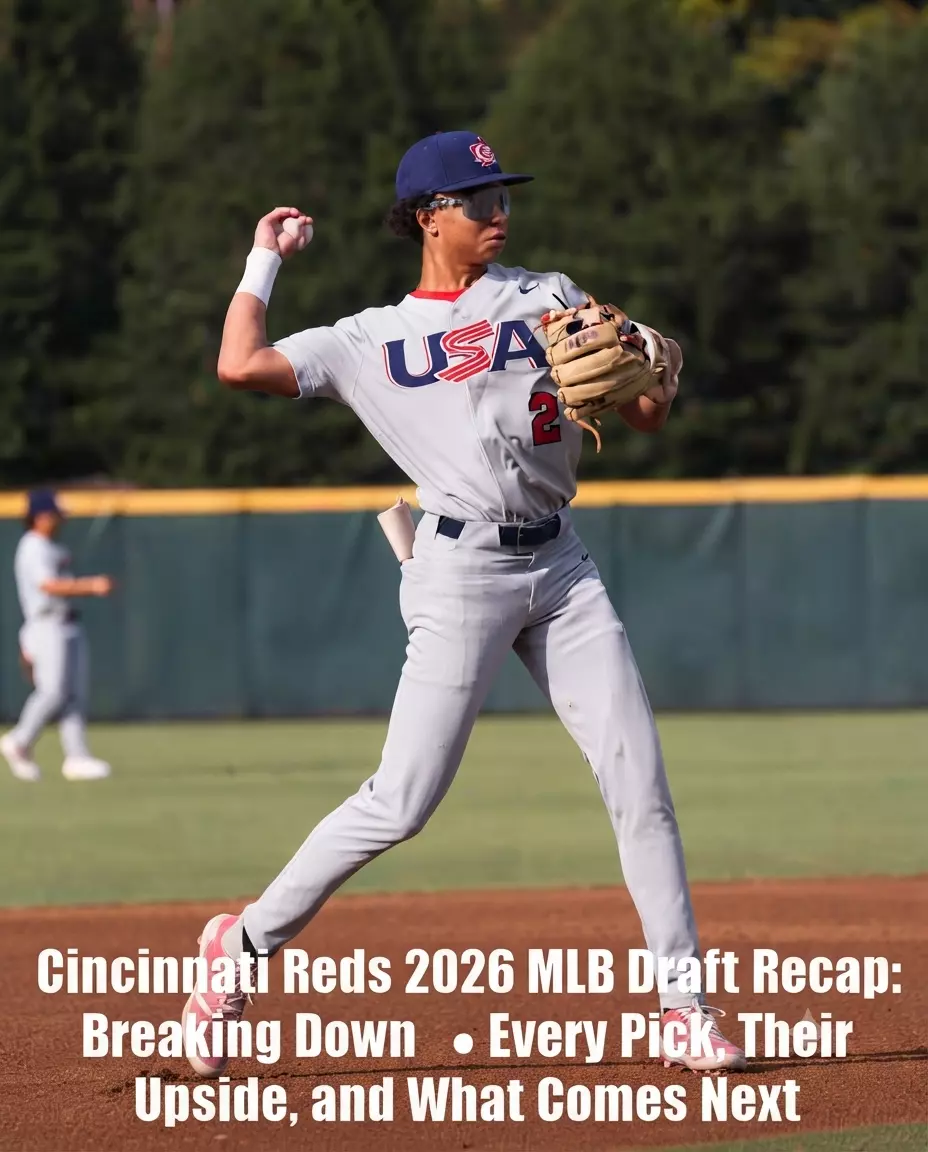
The Cincinnati Reds entered the 2026 MLB Draft with one of the deepest farm systems in baseball, but President of Baseball Operations Nick Krall and his scouting department remained committed to adding the best talent available rather than drafting strictly for organizational need. That philosophy was evident throughout the first two days of the draft, as Cincinnati selected a blend of polished college performers, athletic position players, projectable high school talent, and intriguing pitching prospects.
Here’s a closer look at the Reds’ draft class in order, including each player’s background, why Cincinnati selected them, their ceiling and floor, MLB comparison, and estimated timetable to reach the major leagues.
Round 1 (18th Overall)
Justin Lebron – Shortstop
School:
University of Alabama
The Reds opened the draft by selecting Alabama shortstop Justin Lebron, one of the most complete college position players available. Widely viewed as one of the best pure hitters in the SEC, Lebron combines above-average power with excellent bat speed, athleticism, and defensive versatility.
Why the Reds Drafted Him
Cincinnati has never been afraid to stockpile middle infield talent. Even with Elly De La Cruz established in the majors and several highly regarded infield prospects in the system, the Reds viewed Lebron as the best player on the board. His advanced offensive approach and ability to remain at shortstop made him difficult to pass up.
Ceiling
An All-Star caliber everyday shortstop capable of hitting .280-plus with 25-30 home runs while providing solid defense.
Floor
A quality utility infielder who can play multiple positions while contributing consistent offense.
MLB Comparison
Trea Turner with slightly more power, or a young Carlos Correa offensively.
Estimated MLB Arrival
Late 2028 or sometime during the 2029 season.
Round 2 (58th Overall)
Eric Becker – Shortstop
School:
University of Virginia
Cincinnati doubled down on
athletic middle infielders
by selecting Virginia standout Eric Becker. Becker is known for his baseball IQ, defensive reliability, speed, and contact-oriented offensive approach.
Why the Reds Drafted Him
The Reds value players with defensive versatility and advanced plate discipline. Becker projects as a player capable of moving quickly through the minor leagues while filling multiple defensive roles.
Ceiling
An everyday middle infielder hitting near the top of a lineup.
Floor
A valuable utility player capable of playing second, shortstop, and third base.
MLB Comparison
Tommy Edman or Nico Hoerner.
Estimated MLB Arrival
Competitive Balance Round B (70th Overall)
Sherman Johnson – Right-Handed Pitcher
School:
NC State
Johnson brings a power fastball, quality breaking pitches, and starter potential. His strikeout ability made him one of the more intriguing college arms available.
Why the Reds Drafted Him
The organization continues searching for high-upside pitching to complement an already talented group of young arms. Johnson offers both durability and
swing-and-miss stuff.
Ceiling
No. 2 or No. 3 starting pitcher.
Floor
Late-inning bullpen arm capable of missing bats.
MLB Comparison
Hunter Greene with less velocity but better command, or Brady Singer.
Estimated MLB Arrival
2028-2029.
Day Two Highlights
After addressing premium talent early, Cincinnati focused on adding athletic position players, experienced college pitchers, and several developmental prospects with significant upside. The strategy balanced high-floor selections with players who possess long-term star potential if their tools continue to develop.
Several later-round selections stand out because of their athleticism, versatility, or unique developmental paths.
Jack Lausch – Outfielder/Quarterback
One of the more fascinating picks in the draft, Lausch starred as both a baseball player and quarterback at Northwestern. His athleticism, competitiveness, and upside made him a worthwhile developmental selection despite being relatively raw compared to traditional baseball prospects.
Ceiling:
Athletic fourth outfielder with everyday potential if the bat develops.
Floor:
Organizational depth with defensive value.
MLB Comparison:
Jake Meyers.
Timeline:
2029 or later.
Overall Draft Philosophy
The Reds once again demonstrated their commitment to selecting the best available talent rather than drafting strictly for positional need.
Several themes emerged throughout the class:
Premium athletes
Up-the-middle defenders
Advanced college hitters
Projectable pitching
Players with defensive versatility
High baseball IQ
Rather than chasing immediate organizational holes, Cincinnati continued building long-term depth throughout the system. That approach has helped produce recent homegrown contributors and should keep the pipeline among baseball’s strongest.
Biggest Potential Steal
Justin Lebron has the talent to eventually become one of the best players selected outside the top ten. His combination of hitting ability, athleticism, and defensive value gives him legitimate All-Star potential.
Safest Pick
Eric Becker appears to possess one of the highest floors in the class. Even if his power never fully develops, his defense, instincts, and contact skills should give him an opportunity to reach the major leagues.
Highest Upside
Sherman Johnson could ultimately become one of the draft’s best pitchers if his command continues improving. Power arms with multiple swing-and-miss pitches are always valuable, and Cincinnati has shown an ability to maximize pitching development.
Projected Timeline
2027:
First professional full season for most of the class.
2028:
Becker and Johnson could begin reaching Triple-A.
Late 2028–2029:
Lebron could make his major league debut.
2029–2031:
Much of the class should begin impacting the major league roster.
Final Thoughts
The Reds entered the 2026 MLB Draft looking to strengthen one of baseball’s better farm systems, and they accomplished that objective. By selecting Justin Lebron in the first round and continuing to add athletic position players, quality pitching, and versatile prospects throughout the draft, Cincinnati once again emphasized long-term organizational strength over short-term need.
While it will take several years before the true value of this class is known, the Reds appear to have assembled another group capable of producing future everyday players and major league contributors. If even a handful of these prospects reach their ceilings, this draft could play a significant role in keeping Cincinnati competitive well into the next decade.
Up To $1500 in Bonus Bets Paid Back if your First Bet Does Not Win
T&Cs apply
4.5/5
Gambling problem? Call 1-800-GAMBLER or 1-800-MY-RESET (Available in the US) 877-8-HOPENY or text HOPENY (467369) (NY) 1-800-327-5050 (MA), 1-800-BETS-OFF (IA), 1-800-981-0023 (PR). 21+ only. Please Gamble Responsibly. See BetMGM.com for Terms. First Bet Offer for new customers only (if applicable). Subject to eligibility requirements. Bonus bets are non-withdrawable. In partnership with Kansas Crossing Casino and Hotel. Promotional offers not available in Mississippi, Massachusetts, New York, Ontario, or Puerto Rico.
New DraftKings Customers: Spend $5+ Get $150 in Bonuses
T&Cs apply
4.5/5
GAMBLING PROBLEM? CALL 1-800-GAMBLER or 1-800-MY-RESET, (800) 327-5050 or visit gamblinghelplinema.org (MA). Please Gamble Responsibly. 888-789-7777/visit ccpg.org (CT), or visit www.mdgamblinghelp.org (MD), 1-800-981-0023 (PR). 21+ and present in most states. (18+ DC/NH/PR/WY). Void in CAN. Eligibility restrictions apply. On behalf of Boot Hill Casino (KS). Pass-thru of per wager tax may apply in IL. 1 per new DraftKings customer. $5+ first-time bet req. Max. $150 issued as non-withdrawable Bonus Bets. Stake removed from payout. Reward issued as $50 in Bonus Bets every 7 days via click-to-claim for 14 days. Bonus Bets and click-to-claims expire 7 days (168hrs) after issuance. Terms: sportsbook.draftkings.com/promos. Ends 10/11/26 at 11:59 PM ET. Sponsored by DK.
Must be 21+. GAMBLING PROBLEM? CALL 1-800-GAMBLER OR CALL 1-800-MY-RESET, www.mdgamblinghelp.org (MD), (800)-327-5050 or gamblinghelplinema.org (MA), Call (877)8-HOPENY or text HOPENY (467369) (NY), (888) 789-7777 or ccpg.org (CT), morethanagame.nc.gov (NC), 1800gambler.net (WV)
Bet $1 and get double the winnings up to $25 for your next 10 bets
T&Cs apply
4.4/5
21+ New users only. Must register using eligible promo code. First bet after registration must qualify. Max. Bonus Bet: $1,000. Bonus Bet expires 14 days after receipt. Void where prohibited. See Caesars.com/promos for full terms. Gambling Problem? 1-800-GAMBLER (1-800-426-2537)
21+ and present in OH. Gambling Problem? Call 1-800-GAMBLER.
This site is using
Cloudflare
and adheres to the
Google Safe Browsing Program. We adapted
Google's Privacy Guidelines
to keep your data safe at all times.
Close
Ready to Win Big? Join the Elite with Our Sports Betting Deals!
FanDuel Promo
New Users – Get $250 in Bonus Bets when you wager $5 for 5 days
Up To $1500 in Bonus Bets Paid Back if your First Bet Does Not Win
Best Slots
T&Cs and 21+ apply
Gambling problem? Call 1-800-GAMBLER or 1-800-MY-RESET (Available in the US) 877-8-HOPENY or text HOPENY (467369) (NY) 1-800-327-5050 (MA), 1-800-BETS-OFF (IA), 1-800-981-0023 (PR). 21+ only. Please Gamble Responsibly. See BetMGM.com for Terms. First Bet Offer for new customers only (if applicable). Subject to eligibility requirements. Bonus bets are non-withdrawable. In partnership with Kansas Crossing Casino and Hotel. Promotional offers not available in Mississippi, Massachusetts, New York, Ontario, or Puerto Rico.
Code:
Open BetMGM
Get Bonus
DraftKings Promo
New DraftKings Customers: Spend $5+ Get $150 in Bonuses
Newcomer
T&Cs and 21+ apply
GAMBLING PROBLEM? CALL 1-800-GAMBLER or 1-800-MY-RESET, (800) 327-5050 or visit gamblinghelplinema.org (MA). Please Gamble Responsibly. 888-789-7777/visit ccpg.org (CT), or visit www.mdgamblinghelp.org (MD), 1-800-981-0023 (PR). 21+ and present in most states. (18+ DC/NH/PR/WY). Void in CAN. Eligibility restrictions apply. On behalf of Boot Hill Casino (KS). Pass-thru of per wager tax may apply in IL. 1 per new DraftKings customer. $5+ first-time bet req. Max. $150 issued as non-withdrawable Bonus Bets. Stake removed from payout. Reward issued as $50 in Bonus Bets every 7 days via click-to-claim for 14 days. Bonus Bets and click-to-claims expire 7 days (168hrs) after issuance. Terms: sportsbook.draftkings.com/promos. Ends 10/11/26 at 11:59 PM ET. Sponsored by DK.
Code:
Open DraftKings
Get Bonus
Find out what the legends have to say about sports this week....