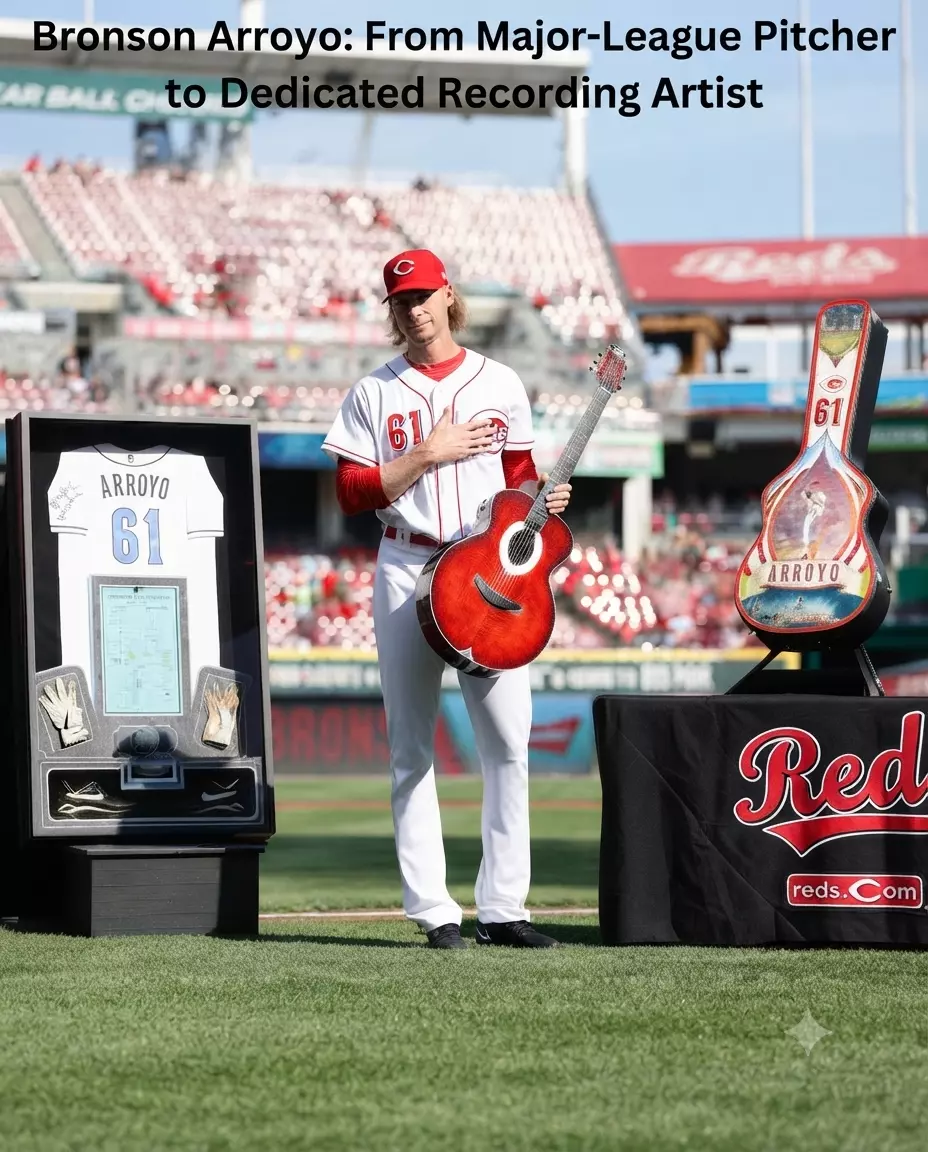
Bronson Arroyo: From Major-League Pitcher to Dedicated Recording Artist
Bronson Arroyo will always be remembered by baseball fans for his towering leg kick, remarkable durability and unforgettable years with the Boston Red Sox and Cincinnati Reds. However, Arroyo’s identity has never been limited to the pitcher’s mound.
Behind the baseball uniform was a musician who carried a guitar through minor-league bus rides, major-league clubhouses, championship seasons, injuries and retirement. What began as a way to pass the time during a long baseball schedule eventually became a serious creative pursuit involving studio albums, original songwriting, festival appearances and performances with some of the musicians who inspired him.
Arroyo’s musical journey is not simply the story of a famous athlete experimenting with a second career. It is the story of a self-taught guitarist who continued learning, performing and writing long after he had already reached the highest level of professional sports.
Growing Up in a Musical Family
Music was part of Arroyo’s life long before he learned to play guitar.
His father sang and performed in bands, while his mother and sister played piano. His grandmother also worked as a music teacher in Key West, Florida. Arroyo therefore grew up in a family where music was regularly played, discussed and appreciated.
The soundtrack of his childhood included artists such as the Beatles, the Mamas & the Papas, Elton John and Billy Joel. Those performers introduced him to strong melodies, memorable choruses and songs capable of telling meaningful stories.
As Arroyo grew older, his musical interests shifted toward the alternative-rock and grunge movement of the 1990s. Pearl Jam, Stone Temple Pilots, Soundgarden and Alice in Chains became major influences. He was also drawn to Oasis, Live, Creed, Bush and other bands whose music combined emotional lyrics with powerful guitars.
Those artists would eventually shape the songs he learned, the covers he performed and the original music he later created.
Learning Guitar in the Minor Leagues
Arroyo did not begin seriously learning guitar as a child. His musical education began after he had already entered professional baseball.
In 1999, while pitching for the Double-A Altoona Curve in the Pittsburgh Pirates organization, Arroyo received an acoustic Yamaha guitar. He was approximately 22 years old and quickly became absorbed in learning how to play it.
Rather than studying through traditional lessons, Arroyo largely taught himself. He used guitar tablature, repeated chord patterns and attempted to recreate songs by the bands he admired. He learned through experimentation, repetition and persistence.
The lifestyle of a minor-league player gave him plenty of opportunities to practice. Long bus rides, hotel stays, rain delays and hours spent waiting at the ballpark became part of his musical classroom.
The guitar gave Arroyo a creative escape from baseball. Pitching was structured, competitive and measured through statistics. Music allowed him to explore ideas without worrying about wins, losses or earned run averages.
By the time he reached the Boston Red Sox organization, Arroyo was regularly playing guitar in clubhouses and training rooms. Teammates became some of his earliest audiences and occasional collaborators.
Building Confidence as a Performer
Arroyo’s earliest performances were informal. He played for teammates, friends and small groups before beginning to appear at public events.
One of the most important opportunities came through Hot Stove Cool Music, a charitable event associated with respected baseball journalist and musician Peter Gammons. Arroyo performed at Boston’s Paradise Rock Club and began meeting experienced musicians who would later become important collaborators.
The performance helped introduce him to the Boston music community. It also showed Arroyo that audiences might accept his music as more than an amusing side project from a professional athlete.
As his baseball profile increased, so did interest in his performances. During one off-day concert in Portland, Maine, Arroyo reportedly attracted approximately 5,000 people.
That popularity created a difficult balance. Baseball remained his profession and primary responsibility, while music was becoming increasingly visible. The Red Sox wanted to make sure his outside performances did not interfere with his preparation or recovery.
Arroyo respected those concerns, but he never stopped playing. He continued practicing, recording and performing whenever his schedule allowed.
His Major Musical Influences
Pearl Jam became one of the most important influences on Arroyo’s musical identity.
He admired the band’s emotional honesty, musical intensity and ability to connect with large audiences without losing its authenticity. He frequently performed Pearl Jam songs and included “Black” on his first album.
Stone Temple Pilots, Soundgarden and Alice in Chains influenced his appreciation for heavier guitar sounds, unusual vocal styles and darker lyrical themes. Oasis, Live, Creed and Bush were also among the artists whose songs helped him learn the instrument.
Arroyo’s later original music expanded beyond 1990s alternative rock. His recordings also contain elements of folk, country, heartland rock and singer-songwriter storytelling. Influences reminiscent of Tom Petty and other narrative-focused artists can be heard throughout his post-baseball work.
Rather than limiting himself to one category, Arroyo has allowed individual songs to determine their own sound. That freedom has enabled him to move from distorted rock guitars to quieter acoustic material without abandoning his musical personality.
Covering the Bases
Arroyo released his first album,
Covering the Bases, in 2005 while pitching for the Boston Red Sox.
The title connected his two worlds, but the project was more than a baseball-themed novelty. It was a collection of songs that had influenced Arroyo and helped him develop as a musician.
The album included his versions of songs associated with artists such as Pearl Jam, Alice in Chains, Foo Fighters, Stone Temple Pilots, Incubus, Fuel, the Goo Goo Dolls, the Verve Pipe, Toad the Wet Sprocket and Vertical Horizon.
Among the tracks were:
“Slide”
“Down in a Hole”
“The Freshmen”
“Everlong”
“Black”
“Pardon Me”
“Plush”
“Shimmer”
“Hunger Strike”
“Best I Ever Had”
“Dirty Water”
The project featured accomplished studio musicians, including drummer Kenny Aronoff, bassist Leland Sklar, Alice in Chains bassist Mike Inez and guitarists Michael Landau and Tim Pierce.
Several Red Sox personalities also became involved. Johnny Damon, Kevin Youkilis and Lenny DiNardo contributed, while Red Sox executive Theo Epstein participated as well. Author Stephen King provided spoken-word material connected to Arroyo’s version of “Everlong.”
The album reached No. 123 on the Billboard 200 and rose to No. 2 on the Heatseekers Albums chart. It reportedly reached the top position on Billboard’s Northeast regional Heatseekers ranking.
For a first recording from an active professional athlete, the album achieved meaningful commercial recognition. More importantly, it showed that Arroyo was capable of working with respected musicians in a professional studio environment.
Performing With Pearl Jam at Fenway Park
One of the defining moments of Arroyo’s musical life occurred in August 2016 when he joined Pearl Jam onstage at Fenway Park.
Arroyo played guitar and sang backing vocals during “Black,” one of Pearl Jam’s most celebrated songs and a track he had covered on
Covering the Bases.
The performance brought together several important parts of his life.
Pearl Jam was one of the bands that inspired him to learn guitar. Fenway Park was the ballpark where he had played for the Red Sox and become a World Series champion. “Black” was one of the songs that had accompanied him during his musical development.
For Arroyo, the performance represented more than a celebrity appearance. It was an opportunity to share the stage with one of his musical heroes in a place that had already played a central role in his baseball career.
He later described it as one of the greatest experiences of his life.
Other Musical Collaborations
Arroyo has performed and recorded with a wide range of musicians and fellow athletes.
He sang backing vocals on the Dropkick Murphys’ version of “Tessie,” a song closely connected to the 2004 Red Sox championship season. Johnny Damon and Lenny DiNardo also participated.
Arroyo has played music with several professional baseball players who developed serious musical interests, including:
Barry Zito
Bernie Williams
Jake Peavy
Mark Trumbo
Aaron Hill
A.J. Pollock
Rubby De La Rosa
He has also encouraged or helped other players learn guitar. For Arroyo, music became a way for athletes to build friendships beyond competition.
A pitcher and hitter might be opponents during a game, but they could become collaborators once they began discussing songs, chords and instruments.
The Bronson Arroyo Band
The Bronson Arroyo Band became the primary vehicle for many of Arroyo’s live performances.
The group has frequently performed alternative-rock covers, including songs from the 1990s that originally inspired Arroyo to become a guitarist. Its shows have also included material associated with Tom Petty, the Lumineers and other rock and folk performers.
Published versions of the band’s lineup have featured Arroyo on lead vocals and guitar alongside musicians such as Steven Bucknell, Chuck Davis, Dave Becknell and Jamie Combs.
The exact lineup can vary depending on the event and location. The Bronson Arroyo Band is best understood as Arroyo’s live-performance group, particularly for cover shows, festivals, charitable appearances and baseball-related celebrations.
The band has helped him connect with audiences who may have first attended because of his baseball career but left with a greater appreciation for his commitment to music.
Bronson Arroyo & The ’04
Arroyo’s original-rock project became known as Bronson Arroyo & The ’04.
The name references the 2004 Boston Red Sox, the championship team that made baseball history by overcoming a three-games-to-none deficit against the New York Yankees before winning the World Series.
The group’s principal lineup has included:
Bronson Arroyo on vocals, guitar and songwriting
Jamie Arentzen on guitar
Ed Valauskas on bass
Clint Walsh on guitar
Eric Gardner on drums
The musicians brought significant professional experience from their work with established recording and touring artists.
The ’04 was not assembled simply to support a retired athlete. Arroyo treated the project as a genuine collaborative band. Members contributed to arrangements, production choices and the overall direction of the music.
That collaborative spirit became central to Arroyo’s first album of original songs.
Some Might Say
Released in 2023,
Some Might Say
marked an important turning point in Arroyo’s musical career.
Unlike
Covering the Bases, the album featured original material. It introduced him not only as a singer and guitarist but also as a songwriter with his own ideas and experiences to communicate.
The album included 10 tracks:
“Full Moon Fever”
“Guerilla Warfare”
“Some Might Say”
“Side FX”
“Higher Ground”
“Own Your Name”
“Hard Way”
“Never Let You Go”
“Nights Alive”
“Afterlife”
Arroyo reportedly wrote approximately 24 songs during the project’s development. The band recorded 13 before choosing 10 for the finished album.
The record maintained Arroyo’s alternative-rock foundation while incorporating other influences. Some songs featured heavier guitars, while others leaned toward folk, country or heartland rock.
The material explored themes such as identity, mortality, relationships and the importance of living fully in the present.
Those subjects carried special meaning for Arroyo. By the time the album was released, he had experienced the end of a long baseball career, major surgery, retirement and the transition into a completely different stage of life.
The album was not an attempt to recreate his days as a major-league celebrity. It was an effort to capture the sound of a real band playing original music together.
Life Lessons
Arroyo continued developing as a songwriter with the release of
Life Lessons
in 2024.
The album moved further away from the louder alternative-rock sound of his earlier work and leaned more heavily into folk and acoustic storytelling.
Its eight songs included:
“Lucky Pennies”
“Street Fight”
“Just a Tree”
“Skate”
“This Kind of Love”
“Why’d You Have to Go and Break Her Heart?”
“So I’ll Beg”
“The One That Cheated”
The project focused on personal memories, relationships and experiences whose meaning became clearer over time.
Where
Covering the Bases
revealed Arroyo’s musical influences and
Some Might Say
introduced his original rock material,
Life Lessons
presented him as a reflective storyteller.
The album demonstrated that Arroyo was not interested in making the same record repeatedly. He wanted his music to evolve as his life changed.
Raw Confessions
Arroyo continued that more personal direction with
Raw Confessions, released in 2025.
The eight-track project included:
“If You Will I Will”
“1943”
“You Don’t Want Love”
“End of the Stars”
“Darlin Darlin”
“Cowboys & Indians”
“Reason to Live”
“I Want You to Know”
Like
Life Lessons, the album emphasized storytelling, vulnerability and emotional honesty.
The title reflected Arroyo’s willingness to reveal parts of himself that were never visible through baseball statistics. The songs explored relationships, memories, love, loss and reflection.
His later recordings show a musician becoming increasingly comfortable with simplicity. Instead of relying only on large rock arrangements, Arroyo began allowing lyrics, melodies and personal stories to carry the songs.
Musical Success and Accomplishments
Comparing music with baseball can be difficult because the two industries measure achievement differently.
Baseball provides exact statistics for victories, strikeouts and innings pitched. Music is often measured through album sales, chart rankings, audience reaction, artistic growth and longevity.
Performing at professional ballparks and respected music venues
Participating in charitable concerts
Recording with accomplished touring and studio musicians
Developing from a cover artist into an original songwriter
Competing as Sherlock Hound on
The Masked Singer
His career as a musician has now extended across multiple decades. That longevity separates his work from the many short-lived musical projects attempted by athletes and celebrities.
Places Arroyo Has Performed
Arroyo has performed in venues ranging from small clubs to major-league ballparks.
Some of his most notable stages and events have included:
Fenway Park in Boston
Great American Ball Park in Cincinnati
Paradise Rock Club in Boston
Boston’s Symphony Hall
Redsfest
The Innings Festival in Tempe, Arizona
Charitable events connected to baseball and community organizations
Clubs, restaurants and regional festivals throughout the country
Music also became an important part of Arroyo’s farewell from professional baseball.
During “Kickin’ It with Bronson” night at Great American Ball Park in 2017, Arroyo performed an on-field concert as the Reds and their fans celebrated his career.
The event was a fitting reflection of his personality. Baseball and music were not competing identities. They were two important parts of the same person.
Giving Back Through Music
Arroyo has frequently used music to support charitable causes.
His performances have benefited organizations including the Reds Community Fund and Homes for Our Troops. One concert involving Arroyo, Raquel Aurilia and the Screaming Mimes reportedly raised approximately $35,000 for the Reds Community Fund.
He also became a regular musical presence at Redsfest, giving Cincinnati fans another opportunity to connect with him away from the mound.
These appearances showed that Arroyo understood the platform baseball had given him. Music provided another way to entertain fans, support communities and raise money for worthwhile causes.
The Connection Between Pitching and Performing
Pitching and music may appear unrelated, but Arroyo has demonstrated that they share important qualities.
Both depend on rhythm.
A pitcher must repeat his delivery while changing speeds and responding to the situation. A musician must remain inside the rhythm of a song while reacting to bandmates and the audience.
Both also require preparation and improvisation.
Arroyo could study hitters and develop a game plan, but he still had to adjust once the game began. A band can rehearse a song repeatedly, but every live performance carries its own energy and unexpected moments.
Pitching and performing also require the ability to recover from mistakes. A pitcher must move forward after allowing a home run. A musician must continue after missing a note.
Perhaps most importantly, both require the confidence to perform in front of an audience.
Arroyo spent years standing alone on a major-league mound while thousands of people watched. That experience helped prepare him for the vulnerability of standing onstage with a guitar and microphone.
Arroyo’s Musical Goals
Arroyo has consistently emphasized authenticity.
He does not want his recordings to be viewed simply as projects made possible by a famous baseball name. He wants listeners to recognize the hours of practice, songwriting and collaboration behind the music.
One of his goals has been to develop his original songs well enough to perform them both with a full band and alone with an acoustic guitar.
Solo acoustic performances give him the opportunity to explain the stories behind his songs and create a more personal connection with smaller audiences.
He has also expressed interest in continuing to perform selected festivals and events when the schedules of his band members allow.
The consecutive release of original projects demonstrates that Arroyo views music as an ongoing creative career. He is not attempting to compete with his baseball legacy. Instead, he is building a separate body of work that reflects a different side of his personality.
More Than a Baseball Player With a Guitar
Bronson Arroyo’s musical story is compelling because he was willing to become a beginner after already reaching the top of another profession.
As a major-league pitcher, he was a World Series champion, an All-Star, a Gold Glove winner and a
Cincinnati Reds
Hall of Famer.
Music required him to start again.
He had to learn chords, develop his voice, understand recording studios, write lyrics and accept criticism in a field where his baseball accomplishments offered no guarantee of success.
That willingness to remain vulnerable is one of his most admirable qualities.
Arroyo could have limited his musical life to playing familiar songs at charity events. Instead, he challenged himself to write original material and reveal personal stories through his lyrics.
His development from
Covering the Bases
to
Some Might Say,
Life Lessons
and
Raw Confessions
reflects the journey of an artist continuing to search for his own voice.
Conclusion
Bronson Arroyo’s musical journey began with an acoustic guitar during a Double-A baseball season.
He taught himself to play by studying the songs of Pearl Jam, Stone Temple Pilots, Soundgarden, Oasis and other artists who inspired him. The guitar traveled with him through the minor leagues, major-league clubhouses, a World Series championship and a celebrated career with the
Cincinnati Reds.
Over time, Arroyo moved from clubhouse performances to public concerts, professional recording sessions and appearances at major venues. He released a nationally charting cover album, performed with Pearl Jam at Fenway Park and developed an original band featuring experienced professional musicians.
His later albums revealed a more reflective artist interested in memory, relationships, mortality and the lessons that emerge over a lifetime.
Baseball allowed Arroyo to compete, perform and connect with millions of fans. Music has given him a different kind of freedom—the opportunity to tell stories without a scoreboard.
Bronson Arroyo should not be viewed merely as a former baseball player who enjoys music. He is a committed musician who has continued studying, recording and performing for more than two decades.
His baseball career made him famous. His music reveals who he is when the stadium lights fade, the game ends and only the song remains.
New Users – Get $350 in Bonus Bets when you wager $5 for 7 days
T&Cs apply
4.6/5
Gambling Problem? Call 1-800-GAMBLER or 1-800-MY-RESET. Call 1-888-789-7777 or visit ccpgg.org/chat (CT). Hope is here. GamblingHelpLineMA.org or call (800) 327-5050 for 24/7 support (MA). Visit www.mdgamblinghelp.org (MD). Call 1-877-8HOPE-NY or text HOPENY (NY). 21+ (18+ DC, WY) and present in select states (for KS, in affiliation with Kansas Star Casino). Find online real money wagering only. Min $5 wager required for 7 consecutive days. $5 free play credit. Bonus issued as non-withdrawable bonus with cash withdrawable bonus with cash withdrawable. Bonus bets which expire 7 days after receipt. Restrictions apply. See terms at sportsbook.fanduel.com. Call 1-877-770-7867 (LA).
Up To $1500 in Bonus Bets Paid Back if your First Bet Does Not Win
T&Cs apply
4.5/5
Gambling problem? Call 1-800-GAMBLER or 1-800-MY-RESET (Available in the US) 877-8-HOPENY or text HOPENY (467369) (NY) 1-800-327-5050 (MA), 1-800-BETS-OFF (IA), 1-800-981-0023 (PR). 21+ only. Please Gamble Responsibly. See BetMGM.com for Terms. First Bet Offer for new customers only (if applicable). Subject to eligibility requirements. Bonus bets are non-withdrawable. In partnership with Kansas Crossing Casino and Hotel. Promotional offers not available in Mississippi, Massachusetts, New York, Ontario, or Puerto Rico.
New DraftKings Customers: Bet $5, Get $200 + 3 Months of NBA League Pass!
T&Cs apply
4.5/5
GAMBLING PROBLEM? CALL 1-800-GAMBLER or 1-800-MY-RESET, (800) 327-5050 or visit gamblinghelplinema.org (MA). Please Gamble Responsibly. 888-789-7777/visit ccpg.org (CT), or visit www.mdgamblinghelp.org (MD), 1-800-981-0023 (PR). 21+ and present in most states. (18+ DC/NH/PR/WY). Void in CAN. Eligibility restrictions apply. On behalf of Boot Hill Casino (KS). Pass-thru of per wager tax may apply in IL. 1 per new Sportsbook customer. $5+ first-time bet req. Max. $200 issued as non-withdrawable Bonus Bets. Stake removed from payout. Reward issued as $50 in Bonus Bets every 7 days via click-to-claim for 21 days. Bonus Bets and click-to-claims expire 7 days (168hrs) after issuance. Terms: dkng.co/offer. Get 1 promo code to redeem a 3-month NBA League Pass subscription, complimentary of DraftKings. Subscription auto-renews monthly at then-current price (currently $16.99/mo); cancel anytime. Terms, restrictions, and eligibility requirements apply. Redeem League Pass by 12/19/26 at 11:59 PM ET. Addt’l terms: support.watch.nba.com/hc/en-us/articles/9165532876183-League-Pass-Terms-of-Use_. Ends 11/29/26 at 11:59 PM ET. Sponsored by DK.
Must be 21+. GAMBLING PROBLEM? CALL 1-800-GAMBLER OR CALL 1-800-MY-RESET, www.mdgamblinghelp.org (MD), (800)-327-5050 or gamblinghelplinema.org (MA), Call (877)8-HOPENY or text HOPENY (467369) (NY), (888) 789-7777 or ccpg.org (CT), morethanagame.nc.gov (NC), 1800gambler.net (WV)
Bet $1 and get double the winnings up to $25 for your next 10 bets
T&Cs apply
4.4/5
21+ New users only. Must register using eligible promo code. First bet after registration must qualify. Max. Bonus Bet: $1,000. Bonus Bet expires 14 days after receipt. Void where prohibited. See Caesars.com/promos for full terms. Gambling Problem? 1-800-GAMBLER (1-800-426-2537)
21+ and present in OH. Gambling Problem? Call 1-800-GAMBLER.
This site is using
Cloudflare
and adheres to the
Google Safe Browsing Program. We adapted
Google's Privacy Guidelines
to keep your data safe at all times.
Close
Ready to Win Big? Join the Elite with Our Sports Betting Deals!
FanDuel Promo
New Users – Get $350 in Bonus Bets when you wager $5 for 7 days
Our Favorite
T&Cs and 21+ apply
Gambling Problem? Call 1-800-GAMBLER or 1-800-MY-RESET. Call 1-888-789-7777 or visit ccpgg.org/chat (CT). Hope is here. GamblingHelpLineMA.org or call (800) 327-5050 for 24/7 support (MA). Visit www.mdgamblinghelp.org (MD). Call 1-877-8HOPE-NY or text HOPENY (NY). 21+ (18+ DC, WY) and present in select states (for KS, in affiliation with Kansas Star Casino). Find online real money wagering only. Min $5 wager required for 7 consecutive days. $5 free play credit. Bonus issued as non-withdrawable bonus with cash withdrawable bonus with cash withdrawable. Bonus bets which expire 7 days after receipt. Restrictions apply. See terms at sportsbook.fanduel.com. Call 1-877-770-7867 (LA).
Code:
Open FanDuel
Get Bonus
BetMGM Promo
Up To $1500 in Bonus Bets Paid Back if your First Bet Does Not Win
Best Slots
T&Cs and 21+ apply
Gambling problem? Call 1-800-GAMBLER or 1-800-MY-RESET (Available in the US) 877-8-HOPENY or text HOPENY (467369) (NY) 1-800-327-5050 (MA), 1-800-BETS-OFF (IA), 1-800-981-0023 (PR). 21+ only. Please Gamble Responsibly. See BetMGM.com for Terms. First Bet Offer for new customers only (if applicable). Subject to eligibility requirements. Bonus bets are non-withdrawable. In partnership with Kansas Crossing Casino and Hotel. Promotional offers not available in Mississippi, Massachusetts, New York, Ontario, or Puerto Rico.
Code:
Open BetMGM
Get Bonus
DraftKings Promo
New DraftKings Customers: Bet $5, Get $200 + 3 Months of NBA League Pass!
Newcomer
T&Cs and 21+ apply
GAMBLING PROBLEM? CALL 1-800-GAMBLER or 1-800-MY-RESET, (800) 327-5050 or visit gamblinghelplinema.org (MA). Please Gamble Responsibly. 888-789-7777/visit ccpg.org (CT), or visit www.mdgamblinghelp.org (MD), 1-800-981-0023 (PR). 21+ and present in most states. (18+ DC/NH/PR/WY). Void in CAN. Eligibility restrictions apply. On behalf of Boot Hill Casino (KS). Pass-thru of per wager tax may apply in IL. 1 per new Sportsbook customer. $5+ first-time bet req. Max. $200 issued as non-withdrawable Bonus Bets. Stake removed from payout. Reward issued as $50 in Bonus Bets every 7 days via click-to-claim for 21 days. Bonus Bets and click-to-claims expire 7 days (168hrs) after issuance. Terms: dkng.co/offer. Get 1 promo code to redeem a 3-month NBA League Pass subscription, complimentary of DraftKings. Subscription auto-renews monthly at then-current price (currently $16.99/mo); cancel anytime. Terms, restrictions, and eligibility requirements apply. Redeem League Pass by 12/19/26 at 11:59 PM ET. Addt’l terms: support.watch.nba.com/hc/en-us/articles/9165532876183-League-Pass-Terms-of-Use_. Ends 11/29/26 at 11:59 PM ET. Sponsored by DK.
Code:
Open DraftKings
Get Bonus
Find out what the legends have to say about sports this week....
New Users – Get $350 in Bonus Bets when you wager $5 for 7 days
Gambling Problem? Call 1-800-GAMBLER or 1-800-MY-RESET. Call 1-888-789-7777 or visit ccpgg.org/chat (CT). Hope is here. GamblingHelpLineMA.org or call (800) 327-5050 for 24/7 support (MA). Visit www.mdgamblinghelp.org (MD). Call 1-877-8HOPE-NY or text HOPENY (NY). 21+ (18+ DC, WY) and present in select states (for KS, in affiliation with Kansas Star Casino). Find online real money wagering only. Min $5 wager required for 7 consecutive days. $5 free play credit. Bonus issued as non-withdrawable bonus with cash withdrawable bonus with cash withdrawable. Bonus bets which expire 7 days after receipt. Restrictions apply. See terms at sportsbook.fanduel.com. Call 1-877-770-7867 (LA).