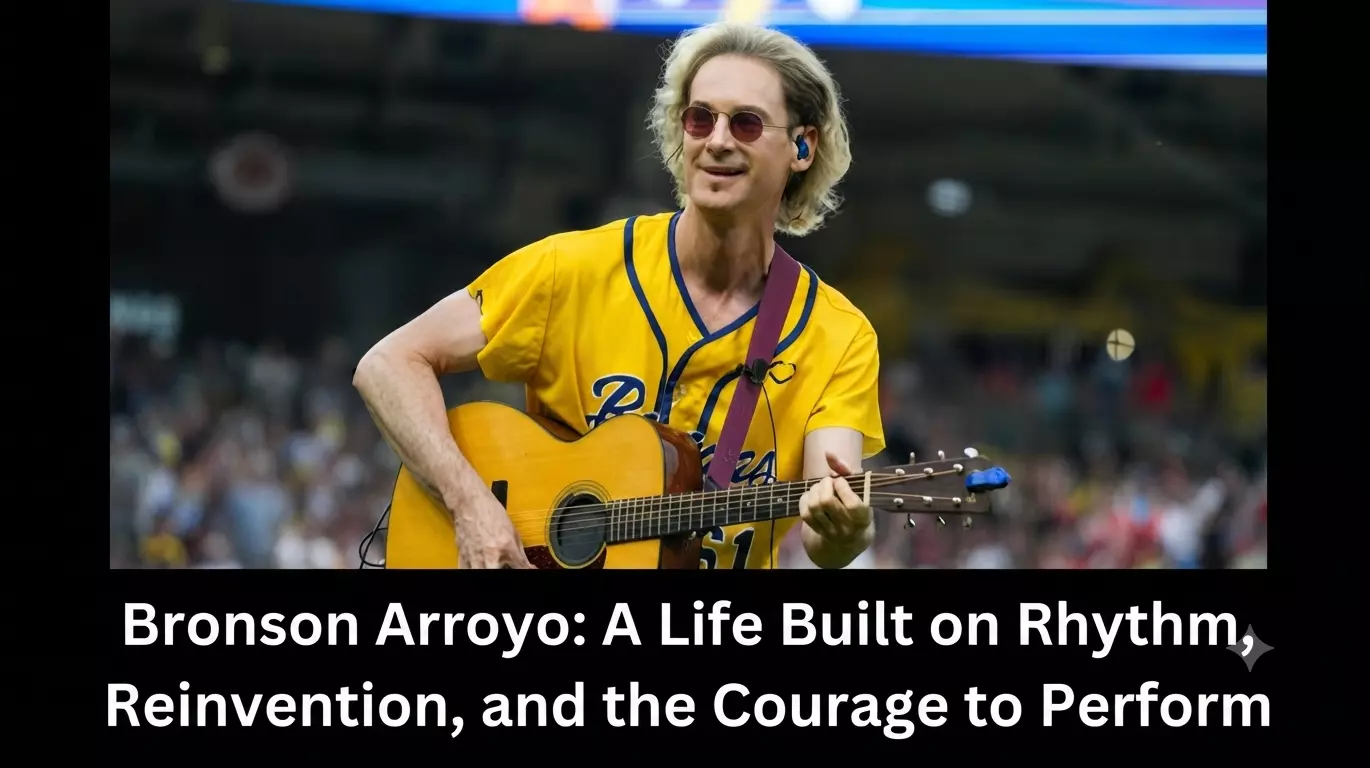
Bronson Arroyo: A Life Built on Rhythm, Reinvention, and the Courage to Perform
Bronson Arroyo has spent most of his life performing in front of crowds.
Sometimes he stood alone on a pitcher’s mound, studying a hitter while thousands of people waited for his next move. Other times he stood behind a microphone with a guitar in his hands, asking an audience to listen to something more personal.
Baseball and music may appear to belong to completely different worlds, but in Arroyo’s life they have always been connected. Both require rhythm, preparation, confidence, improvisation, and the ability to recover when something goes wrong. Both demand repetition without allowing the performance to become mechanical. Most importantly, both require the courage to reveal who you are while people are watching.
Arroyo became a World Series champion, an All-Star, a Gold Glove winner, and a Cincinnati Reds Hall of Famer. He also became a recording artist, songwriter, bandleader, and live performer who shared a stage with Pearl Jam at Fenway Park.
His story is not about a baseball player who later discovered music. It is about a lifelong performer who found two different ways to communicate.
Growing Up With Competition and Music
Bronson Arroyo was born on February 24, 1977, in Key West, Florida, and grew up primarily in Brooksville.
Sports quickly became an important part of his identity. Arroyo was not only a talented baseball player but also an accomplished basketball player. At Hernando High School, he succeeded as a pitcher, shortstop, leadoff hitter, and scorer on the basketball court.
As a senior baseball player, Arroyo went 10-3 with a remarkable 0.44 ERA and 131 strikeouts in 80 innings. He also batted .308 and helped Hernando reach the state semifinals. His performance earned him first-team all-state recognition and district Player of the Year honors.
He had signed a letter of intent to play baseball at the University of South Florida, but the Pittsburgh Pirates selected him in the third round of the 1995 Major League Baseball Draft. Arroyo chose professional baseball and began his career almost immediately after graduating from high school.
Music was also present in his family.
His father sang and performed in bands. His mother and sister played piano, and his grandmother had worked as a music teacher. Arroyo grew up hearing artists such as the Beatles, Elton John,
Billy Joel, and the Mamas & the Papas.
As a teenager, he became especially interested in the alternative-rock and grunge music of the 1990s. Pearl Jam, Stone Temple Pilots, Soundgarden, Alice in Chains, Oasis, Live, Creed, and Bush became important influences.
At that stage, however, music was something Arroyo admired. Baseball was the path he was actively pursuing.
That began to change in the minor leagues.
Learning Patience in the Minor Leagues
Arroyo spent several years developing in the Pirates organization.
The minor leagues required far more than physical ability. There were long bus rides, small stadiums, hotel rooms, rain delays, uncertain promotions, and constant pressure to prove that he belonged.
Those years helped Arroyo develop patience, independence, and resilience.
They also gave him the time and space to learn guitar.
In 1999, while pitching for the Double-A Altoona Curve, Arroyo received an acoustic Yamaha guitar. He was approximately 22 years old and largely taught himself to play.
He learned through guitar tablature, repetition, and the songs he already loved. Instead of beginning with formal theory, he studied chord shapes and tried to reproduce the sounds of Pearl Jam, Alice in Chains, Oasis, Stone Temple Pilots, and other favorite bands.
The guitar became a companion during the quiet parts of professional baseball.
It filled the empty hours between games. It gave him something creative to focus on during road trips. It offered a world where there were no earned run averages, roster moves, or scouting reports.
Baseball was teaching Arroyo how to compete. Music was teaching him how to listen.
The First Major-League Opportunity
Arroyo made his major-league debut with Pittsburgh in June 2000. In an unusual beginning, his first appearance came as a pinch-hitter before he made his pitching debut the following night.
He earned his first victory by pitching seven scoreless innings against the Philadelphia Phillies and later recorded a complete-game victory over the New York Yankees.
However, Arroyo struggled to secure a permanent position in Pittsburgh’s rotation. He moved between the major leagues and Triple-A and never fully established himself in the organization.
After the 2002 season, the Pirates placed him on waivers.
At the time, it was a major professional disappointment. Yet that rejection became the first great example of a pattern that would define Arroyo’s life: an unwanted change opening the door to something far greater.
The Boston Red Sox claimed him in February 2003.
Perfection in Pawtucket
Arroyo rebuilt his career with the Triple-A Pawtucket Red Sox.
He went 12-6 with a 3.43 ERA in 2003 and was named Boston’s Minor League Player of the Year. His defining performance came on August 10, when he pitched a perfect game against the Buffalo Bisons.
Arroyo retired all 27 batters he faced and struck out nine.
A perfect game represents total control. No hits. No walks. No errors that allow a runner to reach base.
Music would eventually teach Arroyo the opposite lesson—that imperfections can sometimes give a performance its humanity. But on that day in Pawtucket, he experienced one of the rarest forms of perfection in baseball.
The performance helped Arroyo earn another opportunity in the major leagues.
Boston, Baseball History, and a Growing Musical Identity
Arroyo became a member of Boston’s starting rotation in 2004 and finished the regular season 10-9 with a 4.03 ERA.
That season placed him in the center of one of the most dramatic stories in professional sports.
The Red Sox entered the postseason carrying the weight of an 86-year championship drought. After defeating the Anaheim Angels, Boston fell behind the New York Yankees three games to none in the
American League Championship Series.
No major-league team had ever overcome that deficit.
Arroyo had struggled in his Game 3 start, but he later contributed in relief as Boston began its comeback. In Game 6, he became part of one of the series’ most memorable moments when Alex Rodriguez slapped the ball from his glove while running toward first base.
The umpires ruled Rodriguez out for interference, helping Boston preserve its lead.
The Red Sox completed the historic comeback and swept the St. Louis Cardinals in the World Series. Arroyo was a world champion.
While his baseball profile was growing, his musical confidence was developing as well.
He regularly played guitar in clubhouses and training rooms. His teammates became an informal audience, and music became part of his public identity.
Arroyo also began appearing at charitable music events, including Hot Stove Cool Music, where he entered Boston’s music community and formed relationships with experienced performers.
He was no longer simply practicing alone. He was learning how to perform in front of people.
Covering the Bases
In 2005, while still pitching for Boston, Arroyo released his first album,
Covering the Bases.
The record collected many of the alternative-rock songs that had inspired him and helped him learn guitar. It included covers associated with Pearl Jam, Foo Fighters, Alice in Chains, Stone Temple Pilots, Incubus, Fuel, the Goo Goo Dolls, the Verve Pipe, and other artists.
The project featured respected studio musicians, including Kenny Aronoff, Leland Sklar, Mike Inez, Michael Landau, and Tim Pierce.
Several figures from the Red Sox world also contributed, including Johnny Damon, Kevin Youkilis, Lenny DiNardo, and Theo Epstein. Author Stephen King added spoken material connected to Arroyo’s version of “Everlong.”
The album reached No. 123 on the Billboard 200 and No. 2 on the Heatseekers Albums chart.
For Arroyo, the chart performance offered validation. However, it also created an unavoidable question: Were people listening because they respected the music, or because a member of the Red Sox had made an album?
That tension would remain part of his musical journey. Arroyo had already established himself at the highest level of baseball, but music required him to prove himself again.
The Trade That Changed Everything
Arroyo made 32 starts and pitched more than 200 innings for Boston in 2005.
After the season, he signed a team-friendly contract because he wanted to remain with the Red Sox. Shortly afterward, Boston traded him to the Cincinnati Reds for outfielder Wily Mo Peña.
The news devastated him.
Arroyo believed he had found a permanent home in Boston. He had become part of a championship team, built friendships, connected with the city, and developed a musical presence there.
The trade felt like a betrayal of the loyalty he believed he had demonstrated.
Yet just as being placed on waivers by Pittsburgh led him to Boston, being traded by the Red Sox led him to the most important chapter of his professional life.
Finding a Home in Cincinnati
Arroyo arrived in Cincinnati in 2006 and immediately produced the best season of his career.
He went 14-11 with a career-best 3.29 ERA, led the major leagues with 240⅔ innings, tied for the National League lead with 35 starts, and recorded 184 strikeouts.
He was selected to the National League All-Star team and received the Johnny Vander Meer Award as Cincinnati’s outstanding pitcher.
Arroyo had become more than a reliable starter. He had become one of the faces of the franchise.
His success was not built on overpowering velocity. He survived through command, movement, preparation, and the ability to disrupt timing.
That approach closely resembled music.
A pitcher can change the emotional rhythm of an at-bat by slowing down, speeding up, pausing, or changing speeds. A musician can create tension and release through tempo, silence, and dynamics.
Arroyo did not overpower hitters. He interrupted their rhythm.
The Art of Durability
From 2006 through 2013, Arroyo made at least 32 starts every season.
He pitched 200 or more innings seven times during that eight-year period and finished with 199 innings in the other season.
That consistency became one of his greatest achievements.
Durability is often described as a physical quality, but Arroyo’s durability also required emotional discipline. He had to prepare after victories and defeats. He had to return to the mound after surrendering home runs. He had to continue trusting his approach even when a well-executed pitch produced a bad result.
Great American Ball Park
was known as a difficult environment for pitchers. Fly balls could become home runs quickly, and Arroyo occasionally allowed them in large numbers.
Still, he kept taking the baseball.
Like a musician performing the same song night after night, Arroyo had to preserve attention inside repetition. He could not allow familiarity to become carelessness.
His dependability became part of his identity and one of the reasons Cincinnati fans embraced him.
Returning the Reds to October
Arroyo won a career-high 17 games in 2010 and helped lead the Reds to the National League Central championship.
It was Cincinnati’s first postseason appearance in 15 years.
Arroyo also won the National League Gold Glove Award, an accomplishment that reflected anticipation, awareness, balance, and his ability to contribute beyond the act of pitching.
The Gold Glove was a fitting honor for someone whose success often came from subtle details.
In 2012, Arroyo helped the Reds win another division title and produced one of the finest postseason performances in franchise history.
Facing the San Francisco Giants in Game 2 of the National League Division Series, he carried a perfect game into the fifth inning and allowed only one hit over seven scoreless innings.
The Reds won 9-0 and took a two-games-to-none series lead.
Cincinnati then lost the next three games and was eliminated.
Arroyo had now experienced both sides of postseason improbability. With Boston, he had been part of a team that escaped a seemingly impossible deficit. With Cincinnati, he watched a commanding advantage disappear.
Those experiences reinforced one of sports’ most difficult lessons: certainty is temporary.
Music as a Parallel Life
Throughout his Cincinnati years, music remained an important part of Arroyo’s identity.
He performed at Redsfest and other team events, appeared at charitable concerts, and used music to support causes such as the Reds Community Fund and Homes for Our Troops.
His band performed the alternative-rock songs that had shaped him, along with material from artists such as Tom Petty and the Lumineers.
For fans, his long hair, guitar, and rock-and-roll personality made him instantly recognizable. But Arroyo’s musical work was not simply a public image.
It helped him manage the pressure and repetition of professional baseball.
Music gave him a place where a mistake did not automatically become a statistic. It gave him a way to connect with teammates and fans outside competition. It allowed him to reveal emotion more openly than the culture of professional sports often encourages.
The pitcher and musician were not separate personalities. Each helped sustain the other.
Injury and the Loss of an Identity
After the 2013 season, Arroyo signed with the Arizona Diamondbacks.
He continued to pitch effectively, but his extraordinary durability ended when he injured the ulnar collateral ligament in his right elbow.
Arroyo underwent Tommy John surgery and missed the remainder of the 2014 season and all of 2015.
For years, his identity had been based on availability. He was the pitcher who always took the ball. Suddenly, his body would not allow him to do so.
He spent time with the Atlanta Braves, Los Angeles Dodgers, and Washington Nationals organizations while attempting to recover, but he did not return to the major leagues with any of them.
The injury forced Arroyo to confront a question that eventually faces every athlete: Who are you when the thing you have always done is no longer available?
Music provided part of the answer.
Returning to Cincinnati
Arroyo returned to the Reds in 2017.
At age 40, he earned a place in the starting rotation after years of surgery and rehabilitation. The results were difficult, and his final major-league appearance came on June 18.
Yet the comeback carried meaning beyond the statistics.
Arroyo finished his career in the city where he had built his greatest baseball legacy. Later that season, the Reds honored him with “Kickin’ It with Bronson,” a celebration that included an on-field concert.
It was an appropriate farewell.
The pitcher left the mound, and the musician remained on the field.
Sharing the Stage With Pearl Jam
One of Arroyo’s most meaningful musical accomplishments occurred in August 2016, when he joined Pearl Jam onstage at Fenway Park.
He played guitar and sang backing vocals during “Black,” a song he had covered on
Covering the Bases
and one that had helped inspire his musical development.
The moment united several parts of his life.
Pearl Jam represented the music that had influenced him as a young man. Fenway Park represented his years with the Red Sox and the 2004 World Series championship. The guitar represented the identity he had built during the quiet spaces of his baseball career.
Standing on that stage, Arroyo was no longer simply a former Red Sox pitcher making a guest appearance. He was a musician sharing a song with one of the bands that had taught him what music could feel like.
From Covers to Original Songs
For years, Arroyo was primarily known for performing songs written by others.
That changed with
Some Might Say, released in 2023 with Bronson Arroyo & The ’04.
The name of the group honored the
2004 Red Sox, but the music represented a new step forward. Arroyo was no longer simply introducing listeners to his influences. He was presenting his own songs.
The album explored identity, mortality, relationships, and the importance of living in the present. Its sound retained elements of alternative rock while also moving toward folk, country, and heartland rock.
Writing original music required a different kind of vulnerability.
In baseball, Arroyo could rely on preparation and experience. In a cover song, he could interpret a structure that had already proven meaningful to listeners.
An original song offered no such protection.
It required him to reveal his own ideas and accept the possibility that people might not connect with them.
Life Lessons
and
Raw Confessions
Arroyo continued evolving with
Life Lessons
in 2024 and
Raw Confessions
in 2025.
These projects moved further toward folk and singer-songwriter storytelling. They explored memories, relationships, love, loss, regret, and personal reflection.
The shift toward quieter music was significant.
Loud guitars and familiar rock songs can create a certain kind of protection. Acoustic arrangements place greater attention on the voice, the lyric, and the story.
Arroyo’s later work demonstrated a willingness to become increasingly exposed as an artist.
The same person who once stood alone on a mound now stood alone inside his own words.
Baseball Statistics and Musical Meaning
Arroyo completed his major-league career with 148 victories, 1,571 strikeouts, and more than 2,400 innings pitched.
Those statistics provide clear evidence of his baseball accomplishments.
Music does not offer the same certainty.
A song can fail to appear on a chart and still change someone’s life. A small performance can create a deeper connection than a stadium show. A lyric can remain meaningful even when the artist never knows who heard it.
Arroyo’s first album reached the Billboard 200, and he has released multiple full-length projects. He has performed at Fenway Park, Great American Ball Park, Paradise Rock Club, Redsfest, festivals, charitable events, and regional venues.
Yet his musical success may be better measured by development.
He progressed from a self-taught guitarist passing time in Double-A to a recording artist working with accomplished musicians. He moved from cover songs to original compositions and from rock performances to intimate storytelling.
He was willing to become a beginner after already becoming elite at something else.
That may be one of the most impressive accomplishments of his life.
Two Careers Connected by Rhythm
The similarities between pitching and music are central to understanding Arroyo.
Both require rhythm.
A pitcher uses timing to keep hitters uncomfortable. A musician uses timing to create feeling.
Both require repetition.
A pitcher repeats his delivery thousands of times. A musician practices the same progression until it becomes instinctive.
Both require improvisation.
A game plan can change after one swing. A performance can change based on the energy of the room.
Both require recovery.
A pitcher must continue after allowing a home run. A musician must continue after missing a chord or lyric.
Both also demand honesty.
A hitter eventually exposes a pitcher who cannot command his pitches. An audience can sense when a performer does not believe what he is singing.
Arroyo survived in both worlds by remaining himself.
Legacy
Bronson Arroyo entered the Cincinnati Reds Hall of Fame in 2023.
The honor recognized his victories, innings, durability, postseason contributions, and role in helping return the franchise to contention.
However, his broader legacy reaches beyond baseball.
He demonstrated that individuality and professionalism do not have to conflict. He could wear his hair long, carry a guitar, and maintain a rock-and-roll personality while still becoming one of baseball’s most dependable starting pitchers.
He showed that losing velocity did not have to mean losing effectiveness. Intelligence, preparation, and adaptation could extend a career.
He also showed that retirement does not have to represent an ending. It can provide the space for another part of a person’s life to become more visible.
Baseball gave Arroyo a public identity. Music allowed him to examine that identity and move beyond it.
Conclusion
Bronson Arroyo’s
life story is not divided into a baseball chapter and a music chapter.
The guitar was present during the minor leagues. Music traveled with him through Boston, Cincinnati, injuries, and retirement. The discipline he learned in baseball helped him grow as a musician, while the freedom he found in music helped him survive the pressures of baseball.
He was a pitcher who succeeded by disrupting rhythm and a musician who learned how to create it.
He experienced rejection in Pittsburgh, history in Boston, belonging in Cincinnati, injury in Arizona, and reinvention after baseball. Each stage required him to adjust without losing the qualities that made him recognizable.
The championship ring, perfect game, All-Star selection, Gold Glove, Reds Hall of Fame induction, Billboard appearance, original albums, and Pearl Jam performance are not separate achievements.
Together, they tell the story of a person who repeatedly accepted the risk of performing.
On the mound, Arroyo asked hitters to respond to his timing.
Onstage, he asks listeners to enter his.
Baseball made Bronson Arroyo famous, but the combination of baseball and music reveals the complete vision of his life: a life built on rhythm, resilience, creativity, and the willingness to keep becoming someone new.
New Users – Get $350 in Bonus Bets when you wager $5 for 7 days
T&Cs apply
4.6/5
Gambling Problem? Call 1-800-GAMBLER or 1-800-MY-RESET. Call 1-888-789-7777 or visit ccpgg.org/chat (CT). Hope is here. GamblingHelpLineMA.org or call (800) 327-5050 for 24/7 support (MA). Visit www.mdgamblinghelp.org (MD). Call 1-877-8HOPE-NY or text HOPENY (NY). 21+ (18+ DC, WY) and present in select states (for KS, in affiliation with Kansas Star Casino). Find online real money wagering only. Min $5 wager required for 7 consecutive days. $5 free play credit. Bonus issued as non-withdrawable bonus with cash withdrawable bonus with cash withdrawable. Bonus bets which expire 7 days after receipt. Restrictions apply. See terms at sportsbook.fanduel.com. Call 1-877-770-7867 (LA).
Up To $1500 in Bonus Bets Paid Back if your First Bet Does Not Win
T&Cs apply
4.5/5
Gambling problem? Call 1-800-GAMBLER or 1-800-MY-RESET (Available in the US) 877-8-HOPENY or text HOPENY (467369) (NY) 1-800-327-5050 (MA), 1-800-BETS-OFF (IA), 1-800-981-0023 (PR). 21+ only. Please Gamble Responsibly. See BetMGM.com for Terms. First Bet Offer for new customers only (if applicable). Subject to eligibility requirements. Bonus bets are non-withdrawable. In partnership with Kansas Crossing Casino and Hotel. Promotional offers not available in Mississippi, Massachusetts, New York, Ontario, or Puerto Rico.
New DraftKings Customers: Bet $5, Get $200 + 3 Months of NBA League Pass!
T&Cs apply
4.5/5
GAMBLING PROBLEM? CALL 1-800-GAMBLER or 1-800-MY-RESET, (800) 327-5050 or visit gamblinghelplinema.org (MA). Please Gamble Responsibly. 888-789-7777/visit ccpg.org (CT), or visit www.mdgamblinghelp.org (MD), 1-800-981-0023 (PR). 21+ and present in most states. (18+ DC/NH/PR/WY). Void in CAN. Eligibility restrictions apply. On behalf of Boot Hill Casino (KS). Pass-thru of per wager tax may apply in IL. 1 per new Sportsbook customer. $5+ first-time bet req. Max. $200 issued as non-withdrawable Bonus Bets. Stake removed from payout. Reward issued as $50 in Bonus Bets every 7 days via click-to-claim for 21 days. Bonus Bets and click-to-claims expire 7 days (168hrs) after issuance. Terms: dkng.co/offer. Get 1 promo code to redeem a 3-month NBA League Pass subscription, complimentary of DraftKings. Subscription auto-renews monthly at then-current price (currently $16.99/mo); cancel anytime. Terms, restrictions, and eligibility requirements apply. Redeem League Pass by 12/19/26 at 11:59 PM ET. Addt’l terms: support.watch.nba.com/hc/en-us/articles/9165532876183-League-Pass-Terms-of-Use_. Ends 11/29/26 at 11:59 PM ET. Sponsored by DK.
Must be 21+. GAMBLING PROBLEM? CALL 1-800-GAMBLER OR CALL 1-800-MY-RESET, www.mdgamblinghelp.org (MD), (800)-327-5050 or gamblinghelplinema.org (MA), Call (877)8-HOPENY or text HOPENY (467369) (NY), (888) 789-7777 or ccpg.org (CT), morethanagame.nc.gov (NC), 1800gambler.net (WV)
Bet $1 and get double the winnings up to $25 for your next 10 bets
T&Cs apply
4.4/5
21+ New users only. Must register using eligible promo code. First bet after registration must qualify. Max. Bonus Bet: $1,000. Bonus Bet expires 14 days after receipt. Void where prohibited. See Caesars.com/promos for full terms. Gambling Problem? 1-800-GAMBLER (1-800-426-2537)
21+ and present in OH. Gambling Problem? Call 1-800-GAMBLER.
This site is using
Cloudflare
and adheres to the
Google Safe Browsing Program. We adapted
Google's Privacy Guidelines
to keep your data safe at all times.
Close
Ready to Win Big? Join the Elite with Our Sports Betting Deals!
FanDuel Promo
New Users – Get $350 in Bonus Bets when you wager $5 for 7 days
Our Favorite
T&Cs and 21+ apply
Gambling Problem? Call 1-800-GAMBLER or 1-800-MY-RESET. Call 1-888-789-7777 or visit ccpgg.org/chat (CT). Hope is here. GamblingHelpLineMA.org or call (800) 327-5050 for 24/7 support (MA). Visit www.mdgamblinghelp.org (MD). Call 1-877-8HOPE-NY or text HOPENY (NY). 21+ (18+ DC, WY) and present in select states (for KS, in affiliation with Kansas Star Casino). Find online real money wagering only. Min $5 wager required for 7 consecutive days. $5 free play credit. Bonus issued as non-withdrawable bonus with cash withdrawable bonus with cash withdrawable. Bonus bets which expire 7 days after receipt. Restrictions apply. See terms at sportsbook.fanduel.com. Call 1-877-770-7867 (LA).
Code:
Open FanDuel
Get Bonus
BetMGM Promo
Up To $1500 in Bonus Bets Paid Back if your First Bet Does Not Win
Best Slots
T&Cs and 21+ apply
Gambling problem? Call 1-800-GAMBLER or 1-800-MY-RESET (Available in the US) 877-8-HOPENY or text HOPENY (467369) (NY) 1-800-327-5050 (MA), 1-800-BETS-OFF (IA), 1-800-981-0023 (PR). 21+ only. Please Gamble Responsibly. See BetMGM.com for Terms. First Bet Offer for new customers only (if applicable). Subject to eligibility requirements. Bonus bets are non-withdrawable. In partnership with Kansas Crossing Casino and Hotel. Promotional offers not available in Mississippi, Massachusetts, New York, Ontario, or Puerto Rico.
Code:
Open BetMGM
Get Bonus
DraftKings Promo
New DraftKings Customers: Bet $5, Get $200 + 3 Months of NBA League Pass!
Newcomer
T&Cs and 21+ apply
GAMBLING PROBLEM? CALL 1-800-GAMBLER or 1-800-MY-RESET, (800) 327-5050 or visit gamblinghelplinema.org (MA). Please Gamble Responsibly. 888-789-7777/visit ccpg.org (CT), or visit www.mdgamblinghelp.org (MD), 1-800-981-0023 (PR). 21+ and present in most states. (18+ DC/NH/PR/WY). Void in CAN. Eligibility restrictions apply. On behalf of Boot Hill Casino (KS). Pass-thru of per wager tax may apply in IL. 1 per new Sportsbook customer. $5+ first-time bet req. Max. $200 issued as non-withdrawable Bonus Bets. Stake removed from payout. Reward issued as $50 in Bonus Bets every 7 days via click-to-claim for 21 days. Bonus Bets and click-to-claims expire 7 days (168hrs) after issuance. Terms: dkng.co/offer. Get 1 promo code to redeem a 3-month NBA League Pass subscription, complimentary of DraftKings. Subscription auto-renews monthly at then-current price (currently $16.99/mo); cancel anytime. Terms, restrictions, and eligibility requirements apply. Redeem League Pass by 12/19/26 at 11:59 PM ET. Addt’l terms: support.watch.nba.com/hc/en-us/articles/9165532876183-League-Pass-Terms-of-Use_. Ends 11/29/26 at 11:59 PM ET. Sponsored by DK.
Code:
Open DraftKings
Get Bonus
Find out what the legends have to say about sports this week....
New Users – Get $350 in Bonus Bets when you wager $5 for 7 days
Gambling Problem? Call 1-800-GAMBLER or 1-800-MY-RESET. Call 1-888-789-7777 or visit ccpgg.org/chat (CT). Hope is here. GamblingHelpLineMA.org or call (800) 327-5050 for 24/7 support (MA). Visit www.mdgamblinghelp.org (MD). Call 1-877-8HOPE-NY or text HOPENY (NY). 21+ (18+ DC, WY) and present in select states (for KS, in affiliation with Kansas Star Casino). Find online real money wagering only. Min $5 wager required for 7 consecutive days. $5 free play credit. Bonus issued as non-withdrawable bonus with cash withdrawable bonus with cash withdrawable. Bonus bets which expire 7 days after receipt. Restrictions apply. See terms at sportsbook.fanduel.com. Call 1-877-770-7867 (LA).