For five innings, the Los Angeles Dodgers could not produce a baserunner. Not a hit. Not a walk. Not even the smallest opening
For five innings, the Los Angeles Dodgers could not produce a baserunner.
Not a hit. Not a walk. Not even the smallest opening that might have turned one swing into a different game.
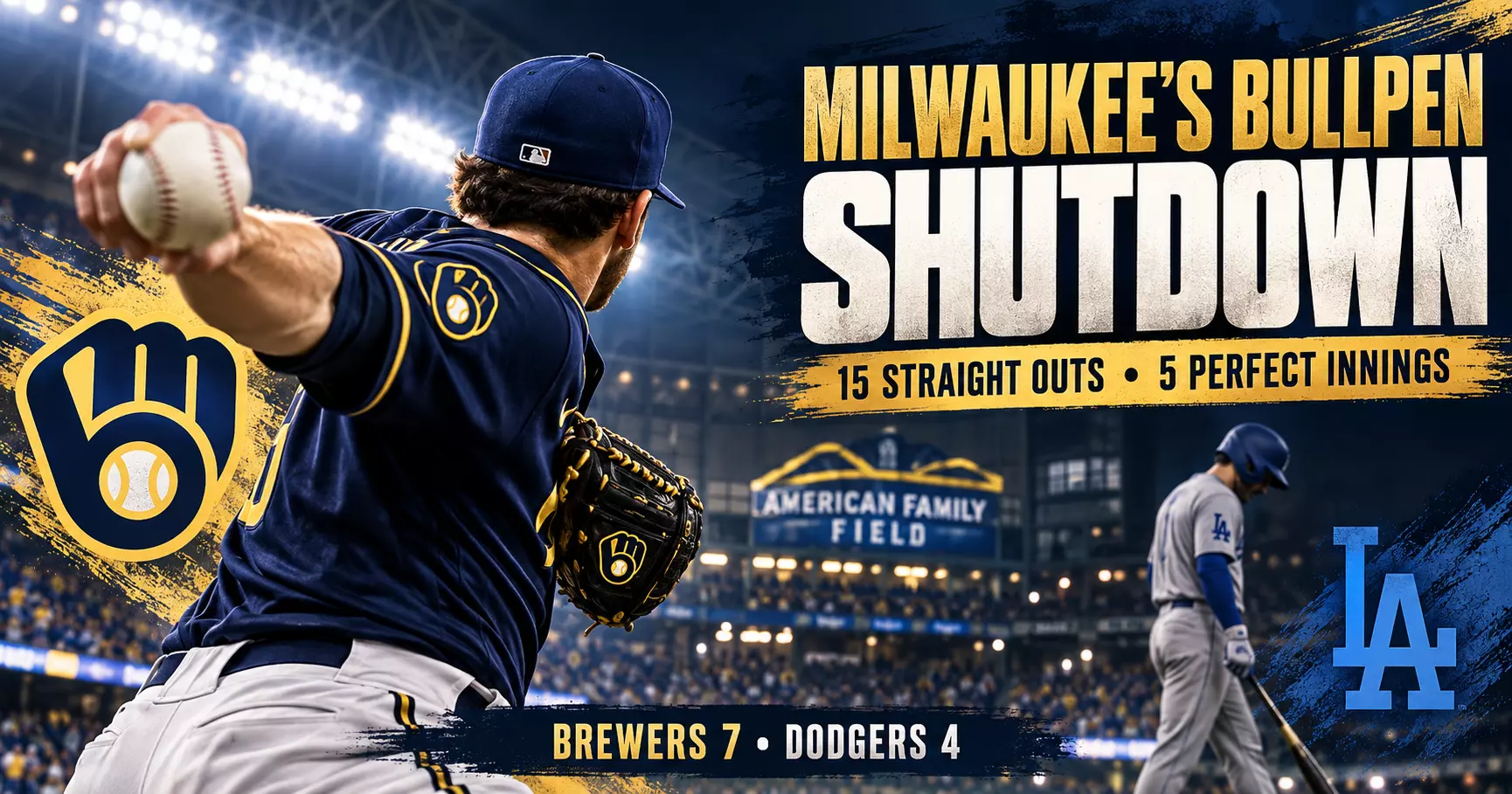
Dustin May, JoJo Romero, Abner Uribe and Aaron Ashby retired the final 15 Dodgers hitters in order as Milwaukee won Game 2 of the National League Championship Series, 7–4, on Monday. The Brewers now lead the best-of-seven series 2–0.
William Contreras supplied the offensive headlines. Milwaukee’s bullpen supplied the certainty.
Against the two-time defending World Series champions, the Brewers showed why October games are often decided by the pitchers who finish them.
Milwaukee Took Control Before It Took the Lead
The relief effort began with the game still unsettled.
Logan Henderson encountered trouble in the fifth inning after a Kyle Tucker double and a throwing error on Tommy Edman’s sacrifice bunt. May entered with the potential go-ahead run already aboard. He retired all three hitters he faced, although the inherited runner scored on Freddie Freeman’s sacrifice fly.
That distinction matters.
Milwaukee’s bullpen
was perfect in retiring the batters it faced. It did not prevent every runner inherited from the starter from scoring.
May’s work nevertheless stopped the inning from becoming something larger. Milwaukee trailed 4–3, then Contreras tied it with a home run in the bottom of the fifth.
The relief corps gave the offense the opportunity to change the game without needing to chase an expanding deficit.
That is one of the most valuable things a postseason bullpen can provide: time.
Four Pitchers Turned the Final Five Innings Into a Shutdown
The workload was distributed across several arms.
May handled an inning. Romero followed with a clean sixth. Uribe recorded four outs, and Ashby finished with five outs for the save. Together, the group struck out seven Dodgers while allowing nobody to reach base.
This was not a case of one closer protecting a comfortable lead after everyone else completed the difficult work.
The difficult work was shared.
Milwaukee needed outs before it moved ahead, outs while protecting a one-run advantage and outs after adding insurance. Different pitchers handled those responsibilities without creating a new problem for the next man.
Depth becomes meaningful when a manager can use several relievers in consequential situations. Game 2 demonstrated that Pat Murphy had more than one answer.
The Dodgers Never Got to Build an Inning
Retiring 15 consecutive hitters is impressive against any lineup. Against Los Angeles, it also prevented the Dodgers from using their offensive depth.
A walk can change how a pitcher approaches the next hitter. A single can bring a dangerous bat to the plate with a chance to tie the game. A prolonged inning can force a manager to make another pitching change.
Milwaukee allowed none of that.
The Dodgers could not advance runners, pressure the defense or turn a routine plate appearance into a rally. Each hitter had to begin again with the bases empty.
That does not mean Milwaukee has permanently solved the Dodgers. It means Los Angeles never established an offensive foothold during the portion of Game 2 that decided the outcome.
Reputation could not put a runner on first base.
This Bullpen Has Been Delivering Throughout October
The performance was extraordinary, but it was not isolated.
Through Game 2, Milwaukee relievers had allowed just one earned run in 28⅔ postseason innings. In the NLCS opener, the bullpen supplied 4⅔ scoreless innings to protect a 2–1 victory.
That makes the relief corps a central reason Milwaukee is two wins from a pennant.
The Brewers have been able to survive different types of games. They protected a narrow lead in the opener. In Game 2, they overcame a less effective start and gave their hitters room to rally.
The broader lesson is that starting pitchers do not have to provide identical performances for Milwaukee to win.
A team with dependable relief options can respond when the original plan changes. It can absorb an early exit, cover important middle innings and preserve a lead without demanding that one pitcher perform every role.
Contreras homered to tie the game in the fifth and singled home the go-ahead run in the sixth. The Brewers added two more runs in the eighth.
Those contributions changed what the bullpen needed to protect.
The relievers kept the game within reach. The offense then provided a lead and eventually a cushion. That cooperation made Milwaukee’s victory more convincing than a bullpen performance considered by itself.
It also illustrates why the Brewers should not be described simply as a team waiting for Los Angeles to fail.
Milwaukee created its own pressure, produced timely hits and then prevented the Dodgers from answering.
The Dodgers Must Make Milwaukee Work Harder
Los Angeles finished Game 2 with three hits and went hitless in four at-bats with runners in scoring position. Its postseason total in those situations fell to 2-for-26.
That is a problem requiring more than confidence that the lineup will eventually recover.
The Dodgers need better plate appearances, fewer quick outs and enough traffic to force
Milwaukee
into difficult decisions. The objective should be to create an inning in which Murphy cannot move comfortably from one effective reliever to the next.
That requires discipline as well as power. Trying to erase a series deficit with every swing can make a struggling offense easier to pitch to.
Los Angeles still has the talent to change the matchup. It must now demonstrate that talent against a bullpen that has given it almost nothing.
Milwaukee Has an Advantage, Not a Guarantee
The series moves to Los Angeles for Game 3 on Wednesday. The Brewers remain two victories away from advancing.
Maintaining this level of relief pitching will require continued command, sound defense and careful workload management. No bullpen should be expected to produce five perfect innings whenever the game demands them.
But Milwaukee does not need perfection every night to benefit from what it has built.
It needs several pitchers capable of securing important outs and a manager willing to use them when those outs matter most.
Game 2 showed that combination at its best.
The Dodgers brought an extraordinary roster to Milwaukee. For the final five innings, the Brewers reduced it to 15 unsuccessful plate appearances.
That is how a bullpen turns depth into control—and a contender into a team leading the series.
New Users – Get $350 in Bonus Bets when you wager $5 for 7 days
T&Cs apply
4.6/5
Gambling Problem? Call 1-800-GAMBLER or 1-800-MY-RESET. Call 1-888-789-7777 or visit ccpgg.org/chat (CT). Hope is here. GamblingHelpLineMA.org or call (800) 327-5050 for 24/7 support (MA). Visit www.mdgamblinghelp.org (MD). Call 1-877-8HOPE-NY or text HOPENY (NY). 21+ (18+ DC, WY) and present in select states (for KS, in affiliation with Kansas Star Casino). Find online real money wagering only. Min $5 wager required for 7 consecutive days. $5 free play credit. Bonus issued as non-withdrawable bonus with cash withdrawable bonus with cash withdrawable. Bonus bets which expire 7 days after receipt. Restrictions apply. See terms at sportsbook.fanduel.com. Call 1-877-770-7867 (LA).
Up To $1500 in Bonus Bets Paid Back if your First Bet Does Not Win
T&Cs apply
4.5/5
Gambling problem? Call 1-800-GAMBLER or 1-800-MY-RESET (Available in the US) 877-8-HOPENY or text HOPENY (467369) (NY) 1-800-327-5050 (MA), 1-800-BETS-OFF (IA), 1-800-981-0023 (PR). 21+ only. Please Gamble Responsibly. See BetMGM.com for Terms. First Bet Offer for new customers only (if applicable). Subject to eligibility requirements. Bonus bets are non-withdrawable. In partnership with Kansas Crossing Casino and Hotel. Promotional offers not available in Mississippi, Massachusetts, New York, Ontario, or Puerto Rico.
New DraftKings Customers: Bet $5, Get $200 + 3 Months of NBA League Pass!
T&Cs apply
4.5/5
GAMBLING PROBLEM? CALL 1-800-GAMBLER or 1-800-MY-RESET, (800) 327-5050 or visit gamblinghelplinema.org (MA). Please Gamble Responsibly. 888-789-7777/visit ccpg.org (CT), or visit www.mdgamblinghelp.org (MD), 1-800-981-0023 (PR). 21+ and present in most states. (18+ DC/NH/PR/WY). Void in CAN. Eligibility restrictions apply. On behalf of Boot Hill Casino (KS). Pass-thru of per wager tax may apply in IL. 1 per new Sportsbook customer. $5+ first-time bet req. Max. $200 issued as non-withdrawable Bonus Bets. Stake removed from payout. Reward issued as $50 in Bonus Bets every 7 days via click-to-claim for 21 days. Bonus Bets and click-to-claims expire 7 days (168hrs) after issuance. Terms: dkng.co/offer. Get 1 promo code to redeem a 3-month NBA League Pass subscription, complimentary of DraftKings. Subscription auto-renews monthly at then-current price (currently $16.99/mo); cancel anytime. Terms, restrictions, and eligibility requirements apply. Redeem League Pass by 12/19/26 at 11:59 PM ET. Addt’l terms: support.watch.nba.com/hc/en-us/articles/9165532876183-League-Pass-Terms-of-Use_. Ends 11/29/26 at 11:59 PM ET. Sponsored by DK.
Must be 21+. GAMBLING PROBLEM? CALL 1-800-GAMBLER OR CALL 1-800-MY-RESET, www.mdgamblinghelp.org (MD), (800)-327-5050 or gamblinghelplinema.org (MA), Call (877)8-HOPENY or text HOPENY (467369) (NY), (888) 789-7777 or ccpg.org (CT), morethanagame.nc.gov (NC), 1800gambler.net (WV)
Bet $1 and get double the winnings up to $25 for your next 10 bets
T&Cs apply
4.4/5
21+ New users only. Must register using eligible promo code. First bet after registration must qualify. Max. Bonus Bet: $1,000. Bonus Bet expires 14 days after receipt. Void where prohibited. See Caesars.com/promos for full terms. Gambling Problem? 1-800-GAMBLER (1-800-426-2537)
21+ and present in OH. Gambling Problem? Call 1-800-GAMBLER.
This site is using
Cloudflare
and adheres to the
Google Safe Browsing Program. We adapted
Google's Privacy Guidelines
to keep your data safe at all times.
Close
Ready to Win Big? Join the Elite with Our Sports Betting Deals!
FanDuel Promo
New Users – Get $350 in Bonus Bets when you wager $5 for 7 days
Our Favorite
T&Cs and 21+ apply
Gambling Problem? Call 1-800-GAMBLER or 1-800-MY-RESET. Call 1-888-789-7777 or visit ccpgg.org/chat (CT). Hope is here. GamblingHelpLineMA.org or call (800) 327-5050 for 24/7 support (MA). Visit www.mdgamblinghelp.org (MD). Call 1-877-8HOPE-NY or text HOPENY (NY). 21+ (18+ DC, WY) and present in select states (for KS, in affiliation with Kansas Star Casino). Find online real money wagering only. Min $5 wager required for 7 consecutive days. $5 free play credit. Bonus issued as non-withdrawable bonus with cash withdrawable bonus with cash withdrawable. Bonus bets which expire 7 days after receipt. Restrictions apply. See terms at sportsbook.fanduel.com. Call 1-877-770-7867 (LA).
Code:
Open FanDuel
Get Bonus
BetMGM Promo
Up To $1500 in Bonus Bets Paid Back if your First Bet Does Not Win
Best Slots
T&Cs and 21+ apply
Gambling problem? Call 1-800-GAMBLER or 1-800-MY-RESET (Available in the US) 877-8-HOPENY or text HOPENY (467369) (NY) 1-800-327-5050 (MA), 1-800-BETS-OFF (IA), 1-800-981-0023 (PR). 21+ only. Please Gamble Responsibly. See BetMGM.com for Terms. First Bet Offer for new customers only (if applicable). Subject to eligibility requirements. Bonus bets are non-withdrawable. In partnership with Kansas Crossing Casino and Hotel. Promotional offers not available in Mississippi, Massachusetts, New York, Ontario, or Puerto Rico.
Code:
Open BetMGM
Get Bonus
DraftKings Promo
New DraftKings Customers: Bet $5, Get $200 + 3 Months of NBA League Pass!
Newcomer
T&Cs and 21+ apply
GAMBLING PROBLEM? CALL 1-800-GAMBLER or 1-800-MY-RESET, (800) 327-5050 or visit gamblinghelplinema.org (MA). Please Gamble Responsibly. 888-789-7777/visit ccpg.org (CT), or visit www.mdgamblinghelp.org (MD), 1-800-981-0023 (PR). 21+ and present in most states. (18+ DC/NH/PR/WY). Void in CAN. Eligibility restrictions apply. On behalf of Boot Hill Casino (KS). Pass-thru of per wager tax may apply in IL. 1 per new Sportsbook customer. $5+ first-time bet req. Max. $200 issued as non-withdrawable Bonus Bets. Stake removed from payout. Reward issued as $50 in Bonus Bets every 7 days via click-to-claim for 21 days. Bonus Bets and click-to-claims expire 7 days (168hrs) after issuance. Terms: dkng.co/offer. Get 1 promo code to redeem a 3-month NBA League Pass subscription, complimentary of DraftKings. Subscription auto-renews monthly at then-current price (currently $16.99/mo); cancel anytime. Terms, restrictions, and eligibility requirements apply. Redeem League Pass by 12/19/26 at 11:59 PM ET. Addt’l terms: support.watch.nba.com/hc/en-us/articles/9165532876183-League-Pass-Terms-of-Use_. Ends 11/29/26 at 11:59 PM ET. Sponsored by DK.
Code:
Open DraftKings
Get Bonus
Find out what the legends have to say about sports this week....
New Users – Get $350 in Bonus Bets when you wager $5 for 7 days
Gambling Problem? Call 1-800-GAMBLER or 1-800-MY-RESET. Call 1-888-789-7777 or visit ccpgg.org/chat (CT). Hope is here. GamblingHelpLineMA.org or call (800) 327-5050 for 24/7 support (MA). Visit www.mdgamblinghelp.org (MD). Call 1-877-8HOPE-NY or text HOPENY (NY). 21+ (18+ DC, WY) and present in select states (for KS, in affiliation with Kansas Star Casino). Find online real money wagering only. Min $5 wager required for 7 consecutive days. $5 free play credit. Bonus issued as non-withdrawable bonus with cash withdrawable bonus with cash withdrawable. Bonus bets which expire 7 days after receipt. Restrictions apply. See terms at sportsbook.fanduel.com. Call 1-877-770-7867 (LA).