Ken Johnson kept Cincinnati hitless for nine innings. Houston lost anyway.On April 23, 1964, at Colt Stadium, the Houston Colt .45s fell 1–0
Ken Johnson kept Cincinnati hitless for nine innings. Houston lost anyway.
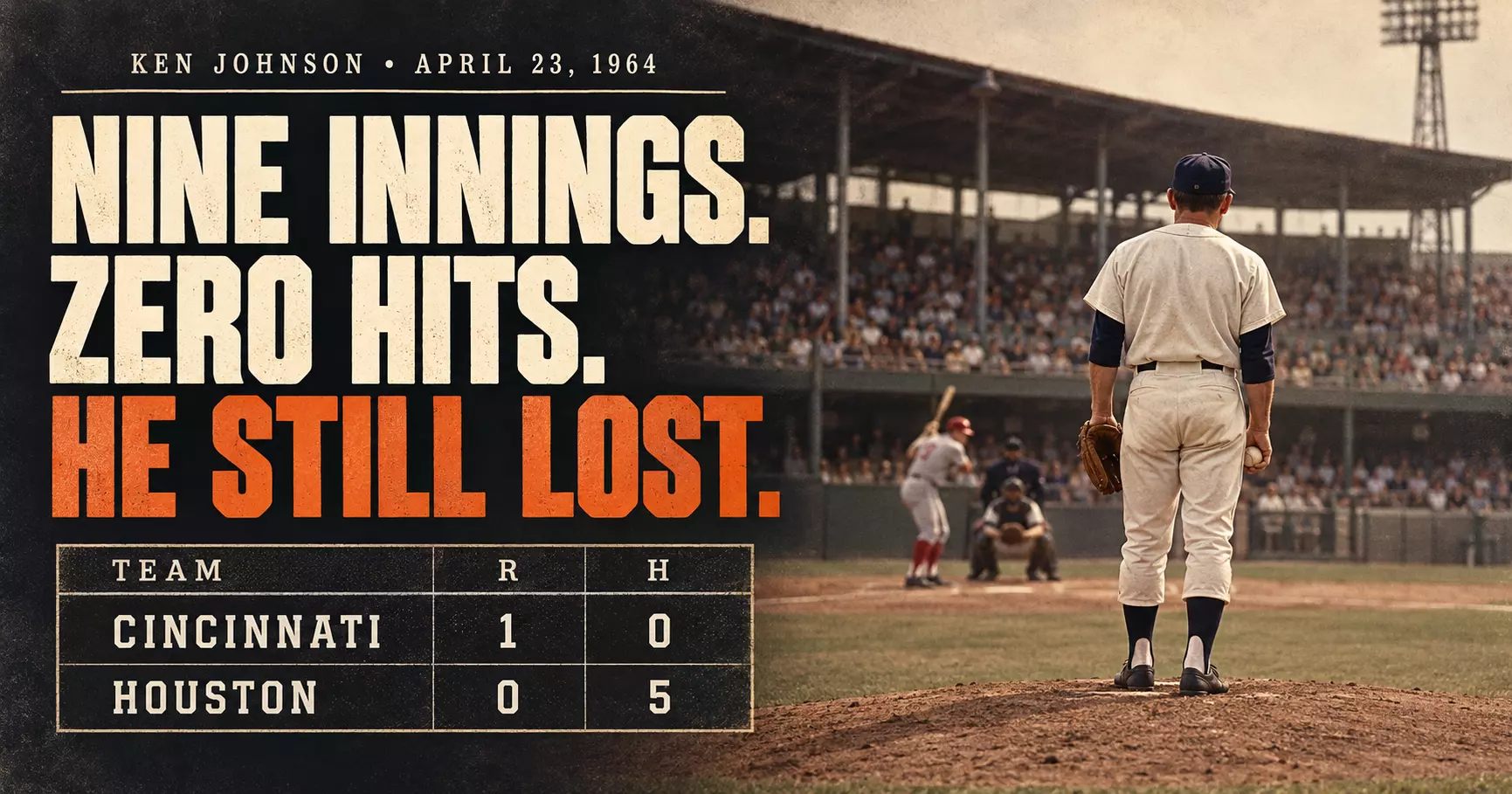
On April 23, 1964, at Colt Stadium, the Houston Colt .45s fell 1–0 to the Reds despite Johnson’s complete-game no-hitter. His final pitching line contained nine strikeouts, two walks, no hits and one unearned run.
It sounds like a contradiction. It was a lesson in how baseball works.
Johnson could prevent hits. He could not manufacture runs for Houston, and he could not erase two ninth-inning errors—including his own—that gave Cincinnati the only run it needed.
A No-Hitter Is Not a Shutout
A no-hitter records the absence of hits. It does not require the absence of baserunners or runs.
Batters can reach through walks or errors, and a team can move those runners around without collecting a hit. Johnson’s game demonstrated that distinction in devastating fashion.
His two walks had not produced a run. Through eight innings, Cincinnati remained hitless and the score remained 0–0.
Across the field,
Joe Nuxhall was producing a different kind of masterpiece. The Reds’ left-hander would finish with a five-hit shutout, one walk and six strikeouts.
Johnson had allowed fewer hits. Nuxhall’s team would score more runs. Only the second comparison determined the winner.
Houston Had Chances to Change the Story
The Colt .45s did not spend the entire evening without opportunities.
In the seventh, Houston put its first two batters aboard. Johnny Weekly’s ground ball became a double play that erased both baserunners, and the inning ended without a run.
In the eighth, Jimmy Wynn led off with a double. Houston again failed to score.
Those missed chances are essential to understanding the defeat. The ninth-inning errors decided where Cincinnati’s run came from, but Houston’s offense explains why that single run was enough.
One timely hit might have changed the evening. Instead, Johnson entered the ninth without any cushion.
He was pitching for history while still trying to give Houston a chance to win.
Pete Rose’s Bunt Started the Trouble
Nuxhall opened the top of the ninth by grounding out to third baseman Bob Aspromonte.
Then Pete Rose bunted.
Johnson fielded the ball but threw wildly toward first baseman Pete Runnels. Rose reached second on the throwing error.
The official scoring mattered: Rose had reached through an error, so the no-hitter remained intact. The score also remained tied.
But Johnson’s mistake had placed the potential winning run in scoring position with one out.
Rose’s bunt was a practical attempt to reach base in a scoreless game. Cincinnati needed a run, and it had found an opening without a hit.
An Out Came With a Painful Price
Chico Ruiz’s next batted ball struck Johnson’s shin and caromed to Aspromonte. The third baseman threw Ruiz out at first while Rose advanced to third.
Johnson had recorded the second out, but he had also suffered a painful injury.
He now needed one more out to finish nine hitless, scoreless innings. Rose stood 90 feet from home.
That is what makes the next play so cruel. Cincinnati did not require a spectacular swing or an extra-base hit. A routine ball in play became enough.
Nellie Fox’s Error Brought Home the Only Run
Vada Pinson grounded to second baseman Nellie Fox.
Fox mishandled the ball. Pinson reached first, and Rose scored.
Two errors had transformed a bunt into the game’s only run: Johnson’s throw allowed Rose to reach second, and Fox’s mistake allowed him to cross the plate after Ruiz’s out moved him to third.
Johnson then retired Frank Robinson on a fly ball to left fielder Wynn.
The no-hitter was complete. The game was not.
Houston still had the bottom of the ninth to save its pitcher from an extraordinary defeat.
Nuxhall Finished the Shutout
The Colt .45s received one final opening when Runnels reached on Cincinnati first baseman Deron Johnson’s error with two outs.
Bob Lillis entered as a pinch-runner.
Weekly struck out looking, ending the game.
Cincinnati finished with one run and no hits. Houston finished with five hits and no runs.
Nuxhall received the victory. Ken Johnson received the loss.
The difference was not a scoring technicality. The Reds had legally scored a run; Houston had not. Johnson’s remarkable pitching achievement and his defeat could coexist because they measured different things.
Johnson Refused to Leave Fox With All the Blame
The aftermath gives this story something beyond its statistical oddity.
According to SABR’s reconstruction, which cites contemporary newspaper reporting, Fox apologized to Johnson after the game. Johnson reminded him that his own throwing error had put Rose aboard.
“I put the guy on myself,” Johnson said.
That response recognized the whole sequence. Fox’s error was the final defensive mistake, but it was not the only one.
Contemporary
Houston Chronicle
reporting also recorded Johnson’s pride in his performance: “I just pitched the best game of baseball I ever pitched in my whole life.”
He could acknowledge the loss without pretending the achievement had disappeared.
A Remarkable Performance—and a Team Defeat
Johnson became the first
major-league pitcher
to lose a completed nine-inning game in which he personally allowed no hits.
The precise wording matters. His outing was a complete-game no-hitter, not a perfect game. Cincinnati had baserunners, and one scored.
It also deserves to be remembered as more than Nellie Fox’s error. Johnson contributed a costly mistake. Houston failed to capitalize on its opportunities. Nuxhall pitched well enough to make one run decisive.
That combination produced one of baseball’s most astonishing box scores.
Ken Johnson gave Cincinnati no hits.
Houston gave him no runs.
And an exceptional night on the mound became a defeat.
New Users – Get $350 in Bonus Bets when you wager $5 for 7 days
T&Cs apply
4.6/5
Gambling Problem? Call 1-800-GAMBLER or 1-800-MY-RESET. Call 1-888-789-7777 or visit ccpgg.org/chat (CT). Hope is here. GamblingHelpLineMA.org or call (800) 327-5050 for 24/7 support (MA). Visit www.mdgamblinghelp.org (MD). Call 1-877-8HOPE-NY or text HOPENY (NY). 21+ (18+ DC, WY) and present in select states (for KS, in affiliation with Kansas Star Casino). Find online real money wagering only. Min $5 wager required for 7 consecutive days. $5 free play credit. Bonus issued as non-withdrawable bonus with cash withdrawable bonus with cash withdrawable. Bonus bets which expire 7 days after receipt. Restrictions apply. See terms at sportsbook.fanduel.com. Call 1-877-770-7867 (LA).
Up To $1500 in Bonus Bets Paid Back if your First Bet Does Not Win
T&Cs apply
4.5/5
Gambling problem? Call 1-800-GAMBLER or 1-800-MY-RESET (Available in the US) 877-8-HOPENY or text HOPENY (467369) (NY) 1-800-327-5050 (MA), 1-800-BETS-OFF (IA), 1-800-981-0023 (PR). 21+ only. Please Gamble Responsibly. See BetMGM.com for Terms. First Bet Offer for new customers only (if applicable). Subject to eligibility requirements. Bonus bets are non-withdrawable. In partnership with Kansas Crossing Casino and Hotel. Promotional offers not available in Mississippi, Massachusetts, New York, Ontario, or Puerto Rico.
New DraftKings Customers: Bet $5, Get $200 + 3 Months of NBA League Pass!
T&Cs apply
4.5/5
GAMBLING PROBLEM? CALL 1-800-GAMBLER or 1-800-MY-RESET, (800) 327-5050 or visit gamblinghelplinema.org (MA). Please Gamble Responsibly. 888-789-7777/visit ccpg.org (CT), or visit www.mdgamblinghelp.org (MD), 1-800-981-0023 (PR). 21+ and present in most states. (18+ DC/NH/PR/WY). Void in CAN. Eligibility restrictions apply. On behalf of Boot Hill Casino (KS). Pass-thru of per wager tax may apply in IL. 1 per new Sportsbook customer. $5+ first-time bet req. Max. $200 issued as non-withdrawable Bonus Bets. Stake removed from payout. Reward issued as $50 in Bonus Bets every 7 days via click-to-claim for 21 days. Bonus Bets and click-to-claims expire 7 days (168hrs) after issuance. Terms: dkng.co/offer. Get 1 promo code to redeem a 3-month NBA League Pass subscription, complimentary of DraftKings. Subscription auto-renews monthly at then-current price (currently $16.99/mo); cancel anytime. Terms, restrictions, and eligibility requirements apply. Redeem League Pass by 12/19/26 at 11:59 PM ET. Addt’l terms: support.watch.nba.com/hc/en-us/articles/9165532876183-League-Pass-Terms-of-Use_. Ends 11/29/26 at 11:59 PM ET. Sponsored by DK.
Must be 21+. GAMBLING PROBLEM? CALL 1-800-GAMBLER OR CALL 1-800-MY-RESET, www.mdgamblinghelp.org (MD), (800)-327-5050 or gamblinghelplinema.org (MA), Call (877)8-HOPENY or text HOPENY (467369) (NY), (888) 789-7777 or ccpg.org (CT), morethanagame.nc.gov (NC), 1800gambler.net (WV)
Bet $1 and get double the winnings up to $25 for your next 10 bets
T&Cs apply
4.4/5
21+ New users only. Must register using eligible promo code. First bet after registration must qualify. Max. Bonus Bet: $1,000. Bonus Bet expires 14 days after receipt. Void where prohibited. See Caesars.com/promos for full terms. Gambling Problem? 1-800-GAMBLER (1-800-426-2537)
21+ and present in OH. Gambling Problem? Call 1-800-GAMBLER.
This site is using
Cloudflare
and adheres to the
Google Safe Browsing Program. We adapted
Google's Privacy Guidelines
to keep your data safe at all times.
Close
Ready to Win Big? Join the Elite with Our Sports Betting Deals!
FanDuel Promo
New Users – Get $350 in Bonus Bets when you wager $5 for 7 days
Our Favorite
T&Cs and 21+ apply
Gambling Problem? Call 1-800-GAMBLER or 1-800-MY-RESET. Call 1-888-789-7777 or visit ccpgg.org/chat (CT). Hope is here. GamblingHelpLineMA.org or call (800) 327-5050 for 24/7 support (MA). Visit www.mdgamblinghelp.org (MD). Call 1-877-8HOPE-NY or text HOPENY (NY). 21+ (18+ DC, WY) and present in select states (for KS, in affiliation with Kansas Star Casino). Find online real money wagering only. Min $5 wager required for 7 consecutive days. $5 free play credit. Bonus issued as non-withdrawable bonus with cash withdrawable bonus with cash withdrawable. Bonus bets which expire 7 days after receipt. Restrictions apply. See terms at sportsbook.fanduel.com. Call 1-877-770-7867 (LA).
Code:
Open FanDuel
Get Bonus
BetMGM Promo
Up To $1500 in Bonus Bets Paid Back if your First Bet Does Not Win
Best Slots
T&Cs and 21+ apply
Gambling problem? Call 1-800-GAMBLER or 1-800-MY-RESET (Available in the US) 877-8-HOPENY or text HOPENY (467369) (NY) 1-800-327-5050 (MA), 1-800-BETS-OFF (IA), 1-800-981-0023 (PR). 21+ only. Please Gamble Responsibly. See BetMGM.com for Terms. First Bet Offer for new customers only (if applicable). Subject to eligibility requirements. Bonus bets are non-withdrawable. In partnership with Kansas Crossing Casino and Hotel. Promotional offers not available in Mississippi, Massachusetts, New York, Ontario, or Puerto Rico.
Code:
Open BetMGM
Get Bonus
DraftKings Promo
New DraftKings Customers: Bet $5, Get $200 + 3 Months of NBA League Pass!
Newcomer
T&Cs and 21+ apply
GAMBLING PROBLEM? CALL 1-800-GAMBLER or 1-800-MY-RESET, (800) 327-5050 or visit gamblinghelplinema.org (MA). Please Gamble Responsibly. 888-789-7777/visit ccpg.org (CT), or visit www.mdgamblinghelp.org (MD), 1-800-981-0023 (PR). 21+ and present in most states. (18+ DC/NH/PR/WY). Void in CAN. Eligibility restrictions apply. On behalf of Boot Hill Casino (KS). Pass-thru of per wager tax may apply in IL. 1 per new Sportsbook customer. $5+ first-time bet req. Max. $200 issued as non-withdrawable Bonus Bets. Stake removed from payout. Reward issued as $50 in Bonus Bets every 7 days via click-to-claim for 21 days. Bonus Bets and click-to-claims expire 7 days (168hrs) after issuance. Terms: dkng.co/offer. Get 1 promo code to redeem a 3-month NBA League Pass subscription, complimentary of DraftKings. Subscription auto-renews monthly at then-current price (currently $16.99/mo); cancel anytime. Terms, restrictions, and eligibility requirements apply. Redeem League Pass by 12/19/26 at 11:59 PM ET. Addt’l terms: support.watch.nba.com/hc/en-us/articles/9165532876183-League-Pass-Terms-of-Use_. Ends 11/29/26 at 11:59 PM ET. Sponsored by DK.
Code:
Open DraftKings
Get Bonus
Find out what the legends have to say about sports this week....
New Users – Get $350 in Bonus Bets when you wager $5 for 7 days
Gambling Problem? Call 1-800-GAMBLER or 1-800-MY-RESET. Call 1-888-789-7777 or visit ccpgg.org/chat (CT). Hope is here. GamblingHelpLineMA.org or call (800) 327-5050 for 24/7 support (MA). Visit www.mdgamblinghelp.org (MD). Call 1-877-8HOPE-NY or text HOPENY (NY). 21+ (18+ DC, WY) and present in select states (for KS, in affiliation with Kansas Star Casino). Find online real money wagering only. Min $5 wager required for 7 consecutive days. $5 free play credit. Bonus issued as non-withdrawable bonus with cash withdrawable bonus with cash withdrawable. Bonus bets which expire 7 days after receipt. Restrictions apply. See terms at sportsbook.fanduel.com. Call 1-877-770-7867 (LA).