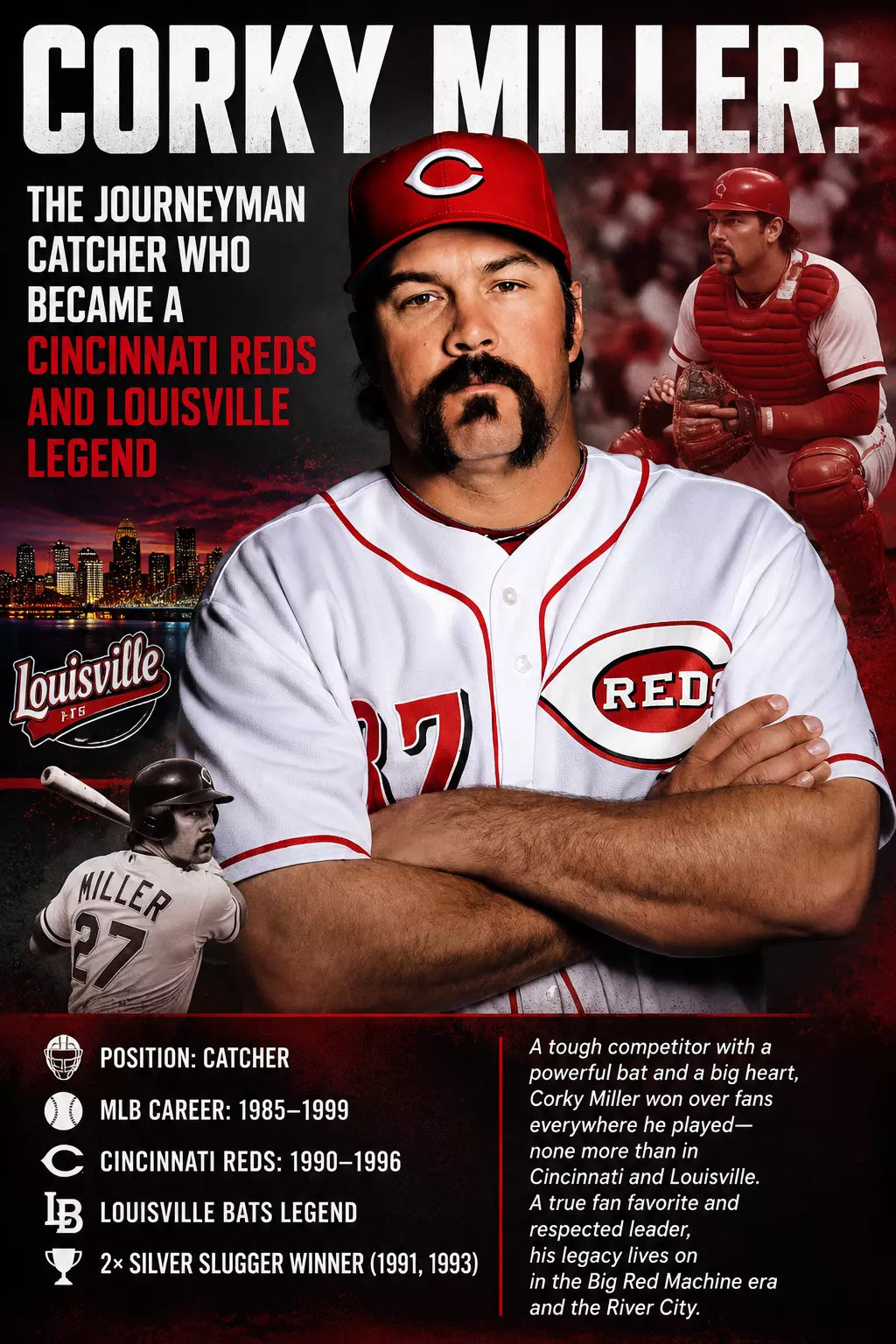
Corky Miller: The Journeyman Catcher Who Became a Cincinnati Reds and Louisville Legend
Corky Miller: The Journeyman Catcher Who Became a Cincinnati Reds and Louisville Legend
Some baseball players become legends because of Hall of Fame statistics. Others are remembered for championships, record-breaking seasons or unforgettable postseason performances.
Corky Miller built his reputation differently.
With his unmistakable mustache, rugged appearance and old-school approach to catching, Miller became one of the most recognizable backup catchers of his era. His Major League numbers were modest, but his value extended far beyond batting average, home runs or runs batted in.
Pitchers trusted him. Teammates respected him. Coaches valued his knowledge. Fans embraced his personality.
Most importantly, Miller kept finding ways to stay in professional baseball.
He played parts of 11 Major League seasons from 2001 through 2013, appearing for the Cincinnati Reds, Minnesota Twins, Boston Red Sox, Atlanta Braves and Chicago White Sox. Miller finished his MLB career with 216 games, 104 hits, 28 doubles, 11 home runs and 67 RBI while batting .193 with a .277 on-base percentage. Of those 216 games, 153 came in a Cincinnati uniform.
Yet his greatest legacy may have been created roughly 100 miles southwest of Cincinnati.
Miller spent 10 seasons with Triple-A Louisville, playing a franchise-record 548 games. His No. 8 was retired in 2014, making him the first player in Louisville franchise history to receive that honor.
More than two decades after his Major League debut, Miller remains connected to the Reds organization.
In 2026, he is still serving as Cincinnati’s Catching Coordinator, helping shape another generation of professional catchers. He is also continuing his role as an ambassador for the organization, including serving as commissioner of the Reds Fantasy Camp: Daytona Edition in November 2026.
Corky Miller’s career is proof that baseball greatness can be measured in more ways than statistics.
Growing Up in California
Corky Miller was born March 18, 1976, in Yucaipa, California.
Baseball entered his life early, and catching eventually became the position that would define him.
Miller attended Yucaipa High School, where he developed into an accomplished baseball player. During his junior and senior seasons, he earned All-State and All-CIF recognition.
The California Angels selected him in the 23rd round of the 1994 Major League Baseball Draft, 629th overall. Instead of immediately entering professional baseball, Miller continued developing at the college level.
That decision proved important.
Rather than being remembered as a late-round high school draft pick, Miller transformed himself into a player capable of building one of the more unusual professional catching careers of his generation.
Becoming a College Baseball Star
Miller attended San Bernardino Valley College before transferring to the University of Nevada, Reno.
At Nevada, his career took another step forward.
He earned All-Big West Conference honors in 1997 before being named a second-team All-American in 1998. During his final season at Nevada, Miller hit .377 with 14 home runs and 63 RBI in 53 games.
He also demonstrated a trait that would follow him throughout professional baseball: an extraordinary willingness—or ability—to get hit by pitches.
Nevada’s record book credits Miller with 29 hit-by-pitches in 1998 after being plunked 25 times the previous season.
His college career gave him another opportunity to enter professional baseball.
This time, Cincinnati came calling.
Signing With the Cincinnati Reds
The Reds signed Miller as an undrafted free agent in 1998.
His path to Cincinnati was hardly guaranteed.
Unlike a highly drafted prospect who receives a significant signing bonus and repeated opportunities to develop, Miller had to prove he belonged at virtually every stop.
He did exactly that.
Miller began his professional career at Billings in 1998 and continued climbing Cincinnati’s farm system.
In 1999, he played in the Midwest League All-Star Game.
By 2000, his reputation was beginning to extend well beyond statistics. In a USA Today Baseball Weekly poll of Southern League players, Miller was voted both the player respondents most wanted in their clubhouse and the player they believed would make the best future manager.
Those honors turned out to be remarkably prophetic.
Miller understood pitchers.
He understood preparation.
He understood clubhouses.
And he understood the responsibilities that came with being a catcher.
Then his offensive production surged.
Breaking Through in 2001
The 2001 season changed Miller’s career.
Splitting the season between Double-A Chattanooga and Triple-A Louisville, he batted .309 with 16 home runs and 70 RBI in 103 games.
After reaching Louisville, Miller became even more dangerous, batting .347 with seven home runs, 28 RBI and a 1.001 OPS in only 44 games.
Cincinnati could no longer ignore him.
On September 4, 2001, at 25 years old, Miller made his Major League debut for the Reds against Houston.
Years of minor-league bus rides, uncertain roster spots and organizational depth charts had finally led him to the Major Leagues.
And Miller wasted little time becoming memorable.
Corky Miller Steals Home
On September 27, 2001, Cincinnati was playing Philadelphia at Veterans Stadium.
Miller reached third base in the fifth inning.
With Phillies left-hander Omar Daal on the mound, Miller noticed an opportunity. Daal made a move toward first base, and Miller broke for home.
The 250-pound catcher stole home.
It became the only stolen base of his Major League career.
More significantly, Miller became the first Reds catcher to steal home since Johnny Bench had done it on September 6, 1976. Cincinnati eventually won the game 2-1.
For a player whose career would eventually become defined by toughness, humor and unexpected moments, it was almost a perfect introduction.
Then came another surprise.
The next day, Miller hit his first Major League home run.
On October 3 against the Chicago Cubs, he hit two home runs in the same game.
Corky Miller had officially arrived.
His Best Major League Season
Miller received the most extensive Major League playing time of his career in 2002.
Appearing in a career-high 39 games for Cincinnati, he batted .254 with 29 hits, 10 doubles, three home runs and 15 RBI. His .749 OPS was the highest he produced during a season in which he received more than 100 plate appearances.
But Miller was never expected to become the centerpiece of Cincinnati’s lineup.
His job was different.
A backup catcher may go days without starting but still must understand every pitcher on the roster. He must study opposing hitters, control the running game, prepare scouting information and be ready to enter a game without warning.
Those responsibilities suited Miller.
His defensive fundamentals and ability to establish relationships with pitchers became the qualities organizations valued most.
Those skills also helped him survive one of the most unpredictable jobs in baseball.
Becoming a Baseball Journeyman
Miller remained with Cincinnati through 2004 before beginning the nomadic portion of his career.
He spent Major League time with Minnesota in 2005 and Boston in 2006.
Then came Atlanta, where Miller appeared in the majors during both 2007 and 2008.
In 2009, he made the Chicago White Sox roster and appeared in 14 games.
Miller also spent significant portions of those seasons in Triple-A, moving through Rochester, Pawtucket, Richmond and Charlotte.
For many players, repeatedly changing organizations and traveling between Triple-A and the Major Leagues can become exhausting.
For Miller, it became part of his identity.
He was the veteran catcher organizations knew they could trust.
When a team needed experience, catching depth and someone capable of handling a pitching staff, Miller kept finding opportunities.
From 2001 through 2014, Miller spent time in the Triple-A International League for 14 consecutive seasons.
Eventually, his journey brought him back to the organization where his Major League career had started.
Returning to Cincinnati
On June 26, 2009, Miller was traded from the White Sox organization to Cincinnati in exchange for outfielder Norris Hopper.
He was assigned to Louisville.
Two months later, he was back in Cincinnati.
Miller appeared in
21 games for the Reds in 2009, beginning the second chapter of his Cincinnati career. Combined with his 14 appearances for Chicago earlier that season, he played 35 Major League games in 2009.
The following season brought an even larger role.
In 2010, Miller appeared in 32 games for Cincinnati and made 19 starts behind the plate.
The numbers told part of the story.
Reds pitchers posted a team-best
2.86 ERA while Miller was catching, illustrating the value Cincinnati saw in his ability to work with the pitching staff.
His contribution wasn’t always something that could be measured by his own batting line.
A veteran catcher can help a pitcher survive a difficult inning, recognize a hitter’s weakness, change a sequence of pitches or settle down a young arm before a game gets away.
Miller had become exactly that kind of catcher.
Louisville Becomes Home
Although Miller traveled repeatedly between Cincinnati and Louisville, Triple-A Louisville became one of the defining places of his career.
He played there from 2001 through 2004 and again from 2009 through 2014.
Fans watched him travel up Interstate 71 as Cincinnati repeatedly called him to the Major Leagues and sent him back to Triple-A.
Instead of becoming merely another veteran passing through Louisville, Miller became part of the franchise’s identity.
The famous mustache certainly helped.
Louisville eventually embraced the look with promotions built around Miller, including the memorable
“Fear the ‘Stache”
theme.
But Miller’s popularity was based on far more than facial hair.
He stayed.
Season after season, prospect after prospect and roster after roster, Corky Miller remained.
Young pitchers arriving in Triple-A found an experienced catcher capable of helping prepare them for the Major Leagues.
Young catchers found someone who understood the position at its highest level.
Fans found something increasingly rare in minor-league baseball: a player who remained in one city long enough to become genuinely connected to the franchise.
By the end of his playing career, Miller had appeared in
548 games for Louisville, setting the franchise record.
He also finished with 416 hits, 99 doubles, 50 home runs and 236 RBI for Louisville.
He wasn’t simply a player passing through Triple-A anymore.
Corky Miller had become a Louisville baseball institution.
One Final Major League Comeback
Miller spent the entire 2012 season with Louisville.
At 36 years old, it would have been reasonable to believe his Major League career was over.
It wasn’t.
Cincinnati brought him back in 2013.
At age 37, Miller became the oldest Reds player to start a game at catcher since 37-year-old Bob Scheffing in 1951.
He appeared in 17 games and made 12 starts.
Miller batted .257 with a .366 on-base percentage and five doubles. During his final nine appearances, he hit an extraordinary .467 with four doubles and seven RBI.
On July 31, Miller recorded the 100th hit of his Major League career.
Then, on August 7 against Oakland, he delivered one of the most memorable games of his final season.
Miller ripped RBI doubles in consecutive innings as Cincinnati defeated the Athletics 6-5.
His sons, Caden and Chase, were at Great American Ball Park that day as part of the Reds’ family activities.
Miller later left the game after suffering a right quadriceps contusion in a collision at home plate, but not before helping drive Cincinnati to victory.
One more memorable moment was still waiting.
A Fitting Final Major League At-Bat
On September 29, 2013, the Reds faced the Pittsburgh Pirates in the final game of the regular season.
Miller came to the plate for what would become the final Major League at-bat of his career.
He doubled.
The hit drove home two runs, accounting for all of Cincinnati’s scoring in a 4-2 loss.
One at-bat.
One hit.
One double.
Two RBI.
Miller’s Major League career ended with him doing precisely what Cincinnati had asked him to do throughout his career: be ready when his opportunity arrived.
It was difficult to imagine a more appropriate conclusion.
Corky Miller’s Major League Career
Miller finished his Major League career with:
11 seasons
216 games
616 plate appearances
539 at-bats
104 hits
28 doubles
11 home runs
67 RBI
49 walks
1 stolen base
.193 batting average
.277 on-base percentage
.306 slugging percentage
.583 OPS
MLB appearances with the
Cincinnati Reds, Minnesota Twins, Boston Red Sox, Atlanta Braves and Chicago White Sox
153 games with Cincinnati
84 hits, nine home runs and 53 RBI as a Red
Those numbers will never tell the entire Corky Miller story.
The longevity was the accomplishment.
Louisville Retires No. 8
Miller returned to Louisville for one final season in 2014.
A back injury limited his playing time, and the transition from player to teacher had already begun.
Then came an honor few career minor leaguers ever receive.
On
August 31, 2014, the Louisville Bats retired Corky Miller’s No. 8.
He became the
first player in franchise history to have his number retired.
Miller finished his Louisville career as the franchise’s all-time leader with 548 games played and 99 doubles.
For a player who had spent much of his career labeled a backup, journeyman or organizational catcher, the ceremony represented something far greater.
Louisville recognized what the Major League statistics could not measure.
Corky Miller had become part of the franchise.
From Catcher to Coach
Retirement did not end Miller’s relationship with baseball—or with the Cincinnati Reds.
Instead, the qualities that allowed him to survive so long as a player became valuable teaching tools.
In 2015, Miller joined the coaching staff of the Dayton Dragons while also traveling through Cincinnati’s farm system as a catching instructor.
The Reds specifically praised his defensive fundamentals and his ability to develop productive relationships with pitchers.
His responsibilities eventually expanded.
Miller became the organization’s Catching Coordinator, working with catchers throughout Cincinnati’s minor-league system.
His influence can be seen in the development process of players who passed through the organization. Tucker Barnhart, for example, worked alongside Miller in Louisville before developing into Cincinnati’s primary catcher and eventually becoming a Gold Glove winner.
And the role continues.
A 2026 Dayton Dragons organizational preview still identifies Miller as the
Reds Catching Coordinator, confirming that more than a decade after his final professional game, he remains part of Cincinnati’s player-development operation.
The prediction made by Southern League players back in 2000 suddenly looks even more impressive.
They thought Corky Miller had the mind to manage.
Cincinnati discovered he certainly had the mind to teach.
Still Representing the Reds in 2026
Miller’s place in the organization now extends beyond player development.
He remains a recognizable representative of the Reds and one of the former players fans continue to associate closely with the franchise.
In 2026, Miller is included among the former Reds participating in the organization’s Fantasy Camp program.
More significantly, the Reds Hall of Fame named Miller
commissioner of the inaugural Reds Fantasy Camp: Daytona Edition, scheduled for November 12-16, 2026, at historic Jackie Robinson Ballpark in Daytona Beach, Florida.
Joe Oliver, Eddie Taubensee, Lenny Harris and Brandon Larson are among the former Reds scheduled to participate alongside him.
That role is another indication of how Miller’s relationship with the organization has evolved.
He arrived as an undrafted free agent trying to earn a minor-league roster spot.
Nearly three decades later, he is helping teach Reds prospects and representing the franchise to generations of fans.
Career Highlights
Corky Miller’s accomplishments include:
Selected by the California Angels in the
23rd round of the 1994 MLB Draft
All-Big West Conference
selection at Nevada in 1997
Second-team All-American
at Nevada in 1998
Hit
.377 with 14 home runs and 63 RBI
at Nevada in 1998
Signed by Cincinnati as an
undrafted free agent in 1998
Midwest League All-Star in 1999
Voted the Southern League player others most wanted in their clubhouse in 2000
Hit
.309 with 16 home runs and 70 RBI
in the minors in 2001
Made his Major League debut on
September 4, 2001
Became the first Reds catcher since
Johnny Bench
to steal home
Hit two home runs against the Cubs on
October 3, 2001
Played parts of
11 Major League seasons
Appeared in
216 Major League games
Played for
five MLB organizations
Played
548 games for Triple-A Louisville
Became Louisville’s franchise leader in games played
Finished with
99 doubles
for Louisville
Had his
No. 8 retired in 2014
Became the
first Louisville player to have his uniform number retired
Completed a
17-season professional playing career
Transitioned into coaching and catcher development with Cincinnati
Continues as the
Reds Catching Coordinator in 2026
Named commissioner of the
2026 Reds Fantasy Camp: Daytona Edition
More Than a Backup Catcher
Calling Corky Miller simply a backup catcher misses much of what made his career extraordinary.
Backup catchers occupy one of baseball’s strangest roles.
They may go a week without starting but still have to understand every pitcher on the roster.
They have to prepare for opposing hitters even when they don’t know if they will play.
They have to be ready defensively at any moment.
And they must accept that much of their contribution will never appear in traditional statistics.
Miller excelled in that environment.
His toughness fit the position.
His baseball intelligence helped pitchers.
His personality helped clubhouses.
His willingness to return to Triple-A repeatedly extended his career when many veterans might have walked away.
Miller understood his role.
More importantly, he embraced it.
That became one of his greatest strengths.
The Mustache and the Personality
Of course, no Corky Miller profile would be complete without discussing the mustache.
During the later stages of his career, Miller’s thick facial hair became part of his baseball identity.
It fit perfectly.
He looked like an old-school catcher.
He played like one.
Louisville fans embraced the look so completely that “Fear the ‘Stache” became associated with their longtime catcher.
But the reason the gimmick worked was simple.
Fans already loved the player underneath it.
They had watched Miller travel repeatedly between Louisville and Cincinnati.
They had watched him grow from prospect to Major Leaguer, from veteran to mentor, and eventually from player to organizational institution.
The mustache simply gave them a symbol.
Corky Miller’s Legacy
Corky Miller will never be evaluated the same way as Johnny Bench, Joe Morgan, Pete Rose or the statistical giants of Cincinnati Reds history.
That isn’t the point of his story.
His legacy represents another side of professional baseball.
Miller represents the thousands of minor-league innings played far away from national television.
He represents the backup catcher studying hitters while another player starts.
He represents the veteran returning to Triple-A and helping an organization’s next generation prepare for the Major Leagues.
He represents perseverance.
Miller was drafted out of high school but continued to college.
He became an All-American.
Then he entered professional baseball as an undrafted free agent.
He spent years climbing the minor leagues.
He reached Cincinnati.
Then he lost roster spots.
He changed organizations.
He returned to Triple-A.
He climbed back to the Major Leagues.
And then he did it again.
Somehow, Corky Miller kept surviving.
That resilience turned an unlikely career into a 17-season professional baseball journey.
And when his playing days were finished, Cincinnati still wasn’t finished with Corky Miller.
The organization simply gave him another job.
Instead of developing himself into a Major League catcher, he began developing the catchers who would come after him.
Conclusion
Corky Miller’s baseball story was never about superstardom.
It was about survival, preparation, toughness and earning trust.
He traveled from Yucaipa High School to San Bernardino Valley College and Nevada, from the lowest levels of Cincinnati’s farm system to the Major Leagues, and through five different MLB organizations.
Yet Cincinnati and Louisville always seemed to pull him back.
With the Reds, Miller became a dependable veteran catcher, clubhouse presence and fan favorite.
With Louisville, he became something even greater.
He became a franchise legend.
The retirement of his No. 8 demonstrated how deeply one player can affect an organization without ever becoming a Major League superstar.
Then Miller carried his baseball knowledge into coaching.
As of 2026, nearly 30 years after Cincinnati first signed him, he remains the Reds’ Catching Coordinator and continues representing the organization at events such as Reds Fantasy Camp.
His Major League statistics may look ordinary.
His baseball life was anything but ordinary.
The mustache made Corky Miller recognizable.
The toughness made him memorable.
The relationships made him respected.
The longevity made him remarkable.
And the fact that he simply refused to disappear—from Cincinnati, from Louisville and from professional baseball—made Corky Miller one of the most unique and beloved figures in the modern history of the Cincinnati Reds organization.
New Users – Get $350 in Bonus Bets when you wager $5 for 7 days
T&Cs apply
4.6/5
Gambling Problem? Call 1-800-GAMBLER or 1-800-MY-RESET. Call 1-888-789-7777 or visit ccpgg.org/chat (CT). Hope is here. GamblingHelpLineMA.org or call (800) 327-5050 for 24/7 support (MA). Visit www.mdgamblinghelp.org (MD). Call 1-877-8HOPE-NY or text HOPENY (NY). 21+ (18+ DC, WY) and present in select states (for KS, in affiliation with Kansas Star Casino). Find online real money wagering only. Min $5 wager required for 7 consecutive days. $5 free play credit. Bonus issued as non-withdrawable bonus with cash withdrawable bonus with cash withdrawable. Bonus bets which expire 7 days after receipt. Restrictions apply. See terms at sportsbook.fanduel.com. Call 1-877-770-7867 (LA).
Up To $1500 in Bonus Bets Paid Back if your First Bet Does Not Win
T&Cs apply
4.5/5
Gambling problem? Call 1-800-GAMBLER or 1-800-MY-RESET (Available in the US) 877-8-HOPENY or text HOPENY (467369) (NY) 1-800-327-5050 (MA), 1-800-BETS-OFF (IA), 1-800-981-0023 (PR). 21+ only. Please Gamble Responsibly. See BetMGM.com for Terms. First Bet Offer for new customers only (if applicable). Subject to eligibility requirements. Bonus bets are non-withdrawable. In partnership with Kansas Crossing Casino and Hotel. Promotional offers not available in Mississippi, Massachusetts, New York, Ontario, or Puerto Rico.
New DraftKings Customers: Bet $5, Get $200 + 3 Months of NBA League Pass!
T&Cs apply
4.5/5
GAMBLING PROBLEM? CALL 1-800-GAMBLER or 1-800-MY-RESET, (800) 327-5050 or visit gamblinghelplinema.org (MA). Please Gamble Responsibly. 888-789-7777/visit ccpg.org (CT), or visit www.mdgamblinghelp.org (MD), 1-800-981-0023 (PR). 21+ and present in most states. (18+ DC/NH/PR/WY). Void in CAN. Eligibility restrictions apply. On behalf of Boot Hill Casino (KS). Pass-thru of per wager tax may apply in IL. 1 per new Sportsbook customer. $5+ first-time bet req. Max. $200 issued as non-withdrawable Bonus Bets. Stake removed from payout. Reward issued as $50 in Bonus Bets every 7 days via click-to-claim for 21 days. Bonus Bets and click-to-claims expire 7 days (168hrs) after issuance. Terms: dkng.co/offer. Get 1 promo code to redeem a 3-month NBA League Pass subscription, complimentary of DraftKings. Subscription auto-renews monthly at then-current price (currently $16.99/mo); cancel anytime. Terms, restrictions, and eligibility requirements apply. Redeem League Pass by 12/19/26 at 11:59 PM ET. Addt’l terms: support.watch.nba.com/hc/en-us/articles/9165532876183-League-Pass-Terms-of-Use_. Ends 11/29/26 at 11:59 PM ET. Sponsored by DK.
Must be 21+. GAMBLING PROBLEM? CALL 1-800-GAMBLER OR CALL 1-800-MY-RESET, www.mdgamblinghelp.org (MD), (800)-327-5050 or gamblinghelplinema.org (MA), Call (877)8-HOPENY or text HOPENY (467369) (NY), (888) 789-7777 or ccpg.org (CT), morethanagame.nc.gov (NC), 1800gambler.net (WV)
Bet $1 and get double the winnings up to $25 for your next 10 bets
T&Cs apply
4.4/5
21+ New users only. Must register using eligible promo code. First bet after registration must qualify. Max. Bonus Bet: $1,000. Bonus Bet expires 14 days after receipt. Void where prohibited. See Caesars.com/promos for full terms. Gambling Problem? 1-800-GAMBLER (1-800-426-2537)
21+ and present in OH. Gambling Problem? Call 1-800-GAMBLER.
This site is using
Cloudflare
and adheres to the
Google Safe Browsing Program. We adapted
Google's Privacy Guidelines
to keep your data safe at all times.
Close
Ready to Win Big? Join the Elite with Our Sports Betting Deals!
FanDuel Promo
New Users – Get $350 in Bonus Bets when you wager $5 for 7 days
Our Favorite
T&Cs and 21+ apply
Gambling Problem? Call 1-800-GAMBLER or 1-800-MY-RESET. Call 1-888-789-7777 or visit ccpgg.org/chat (CT). Hope is here. GamblingHelpLineMA.org or call (800) 327-5050 for 24/7 support (MA). Visit www.mdgamblinghelp.org (MD). Call 1-877-8HOPE-NY or text HOPENY (NY). 21+ (18+ DC, WY) and present in select states (for KS, in affiliation with Kansas Star Casino). Find online real money wagering only. Min $5 wager required for 7 consecutive days. $5 free play credit. Bonus issued as non-withdrawable bonus with cash withdrawable bonus with cash withdrawable. Bonus bets which expire 7 days after receipt. Restrictions apply. See terms at sportsbook.fanduel.com. Call 1-877-770-7867 (LA).
Code:
Open FanDuel
Get Bonus
BetMGM Promo
Up To $1500 in Bonus Bets Paid Back if your First Bet Does Not Win
Best Slots
T&Cs and 21+ apply
Gambling problem? Call 1-800-GAMBLER or 1-800-MY-RESET (Available in the US) 877-8-HOPENY or text HOPENY (467369) (NY) 1-800-327-5050 (MA), 1-800-BETS-OFF (IA), 1-800-981-0023 (PR). 21+ only. Please Gamble Responsibly. See BetMGM.com for Terms. First Bet Offer for new customers only (if applicable). Subject to eligibility requirements. Bonus bets are non-withdrawable. In partnership with Kansas Crossing Casino and Hotel. Promotional offers not available in Mississippi, Massachusetts, New York, Ontario, or Puerto Rico.
Code:
Open BetMGM
Get Bonus
DraftKings Promo
New DraftKings Customers: Bet $5, Get $200 + 3 Months of NBA League Pass!
Newcomer
T&Cs and 21+ apply
GAMBLING PROBLEM? CALL 1-800-GAMBLER or 1-800-MY-RESET, (800) 327-5050 or visit gamblinghelplinema.org (MA). Please Gamble Responsibly. 888-789-7777/visit ccpg.org (CT), or visit www.mdgamblinghelp.org (MD), 1-800-981-0023 (PR). 21+ and present in most states. (18+ DC/NH/PR/WY). Void in CAN. Eligibility restrictions apply. On behalf of Boot Hill Casino (KS). Pass-thru of per wager tax may apply in IL. 1 per new Sportsbook customer. $5+ first-time bet req. Max. $200 issued as non-withdrawable Bonus Bets. Stake removed from payout. Reward issued as $50 in Bonus Bets every 7 days via click-to-claim for 21 days. Bonus Bets and click-to-claims expire 7 days (168hrs) after issuance. Terms: dkng.co/offer. Get 1 promo code to redeem a 3-month NBA League Pass subscription, complimentary of DraftKings. Subscription auto-renews monthly at then-current price (currently $16.99/mo); cancel anytime. Terms, restrictions, and eligibility requirements apply. Redeem League Pass by 12/19/26 at 11:59 PM ET. Addt’l terms: support.watch.nba.com/hc/en-us/articles/9165532876183-League-Pass-Terms-of-Use_. Ends 11/29/26 at 11:59 PM ET. Sponsored by DK.
Code:
Open DraftKings
Get Bonus
Find out what the legends have to say about sports this week....
New Users – Get $350 in Bonus Bets when you wager $5 for 7 days
Gambling Problem? Call 1-800-GAMBLER or 1-800-MY-RESET. Call 1-888-789-7777 or visit ccpgg.org/chat (CT). Hope is here. GamblingHelpLineMA.org or call (800) 327-5050 for 24/7 support (MA). Visit www.mdgamblinghelp.org (MD). Call 1-877-8HOPE-NY or text HOPENY (NY). 21+ (18+ DC, WY) and present in select states (for KS, in affiliation with Kansas Star Casino). Find online real money wagering only. Min $5 wager required for 7 consecutive days. $5 free play credit. Bonus issued as non-withdrawable bonus with cash withdrawable bonus with cash withdrawable. Bonus bets which expire 7 days after receipt. Restrictions apply. See terms at sportsbook.fanduel.com. Call 1-877-770-7867 (LA).