Six days after fighting each other in Texas, the Cleveland Indians and Texas Rangers found themselves on the same side of a much different battle
Six days after fighting each other in Texas, the Cleveland Indians and Texas Rangers found themselves on the same side of a much more dangerous confrontation.
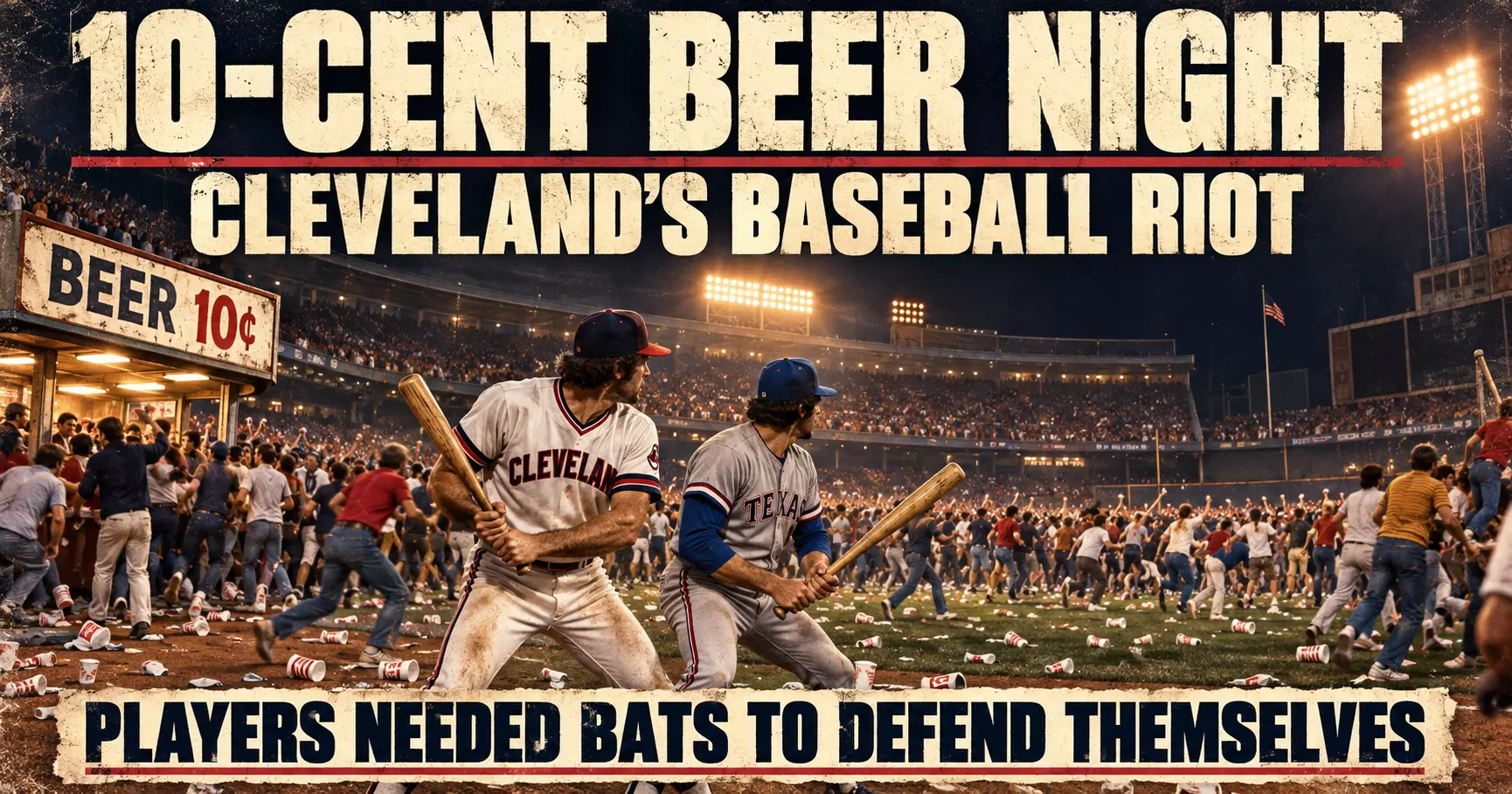
On June 4, 1974, Cleveland’s Ten-Cent Beer Night ended with players from both clubs confronting a crowd that had overrun the field. Baseball bats became tools of protection, and opponents helped one another reach safety.
The extraordinary part of the story was Cleveland’s decision to help the visiting team. When the visiting Rangers needed help, the Indians left their dugout to defend them against members of their own home crowd.
A Cheap Promotion With Dangerous Conditions
The Indians wanted to attract customers to Cleveland Stadium. Their offer was straightforward: eight ounces of Stroh’s beer for a dime, down from the regular price of 65 cents.
The announced attendance was 25,134. The Encyclopedia of
Cleveland History
estimates that spectators purchased approximately 60,000 cups of beer. That beer total is an estimate, rather than an exact accounting.
Fans could purchase six beers at a time and return for more.
The teams had fought in Arlington on May 29 after Texas’s Lenny Randle collided with Cleveland pitcher Milt Wilcox. Spectators there threw food and beer at Cleveland personnel. Radio host Pete Franklin subsequently stirred Cleveland fans’ resentment toward the Rangers.
The Warning Signs Came Early
Field intrusions began well before the final riot. In Cleveland Magazine’s oral history, Rangers first baseman Mike Hargrove remembered the number of spectators running across the field increasing as the game progressed.
Thrown objects made the danger more obvious. Rangers catcher Jim Sundberg recalled seeing a bottle coming from the upper deck while he was in the on-deck circle. Hargrove remembered an empty gallon wine jug landing near him.
Those recollections explain why the night deserves more than a nostalgic laugh. Players were trying to do their jobs while people invaded their workplace and threw objects capable of injuring them.
Each intrusion also exposed how little control stadium personnel had over the situation. By the time the decisive confrontation arrived, the boundary between spectators and players had repeatedly broken down.
Cleveland Had a Chance to Win
Meanwhile, an actual baseball game was still taking place.
Texas entered the bottom of the ninth leading 5–3. With one out, George Hendrick doubled. Cleveland manager Ken Aspromonte then used three consecutive pinch hitters—Ed Crosby, Rusty Torres and Alan Ashby—and all three singled.
John Lowenstein’s sacrifice fly brought home the tying run. The score was 5–5, with two outs and Cleveland’s potential winning run at second base.
The home team had recovered from a deficit and had an opportunity to complete its comeback. What happened next cost Cleveland that chance.
A Confrontation in Right Field
A spectator approached Texas right fielder Jeff Burroughs and tried to take his cap. In SABR’s account, Burroughs kicked toward the intruder and stumbled. From the dugout, Martin believed his player had been knocked down.
Martin led Rangers personnel onto the field with bats to help Burroughs. More spectators poured onto the playing surface, and the confrontation expanded into a riot.
Cleveland intervened.
The Indians Came to the Rangers’ Defense
Aspromonte recalled his response in Cleveland Magazine’s oral history:
“We gotta go help Billy.”
The Indians came out to assist the Rangers. Sundberg remembered the players gathered in a small circle, joined by Cleveland personnel, gradually working their way toward the dugout.
He also recalled Cleveland catcher Dave Duncan tackling a man who had threatened him. That detail comes from Sundberg’s eyewitness recollection, rather than a play-by-play record.
The reversal was remarkable. These clubs had recently exchanged punches. Now Cleveland players were helping protect Texas players from Cleveland spectators.
Helping the visitors meant exposing themselves to the same danger. The Indians could have remained in their dugout. Instead, they went toward the men who needed assistance.
Injuries and a Forfeit
Cleveland pitcher Tom Hilgendorf suffered a head injury from a thrown metal folding chair. Burroughs injured his thumb, and umpire Nestor Chylak was also hurt during the disorder. [2]
Chylak declared a forfeit in favor of Texas. The
surviving box score
records the runs scored as 5–5 and identifies the Rangers as the winners by forfeit. Cleveland did not lose because Texas scored a deciding run; it lost because the game could not safely continue.
Martin later praised the home team:
“I am very proud of the Cleveland players. They saved our lives.”
The Players Deserve to Be Remembered
Ten-Cent Beer Night has an irresistible name. It invites jokes about an obviously dangerous combination of alcohol and poor crowd control.
But remembering only the promotion misses the most compelling part of the event.
The players had to make decisions while objects were flying and spectators were surrounding them. Cleveland’s response was to help the opposition escape.
The lasting image should be two teams working together to get off a field that had become unsafe. On a night when baseball’s normal boundaries collapsed, the players recognized an obligation that extended beyond their uniforms.
Sources
[1] Encyclopedia of Cleveland History: Ten-Cent Beer Night
[2] SABR: June 4, 1974—10-cent beer riot at Cleveland Stadium leads to forfeit
[3] Cleveland Magazine: An Oral History of Cleveland Baseball’s Most Infamous Night
[4] Baseball-Reference: Texas Rangers vs. Cleveland Indians, June 4, 1974
Up To $1500 in Bonus Bets Paid Back if your First Bet Does Not Win
T&Cs apply
4.5/5
Gambling problem? Call 1-800-GAMBLER or 1-800-MY-RESET (Available in the US) 877-8-HOPENY or text HOPENY (467369) (NY) 1-800-327-5050 (MA), 1-800-BETS-OFF (IA), 1-800-981-0023 (PR). 21+ only. Please Gamble Responsibly. See BetMGM.com for Terms. First Bet Offer for new customers only (if applicable). Subject to eligibility requirements. Bonus bets are non-withdrawable. In partnership with Kansas Crossing Casino and Hotel. Promotional offers not available in Mississippi, Massachusetts, New York, Ontario, or Puerto Rico.
New DraftKings Customers: Spend $5+ Get $150 in Bonuses
T&Cs apply
4.5/5
GAMBLING PROBLEM? CALL 1-800-GAMBLER or 1-800-MY-RESET, (800) 327-5050 or visit gamblinghelplinema.org (MA). Please Gamble Responsibly. 888-789-7777/visit ccpg.org (CT), or visit www.mdgamblinghelp.org (MD), 1-800-981-0023 (PR). 21+ and present in most states. (18+ DC/NH/PR/WY). Void in CAN. Eligibility restrictions apply. On behalf of Boot Hill Casino (KS). Pass-thru of per wager tax may apply in IL. 1 per new DraftKings customer. $5+ first-time bet req. Max. $150 issued as non-withdrawable Bonus Bets. Stake removed from payout. Reward issued as $50 in Bonus Bets every 7 days via click-to-claim for 14 days. Bonus Bets and click-to-claims expire 7 days (168hrs) after issuance. Terms: sportsbook.draftkings.com/promos. Ends 10/11/26 at 11:59 PM ET. Sponsored by DK.
Must be 21+. GAMBLING PROBLEM? CALL 1-800-GAMBLER OR CALL 1-800-MY-RESET, www.mdgamblinghelp.org (MD), (800)-327-5050 or gamblinghelplinema.org (MA), Call (877)8-HOPENY or text HOPENY (467369) (NY), (888) 789-7777 or ccpg.org (CT), morethanagame.nc.gov (NC), 1800gambler.net (WV)
Bet $1 and get double the winnings up to $25 for your next 10 bets
T&Cs apply
4.4/5
21+ New users only. Must register using eligible promo code. First bet after registration must qualify. Max. Bonus Bet: $1,000. Bonus Bet expires 14 days after receipt. Void where prohibited. See Caesars.com/promos for full terms. Gambling Problem? 1-800-GAMBLER (1-800-426-2537)
21+ and present in OH. Gambling Problem? Call 1-800-GAMBLER.
This site is using
Cloudflare
and adheres to the
Google Safe Browsing Program. We adapted
Google's Privacy Guidelines
to keep your data safe at all times.
Close
Ready to Win Big? Join the Elite with Our Sports Betting Deals!
FanDuel Promo
New Users – Get $250 in Bonus Bets when you wager $5 for 5 days
Up To $1500 in Bonus Bets Paid Back if your First Bet Does Not Win
Best Slots
T&Cs and 21+ apply
Gambling problem? Call 1-800-GAMBLER or 1-800-MY-RESET (Available in the US) 877-8-HOPENY or text HOPENY (467369) (NY) 1-800-327-5050 (MA), 1-800-BETS-OFF (IA), 1-800-981-0023 (PR). 21+ only. Please Gamble Responsibly. See BetMGM.com for Terms. First Bet Offer for new customers only (if applicable). Subject to eligibility requirements. Bonus bets are non-withdrawable. In partnership with Kansas Crossing Casino and Hotel. Promotional offers not available in Mississippi, Massachusetts, New York, Ontario, or Puerto Rico.
Code:
Open BetMGM
Get Bonus
DraftKings Promo
New DraftKings Customers: Spend $5+ Get $150 in Bonuses
Newcomer
T&Cs and 21+ apply
GAMBLING PROBLEM? CALL 1-800-GAMBLER or 1-800-MY-RESET, (800) 327-5050 or visit gamblinghelplinema.org (MA). Please Gamble Responsibly. 888-789-7777/visit ccpg.org (CT), or visit www.mdgamblinghelp.org (MD), 1-800-981-0023 (PR). 21+ and present in most states. (18+ DC/NH/PR/WY). Void in CAN. Eligibility restrictions apply. On behalf of Boot Hill Casino (KS). Pass-thru of per wager tax may apply in IL. 1 per new DraftKings customer. $5+ first-time bet req. Max. $150 issued as non-withdrawable Bonus Bets. Stake removed from payout. Reward issued as $50 in Bonus Bets every 7 days via click-to-claim for 14 days. Bonus Bets and click-to-claims expire 7 days (168hrs) after issuance. Terms: sportsbook.draftkings.com/promos. Ends 10/11/26 at 11:59 PM ET. Sponsored by DK.
Code:
Open DraftKings
Get Bonus
Find out what the legends have to say about sports this week....